


Ramadan in War-torn Sudan Eclipsed by Famine, Inflation

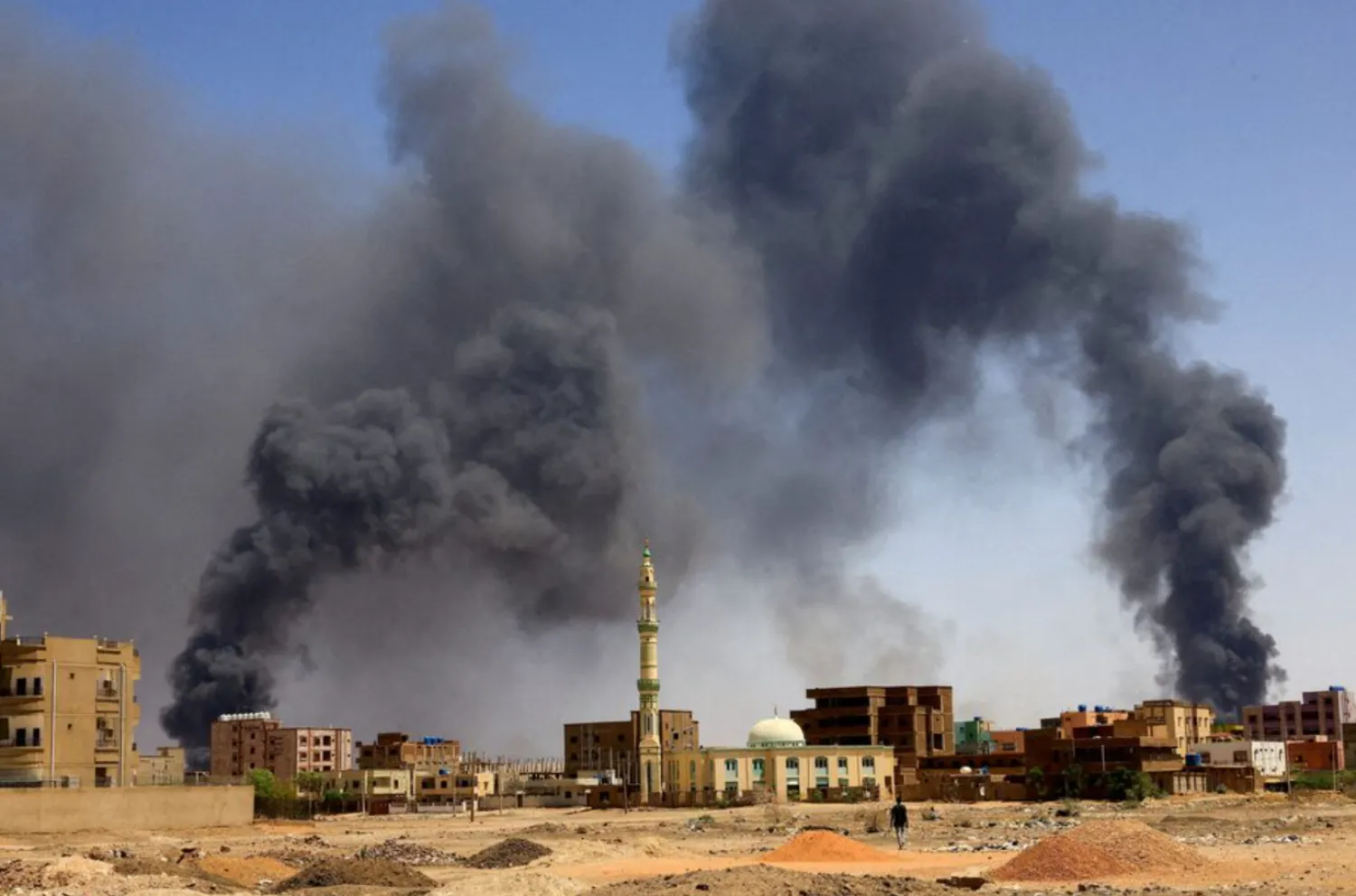
A man walks while smoke rises above buildings after aerial bombardment, during clashes between the Rapid Support Forces and the army in Khartoum North, Sudan, May 1, 2023. REUTERS/Mohamed Nureldin Abdallah/File Photo Purchase
TT

Ramadan in War-torn Sudan Eclipsed by Famine, Inflation

A man walks while smoke rises above buildings after aerial bombardment, during clashes between the Rapid Support Forces and the army in Khartoum North, Sudan, May 1, 2023. REUTERS/Mohamed Nureldin Abdallah/File Photo Purchase

In the safety of Sudan's eastern coast, residents preparing for Ramadan were struggling to afford basic holiday staples as the war raging elsewhere in the country has sent prices soaring.

The situation was much more dire in areas hit directly by the nearly two-year war, where famine, displacement, severe shortages and looting overshadowed the usual spirit of generosity and community of the holy Muslim month that began on Saturday.

At a market in Port Sudan, a relative safe haven in the east, prices are out of reach for many families.

Sugar, widely used in drinks and sweets to break the daily dawn-to-dusk fast, goes for 2,400 Sudanese pounds ($1) per kilo.

A kilo of veal costs 24,000 pounds, and mutton 28,000, according to consumers, AFP reported.

"We are struggling to afford Ramadan goods," said resident Mahmoud Abd El Kader, protesting the "extremely expensive" prices.

Another resident, Hassan Osman, told AFP that "prices are too high, goods are too expensive, people cannot afford them."

According to labor unions, the average monthly pay is around $60, but public workers in some Sudanese states have gone without pay during the war.

Those who did have had to grapple with the plummeting value of the local currency, down from about 600 pounds to the US dollar to 2,400 pounds on the parallel market, and inflation that hit 145 percent in January according to official figures.

In some parts of Sudan, there were pressing concerns not about the prices of food -- but about whether it was available at all.

The fighting since April 2023 between the forces of rival generals, which has killed tens of thousands of people and displaced more than 12 million, has also pushed entire areas of Sudan into hunger and cut off crucial supply routes.

In parts of the vast western region of Darfur and Kordofan in the south -- both focal points of the war between the army the Rapid Support Forces (RSF) -- food supply routes have been cut off, and starvation has set in.

Famine has gripped three displacement camps in North Darfur and some parts of the south, and is expected to spread to five more areas by May, according to a UN-backed assessment.

Some residents of Darfur have resorted to eating peanut shells and tree leaves to survive.

And with aid agencies struggling to reach these areas, hunger is spreading rapidly.

The UN's World Food Program said Wednesday it was forced to suspend operations in and around one famine-hit camp in North Darfur because of escalating violence.

"It is very difficult here," said Omar Manago, a humanitarian worker in North Darfur.

"There is a severe shortage of drinking water and food. Many families have not eaten a proper meal in months," he added.

UN human rights chief Volker Turk warned on Thursday that without an immediate surge in aid, hundreds of thousands of people could die.

"Sudan is... on the verge of a further explosion into chaos, and at increasing risk of atrocity crimes and mass deaths from famine," Turk told the UN Human Rights Council.

Manago said that most markets in North Darfur are now gone.

"Everything has been burned down by the" RSF fighters, he said.

Other conflict-hit areas, where food stocks are running dangerously low, have also seen widespread looting.

In the capital Khartoum, where fighting between the army and the RSF has intensified in recent weeks, volunteers were distributing any aid they could find, but the needs far outweigh the meagre supply.

Some cherished Ramadan traditions have perished.

"Before the war, volunteers used to line the streets, handing out iftar meals to those who could not make it home in time," said Sabrine Zerouk, 30, from Omdurman on the outskirts of the capital.

"That is no longer happening like before," she told AFP.

In previous years, Sudanese families would prepare elaborate iftar meals the break the daily Ramadan fast, sharing food with neighbors and those in need.

"What I miss the most is breaking fast with family and friends," said Mohamed Moussa, a 30-year-old doctor at one of the last functioning hospitals in Omdurman.

"And the Ramadan decorations, too -- these are among the things we've lost."


Guterres Condemns Houthi Detention of Another 10 UN Staff in Yemen

 United National Secretary-General Antonio Guterres speaks during an event to mark the end of the UN political mission, in Baghdad, Iraq, Saturday, Dec. 13, 2025. (AP)
United National Secretary-General Antonio Guterres speaks during an event to mark the end of the UN political mission, in Baghdad, Iraq, Saturday, Dec. 13, 2025. (AP)
TT

Guterres Condemns Houthi Detention of Another 10 UN Staff in Yemen

 United National Secretary-General Antonio Guterres speaks during an event to mark the end of the UN political mission, in Baghdad, Iraq, Saturday, Dec. 13, 2025. (AP)
United National Secretary-General Antonio Guterres speaks during an event to mark the end of the UN political mission, in Baghdad, Iraq, Saturday, Dec. 13, 2025. (AP)

United Nations Secretary-General Antonio Guterres on Friday condemned the Houthi detention of another 10 UN personnel in Yemen, taking the total to 69, his spokesperson said.

The Iran-aligned ‌Houthis detained ‌the ‌additional ⁠UN staff on ‌Thursday, said UN spokesperson Stephane Dujarric, and Guterres calls for the immediate release of all those detained.

"These detentions render ⁠the delivery of UN ‌humanitarian assistance in Houthi-controlled ‍areas ‍untenable. This directly affects millions ‍of people in need and limits their access to life-saving assistance," Dujarric said.

The United Nations has repeatedly rejected Houthi ⁠accusations that UN staff or UN operations in Yemen were involved in spying.


Asharq Al-Awsat Publishes Outline of Lebanon’s Deposit Repayment Plan

Lebanese Prime Minister Nawaf Salam. (Reuters)
TT

Asharq Al-Awsat Publishes Outline of Lebanon’s Deposit Repayment Plan

Lebanese Prime Minister Nawaf Salam. (Reuters)

Lebanon’s Prime Minister Nawaf Salam is pushing to secure approval for a draft law aimed at resolving the fate of bank deposits frozen since the country’s financial collapse in 2019, proposing full repayment of deposits below $100,000 over four years and the conversion of larger sums into long term, asset backed debt instruments, a senior government source told Asharq Al-Awsat.

Under the proposal, depositors with balances exceeding that threshold would receive annual cash payments equal to 2% of the value of their holdings, with the remainder repaid over maturities of up to 15 years, the source said.

Lebanese government sources said Salam hopes the draft law can be approved next week, before the country enters the year end holiday period, after broad political agreement was secured on its main outlines and some objections within the government itself were addressed.

This would allow the state’s negotiating team to defend the plan in parliament and against opposition from bankers and some depositors.

While the plan is “not ideal” from the perspective of Salam and other officials, the sources said it is viewed as “the best possible option,” especially as Salam believes that every day of delay worsens the crisis.

According to the sources, he has said that had such a law been passed at the start of the crisis in 2019, the situation would be far better than it is today.

Asharq Al-Awsat reviewed the plan, formally titled the financial gap draft law, which was circulated to ministers on Friday afternoon. The government has completed the draft, which is intended to determine the scale of losses resulting from the crisis and how they would be distributed among the Lebanese state, the central bank, commercial banks and depositors.

The bill is expected to be approved and then sent to parliament for debate and ratification, as a core component of the financial reforms required by the International Monetary Fund.

The source said that “every day the law’s approval is delayed, deposits will erode further,” pledging to hold accountable those responsible for preventing Lebanese citizens from withdrawing their savings and enticing them with higher interest rates in exchange for transferring their personal funds.

“This file can no longer tolerate postponement,” the source said. “Every time we delay a decision, we are effectively widening the gap instead of narrowing it.”

Weapons and financial reform

The government is pressing ahead with financial reforms alongside the implementation of its decision to impose state monopoly over weapons.

The source said that “weapons and reforms are linked,” adding, “We have taken our decision to restrict weapons, and we are ready to provide development and security. This is what the Lebanese state will deliver.”

They also said Lebanon could not wait for regional political developments to resolve its internal problems.

“The foundation is the implementation of the constitution and the Taif Agreement,” the source said, adding that the government needs to understand Hezbollah’s vision for the post weapons phase and how it intends to integrate into the state building project.

The government views the financial gap law as “the main gateway to safeguarding people’s deposits,” stressing the need to complete it quickly while creating the best possible conditions for restoring depositors’ funds.

The source said some large depositors must bear responsibility because they “were not innocent of many violations and abuses,” while a third core principle is that the state itself will shoulder its share of responsibility.

Mechanism for repaying deposits

The approach is based on a set of fundamental principles. “Whether we agree on them immediately or the discussion takes longer, they remain the basis for implementation, and we operate within the available means,” the source said.

“These principles are not slogans, but executive rules, and any solution that does not start from them cannot be fair or sustainable.”

They also said that it was impossible to repay all deposits at once because of the size of the financial gap.

The source explained that deposits were divided into two categories, those below $100,000 and those above that threshold. Deposits would be repaid in installments over four years on the grounds that small depositors were the most harmed by the crisis.

“They are not beneficiaries of financial engineering schemes or excessive interest rates,” the source said.

“Their money is a lifetime’s savings and should not be touched.”

The source added that the standard applied would be the individual depositor, not the number of accounts.

“If a person has an account worth $40,000 at one bank and another worth $40,000 at a different bank, the two accounts are combined and treated as a single deposit of $80,000,” they explained, calling this principle essential to prevent circumvention and ensure fairness among depositors.

Asset backed bonds

For deposits exceeding $100,000, the source said they would be handled through bonds backed by real assets.

“We are not talking about fictitious bonds,” the source affirmed. “These are bonds backed by actual assets owned by the state or the central bank, including land, facilities and productive institutions.”

They said the Central Bank holds assets valued at tens of billions of dollars, ranging from the casino to land holdings and various institutions, providing a real base for such bonds.

The bonds would be long term, with maturities of between 10 and 15 years, with 2% of their value paid in cash annually.

By way of example, the source said that a depositor holding a bond worth $2 million would receive $40,000 a year in cash. Over time, the principal would decline, and by the end of the term the full original deposit would be recovered.

The importance of asset backed bonds, he said, lies in the guarantees provided by Central Bank assets and state property, allowing depositors to sell the bonds on local or international markets to other investors if they wish to recover their funds immediately.

Review of the previous period

The plan also includes an assessment of profits made in previous years. The source pointed to the period before the crisis, saying that since 2016, during what were known as financial engineering operations, abnormally high interest rates were offered, benefiting large depositors and major investors.

“Some made profits of tens of millions of dollars,” the source said, adding that they could not be treated the same as small depositors who did not benefit from any exceptional returns.

They stressed that original deposits would not be touched, but that gains generated by inflated interest rates would be corrected.

The source said that those who repaid their loans at the 1,500 Lebanese pound per dollar rate included low income borrowers who took loans to buy a home or a car, and that their cases were normal.

However, borrowers who took loans for large projects, investments or contracting would have their files reviewed based on the exchange rate at the time their debts were repaid.

Those who made profits by converting funds from Lebanese pounds to dollars would be fined, with the proceeds directed to a fund to recover depositors’ money.

The source stressed that losses could not be borne by depositors alone.

“There is a clear hierarchy,” they stressed.

“First bank shareholders, then the banks themselves, then the Central Bank, and after that the state. This is the standard applied globally, and it cannot be bypassed or reversed.”

Bank recapitalization

The source said the plan gives banks five years to recapitalize themselves, while the state would assume responsibility for increasing the capital of the central bank.

Bank restructuring is unavoidable, they clarified, adding that raising capital is first and foremost the responsibility of shareholders.

“It is not possible to maintain a banking system without holding those who benefited from profits accountable for losses,” the source said.

“This is not an attack on banks, but a basic condition for rebuilding a sound banking system.”

They acknowledged that the decision would face objections from financial and political forces, but said that failing to act would be even more difficult.

“If we do not do this now, we will not do it later,” the source said, adding that “every additional delay means greater losses.”


Over 1,000 Patients Have Died Awaiting Evacuation from Gaza Since July 2024, Says WHO

 A Palestinian looks over an area of buildings destroyed during Israeli air and ground operations at sunset in northern Nuseirat, central Gaza Strip, Friday, Dec. 19, 2025. (AP)
A Palestinian looks over an area of buildings destroyed during Israeli air and ground operations at sunset in northern Nuseirat, central Gaza Strip, Friday, Dec. 19, 2025. (AP)
TT

Over 1,000 Patients Have Died Awaiting Evacuation from Gaza Since July 2024, Says WHO

 A Palestinian looks over an area of buildings destroyed during Israeli air and ground operations at sunset in northern Nuseirat, central Gaza Strip, Friday, Dec. 19, 2025. (AP)
A Palestinian looks over an area of buildings destroyed during Israeli air and ground operations at sunset in northern Nuseirat, central Gaza Strip, Friday, Dec. 19, 2025. (AP)

More than 1,000 patients have died while waiting for urgent medical evacuation from war-ravaged Gaza in the last year and a half, the World Health Organization said Friday.

WHO chief Tedros Adhanom Ghebreyesus said on X that the UN agency and its partners had "evacuated over 10,600 patients from Gaza with severe health conditions, including over 5,600 children" since the start of the war more than two years ago.

But he warned that "many more patients remain in Gaza awaiting evacuation to receive appropriate healthcare".

Citing numbers from the health ministry in Hamas-run Gaza, Tedros said that 1,092 patients were known to have died while awaiting medical evacuation just between July 2024 and November 28, 2025.

"This figure is likely underreported," he warned, calling on "more countries to open doors to patients from Gaza, and for medical evacuation to the West Bank, including East Jerusalem, to be restored".

"Lives depend on it."

WHO spokesman Tarik Jasarevic told reporters in Geneva on Friday that some 18,500 patients were still in need of treatment outside Gaza, including more than 4,000 children.

A Doctors Without Borders official told AFP earlier this month that the WHO figures refer only to registered patients, and that the actual number of people in need of urgent evacuation was several times higher.

"Many of these people don't have time to wait," Jasarevic stressed.

Up to December 1, more than 30 countries had taken patients from Gaza, but only a handful, including Egypt and the United Arab Emirates, had accepted large numbers.

A US-sponsored ceasefire has halted fighting in Gaza, which began after Hamas's deadly attack on Israel on October 7, 2023.

But the deal, in effect since October 10, remains fragile as Israel and Hamas accuse each other almost daily of violations.
