


Arab Leaders Endorse Egypt’s Plan to Rebuild Gaza as an Alternative to Trump’s Proposal 

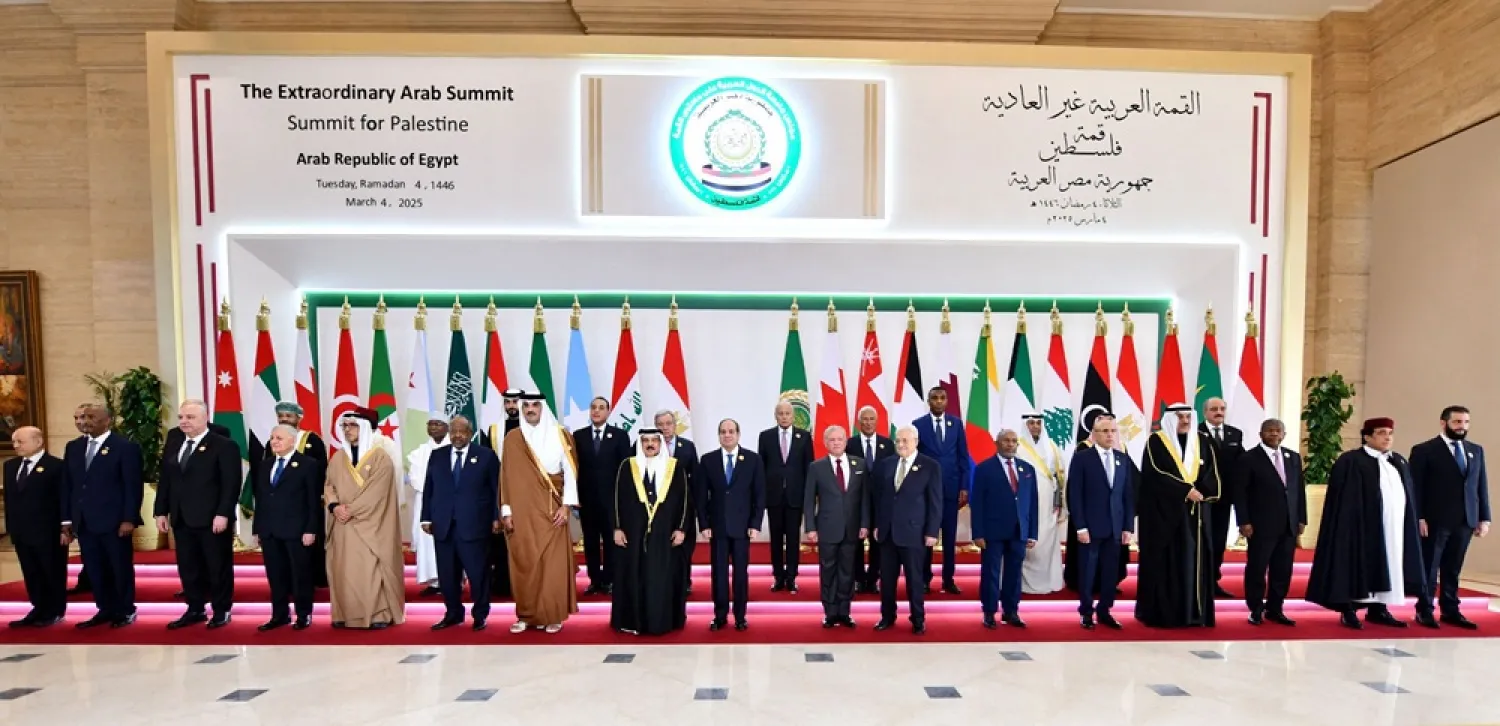
Egyptian President Abdel Fattah al-Sisi poses for a picture with leaders as Egypt hosts emergency Arab summit to discuss Palestinian developments, at Egypt's New Administrative Capital in Cairo, March 4, 2025. (Egyptian Presidency/Handout via Reuters)
TT

Arab Leaders Endorse Egypt’s Plan to Rebuild Gaza as an Alternative to Trump’s Proposal 

Egyptian President Abdel Fattah al-Sisi poses for a picture with leaders as Egypt hosts emergency Arab summit to discuss Palestinian developments, at Egypt's New Administrative Capital in Cairo, March 4, 2025. (Egyptian Presidency/Handout via Reuters)

Arab leaders on Tuesday endorsed Egypt's postwar plan for the Gaza Strip that would allow its roughly 2 million Palestinians to remain, in a counterproposal to US President Donald Trump’s plan to depopulate the territory and redevelop it as a beach destination. 

The $53 billion plan's endorsement by Arab leaders at a summit in Cairo amounted to a rejection of Trump’s proposal. The summit conclusions were welcomed by Hamas, rejected by Israel and given a lukewarm response by the Trump administration. 

Egyptian President Abdel Fattah al-Sisi expressed his appreciation for "the consensus among the Arab countries to support the reconstruction plan for the Gaza Strip, which allows the Palestinian people to stay on their land without displacement." 

In a social media post after the summit, Sisi said he looked forward to working with Trump, other Arab nations and the international community "to adopt a plan that aims for a comprehensive and just settlement of the Palestinian Issue, ends the root causes of the Israeli Palestinian conflict, guarantees the security and stability of the peoples of the region and establishes the Palestinian State." 

Initial reactions White House National Security Council spokesman Brian Hughes dismissed the Egyptian proposal as unworkable. 

"The current proposal does not address the reality that Gaza is currently uninhabitable and residents cannot humanely live in a territory covered in debris and unexploded ordnance," Hughes said. "President Trump stands by his vision to rebuild Gaza free from Hamas. We look forward to further talks to bring peace and prosperity to the region." 

A spokesperson for Israel's foreign ministry, Oren Marmorstein, posted on X that the Egyptian plan "fails to address the realities of the situation" and said the summit's joint communique does not mention Hamas' Oct. 7, 2023 attack that sparked the war or condemn the militant group. The plan, he said, remains "rooted in outdated perspectives." 

Marmorstein reiterated Israel’s support for Trump’s plan to resettle Gaza's population elsewhere, describing it as "an opportunity for the Gazans to have free choice based on their free will." 

Egypt’s Foreign Minister Badr Abdelatty blasted Israel’s rejection as "unacceptable," describing its position as "stubborn and extremist." 

"There will be no peace neither to Israel or to the region" without establishing an independent Palestinian state in accordance with United Nations resolutions, he said. He said "Israel violates all international law rules … the international law must be imposed." 

"No single state should be allowed to impose its will on the international community," Abdelatty said. 

Hamas welcomed the summit’s outcome, saying it marked a new phase of Arab and Islamic alignment with the Palestinian cause and that it valued Arab leaders’ rejection of attempts to transfer Palestinians from their territories in Gaza and the occupied West Bank. 

Israel has embraced what it says is an alternative US proposal for the ceasefire itself and the release of hostages taken in Hamas' attack on southern Israel on Oct. 7, 2023, which triggered the war. Israel has blocked the entry of food, fuel, medicine and other supplies to Gaza to try to get Hamas to accept the new proposal and has warned of additional consequences, raising fears of a return to fighting. 

The suspension of aid drew widespread criticism, with human rights groups saying that it violated Israel's obligations as an occupying power under international law. 

The alternative proposal would require Hamas to release half its remaining hostages — the group’s main bargaining chip — in exchange for a ceasefire extension and a promise to negotiate a lasting truce. Israel made no mention of releasing more Palestinian prisoners — a key component of the first phase. 

Egypt's postwar plan Egypt’s plan foresees rebuilding Gaza by 2030 without removing its population. The first phase calls for starting the removal of unexploded ordnance and clearing more than 50 million tons of rubble left by Israel’s bombardment and military offensives. 

Arab League chief Ahmed Aboul Gheit said the summit’s final communique calls on the UN Security Council to deploy an international peacekeeping force in Gaza and the occupied West Bank. 

"Peace is the Arabs’ strategic option," he said, adding that the communique rejected the transfer of Palestinians and endorsed Egypt’s reconstruction plan. "The Egyptian plan creates a path for a new security and political context in Gaza." 

The communique said Egypt will host an international conference in cooperation with the United Nations for Gaza’s reconstruction, and a World Bank-overseen trust fund will be established to receive pledges to implement the early recovery and reconstruction plan. 

According to a 112-page draft of the plan obtained by The Associated Press, hundreds of thousands of temporary housing units would be set up for Gaza’s population while reconstruction takes place. Rubble would be recycled, with some of it used as infill to expand land on Gaza’s Mediterranean coast. 

In the following years, the plan envisages completely reshaping the strip, building "sustainable, green and walkable" housing and urban areas, with renewable energy. It renovates agricultural lands and creates industrial zones and large park areas. 

It also calls for the opening of an airport, a fishing port and a commercial port. The Oslo peace accords in the 1990s called for the opening of an airport and a commercial port in Gaza, but the projects withered as the peace process collapsed. 

Hamas would cede power to an interim administration of political independents until a reformed Palestinian Authority can assume control. Palestinian President Mahmoud Abbas, head of the Western-backed authority and an opponent of Hamas, attended the summit. 

Israel has ruled out any role for the Palestinian Authority in Gaza and, along with the United States, has demanded Hamas’ disarmament. Hamas, which doesn't accept Israel's existence, has said it's willing to cede power in Gaza to other Palestinians, but won't give up its arms until there is a Palestinian state. 

Israel has vowed to maintain open-ended security control over both territories, which it captured in the 1967 Mideast war and which Palestinians want for their future state. Israel’s government and most of its political class are opposed to Palestinian statehood. 

Trump shocked the region last month by suggesting Gaza’s roughly 2 million Palestinians be resettled in other countries. He said the United States would take ownership of the territory and redevelop it into a Middle Eastern "Riviera." 

Netanyahu embraced the proposal, which was roundly rejected by Palestinians, Arab countries and human rights experts, who said it would likely violate international law. 

The war began with Hamas' Oct. 7 attack on Israel, in which Palestinian gunmen killed about 1,200 people, mostly civilians, and took 251 people hostage. Hamas-led fighters are still holding 59 hostages, 35 of whom are believed to be dead. 

Most of the rest were released in ceasefire agreements. Israel has rescued eight living hostages and recovered the remains of dozens more. 

Israel's 15-month offensive killed more than 48,000 Palestinians, according to Gaza's Health Ministry. It doesn't say how many were fighters, but the ministry says women and children made up more than half the dead. Israel says it killed over 17,000 fighters, without providing evidence. 

The offensive destroyed large areas of Gaza, including much of its health system and other infrastructure. At its height, the war displaced about 90% of the population, mostly within the territory, where hundreds of thousands packed into squalid tent camps and schools repurposed as shelters. 


US Army Names 2 Iowa Guard Members Killed in Attack in Syria

 This undated combo photo created with images released by the Iowa National Guard shows Sgts. William Nathaniel Howard, left, and Edgar Brian Torres-Tovar. (Iowa National Guard via AP)
This undated combo photo created with images released by the Iowa National Guard shows Sgts. William Nathaniel Howard, left, and Edgar Brian Torres-Tovar. (Iowa National Guard via AP)
TT

US Army Names 2 Iowa Guard Members Killed in Attack in Syria

 This undated combo photo created with images released by the Iowa National Guard shows Sgts. William Nathaniel Howard, left, and Edgar Brian Torres-Tovar. (Iowa National Guard via AP)
This undated combo photo created with images released by the Iowa National Guard shows Sgts. William Nathaniel Howard, left, and Edgar Brian Torres-Tovar. (Iowa National Guard via AP)

The two Iowa National Guard members killed in a weekend attack that the US military blamed on the ISIS group in Syria were identified Monday.

The US Army named them as Sgt. Edgar Brian Torres-Tovar, 25, of Des Moines, and Sgt. William Nathaniel Howard, 29, of Marshalltown.

Iowa Gov. Kim Reynolds ordered all flags in Iowa to fly at half-staff in their honor, saying that, “We are grateful for their service and deeply mourn their loss.”

The Pentagon’s chief spokesman, Sean Parnell, has said a civilian working as a US interpreter also was killed. Three other Guard members were wounded in the attack, the Iowa National Guard said Monday, with two of them in stable condition and the other in good condition.

The attack was a major test for the rapprochement between the United States and Syria since the ouster of autocratic leader Bashar al-Assad a year ago, coming as the US military is expanding its cooperation with Syrian security forces. Hundreds of American troops are deployed in eastern Syria as part of a coalition fighting ISIS.

The shooting Saturday in the Syrian desert near the historic city of Palmyra also wounded members of the country's security forces and killed the gunman. The assailant had joined Syria’s internal security forces as a base security guard two months ago and recently was reassigned amid suspicions that he might be affiliated with ISIS, a Syrian official said.

The man stormed a meeting between US and Syrian security officials who were having lunch together and opened fire after clashing with Syrian guards, Interior Ministry spokesperson Noureddine al-Baba said Sunday.

Al-Baba acknowledged that the incident was “a major security breach” but said that in the year since Assad’s fall, “there have been many more successes than failures” by security forces.

The Army said Monday that the incident is under investigation, but military officials have blamed the attack on an ISIS member.

President Donald Trump said over the weekend that “there will be very serious retaliation” for the attack and that Syrian President Ahmed al-Sharaa was “devastated by what happened,” stressing that Syria was fighting alongside US troops.

Trump welcomed Sharaa, who led the lightning opposition offensive that toppled Assad's rule, to the White House for a historic meeting last month.


Western and Arab Diplomats Tour Lebanon-Israel Border to Observe Hezbollah Disarmament Efforts

 UN vehicles drive past buildings destroyed by Israel's air and ground offensive against Hezbollah in southern Lebanon, as seen from Israel's northernmost town of Metula, Sunday, Nov. 30, 2025. (AP)
UN vehicles drive past buildings destroyed by Israel's air and ground offensive against Hezbollah in southern Lebanon, as seen from Israel's northernmost town of Metula, Sunday, Nov. 30, 2025. (AP)
TT

Western and Arab Diplomats Tour Lebanon-Israel Border to Observe Hezbollah Disarmament Efforts

 UN vehicles drive past buildings destroyed by Israel's air and ground offensive against Hezbollah in southern Lebanon, as seen from Israel's northernmost town of Metula, Sunday, Nov. 30, 2025. (AP)
UN vehicles drive past buildings destroyed by Israel's air and ground offensive against Hezbollah in southern Lebanon, as seen from Israel's northernmost town of Metula, Sunday, Nov. 30, 2025. (AP)

Western and Arab diplomats toured an area along Lebanon’s border with Israel Monday where Lebanese troops and UN peacekeepers have been working for months to end the armed presence of the militant Hezbollah group.

The delegation that included the ambassadors of the United States and Saudi Arabia was accompanied by Gen. Rodolphe Haykal, commander of the Lebanese Armed Forces, as well as top officers in the border region.

The Lebanese government has said that by the end of the year, the army should have cleared all the border area south of the Litani river from Hezbollah’s armed presence.

Hezbollah’s leader Sheik Naim Qassem had said that the group will end its military presence south of the Litani River but vowed again over the weekend that they will keep their weapons in other parts of Lebanon.

Parts of the zone south of the Litani River and north of the border with Israel were formerly a Hezbollah stronghold, off limits to the Lebanese national army and UN peacekeepers deployed in the area.

During the tour, the diplomats and military attaches were taken to an army post that overlooks one of five hills inside Lebanon that were captured by Israeli troops last year.

“The main goal of the military is to guarantee stability,” an army statement quoted Haikal as telling the diplomats. Haykal added that the tour aims to show that the Lebanese army is committed to the ceasefire agreement that ended the Israel-Hezbollah war last year.

There were no comments from the diplomats.

The latest Israel-Hezbollah war began Oct. 8, 2023, a day after Hamas attacked southern Israel, after Hezbollah fired rockets into Israel in solidarity with Hamas. Israel launched a widespread bombardment of Lebanon in September last year that severely weakened Hezbollah, followed by a ground invasion.

The war ended in November 2024 with a ceasefire brokered by the US.

Israel has carried out almost daily airstrikes since then, mainly targeting Hezbollah members but also killing 127 civilians, according to the office of the UN High Commissioner for Human Rights.

On Sunday, the Israeli military said it killed three Hezbollah members in strikes on southern Lebanon.

Over the past weeks, the US has increased pressure on Lebanon to work harder on disarming Hezbollah and canceled a planned trip to Washington last month by Haykal.

US officials were angered in November by a Lebanese army statement that blamed Israel for destabilizing Lebanon and blocking the Lebanese military deployment in south Lebanon.

A senior Lebanese army official told The Associated Press Monday that Haykal will fly to France this week where he will attend a meeting with US, French and Saudi officials to discuss ways of assisting the army in its mission. The officer spoke on condition of anonymity because he wasn’t authorized to speak publicly.

The Lebanese army has been severely affected by the economic meltdown that broke out in Lebanon in October 2019.


ICC Rejects Israeli Bid to Halt Gaza War Investigation

Tents of internally displaced Palestinian families seen among the ruins of destroyed buildings in Al-Zaitun neighborhood during a rainy day in the east of Gaza City on, 12 December 2025, amid a ceasefire between Israel and Hamas. (EPA)
TT

ICC Rejects Israeli Bid to Halt Gaza War Investigation

Tents of internally displaced Palestinian families seen among the ruins of destroyed buildings in Al-Zaitun neighborhood during a rainy day in the east of Gaza City on, 12 December 2025, amid a ceasefire between Israel and Hamas. (EPA)

Appeals judges at the International Criminal Court (ICC) on Monday rejected one in a series of legal challenges brought by Israel against the court's probe into its conduct of the Gaza war.

On appeal, judges refused to overturn a lower court decision that the prosecution's investigation into alleged crimes under its jurisdiction could include events following the deadly attack on Israel by the Palestinian group Hamas on October 7, 2023.

The ruling means the investigation continues and the arrest warrants issued last year for Israeli Prime Minister Benjamin Netanyahu and his former defense chief Yoav Gallant remain in place.

Israel rejects the jurisdiction of the Hague-based court and denies war crimes in Gaza, where it has waged a military campaign it says is aimed at eliminating Hamas following the October 7 attacks.

The ICC initially also issued a warrant for Hamas leader Ibrahim al-Masri for alleged war crimes and crimes against humanity, but withdrew that later following credible reports of his death.

A ceasefire agreement in the conflict took effect on October 10, but the war destroyed much of Gaza’s infrastructure, and living conditions are dire.

According to Gaza health officials, whose data is frequently cited with confidence by the United Nations, some 67,000 Palestinians have been killed by Israel in Gaza.

This ruling focuses on only one of several Israeli legal challenges against the ICC investigations and the arrest warrants for its officials. There is no timeline for the court to rule on the various other challenges to its jurisdiction in this case.
