

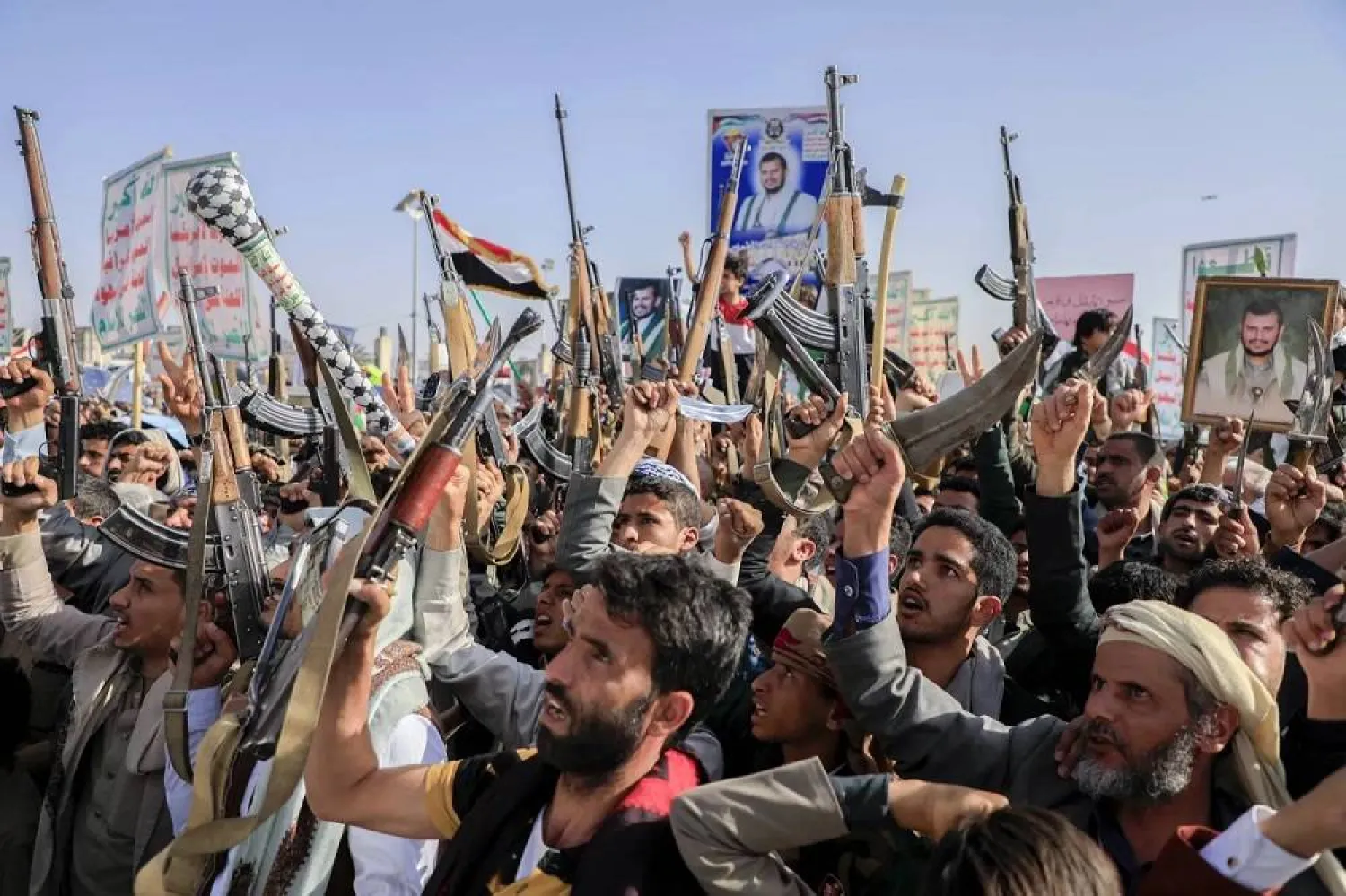

US Houthi Terror Designation Takes Effect, Welcomed by Yemen Govt, Raises UN Concern

The government has fully endorsed the US designation, describing it as an “effective tool to curb material and financial support” for the Houthis. (AP)
TT

US Houthi Terror Designation Takes Effect, Welcomed by Yemen Govt, Raises UN Concern

The government has fully endorsed the US designation, describing it as an “effective tool to curb material and financial support” for the Houthis. (AP)

The US State Department’s designation of Yemen’s Houthi militias as a “foreign terrorist organization” has been welcomed by the legitimate Yemeni government, but has triggered UN concerns over its impact on humanitarian access, with the international body calling for “guarantees.”

While Yemeni reports suggest the designation could economically strangle the Iran-backed Houthis, fears are mounting that the move may push them to derail the fragile truce, resume the war against the government, and escalate attacks on shipping in the Red Sea and Gulf of Aden.

The government has fully endorsed the US designation, describing it as an “effective tool to curb material and financial support” for the Houthis.

It renewed its call for the international community to take similar steps to dry up the militias' funding, arms supplies, and to strengthen efforts aimed at restoring stability and peace in Yemen.

In a statement, Yemen’s Foreign Ministry stressed that the country has long suffered from the ravages of war and Iranian interference.

It called the US designation a reinforcement of its partnership with the United States and its allies in the fight against terrorism, hoping it will help curb activities that threaten the security of its citizens, the region, and global maritime trade.

The statement also affirmed Yemen's readiness to cooperate fully with international partners to ensure the effective implementation of the designation, aiming to serve the interests of the Yemeni people and promote peace and security in the region.

Amid concerns over the impact of the US designation on humanitarian efforts in Houthi-controlled areas, UN Secretary-General spokesperson Stephane Dujarric called for US guarantees.

During a press briefing, he emphasized that the designation should be accompanied by “appropriate assurances” to ensure effective humanitarian aid delivery and to allow civilians access to essential goods and services.

Dujarric also highlighted the UN’s focus on humanitarian response in Yemen, where nearly 19 million people require life-saving assistance, and 17 million are at risk of famine.

He stressed the importance of maintaining the role of the private sector in securing basic needs.

Dujarric cautioned that any disruption in the flow of commercial goods and humanitarian aid could have catastrophic consequences, particularly in a country that relies on imports for around 90% of its food supply.



Iraq Hopes to Ship Oil to Türkiye by Pipeline as War Cuts off Exports

Technicians working at the Majnoon oil field in Basra, Iraq. (Reuters)
TT

Iraq Hopes to Ship Oil to Türkiye by Pipeline as War Cuts off Exports

Technicians working at the Majnoon oil field in Basra, Iraq. (Reuters)

Iraq is hoping to ship up to 250,000 barrels of oil per day to a port in Türkiye via a rehabilitated pipeline, its oil minister said, after the US-Israeli war on Iran cut off its main export route.

The amount would be just a fraction of the roughly 3.5 million barrels per day (bpd) that Iraq exported before the conflict, mostly through its southern Basra port and the Strait of Hormuz, where traffic has been severely disrupted by the war.

Authorities want to restore an old pipeline -- out of service for years -- that links the northern Kirkuk oil fields to the Turkish port of Ceyhan, where the oil could be shipped onwards to international buyers.

Oil Minister Hayan Abdel Ghani said late Sunday that the pipeline's rehabilitation is "complete, but there is a 100-kilometer section that needs to be inspected".

Teams will "conduct a hydrostatic test, which is the final phase of the pipeline's rehabilitation", hopefully "within a week", Ghani added, citing an export target of roughly 250,000 bpd.

The pipeline was damaged by the ISIS group in 2014.

Its use, however, requires "contact with the Turkish side and an agreement on logistical and technical issues", said oil expert Assem Jihad.

Initially, Baghdad wanted to send exports to the Ceyhan port via another pipeline that runs through Kurdistan.

But "so far, no agreement has been reached", Ghani said, as relations between the autonomous Iraqi Kurdistan and the federal government in Baghdad have deteriorated.

He acknowledged that "Iraqi oil exports were halted two or three days after the start of the war".

The country is also considering the possibility of transporting 200,000 bpd by tanker trucks, primarily via Jordan and Syria.

Iraq derives more than 90 percent of its revenue from oil.

Experts have warned that without this income, the state -- Iraq's largest employer -- will be unable to pay civil servants' salaries and risks a foreign currency shortage to finance imports or stabilise its exchange rate.


KSrelief Masam Project Clears 908 Mines Across Yemen in One Week

Saudi Arabia, through its humanitarian arm KSrelief, continues its efforts to clear mines in Yemen, enhancing civilian safety and supporting safe and dignified living conditions for Yemenis - SPA
TT

KSrelief Masam Project Clears 908 Mines Across Yemen in One Week

Saudi Arabia, through its humanitarian arm KSrelief, continues its efforts to clear mines in Yemen, enhancing civilian safety and supporting safe and dignified living conditions for Yemenis - SPA

The Project Masam for clearing landmines in Yemen, implemented by the King Salman Humanitarian Aid and Relief Center (KSrelief), removed 908 mines from various areas of Yemen during the second week of March 2026, including three anti-personnel mines, nine anti-tank mines, 890 unexploded ordnance, and six IEDs, SPA reported.

The team conducted clearance operations across several governorates, removing mines, explosive devices, and unexploded ordnance.

In Aden Governorate, it dismantled two anti-tank mines, 215 pieces of unexploded ordnance, and two IEDs.

It also removed one anti-tank mine and seven pieces of unexploded ordnance in Al-Khawkhah District of Al-Hudaydah Governorate; three anti-personnel mines, three anti-tank mines, 513 pieces of unexploded ordnance, and two IEDs in Al-Mukalla District of Hadhramaut Governorate; and one piece of unexploded ordnance in Midi District of Hajjah Governorate.

The number of mines removed in March rose to 2,171, bringing the total cleared since the launch of the Project Masam to 548,123.

Saudi Arabia, through its humanitarian arm KSrelief, continues its efforts to clear mines in Yemen, enhancing civilian safety and supporting safe and dignified living conditions for Yemenis.


Germany Warns Major Israeli Ground Campaign in Lebanon Would Worsen Humanitarian Situation

A displaced woman and a child sit in a tent in downtown Beirut, Lebanon, 15 March 2026.  EPA/WAEL HAMZEH
A displaced woman and a child sit in a tent in downtown Beirut, Lebanon, 15 March 2026. EPA/WAEL HAMZEH
TT

Germany Warns Major Israeli Ground Campaign in Lebanon Would Worsen Humanitarian Situation

A displaced woman and a child sit in a tent in downtown Beirut, Lebanon, 15 March 2026.  EPA/WAEL HAMZEH
A displaced woman and a child sit in a tent in downtown Beirut, Lebanon, 15 March 2026. EPA/WAEL HAMZEH

Germany is enormously concerned by the developments in Lebanon, said a government spokesperson in Berlin on Monday, and warned that ‌a major Israeli ‌ground offensive ‌would ⁠significantly worsen the ⁠already tense humanitarian situation in the region.

"A glance at this part ⁠of the war ‌zone ‌fills us ‌with concern because we ‌see preparations for a major Israeli ground offensive, which ‌would significantly worsen the already tense humanitarian ⁠situation ⁠in the region," said the spokesperson.

The spokesperson added that Germany welcomed efforts to restart talks between Israel and Lebanon.