


Hamas Warns that Israel's New Airstrikes Breach their Ceasefire

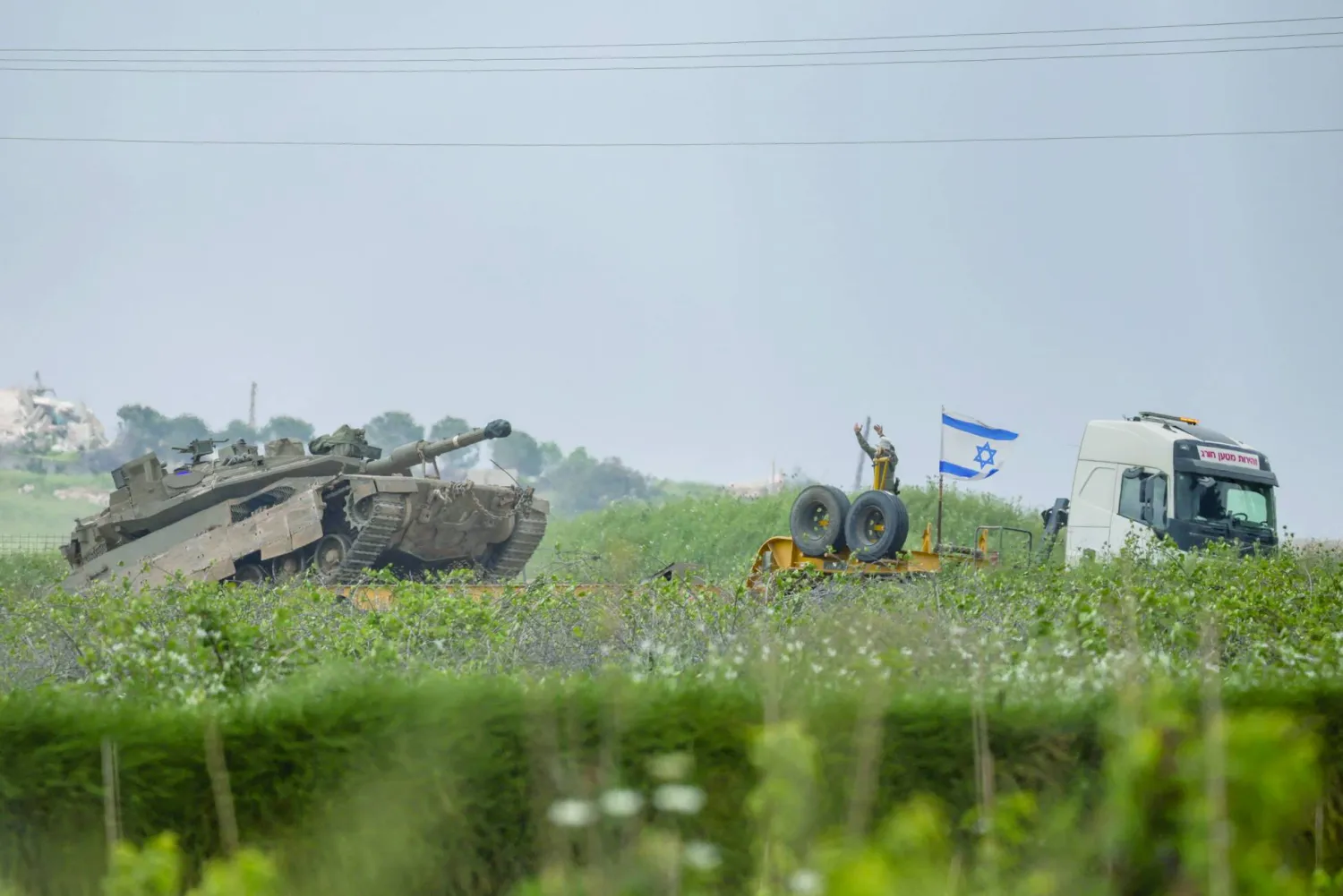
This picture taken from the Israeli side of the border with the Gaza Strip shows smoke plumes rising from explosions above destroyed buildings in the northern Gaza Strip on January 14, 2025, amid the ongoing war between Israel and Hamas. (Photo by Jack GUEZ / AFP)
TT

Hamas Warns that Israel's New Airstrikes Breach their Ceasefire

This picture taken from the Israeli side of the border with the Gaza Strip shows smoke plumes rising from explosions above destroyed buildings in the northern Gaza Strip on January 14, 2025, amid the ongoing war between Israel and Hamas. (Photo by Jack GUEZ / AFP)

Hamas warned that Israel's new airstrikes early Tuesday breached their ceasefire and put the fate of hostages in jeopardy.

Israel said it launched the wave of airstrikes across the Gaza Strip because of a lack of progress in ongoing talks to extend the ceasefire. It was not immediately clear if the operation was a one-time pressure tactic or if the 17-month-old war was being resumed altogether.

Hamas said Israel’s government was responsible for an “unprovoked escalation” against Palestinians, The Associated Press said.

Gaza’s ministry of health said at least 44 people were killed in the airstrikes early Tuesday.

“This comes after Hamas repeatedly refused to release our hostages and rejected all offers it received from the US presidential envoy, Steve Witkoff, and from the mediators,” Netanyahu's office said.

Taher Nunu, a Hamas official, criticized the Israeli attacks. “The international community faces a moral test: either it allows the return of the crimes committed by the occupation army or it enforces a commitment to ending the aggression and war against innocent people in Gaza,” he said.

In Gaza, explosions could be heard at various locations and ambulances were arriving at Al Aqsa Hospital in central Gaza.

The strikes came two months after a ceasefire was reached to pause the war. Over six weeks, Hamas released roughly three dozen hostages in exchange for nearly 2,000 Palestinian prisoners.

But since the first phase of the ceasefire ended two weeks ago, the sides have not been able to agree on a way forward with a second phase aimed at releasing the nearly 60 remaining hostages and ending the war altogether. Netanyahu has repeatedly threatened to resume the war, and early this month cut off the entry of all food and aid deliveries into the besieged territory to put pressure on Hamas.

The war erupted with Hamas' Oct 7, 2023, cross-border attack, which killed some 1,200 people and took 250 others hostage. Israel responded with a military offensive that killed over 48,000 Palestinians, according to local health officials, and displaced an estimated 90% of Gaza's population. The territory's Health Ministry doesn't differentiate between civilians and militants, but says over half of the dead have been women and children.

“Israel will, from now on, act against Hamas with increasing military strength,” Netanyahu's office said.

The ceasefire had brought some relief to Gaza and allowed hundreds of thousands of displaced Palestinians to resume to what remained of their homes.

But the territory is coping with vast destruction, with no immediate plans to rebuild. A resumption of the war threatens to reverse any progress made in recent weeks toward halting Gaza's humanitarian crisis.

While the ceasefire largely halted the fighting, Israel has left troops in Gaza throughout the past two months and continued to strike targets, claiming that Palestinians were trying to carry out attacks or approaching troops in no-go zones.

A number of strikes earlier Monday killed a total of 10 people, according to Palestinian officials.

Two strikes in central Gaza hit around the urban refugee camp of Bureij. One struck a school serving as a shelter for displaced Palestinians, killing a 52-year-old man and his 16-year-old nephew, according to officials at nearby Al-Aqsa Martyrs Hospital, where the casualties were taken. The Israeli military said it struck Hamas members planting explosives.

An earlier strike killed three men in Bureij. The Israeli military said the men were trying to plant an explosive device in the ground near Israeli troops. Gaza’s Hamas-led government said the men were collecting firewood.

In Syria, meanwhile, Israel seized a zone in the south after the fall of longtime autocrat Bashar Assad in December. Israel says it is a preemptive security measure against the former extremist insurgents who now run Syria, though their transitional government has not expressed threats against Israel.

Strikes in the southern Syrian city of Daraa killed three people and wounded 19 others, including four children, a woman and three civil defense volunteers, the Syrian civil defense agency said. It said two ambulances were damaged. Other strikes hit military positions near the city.

The Israeli military said it was targeting military command centers and sites in southern Syria that contained weapons and vehicles belonging to Assad’s forces. It said the materials’ presence posed a threat to Israel.

In Lebanon, Israel said it struck two members of the Hezbollah militant group in the southern Lebanese town of Yohmor, who it said were “observation operatives.” Lebanon’s state news agency reported two people killed in the strike and two wounded.

The military later said it carried out further strikes on Hezbollah sites in Lebanon, without specifying where. A US-brokered ceasefire between Israel and Hezbollah went into effect in late November ending the 14-month war between the two sides, and each side has repeatedly accused the other of violating the deal.

Since the ceasefire in Gaza began in mid-January, Israeli forces have killed dozens of Palestinians who the military says approached its troops or entered unauthorized areas.

Still, the deal has tenuously held without an outbreak of wide violence. The ceasefire’s first phase saw an exchange of some hostages held by Hamas in return for the freeing of Palestinians imprisoned by Israel. Egypt, Qatar and the United States have been trying to mediate the next steps in the ceasefire.

Israel wants Hamas to release half of the remaining hostages in return for a promise to negotiate a lasting truce. Hamas instead wants to follow the ceasefire deal reached by the two sides, which calls for negotiations to begin on the ceasefire’s more difficult second phase, in which the remaining hostages would be released and Israeli forces would withdraw from Gaza. Hamas is believed to have 24 living hostages and the bodies of 35 others.



UN Condemns Israel's Moves against Agency for Palestinian Refugees

UNRWA center targeted by Israeli shelling in northern Gaza (DPA)
TT

UN Condemns Israel's Moves against Agency for Palestinian Refugees

UNRWA center targeted by Israeli shelling in northern Gaza (DPA)

The United Nations warned Tuesday that recent actions by Israel against the UN agency for Palestinian refugees risked depriving millions of people of basic services such as education and healthcare.

Israel's parliament passed new legislation on Monday formally stripping the United Nations Relief and Works Agency (UNRWA) of diplomatic immunity, and barring Israeli companies from providing water or electricity to the agency's institutions, AFP reported.

According to UNRWA, the legislation also grants the Israeli government the authority to expropriate the agency's properties in East Jerusalem, including its headquarters and main vocational training center.

UNRWA chief Philippe Lazzarini condemned the legislation as "outrageous", decrying it on social media as "part of an ongoing, systematic campaign to discredit UNRWA and thereby obstruct the core role that the agency plays providing human-development assistance and services to Palestine refugees".

Filippo Grandi, the outgoing head of the UN refugee agency, UNHCR, and a former UNRWA chief, also criticised the move as "very unfortunate".

In an interview with AFP, he highlighted that UNRWA, unlike other UN agencies, provides basic public services such as education and healthcare to the millions of registered Palestinian refugees it serves across Gaza and the West Bank, as well as in Lebanon, Jordan and Syria.

"If you deprive those people of those services... then you had better find a substitute," he said, warning: "I think it would be very difficult."

"At the moment, there is a great risk that millions of people will be deprived of basic services if UNRWA is further deprived of space to work, and resources to work."

Israel has been ratcheting up pressure on UNRWA over the past two years.

It has accused the agency of providing cover for Hamas militants, claiming that some UNRWA employees took part in the militant group's October 7, 2023 assault on Israel, which sparked the war in Gaza.

A series of UN-linked internal and external investigations found some "neutrality-related issues" at UNRWA, but stressed Israel had not provided conclusive evidence for its headline allegation.

Grandi criticised the torrent of accusations that have swirled around the agency.

"UNRWA is a very indispensable organization in the Middle East," he said.

"Contrary to much of the frankly baseless rhetoric that we have heard in the past couple of years, UNRWA is a force for peace and stability," he added.

"In a region in which you need every bit of stability and efforts towards peace, it would be really irresponsible to let such an important organization decline further."


Syria Imposes Night Curfew on Port City of Latakia

People watch as Syrian Security forces are deployed after clashes erupted during a protest in the city of Latakia, Syria, 28 December 2025. EPA/AHMAD FALLAHA
TT

Syria Imposes Night Curfew on Port City of Latakia

People watch as Syrian Security forces are deployed after clashes erupted during a protest in the city of Latakia, Syria, 28 December 2025. EPA/AHMAD FALLAHA

Syrian authorities imposed an overnight curfew in the coastal city of Latakia on Tuesday.

Authorities announced a "curfew in Latakia city, effective from 5:00pm (1400 GMT) on Tuesday, December 30, 2025, until 6:00am (0300 GMT) on Wednesday, December 31, 2025".


Jailed Turkish Kurd Leader Calls on Government to Broker Deal for Syrian Kurds

(FILES) Supporters display a poster depicting jailed leader of the Kurdistan Workers' Party (PKK) Abdullah Ocalan, after he called on the Kurdistan Workers' Party (PKK) to disarm and dissolve itself in Diyarbakir, southeastern Türkiye, on February 27, 2025. (Photo by Yasin AKGUL / AFP)
TT

Jailed Turkish Kurd Leader Calls on Government to Broker Deal for Syrian Kurds

(FILES) Supporters display a poster depicting jailed leader of the Kurdistan Workers' Party (PKK) Abdullah Ocalan, after he called on the Kurdistan Workers' Party (PKK) to disarm and dissolve itself in Diyarbakir, southeastern Türkiye, on February 27, 2025. (Photo by Yasin AKGUL / AFP)

Jailed Turkish Kurd leader Abdullah Ocalan said Tuesday that it was "crucial" for Türkiye’s government to broker a peace deal between the Kurdish-led Syrian Democratic Forces (SDF) and the Damascus government.

Clashes between Syrian forces and the SDF have cast doubt over a deal to integrate the group's fighters into the army, which was due to take effect by the end of the year, reported AFP.

Ocalan, founder of the Kurdistan Workers' Party (PKK) group, called on Türkiye to help ensure implementation of the deal announced in March between the SDF and the Syrian government.

"It is essential for Türkiye to play a role of facilitator, constructively and aimed at dialogue," he said in a message released by Türkiye's pro-Kurdish DEM party.

"This is crucial for both regional peace and to strengthen its own internal peace," Ocalan, who has been jailed for 26 years, added.

"The fundamental demand made in the agreement signed on March 10 between the SDF and the government in Damascus is for a democratic political model permitting (Syria's) peoples to govern together," he added.

"This approach also includes the principle of democratic integration, negotiable with the central authorities. The implementation of the March 10 agreement will facilitate and accelerate that process."

The backbone of the US-backed SDF is the YPG, a Kurdish group seen by Türkiye as an extension of the PKK.

Türkiye and Syria both face long-running unrest in their Kurdish-majority regions, which span their shared border.

In Türkiye, the PKK agreed this year at Ocalan's urging to end its four-decade armed struggle.

In Syria, Sharaa has agreed to merge the Kurds' semi-autonomous administration into the central government, but deadly clashes and a series of differences have held up implementation of the deal.

The SDF is calling for a decentralized government, which Sharaa rejects.

Turkish Foreign Minister Hakan Fidan, whose country sees Kurdish fighters across the border as a threat, urged the SDF last week not to be an "obstacle" to stability.

Syrian Kurdish leader Mazloum Abdi said Thursday that "all efforts" were being made to prevent the collapse of talks.