


Iraq Forms Security Crisis Cell to Coordinate with Syria

Iraqi soldiers deployed along a concrete barrier stretching across parts of the border with Syria. (Security media)
TT

Iraq Forms Security Crisis Cell to Coordinate with Syria

Iraqi soldiers deployed along a concrete barrier stretching across parts of the border with Syria. (Security media)

Iraq has established a “security crisis cell” to coordinate with Syria’s new administration, a government source revealed. While the Iraqi military denied reports of clashes along the border, a local official in the Anbar province confirmed the killing of militants in a preemptive operation.

Amid concerns over potential ISIS infiltrations, Iraq’s Joint Operations Command stressed that the situation remains “completely stable.”

In a statement, it said: “There have been no infiltrations or clashes along the Iraqi-Syrian border. Our security forces, across various units and specializations, maintain full control, reinforced with advanced surveillance and monitoring capabilities.”

Iraqi authorities continue efforts to secure the 600-kilometer border with Syria as part of their broader counterterrorism strategy. The Popular Mobilization Forces (PMF) recently announced the deployment of units at seven key positions near the border, equipped with weapons and thermal surveillance technology.

To enhance security coordination, Iraq has formed a national crisis cell tasked with monitoring developments in Syria and managing border security measures.

The cell includes Defense Minister Thabet Mohammed Al-Abbasi, Foreign Minister Fuad Hussein, Intelligence Chief Hamid Al-Shatri, Sovereignty Alliance leader Khamis Al-Khanjar, and Iraq’s acting ambassador to Damascus Yassin Al-Hujaimi.

According to the source, the crisis cell operates under direct supervision of Prime Minister Mohammed Shia Al-Sudani, with no actions or decisions taken without his approval.

The inclusion of Sunni politician Khamis Al-Khanjar is reportedly aimed at facilitating communication with Syria’s new leadership, headed by interim President Ahmed Al-Sharaa.

Iraqi political sources suggest that Al-Khanjar, who maintains strong ties with Türkiye’s government, has direct contact with Syria’s new administration and has visited Damascus multiple times following the collapse of Bashar Al-Assad’s regime in December.

The source added that Iraq and Syria’s strategic position—bordering Türkiye, Iran, Jordan, and Lebanon—creates shared security and political challenges. The complex security situation in both countries makes the region highly susceptible to regional and international interventions.

Saad Al-Mohammadi, head of Anbar’s security committee, assured that “the security situation along the Syrian border is completely stable, with strong defensive fortifications in place.”

He stated that Iraqi border forces are operating “with high efficiency to prevent smuggling and infiltration attempts.” He also confirmed that two militants were recently killed in a preemptive operation, highlighting the ongoing counterterrorism efforts.

The Iraq-Syria border remains a critical security concern due to its open desert terrain, which militant groups have historically exploited for smuggling and cross-border movements.

In response, Iraqi authorities have intensified military fortifications, particularly in Anbar, which spans 605 kilometers along the Syrian border.


Former Syrian Regime Officer Arrested

Syrian Ministry of Interior in Damascus (Official Website)
TT

Former Syrian Regime Officer Arrested

Syrian Ministry of Interior in Damascus (Official Website)

Syria's Interior Ministry announced on Saturday the arrest of a former officer in Bashar al-Assad's regime holding the rank of major general and accused of committing crimes and violations.

In a statement, the ministry said that "based on precise monitoring and surveillance operations, Internal Security Forces carried out a special security operation that resulted in the arrest of criminal Mohammed Mohsen Nayouf."

"The criminal held the rank of major general under the former regime and occupied several prominent military and leadership positions, including service in the Third Corps, command of the 18th Tank Division, chief of staff of the 11th Division in 2020, and commander of the 105th Republican Guard Brigade in 2016."

According to the statement, the detainee was referred to the relevant authorities to complete investigations and take the necessary legal measures before being referred to the judiciary.

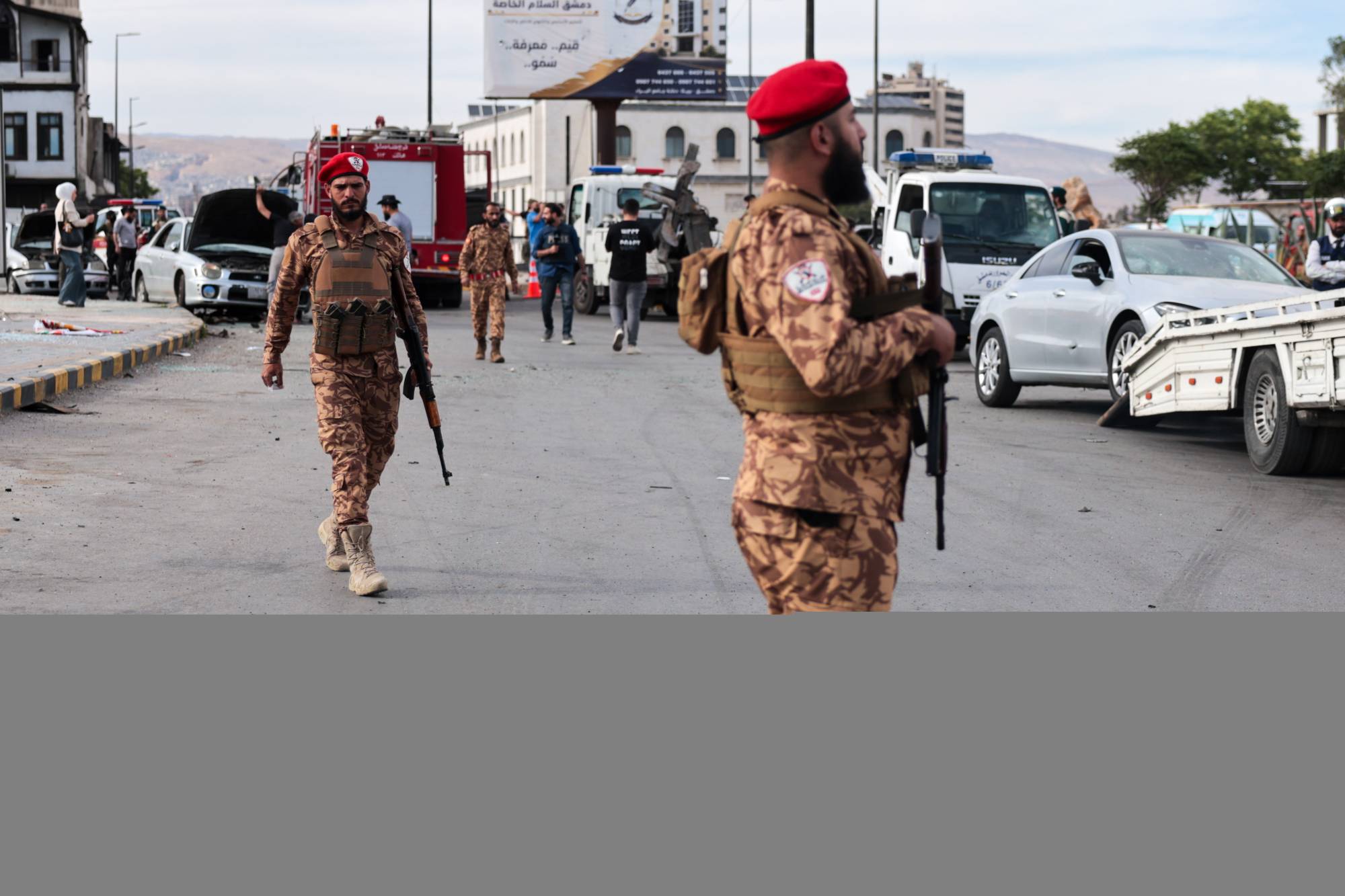
Syrian military police deployed near the explosion site in Bab Sharqi, near the headquarters of the Syrian Defense Ministry in Damascus, Syria, May 19, 2026. EPA/MOHAMMEDALRIFAI

The Syrian Arab News Agency (SANA) reported that the operation, carried out on Friday by the Salamiyah Security Directorate, which is affiliated with the Internal Security Command in Hama, comes "as part of the Interior Ministry's and relevant authorities' efforts to pursue and hold accountable those involved in crimes and violations committed against the Syrian people during the former regime, based on the principle of ending impunity, achieving transitional justice, and guaranteeing the rights of victims and their families."

Earlier on Friday, the Interior Ministry announced the arrest of Mohammed Imad Mahrez, one of the guards at Saydnaya prison during the former regime, making this the second such operation.


Hezbollah Says Message from Iran Shows it 'Will Not Give up' on Group

Displaced residents wave Hezbollah flags, including one bearing a picture of its leader, Naim Qassem, as they pass rubble of destroyed buildings in Dahiyeh, Beirut's southern suburbs, Lebanon, Friday, April 17, 2026, following a ceasefire between Israel and Hezbollah. (AP Photo/Bilal Hussein)
TT

Hezbollah Says Message from Iran Shows it 'Will Not Give up' on Group

Displaced residents wave Hezbollah flags, including one bearing a picture of its leader, Naim Qassem, as they pass rubble of destroyed buildings in Dahiyeh, Beirut's southern suburbs, Lebanon, Friday, April 17, 2026, following a ceasefire between Israel and Hezbollah. (AP Photo/Bilal Hussein)

Hezbollah said Saturday that a message from Tehran showed that Iran would not abandon the Lebanese militant group and that the Islamic republic's latest proposal to end the US-Iran war included a ceasefire in Lebanon.

Iran-backed Hezbollah said in a statement that its chief Naim Qassem had received a message from Tehran's Foreign Minister Abbas Araghchi, which indicated that Iran "will not give up its support for movements demanding justice and freedom, foremost among them Hezbollah".

In Iran's latest proposal through Pakistani mediators aimed at achieving "a permanent and stable end to the war, the demand to include Lebanon in the ceasefire was emphasised", the statement added.


South Lebanon Hospital Damaged in Israeli Strikes

Volunteers from the Lebanese Red Cross rescue a woman in the city of Nabatieh in South Lebanon (AFP)
TT

South Lebanon Hospital Damaged in Israeli Strikes

Volunteers from the Lebanese Red Cross rescue a woman in the city of Nabatieh in South Lebanon (AFP)

Israel kept up strikes on Lebanon on Saturday, hours after overnight raids on the country's south and east, including one that damaged a hospital, its chief executive told AFP.

Lebanon's state-run National News Agency (NNA) reported Israeli airstrikes on around a dozen locations in the south on Saturday including one targeting an agricultural area, "wounding several Syrian workers".

The NNA said an overnight strike in the southern city of Tyre that targeted a site near the hospital caused "severe damage" to the facility.

An AFP correspondent saw shattered glass, ceiling panels blown out and damaged medical equipment at the multi-storey Hiram hospital.

The Israeli military late on Friday night had issued evacuation warnings ahead of strikes on two locations in Tyre, saying it would target "Hezbollah facilities".

Accompanying maps advised people to leave areas within 500 metres (yards) of the target buildings, with the Hiram hospital shown within the advised evacuation area.

The hospital's CEO Dr Salman Aydibi told AFP that around 40 patients were in the facility when the warning was issued, including seven in intensive care.

"We took the patients to a safer location" elsewhere inside the hospital, he said, adding that none were harmed but some 30 staff sustained minor injuries.

He said an evaluation of the damage was ongoing and that the hospital has remained operational, though the emergency department briefly closed.

He said it was the third strike near the facility since the latest Israel-Hezbollah war erupted on March 2.

Israel's army said Saturday that it had targeted "Hezbollah infrastructure sites in Tyre" overnight where operatives from the Iran-backed group worked to "plan and execute attacks" against Israeli soldiers.

"Prior to the strike, steps were taken to mitigate harm to civilians, including the issuing of advance warnings, the use of precise munitions, and aerial surveillance," it added.

Another AFP correspondent saw heavy damage at both targeted sites in Tyre, with a man searching for his belongings among the debris at one location.

Israel's army also targeted east Lebanon overnight, saying it struck a "Hezbollah underground compound" used to manufacture weapons.

Lebanon's Hamas-aligned Islamist group Jamaa Islamiya and its armed wing the Al-Fajr Forces said Saturday in a statement that one of its members was killed in an Israeli strike in east Lebanon.

Under the terms of the ceasefire published by Washington, Israel reserves the right to act against "planned, imminent or ongoing attacks".
