

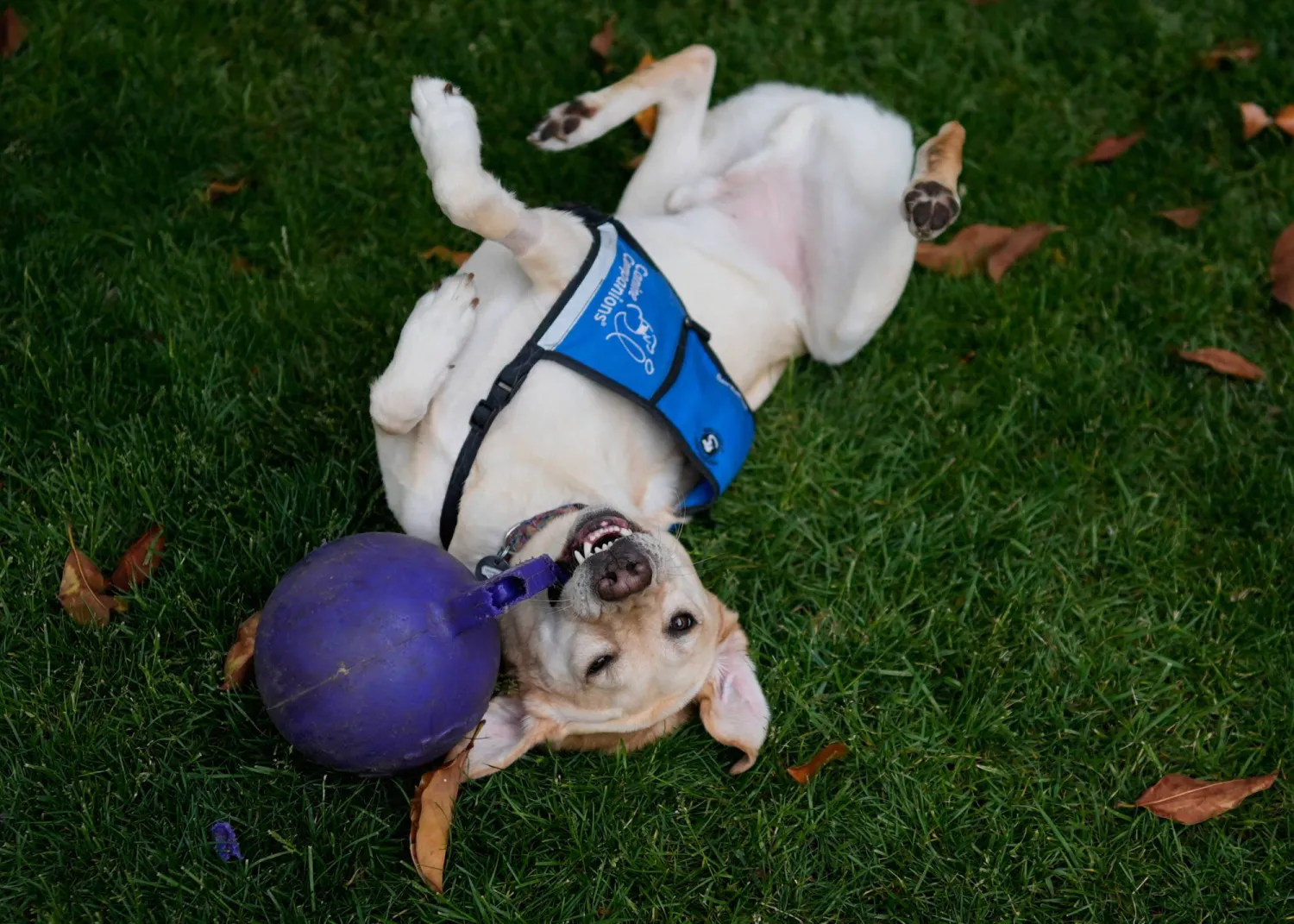

More Children’s Hospitals Turn to Furry Caregivers to Help Kids Heal

Cincinnati Children's Hospital facility dog Grover plays in the grassy facility dog play area at Cincinnati Children's Hospital in Cincinnati, Monday, May 4, 2026. (AP Photo/Carolyn Kaster)
TT

More Children’s Hospitals Turn to Furry Caregivers to Help Kids Heal

Cincinnati Children's Hospital facility dog Grover plays in the grassy facility dog play area at Cincinnati Children's Hospital in Cincinnati, Monday, May 4, 2026. (AP Photo/Carolyn Kaster)

The first time 5-year-old Calvin Owens went outside in more than a month, he met up with his canine friend Hadley on a hospital patio. Despite being tethered to equipment with wires and tubes, the little boy managed to stand up near his wheelchair long enough to toss her a ball.

He smiled as she ran to fetch it. Caregivers cheered.

“Look how good you’re doing!” said Hadley's handler, Schellie Scott.

Such small victories and moments of joy are common whenever Hadley or one of the other three facility dogs at Cincinnati Children’s Hospital show up.

These furry caregivers aren’t the typical therapy dogs volunteers bring to hospitals to comfort patients. They are specially trained, full-time working dogs that provide emotional support during stressful procedures, motivate kids to move around and make hospitals seem less scary. And experts say their ranks are growing at children’s hospitals across the nation.

A mounting body of research shows that even short interactions with facility dogs can improve children’s overall well-being, decrease the pain they feel and reduce signs of stress, like cortisol levels and blood pressure.

“These dogs are making a real difference,” said Kerri Rodriguez, director of the Human-Animal Bond Lab at the University of Arizona. “They can provide a little bit of normalcy, a little bit of comfort, in a really stressful, sterile environment that kids might not feel comfortable in.”

Although no one tracks the number of facility dogs in children's hospitals, Rodriguez points to the continual growth of the annual Facility Dog Summit, where handlers and other participants network and where attendance nearly doubled from 2024 to 2025. Other types of hospitals also have full-time dogs, but experts say children's hospitals account for most of the expansion in programs. One large nonprofit, Canine Assistants in Georgia, has a specific children’s hospital initiative through which it has placed more than 80 dogs nationally.

Dogs have been on the job for years at places such as Mount Sinai Kravis Children’s Hospital in New York, Norton Children’s in Louisville, Kentucky, and St. Louis Children’s Hospital. And new programs keep sprouting up. In March, Johns Hopkins Children’s Center in Maryland introduced its first two facility dogs.

Hospitals generally get the dogs from nonprofits. Organizations such as Canine Companions, where Cincinnati Children's gets its dogs, breed, raise and train them, then place them with hospital staff members but still own them. Dogs and handlers live and work together, The Associated Press reported.

Although hospitals don’t pay for the dogs, they’re responsible for costs such as food and veterinary care, which can add up, especially since most are larger breeds like Labradors or golden retrievers. Hospitals usually fundraise or seek grants to cover the costs.

Experts say the benefits of these sorts of “animal-assisted therapies” are clear. A 2022 study Rodriguez coauthored analyzed a survey conducted across 17 children's hospitals. Pediatric health professionals described how facility dogs provided a comforting presence, built rapport, and normalized the hospital environment for children and families.

A 2021 study in the Journal of Pediatric Nursing concluded that animal- assisted therapies were beneficial for controlling pain and blood pressure in children and teens. Other research also found these therapies reduce anxiety and pain and can even improve heart and lung function.

Facility dogs are allowed in more sensitive areas of the hospital than volunteer dogs, and sometimes serve particular hospital units. Opal, one of two St. Louis dogs, splits her time between the pediatric behavioral health unit and the child protection program.

No matter where the dogs work, keeping them clean is key.

Hadley, in Cincinnati, is bathed twice a month because she works in the cancer and blood diseases area, where kids might have reduced immunity.

She gets even more baths, or cleanings with special wipes, if she’s potentially exposed to germs. Handlers use leashes and balls that can be easily cleaned, and people must sanitize their hands before and after touching the dogs.

If a patient is in isolation, the dog stays outside the room. The one exception is if a dying child wants a dog to be close. In those cases, caregivers say concerns about germs are outweighed by the need to ease fears and provide comfort.

Hadley’s workday starts whenever her handler Scott — whose job as a child life assistant involves keeping patients' lives as normal as possible — arrives at the hospital. Hadley mostly sees patients, but also gets breaks when she can just do what she wants.

On a recent morning, the Labrador-golden retriever mix raced around a grassy dog play area with her canine co-worker, Grover. While Grover is calm and chill, Hadley gets so excited she shakes her head to toss balls to herself.

“Hadley loves life,” Scott said. “Hadley lives big.”

Inside the hospital, the dogs get constant attention. For handlers, "it's like being the assistant to a famous person,” joked Scott.

Signs of the dogs’ celebrity status are everywhere.

They appear on closed-circuit television shows filmed by the hospital and beamed into patient rooms. Photos of the dogs, themed for holidays or events, line the hallways. And there are mailboxes where kids can drop letters or pictures for the dogs and get replies.

Patients can also get trading cards for each dog with stats like breed and birthday, bandanas to decorate for their furry friend, or little stuffed dogs.

Caregivers create books featuring the dogs to show kids about procedures or treatments they’re about to undergo.

Kids hospitalized for long stretches get to know the dogs well.

Aspen Franklin, a 14-year-old fighting a life-threatening immune disorder, has been coming to the hospital since she was a toddler and was recently hospitalized for weeks. At times, Hadley has snuggled beside her in bed.

“She has a calming presence,” Aspen said. “That is a comfort to me.”

Like other facility dogs, Hadley also helps her family cope. When Aspen's younger brother Emory donated his cells for her bone marrow transplant, Hadley spent time with him — and other visiting siblings.

Having Hadley around “is really nice because they’re away from their animals at home,” said their mom, Brittney Franklin, whose family has two dogs and a cat.

Franklin recently watched as Aspen painted with Hadley. The dog couldn’t go in her room so soon after her transplant, so Aspen dabbed colors on a small canvas and handed it to Scott, who put it in a plastic bag and smeared peanut butter on top. Just outside the room, Hadley eagerly licked it up. A piece of abstract art emerged.

Hadley’s next patient was Calvin, the little boy she met on the patio. Calvin has a rare, severe type of childhood arthritis and recently had a bone marrow transplant. Though he could only stand for a few moments at a time, he made the effort repeatedly to play with Hadley.

“He’s such a strong little man,” Scott said.

After Calvin went inside, Hadley met up with 11-year-old Bethany Striggles, who recently finished a chemotherapy treatment for bone cancer. The girl hurled the ball all the way down the hallway, and Hadley bounded happily to retrieve and gently return it. Bethany rewarded her with an ice pop.

“She helps me exercise more,” Bethany said. “She’s energetic and happy and always likes to see me.”

But Hadley does eventually tire. When that happens, she goes back to an office affectionately known as her lair, where she has treats, toys and a big dog bed.

Above the bed is a bulletin board covered with drawings, photos and notes. One, written on orange construction paper, contains a small, pink handprint and the words: “Thank you for being my BEST FRIEND.”



UK Police Arrest Man after Toddler Ends Up in Crocodile Enclosure in Zoo

A crocodile swims in Bandia Conservation Park, in Mbour, Senegal June 14, 2026. REUTERS/Raghed Waked
TT

UK Police Arrest Man after Toddler Ends Up in Crocodile Enclosure in Zoo

A crocodile swims in Bandia Conservation Park, in Mbour, Senegal June 14, 2026. REUTERS/Raghed Waked

Police in eastern England on Thursday arrested a 30-year-old man on suspicion of attempted murder after a 3-year-old boy ended up in a crocodile enclosure at a zoo near the English university city of Cambridge.

Cambridgeshire Police said officers were called early afternoon to Johnsons Zoo in Old Hurst following “reports of an incident involving a 3-year-old boy, during which he ended up in the crocodile enclosure."

The boy was taken to Addenbrooke’s Hospital in Cambridge about 25 miles (40 kilometers) away. According to The Associated Press, police said he was in critical but stable condition, and that a man from the nearby county of Norfolk was arrested on suspicion of murder.

“We do not believe the man arrested and the child are known to each other," said Detective Inspector Verity McCann.

According to its website, the zoo is home to more than 100 animals, including lions, tigers, sloth bears, capybaras, meerkats and crocodiles.


King Abdulaziz Royal Reserve Records 34 New Bird Species for First Time

Among the notable species recorded for the first time were the Rüppell's Vulture - SPA
TT

King Abdulaziz Royal Reserve Records 34 New Bird Species for First Time

Among the notable species recorded for the first time were the Rüppell's Vulture - SPA

The King Abdulaziz Royal Reserve Development Authority announced a significant environmental achievement during the first half of 2026, recording 34 new bird species added for the first time to the reserve's biodiversity list, raising the total number of recorded bird species to 225—a 15% increase in the reserve's documented avian diversity.

The authority explained that this achievement stems from continuous improvement in field monitoring efficiency and comprehensive geographic coverage within the reserve's boundaries, enhancing the accuracy of biodiversity documentation, SPA reported.

Spokesperson of the authority Abdulaziz Al-Furaih stated that the new findings reflect the accelerating development of the reserve's environmental monitoring programs, noting that documenting this number of new species is an important scientific indicator of ecosystem health and habitat integrity within the reserve, reinforcing its standing as one of the region's leading environments supporting biodiversity and migratory bird routes, in line with Saudi Vision 2030 and the Saudi Green Initiative.

Among the notable species recorded for the first time were the Rüppell's Vulture, the rare Red Phalarope, and the Pectoral Sandpiper, alongside migratory and rare birds including the Rose-colored Starling, Yellow Wagtail, Eurasian Skylark, and Song Thrush, reinforcing the reserve's scientific value as an international biodiversity observatory.

The monitoring results also confirmed the documentation of species of high conservation value listed on the IUCN Red List, most notably the African Vulture, classified as critically endangered, alongside near-threatened species such as the Western Orphean Warbler and the White-winged Lark.


Satellite Observations Detect 'Urban Pulse' of Six Global Cities

General view of the Burj Khalifa and the downtown skyline in Dubai, United Arab Emirates, September 30, 2021. REUTERS/Mohammed Salem/File Photo Purchase
TT

Satellite Observations Detect 'Urban Pulse' of Six Global Cities

General view of the Burj Khalifa and the downtown skyline in Dubai, United Arab Emirates, September 30, 2021. REUTERS/Mohammed Salem/File Photo Purchase

While a city is not a living organism, it behaves very much like one. Its metabolic processes may be manifested in growth spurts, metamorphosis over time and even decay. Researchers using satellite imagery have tracked the vital signs of six major global cities, detecting a distinctive "urban pulse" in each.

The researchers looked at Dubai, Lagos, Mexico City, Mumbai, Seattle and Shenzhen using a new way to document dynamic changes unfolding in each of these cities in near real-time.

Historically, experts have relied upon aggregated and infrequent data to document urbanization, such as a yearly census, annual economic figures or a map showing how a city's footprint has changed over a decade - essentially using specific outcomes as metrics. But the scientists behind the new study said such an approach provides an incomplete understanding of a city and can miss the nuances as a metropolis evolves, Reuters reported.

"We got the inspiration from the human pulse, which tells us different information about our health than weight or height," said study lead author Zhe Zhu, a professor of remote sensing and director of the Global Environmental Remote Sensing Laboratory at the University of Connecticut's Department of Natural Resources and the Environment.

"The urban pulse measures the high-frequency process of development, and therefore we can spot early warning signs of economic stress or stagnation before they become full-blown crises," Zhu said. "We compare traditional metrics to looking at a heart attack - the outcome - whereas the 'urban pulse' is like monitoring the daily lifestyle and vital signs leading up to that heart attack - the process."

The biggest takeaway from the study, published in the journal Proceedings of the National Academy of Sciences, is that urbanization is not smooth and steady, the researchers said.

"Urbanization is actually 'spiky,' meaning that it happens in abrupt, intense bursts, or 'cyclical,' moving through boom-and-rest phases that don't match annual seasons, or 'asynchronous,' as different neighborhoods in the exact same city develop at completely different, uncoordinated times," said study senior author Karen Seto, a Yale University professor of geography and urbanization science.

"This is important because, for decades, researchers have characterized cities through static maps," Seto said.

CITIES WITH DIFFERENT CONDITIONS

The researchers used dense and high-frequency satellite imagery from the US space agency NASA's Landsat and the European Space Agency's Sentinel-2 satellites. They tracked physical changes in the cities such as new building construction, demolition, major infrastructure improvements and expansion into green spaces.

"We selected cities with a wide range of political-economic conditions including the state-led development of Shenzhen, the market-driven growth of Seattle, the informal expansion of Lagos and the megaprojects of Dubai," Zhu said.

Shenzhen, formerly a small fishing village near Hong Kong that has become a megacity, exhibited the highest magnitude and intensity of growth, characterized by massive and clustered spikes reflecting rapid, state-led mobilization of capital.

Dubai, the most populous city in the United Arab Emirates, also showed huge growth.

In Nigeria's largest city Lagos, the "pulse" was highly fragmented, with long periods of inactivity punctuated by brief and intense surges.

Seattle, the largest metropolis in the US Pacific Northwest, reflected a market-driven pulse of redevelopment and densification.

Mumbai, India's financial and commercial powerhouse, and Mexico City, North America's most populous city, proved to be highly resilient and showed less disruption during global shocks such as the COVID-19 pandemic than the others.

"Just as a human pulse reacts to illness, our data captured the exact moment COVID-19 triggered a synchronized 'cardiac arrest' in development worldwide. But the recovery was entirely unequal," Zhu said.

"Shenzhen saw a sharp, coordinated dip followed by a rapid rebound. Lagos experienced a muted pulse that transitioned into smaller, incremental changes. Meanwhile, cities like Mumbai and Mexico City showed much less of an impact. It showed us that global shocks don't manifest the exact same way in every city's 'body,'" Zhu said.

The researchers see practical applications for their method.

"For urban planners and policymakers, it functions as a diagnostic tool. Instead of reacting to a crisis after the fact, they can see exactly when and where a neighborhood's 'pulse' is slowing down and intervene early to prevent infrastructure collapse or economic decay. It also prevents cities from overheating their labor and material markets," Seto said.