

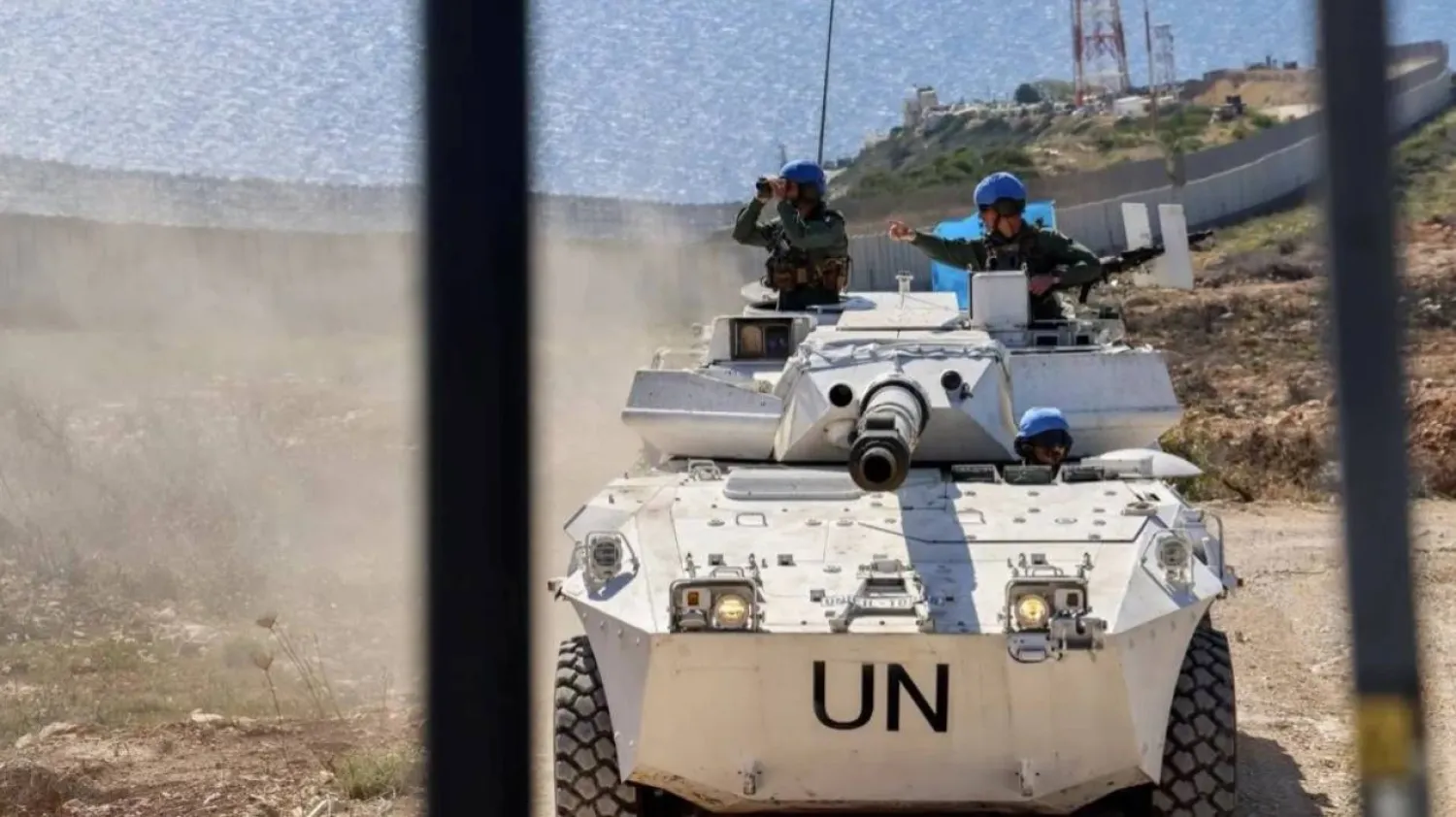

Lebanon, UNIFIL Reaffirm Commitment to Continuing Peacekeeping Patrols

A UNIFIL vehicle patrols along the Blue Line between Lebanon and Israel (UNIFIL)
TT

Lebanon, UNIFIL Reaffirm Commitment to Continuing Peacekeeping Patrols

A UNIFIL vehicle patrols along the Blue Line between Lebanon and Israel (UNIFIL)

Lebanon’s government and the United Nations peacekeeping force (UNIFIL) have reaffirmed that patrols in southern Lebanon would continue uninterrupted, after two young men briefly blocked a UNIFIL convoy in the first such incident since a ceasefire between Israel and Hezbollah took effect in November.

Two local youths riding a motorcycle intercepted a UNIFIL armored patrol vehicle on Friday, forcing it to withdraw. A video circulated online showed one of the men saying, “They are not allowed to enter without the Lebanese army.”

The incident occurred in Tayr Debba, some 20 km north of the Israeli border but still geographically south of the Litani River.

Candice Ardell, deputy director of the UNIFIL Media Office, said peacekeepers were conducting a patrol in support of UN Security Council Resolution 1701 when their convoy was twice obstructed by civilians.

Peacekeepers took an alternate route and were pursued for a short time, but were able to continue their planned patrol, Ardell said. She added that UNIFIL had reported the incident to the Lebanese army.

Ardell reminded all parties that UNIFIL operates in close coordination with the Lebanese Armed Forces (LAF) and that any interference in the peacekeepers' duties violates Lebanon's commitments under Resolution 1701.

Government moves to contain incident

Lebanon’s government moved quickly on Saturday to contact the UNIFIL leadership and members of the five-party mechanism overseeing the ceasefire to contain the fallout from the incident.

A senior government source told Asharq Al-Awsat that “immediate high-level contacts were made to confirm that UNIFIL patrols will continue and that the mission will proceed with its mandate.”

Following the renewal of its mandate last August, UNIFIL pledged to work closely with the LAF, carrying out patrols across its area of operations south of the Litani, where about 20% of patrols are conducted jointly with the Lebanese army.

Last week, Lebanon’s President Joseph Aoun approved the extension of UNIFIL’s mandate for another year.

UNIFIL forces remain visible on the ground around the clock under the authority granted by Resolution 1701, which is the framework for maintaining stability in southern Lebanon along the Blue Line separating Israel and Lebanon.

The ceasefire monitoring mechanism - known as the “Quintet” - includes UNIFIL, the Lebanese army, the Israeli army, and representatives from the United States and France, with Washington currently leading the group.

Public anger simmers

The obstruction has raised questions about whether the incident was a deliberate message to UNIFIL, possibly linked to Hezbollah.

Before the outbreak of hostilities on October 8, 2023, Hezbollah was often accused of orchestrating similar incidents through civilians to restrict UNIFIL’s movements.

However, retired Brig. Gen. Mounir Shehadeh, a former government coordinator with UNIFIL, said the latest incident appeared to be an isolated act.

“This was an individual action by a citizen and had nothing to do with Hezbollah,” Shehadeh told Asharq Al-Awsat, adding that the group had shown full cooperation with the army since the ceasefire began.

Still, Shehadeh acknowledged growing frustration among southern residents over what they see as UNIFIL’s failure to deter Israeli violations.

“People feel that while Lebanon is expected to fulfill all its obligations, Israel is not held accountable,” he said, pointing to daily Israeli raids, home demolitions, and cross-border attacks.

“This resentment fuels public anger at UNIFIL, but the latest obstruction was a personal act, with no link to Hezbollah,” he emphasized.

Political tensions surface

The incident echoes previous protests against UNIFIL’s movements in southern Lebanon, often blamed on Hezbollah, particularly in the lead-up to the Gaza war.

Ali Mourad, an anti-Hezbollah political activist, said such incidents are shaped by a political environment that fosters suspicion of the United Nations and the Lebanese army.

“These actions are not spontaneous,” Mourad told Asharq Al-Awsat.

“They send a political message - one that ultimately harms Lebanon’s own interests.”

Mourad urged southern political leaders to prioritize cooperation with UNIFIL, noting that both Hezbollah and its ally Amal had previously endorsed the ceasefire agreement.

“Obstructing UNIFIL damages Lebanon’s standing and plays into Israel’s hands by suggesting rejection of Resolution 1701,” Mourad said.

He stressed that any disputes with UNIFIL’s activities should be handled exclusively by the Lebanese state.

“It is the state’s responsibility to coordinate with UNIFIL, not individuals acting on their own,” he said.

“We must entrench the culture of turning to state institutions in all matters of dispute.”

UNIFIL said last Tuesday that its peacekeepers continue to patrol the Blue Line and report independently to the Security Council, even under extreme pressure.

During their patrols, they frequently encounter unexploded ordnance and remnants of war that pose dangers to civilians, the Lebanese army, and the peacekeepers themselves, it said.



Israel Military Says Soldier Killed in Gaza 

A drone view shows the destruction in a residential neighborhood, after the withdrawal of the Israeli forces from the area, amid a ceasefire between Israel and Hamas in Gaza, in Gaza City, October 21, 2025. (Reuters)
TT

Israel Military Says Soldier Killed in Gaza 

A drone view shows the destruction in a residential neighborhood, after the withdrawal of the Israeli forces from the area, amid a ceasefire between Israel and Hamas in Gaza, in Gaza City, October 21, 2025. (Reuters)

The Israeli military announced that one of its soldiers had been killed in combat in southern Gaza on Wednesday, but a security source said the death appeared to have been caused by "friendly fire".

"Staff Sergeant Ofri Yafe, aged 21, from HaYogev, a soldier in the Paratroopers Reconnaissance Unit, fell during combat in the southern Gaza Strip," the military said in a statement.

A security source, however, told AFP that the soldier appeared to have been "killed by friendly fire", without providing further details.

"The incident is still under investigation," the source added.

The death brings to five the number of Israeli soldiers killed in Gaza since a ceasefire took effect on October 10.


Syria: SDF’s Mazloum Abdi Says Implementation of Integration Deal May Take Time

People sit outdoors surrounded by nature, with the Tigris river flowing in the background, following a long atmospheric depression, near the Syrian-Turkish border in Derik, Syria, February 16, 2026 REUTERS/Orhan Qereman
TT

Syria: SDF’s Mazloum Abdi Says Implementation of Integration Deal May Take Time

People sit outdoors surrounded by nature, with the Tigris river flowing in the background, following a long atmospheric depression, near the Syrian-Turkish border in Derik, Syria, February 16, 2026 REUTERS/Orhan Qereman

Mazloum Abdi, commander of the Syrian Democratic Forces, said the process of merging the SDF with Syrian government forces “may take some time,” despite expressing confidence in the eventual success of the agreement.

His remarks came after earlier comments in which he acknowledged differences with Damascus over the concept of “decentralization.”

Speaking at a tribal conference in the northeastern city of Hasakah on Tuesday, Abdi said the issue of integration would not be resolved quickly, but stressed that the agreement remains on track.

He said the deal reached last month stipulates that three Syrian army brigades will be created out of the SDF.

Abdi added that all SDF military units have withdrawn to their barracks in an effort to preserve stability and continue implementing the announced integration agreement with the Syrian state.

He also emphasized the need for armed forces to withdraw from the vicinity of the city of Ayn al-Arab (Kobani), to be replaced by security forces tasked with maintaining order.


Israeli Far-Right Minister to Push for ‘Migration’ of West Bank, Gaza Palestinians 

A Palestinian man checks leather belts as people prepare for Ramadan, in the old city of Hebron in the Israeli-occupied West Bank, February 17,2026. (Reuters)
TT

Israeli Far-Right Minister to Push for ‘Migration’ of West Bank, Gaza Palestinians 

A Palestinian man checks leather belts as people prepare for Ramadan, in the old city of Hebron in the Israeli-occupied West Bank, February 17,2026. (Reuters)

Israel's far-right Finance Minister Bezalel Smotrich said he would pursue a policy of "encouraging the migration" of Palestinians from the occupied West Bank and Gaza Strip, Israeli media reported Wednesday.

"We will eliminate the idea of an Arab terror state," said Smotrich, speaking at an event organized by his Religious Zionism Party late on Tuesday.

"We will finally, formally, and in practical terms nullify the cursed Oslo Accords and embark on a path toward sovereignty, while encouraging emigration from both Gaza and Judea and Samaria.

"There is no other long-term solution," added Smotrich, who himself lives in a settlement in the West Bank.

Since last week, Israel has approved a series of measures backed by far-right ministers to tighten control over the West Bank, including in areas administered by the Palestinian Authority under the Oslo Accords, in place since the 1990s.

The measures include a process to register land in the West Bank as "state property" and facilitate direct purchases of land by Jewish Israelis.

The measures have triggered widespread international outrage.

On Tuesday, the UN missions of 85 countries condemned the measures, which critics say amount to de facto annexation of the Palestinian territory.

"We strongly condemn unilateral Israeli decisions and measures aimed at expanding Israel's unlawful presence in the West Bank," they said in a statement.

"Such decisions are contrary to Israel's obligations under international law and must be immediately reversed.

"We underline in this regard our strong opposition to any form of annexation."

UN Secretary-General Antonio Guterres on Monday called on Israel to reverse its land registration policy, calling it "destabilizing" and "unlawful".

The West Bank would form the largest part of any future Palestinian state. Many on Israel's religious right view it as Israeli land.

Israeli NGOs have also raised the alarm over a settlement plan signed by the government which they say would mark the first expansion of Jerusalem's borders into the occupied West Bank since 1967.

The planned development, announced by Israel's Ministry of Construction and Housing, is formally a westward expansion of the Geva Binyamin, or Adam, settlement situated northeast of Jerusalem in the West Bank.

The current Israeli government has fast-tracked settlement expansion, approving a record 52 settlements in 2025.

Excluding Israeli-annexed east Jerusalem, more than 500,000 Israelis live in West Bank settlements and outposts, which are illegal under international law.