

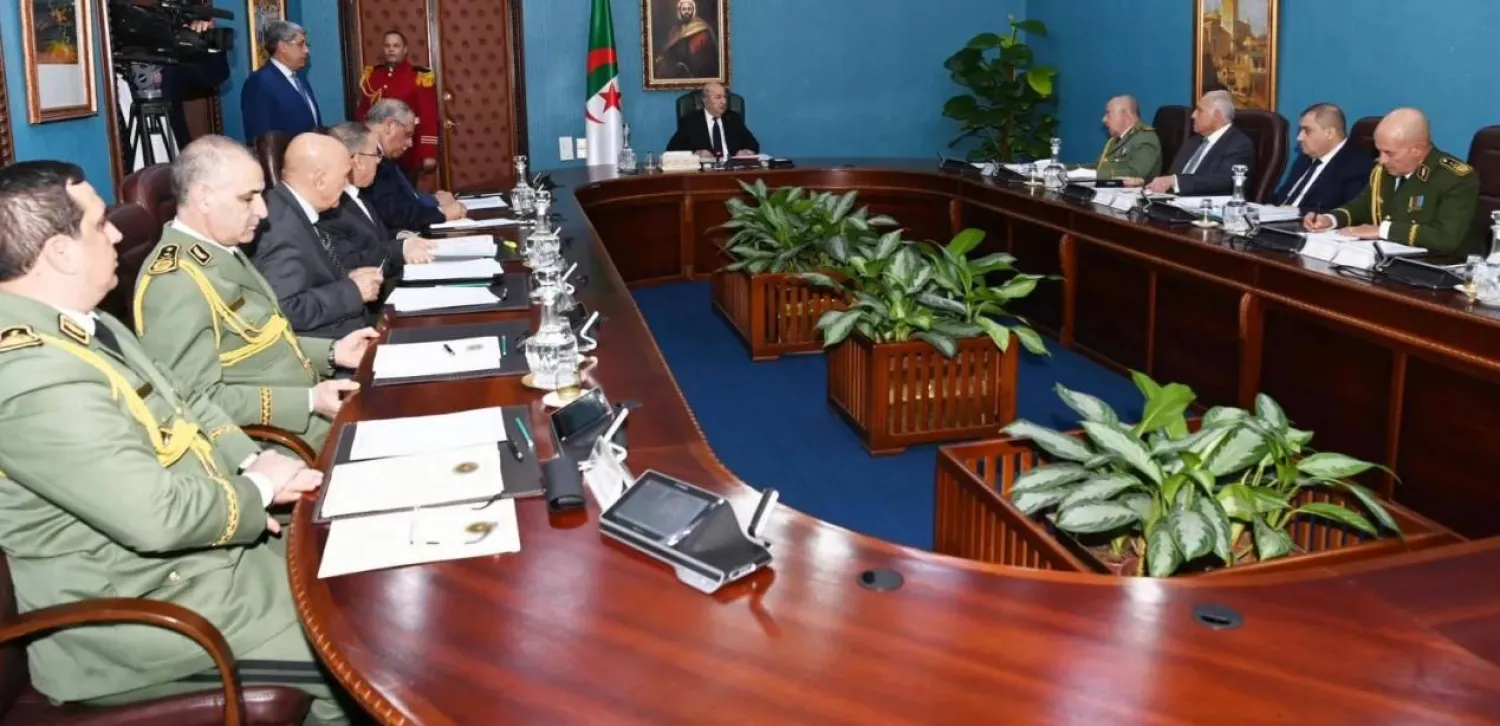

Algeria: Parliamentary Committee Urges Construction of Civilian Shelters Amid Rising Regional Tensions

The Algerian president is seen during a meeting with top civilian and military officials in April (Presidency)
TT

Algeria: Parliamentary Committee Urges Construction of Civilian Shelters Amid Rising Regional Tensions

The Algerian president is seen during a meeting with top civilian and military officials in April (Presidency)

Amid escalating tensions with neighboring Sahel countries, a parliamentary committee in Algeria has recommended the construction of shelters to protect civilians as part of preparations for a proposed “General Mobilization Law.”

The initiative signals Algeria’s readiness to face potential foreign aggression and reflects a broader government effort to bolster national defense capabilities.

The Legal Committee of the People’s National Assembly, Algeria’s lower house of parliament, reviewed the government’s draft mobilization law and called for swift action to establish logistical infrastructure and protective facilities such as shelters, adapted to emergency and wartime conditions.

The committee’s recommendations emphasized not only physical preparedness but also the psychological mobilization of the Algerian public.

The committee advocated for increased investment in technological capabilities to ensure national cybersecurity. It also encouraged support for Algerian researchers and innovators, both within the country and abroad, to develop locally-produced digital content. This push stems from concerns over foreign social media platforms, which the government has accused of disseminating false information and undermining public trust.

Significantly, the committee also proposed exploring the involvement of prisoners in the mobilization effort, suggesting their potential contribution in times of national crisis. The report marks a key step toward parliamentary debate scheduled for the coming week, after which the draft law will be submitted for a vote.

In its justification, the committee cited what it described as Algeria being “targeted by colonial powers and contemporary forces of evil,” including internal and regional actors. It referenced an increasingly unstable regional and international environment, calling for early and comprehensive preparation to safeguard sovereignty, national unity, and territorial integrity.

The proposed legislation aims to marshal both material and human resources. However, the committee stressed that its core purpose is to prepare Algerians morally and psychologically to withstand various forms of aggression, whether military, through enhanced defense readiness, or economic, by supporting local industry and reducing dependency on imports and the informal economy.

The report also outlined objectives in the political and diplomatic arenas, urging the continuation of institutional development and the strengthening of Algeria’s foreign relations based on mutual respect and advocacy for global justice.

In the media and cultural domains, the draft law calls for purging the media sector of so-called “intruders” and countering foreign cultural influence. It emphasizes the role of educational and religious institutions, especially mosques, in promoting national spirit and resilience.

The committee called on Algerians to unite behind the country’s political leadership, security forces, and constitutional institutions. It emphasized national solidarity as essential to countering external threats and ensuring the success of the mobilization initiative.

The mobilization law was introduced following an incident in April in which Algeria’s air force shot down a Malian drone, sparking diplomatic tension. Niger and Burkina Faso sided with Mali, intensifying regional strain. Although tensions with France have also flared, there is no indication of imminent conflict.

The draft law includes provisions to shift the military to wartime readiness, suspend discharges and retirements for key personnel, recall reservists, and reorient industrial production and resource usage to support national defense.



Türkiye, Hamas Discuss Gaza Ceasefire Deal’s Second Phase, Turkish Source Says

Palestinian children play next to tents in a makeshift camp for displaced people set up on the beach in Gaza City, Tuesday, Dec. 16, 2025. (AP)
TT

Türkiye, Hamas Discuss Gaza Ceasefire Deal’s Second Phase, Turkish Source Says

Palestinian children play next to tents in a makeshift camp for displaced people set up on the beach in Gaza City, Tuesday, Dec. 16, 2025. (AP)

Turkish Foreign Minister Hakan Fidan on Wednesday ​met with Hamas political bureau officials in Ankara to discuss the ceasefire in Gaza and advancing the ‌agreement to ‌its ‌second ⁠phase, ​a ‌Turkish Foreign Ministry source said according to Reuters.

The source said the Hamas officials told Fidan that they had fulfilled ⁠their requirements as ‌part of the ‍ceasefire ‍deal, but that Israel's ‍continued targeting of Gaza aimed to prevent the agreement from ​moving to the next phase.

The Hamas members ⁠also said humanitarian aid entering Gaza was not sufficient, and that goods like medication, equipment for housing, and fuel were needed, the source ‌added.


Israel Says It Killed Hamas Financial Officer in Gaza

Buildings destroyed during Israeli ground and air operations stand in the Gaza Strip, as seen from southern Israel, Thursday, Dec. 18, 2025. (AP)
TT

Israel Says It Killed Hamas Financial Officer in Gaza

Buildings destroyed during Israeli ground and air operations stand in the Gaza Strip, as seen from southern Israel, Thursday, Dec. 18, 2025. (AP)

The Israeli army said Wednesday that it had identified a Hamas financial official it killed two weeks ago in a strike in the Gaza Strip.

Abdel Hay Zaqut, a financial official in Hamas's armed wing, on December 13 in the same strike that killed military commander Raed Saad, seen by Israel as one of the architects of Hamas's October 7, 2023 attack.

The Israeli army's Arabic-language spokesperson, Avichay Adraee, said on Wednesday that Zaqut was killed while he was in a vehicle alongside Raed Saad in "a joint operation by the Israeli army and the Shin Bet", Israel's internal security agency.

Zaqut "belonged to the financial department of the armed wing" of Hamas, Adraee wrote on X.

"Over the past year, Zaqut was responsible for collecting and transferring tens of millions of dollars to Hamas's armed wing with the aim of continuing the fight against the State of Israel," he said.

Hamas's leader for the Gaza Strip, Khalil al-Hayya, confirmed on December 14 the death of Saad and "his companions", though he did not name Zaqut.

The Israeli army said Saad headed the weapons production headquarters of Hamas's military wing and oversaw the group's build-up of capabilities.

Since October 10, a fragile truce has been in force in the Gaza Strip, although Israel and Hamas accuse each other of violations.

The war began with Hamas's 2023 attack on Israel, which resulted in the deaths of more than 1,200 people, most of them civilians, according to an AFP tally based on official figures.

Israel's retaliatory campaign has killed more than 70,000 people in the Gaza Strip, according to the health ministry in the Hamas-run territory, a figure the UN deems is credible.


Lebanon Central Bank Governor Expresses Reservations Over Draft Law on Deposit Recovery

 Lebanese Prime Minister Nawaf Salam heads a cabinet meeting in Beirut, Lebanon December 23, 2025. (Reuters)
Lebanese Prime Minister Nawaf Salam heads a cabinet meeting in Beirut, Lebanon December 23, 2025. (Reuters)
TT

Lebanon Central Bank Governor Expresses Reservations Over Draft Law on Deposit Recovery

 Lebanese Prime Minister Nawaf Salam heads a cabinet meeting in Beirut, Lebanon December 23, 2025. (Reuters)
Lebanese Prime Minister Nawaf Salam heads a cabinet meeting in Beirut, Lebanon December 23, 2025. (Reuters)

Lebanon’s Central Bank governor has expressed some reservations over a draft law allowing depositors to gradually recover funds ​frozen in the banking system since a financial collapse in 2019, a move critical to reviving the economy.

Karim Souaid described the proposed timetable for the cash component of deposit repayments as "somewhat ambitious" in a statement on Tuesday.

He suggested ‌it may ‌be adjusted without hindering ‌the depositors' ⁠rights ​guarantee "regular, ‌uninterrupted, and complete payments over time".

He also urged the cabinet to conduct a careful review of the draft law , calling for clarifications to ensure fairness and credibility before it is submitted to parliament.

The central ⁠bank governor said the draft required further refinement, ‌including clearer provisions to guarantee equitable ‍treatment of depositors ‍and to reinforce the state’s commitments ‍under the law.

The 2019 financial collapse - the result of decades of unsustainable financial policies, waste and corruption - led the state to default ​on its sovereign debt and sank the Lebanese pound.

The draft law marks ⁠the first time Beirut has put forward legislation aimed at addressing a vast funding shortfall - estimated at $70 billion in 2022 but now believed to be higher.

Prime Minister Nawaf Salam on Monday urged ministers to swiftly approve the draft legislation.

The cabinet discussed the law on Monday and Tuesday and is set to continue discussions ‌on Friday.