Airstrikes Kill Dozens in Gaza as Criticism of Israel Grows

Internally displaced Palestinians leave with their belongings following an evacuation order issued by the Israeli army from the northern Gaza Strip, in Gaza City, 19 May 2025. EPA/MOHAMMED SABER
TT

Airstrikes Kill Dozens in Gaza as Criticism of Israel Grows

Internally displaced Palestinians leave with their belongings following an evacuation order issued by the Israeli army from the northern Gaza Strip, in Gaza City, 19 May 2025. EPA/MOHAMMED SABER

Israeli airstrikes killed at least 55 Palestinians in Gaza on Tuesday, local medics said, as Israel continued its bombardment of the strip despite mounting international pressure to stop military operations and allow unimpeded deliveries of aid.

Britain's government announced it was suspending trade talks with Israel and summoning the ambassador over "egregious policies" in the occupied West Bank and Gaza, while France signalled possible European action affecting trade ties.

The war, now in its 20th month, has left Gaza in ruins and its population facing worsening hunger. It has strained Israel's relations with much of the international community and those with its closest ally, the United States, now appear to be wavering.

On Tuesday Israel conducted strikes across the densely populated coastal territory and medics said the sites hit included two homes where women and children were among the 18 dead, and a school housing displaced families.

Israel's military, which on Monday warned those in the southern Gazan city of Khan Younis to evacuate to the coast as it prepared for an "unprecedented attack", had no comment.

In Gaza City, Reuters footage showed men, women and children sifting through the rubble of the Daraj neighbourhood school where they had been sheltering, and where charred pieces of clothing and a red teddy bear lay among scattered belongings.

At the nearby Al-Ahli Hospital men performed prayers over bodies wrapped in white shrouds, before carrying them to their graves.

"What is our fault? What is the fault of children? What is the fault of the women we found on the stairs with their hair and clothes torn and burned?" said Omar Ahel, who had been sheltering at the school. "By God, this is injustice."

Outside a Khan Younis hospital, Younis Abu Sahloul said his brother, sister-in-law, and their four children were killed in an airstrike that hit a nearby camp sheltering displaced Palestinians without warning.

Israeli strikes have killed more than 500 people in the past eight days as the military campaign has intensified, medics in Gaza say.

SANCTIONS

British Prime Minister Keir Starmer told parliament he, along with the leaders of France and Canada, was "horrified" by Israel's military escalation, repeating calls for a ceasefire.

The three nations had warned on Monday of "concrete actions" against Israel if it did not stop military operations in Gaza and lift restrictions on aid.

In addition to suspending trade talks, Britain announced sanctions against a number of individuals and groups in the West Bank over alleged violence against Palestinians.

Israeli Foreign Ministry spokesperson Oren Marmorstein said Britain had failed to advance free trade negotiations and called the sanctions "unjustified and regrettable."

"External pressure will not divert Israel from its path in defending its existence and security against enemies who seek its destruction," he posted on X.

Israel's ground and air offensive has displaced nearly all Gaza's 2.3 million residents and killed more than 53,000, according to Gaza health authorities.

The campaign began after Hamas-led gunmen attacked Israeli communities near Gaza's border in October 2023, killing about 1,200 people and seizing 251 hostages, according to Israeli tallies.

'EVERYTHING'S EMPTY'

The hunger crisis in Gaza deepened after Israel imposed a blockade on supplies from March 2. The territory is facing a critical risk of famine, a UN-backed hunger monitor said earlier this month.

On Monday, Israel cleared nine trucks for entry into Gaza, and on Tuesday the United Nations said it had received permission from Israel for about 100 aid trucks to enter.

The UN says Gaza needs at least 500 trucks of aid and commercial goods every day. Throughout the war, trucks with aid have waited weeks and months at Gaza's border to enter.

Louise Wateridge, a spokesperson for the UN Palestinian refugee agency UNRWA, said on Tuesday there was little food left.

"Everything's empty. The warehouses, the distribution centers, they've been empty for weeks," she said, speaking from a warehouse in Jordan that she said had food for 200,000 people, which could be driven to Gaza in just a few hours.

French Foreign Minister Jean-Noel Barrot told French radio on Tuesday that there was a growing call from some countries, including France, to review a long-standing association agreement with Israel. Aid must be "immediate, massive and without any hindrance," he said.

Yair Golan, former deputy chief of staff of Israel's military and current leader of the opposition center-left Democrats party, told local Kan Radio that Israel risked becoming a pariah state.

"A sane country does not engage in combat against civilians, does not kill babies as a hobby, and does not pursue goals of population expulsion," he said.

His comments drew a sharp backlash from Israeli Prime Minister Benjamin Netanyahu, who accused Golan of "echoing the most contemptible antisemitic blood libels" against Israel and the military.

Israel's leadership has insisted that it can free the hostages and dismantle Hamas through force.

Hamas has said it would release the hostages in exchange for an end to the war and the release of Palestinians in Israeli jails. 


EU Urged to 'Act Now' on West Bank Settlement Project

The Palestinian village of Turmus Ayya (foreground) and the Israeli settlement of Shilo (background), north of Ramallah in the Israeli-occupied West Bank, are pictured on May 6, 2026. (Photo by Zain JAAFAR / AFP)
TT

EU Urged to 'Act Now' on West Bank Settlement Project

The Palestinian village of Turmus Ayya (foreground) and the Israeli settlement of Shilo (background), north of Ramallah in the Israeli-occupied West Bank, are pictured on May 6, 2026. (Photo by Zain JAAFAR / AFP)

More than 400 former diplomats, ministers, and senior officials on Wednesday urged the European Union to "act now" against Israel's "illegal" settlements in the occupied West Bank.

The open letter comes as Israel intends to move forward with E1, a new construction project covering around 12 square kilometers (4.6 square miles) with some 3,400 housing units in the occupied West Bank.

The move would further separate east Jerusalem, occupied and annexed by Israel and predominantly inhabited by Palestinians, from the West Bank.

"The EU and its member states, together with partners, must take immediate action to deter Israel from further advancing its illegal annexation of Palestinian land in the West Bank," said the letter signed by more than 440 figures, including former EU foreign policy chief Josep Borrell and former Belgian prime minister Guy Verhofstadt.

The signatories called for targeted sanctions, such as visa bans and business restrictions, on "all those engaged in illegal settlement activity", calling for measures against those promoting or implementing the E1 scheme.

The Israeli government plans to publish an initial tender on June 1 for the construction of housing for up to 15,000 "illegal settlers", AFP quoted the letter as saying, urging the EU and its member states to "act now".

The plan has been condemned by international leaders, with UN Secretary General Antonio Guterres's spokesman saying it would pose an "existential threat" to a contiguous Palestinian state.

Excluding east Jerusalem, more than 500,000 Israelis live in the occupied West Bank in settlements that are illegal under international law, among some three million Palestinians.

In 2025, the expansion of Israeli settlements reached its highest level since at least 2017, when the United Nations began tracking data, according to a UN report.

There has been a spike in deadly attacks by Israeli settlers in the occupied West Bank since the start of the Iran war on February 28, Palestinian officials and the United Nations have said.

Israel has occupied the West Bank since 1967.


Israel Army Says Striking Hezbollah Targets across Lebanon

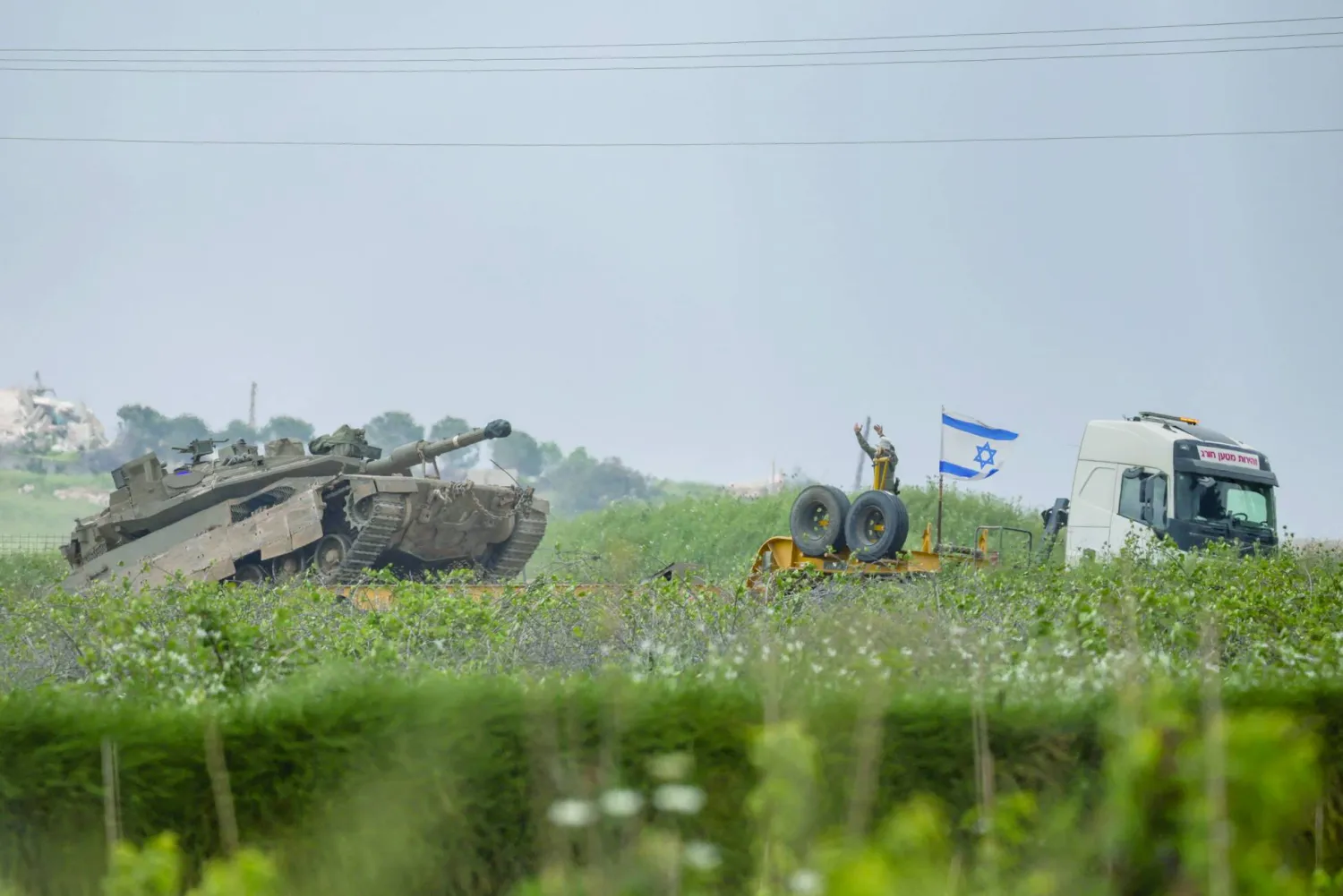
An Israeli soldier gestures next to a tank, on the Israeli side of the border with Lebanon, May 3, 2026. REUTERS/Shir Torem
TT

Israel Army Says Striking Hezbollah Targets across Lebanon

An Israeli soldier gestures next to a tank, on the Israeli side of the border with Lebanon, May 3, 2026. REUTERS/Shir Torem

Israel's army said Wednesday it had begun striking Hezbollah infrastructure in several areas of Lebanon, despite a truce with the neighboring country intended to halt fighting with the Iran-backed militant group. 

"The IDF has begun striking Hezbollah terror infrastructure sites in several areas in Lebanon," a military statement said. 

It came shortly after the army reported "several incidents" during which drones exploded near Israeli soldiers operating in Lebanon's south.  

Lebanon's health ministry said an Israeli strike in Lebanon's eastern Bekaa valley killed four people, with local media reporting the attack took place before the Israeli army issued a warning to evacuate the area along with 11 other towns. 

"An Israeli enemy raid on the town of Zellaya in West Bekaa resulted in four martyrs, including two women and an elderly man," the ministry said. 

Lebanese state media said the attack struck the house of the town's mayor, killing him and three members of his family. 


US Wants 'Concrete Actions' on Iran from Next Iraqi PM

Members of Iraq's pro-Iran paramilitary group Kataeb Hezbollah mourn a comrade who was killed in a strike in Basra, during the funeral in Baghdad on April 8, 2026. AHMAD AL-RUBAYE / AFP/File
TT

US Wants 'Concrete Actions' on Iran from Next Iraqi PM

Members of Iraq's pro-Iran paramilitary group Kataeb Hezbollah mourn a comrade who was killed in a strike in Basra, during the funeral in Baghdad on April 8, 2026. AHMAD AL-RUBAYE / AFP/File

The United States is looking for "concrete actions" by Iraq's next prime minister to distance the state from pro-Iran armed groups before resuming financial shipments and security aid, a senior official said Tuesday.

Iraq's ruling coalition has put forward Ali al-Zaidi as the next leader and he quickly received a congratulatory call from President Donald Trump, who had threatened to end all US support if former frontrunner Nouri al-Maliki took office.

But a senior US State Department official, speaking on condition of anonymity, said Zaidi must address the "blurry line" between pro-Iran armed groups in the Shia-majority country and the state, AFP said.

Washington suspended cash payments for oil revenue, which have been handled from the Federal Reserve Bank of New York in an arrangement dating to the aftermath of the 2003 US invasion of Iraq, as well as security assistance over a spate of attacks on US interests.

Resuming full support "would start with expelling terrorist militias from any state institution, cutting off their support from the Iraqi budget (and) denying salary payments to these militia fighters," the official said.

"Those are the type of concrete actions that would give us confidence and say that there's a new mindset."

The official said US facilities in Iraq suffered more than 600 attacks after February 28, when the United States and Israel launched their war on Iran.

The attacks have come to a standstill since a shaky April 8 ceasefire between the United States and Iran, with the exception of Iranian strikes in Iraqi Kurdistan.

"I'm not underestimating the severity of the challenge or what it would take to disentangle these relationships. It could start with a clear and unambiguous statement of policy that the terrorist militias are not part of the Iraqi state," the official said.

"Certain elements of the Iraqi state have continued to provide political, financial and operational cover for these very terrorist militias," he added.

The United States piled pressure on Iraq after it appeared that Maliki would be the next prime minister. During his previous stint in office, relations deteriorated with Washington over accusations of being too close to Iran's Shia clerical government and fanning sectarian flames.

Attacks by armed groups in Iraq have struck the US embassy in Baghdad, its diplomatic and logistics facility at the capital's airport and oil fields operated by foreign companies.