


Syria’s Govt and Kurds Reach Agreement on Returning Families from Notorious Camp 

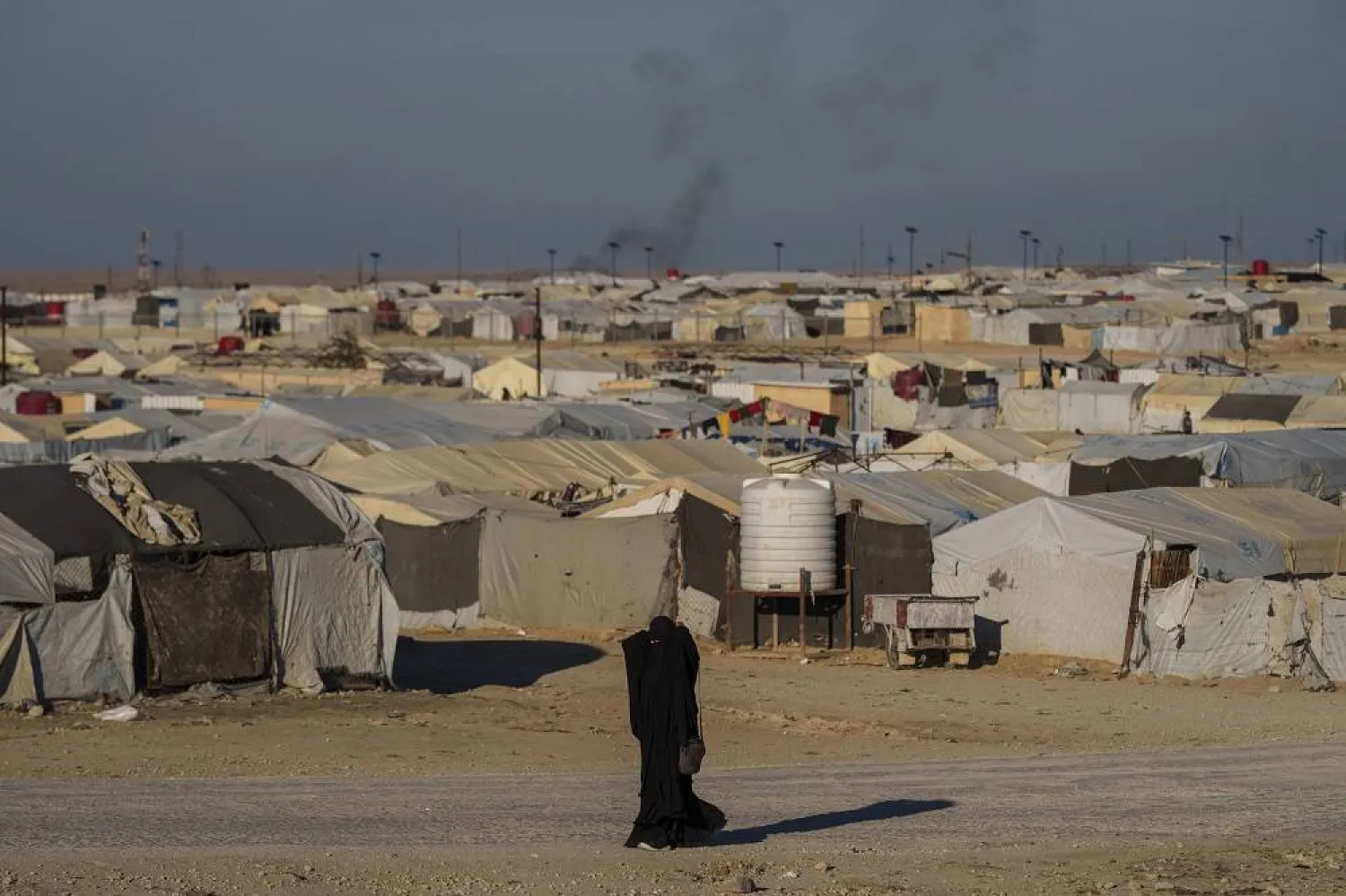
A woman walks in the al-Hol camp in northeastern Syria's Hasakeh province, where tens of thousands of mostly women and children linked to the ISIS group have been living for years, Thursday, Jan. 30, 2025. (AFP)
TT

Syria’s Govt and Kurds Reach Agreement on Returning Families from Notorious Camp 

A woman walks in the al-Hol camp in northeastern Syria's Hasakeh province, where tens of thousands of mostly women and children linked to the ISIS group have been living for years, Thursday, Jan. 30, 2025. (AFP)

Kurdish authorities in northeast Syria announced Monday they have reached an agreement with the transitional government in Damascus to evacuate Syrian citizens from a sprawling camp in the desert that houses tens of thousands of people with alleged ties to the ISIS extremist group.

Sheikhmous Ahmed, an official in the Kurdish-led authority that controls the country’s northeast, said an agreement was reached on a “joint mechanism” for returning the families from al-Hol camp after a meeting among local authorities, representatives of the central government in Damascus and a delegation from the US-led international coalition fighting ISIS.

Ahmed denied reports that administration of the camp will be handed over to Damascus in the near future, saying “there was no discussion in this regard with the visiting delegation or with the Damascus government."

Human rights groups for years have cited poor living conditions and pervasive violence in the camp, which houses about 37,000 people, mostly wives and children of ISIS fighters, as well as supporters of the group. They also include Iraqis as well as nationals of Western countries who traveled to join ISIS.

The US military has been pushing for years for countries that have citizens at al-Hol and the smaller, separate Roj Camp to repatriate them. Iraq has taken back increasing numbers of citizens in recent years, but many other countries have remained reluctant.

As for Syrians housed in the camp, a mechanism has been in place for several years to return those who want to go back to their communities in the Kurdish-controlled areas, where centers have been opened to reintegrate them.

Before now, however, there had not been an agreement with the government in Damascus to return them to areas under the central government’s control.

The new agreement comes amid attempts to increase the cooperation between Kurdish authorities and the new leaders in Damascus after former President Bashar al-Assad was unseated in an opposition offensive in December.

Under a deal signed in March between Syria’s interim President Ahmed al-Sharaa and Mazloum Abdi, the commander of the US-backed, Kurdish-led Syrian Democratic Forces, the SDF is to be merged into the new government armed forces. All border crossings with Iraq and Türkiye and airports and oil fields in the northeast are to come under the central government’s control.

Prisons where about 9,000 suspected members of the ISIS group are held are also expected to come under central government control.

The deal marked a major step toward unifying the disparate factions that had carved up Syria into de facto mini-states during its civil war that began in 2011 after the brutal crackdown by Assad's government on massive anti-government protests.

However, implementation has been slow. Washington has been pushing for its enactment and, in particular, for Damascus to take over management of the prisons in northeast Syria.



Will Lebanon Be the Biggest Loser After the Ceasefire?

Smoke rises after an Iranian missile is intercepted over the Sahel Alma area in Mount Lebanon. (Reuters)
TT

Will Lebanon Be the Biggest Loser After the Ceasefire?

Smoke rises after an Iranian missile is intercepted over the Sahel Alma area in Mount Lebanon. (Reuters)

Political sources in Beirut warned Lebanon could emerge as the biggest loser when the current regional war ends, outlining their concerns to Asharq Al-Awsat.

Lebanon is heading toward a severe internal crisis, the sharpest in its modern history with the dispute centering on Hezbollah’s weapons.

The majority of Shiites in the country insists on keeping them, while most other segments say Lebanon’s survival depends on implementing government decisions to limit arms to the state, in line with Lebanese, Arab, and international positions.

The sources noted that Hezbollah has again entered a regional war it cannot influence, risking burdens Lebanon cannot bear.

Hefty price

The war is proving costly for those involved and for countries hit by its spillover.

A ceasefire would likely show Iran suffered heavy damage to its defense, industrial sectors, and infrastructure, potentially setting it back decades. But its size, energy resources, and experience with economic hardship may help it manage the aftermath, unless losses destabilize the system.

Iranian missiles are expected to have caused damage to Israeli institutions and infrastructure, despite a high interception rate. The cost of interception is steep, but Israel appears ready to absorb it, calling the conflict an existential war and relying on strong US support.

Lebanon will struggle the most. Its economy is already near collapse. The country faces a catastrophic situation, with about one million displaced and heavy destruction along the border with Israel.

Israel has said it intends to establish a “buffer zone” inside Lebanese territory, signaling a return of occupation to parts of the country “pending guarantees for the safety of Galilee residents.”

The most dangerous scenario is that Israel’s campaign on the Lebanese front continues even if a ceasefire is reached between the US and Israel on one side and Iran on the other.

The fallout is worsened by a deepening rift among Lebanon’s components, raising the risk of internal conflict.

The role of parliament Speaker Nabih Berri appears diminished as the conflict widens. The current crisis over the expulsion of the Iranian ambassador reflects a deeper divide between the Shiite camp and others over weapons, the war, and Lebanon’s regional role.

Hezbollah described the expulsion as a “sin”, demanding that the government reverse it.

‘Impossible to coexist’

Voices are rising in Lebanon, warning that it was “impossible to coexist” between a “quasi-state” and a “Hezbollah’s statelet.”

Countries that once backed Lebanon’s reconstruction, especially in the Gulf, are now focused on their own losses from Iranian attacks. They have also made clear that they will not help unless the Lebanese state takes full control over decisions of war and peace.

The sources reiterated their warning that Lebanon risks being the biggest loser, especially if Israel expands its ground offensive and internal divisions deepen to the point of questioning the country’s very formula of coexistence.


Netanyahu Says Israel Is Expanding ‘Buffer Zone’ in Lebanon

Smoke billows from an Israeli strike on Marjeyoun in southern Lebanon on Wednesday. (AFP)
TT

Netanyahu Says Israel Is Expanding ‘Buffer Zone’ in Lebanon

Smoke billows from an Israeli strike on Marjeyoun in southern Lebanon on Wednesday. (AFP)

Israeli Prime Minister Benjamin Netanyahu said on Wednesday that his country's forces were expanding a "buffer zone" in southern Lebanon as the military pressed ahead with its campaign against Hezbollah.

"We have created a genuine security zone preventing any infiltration toward the Galilee and the northern border," Netanyahu said in a video statement.

"We are expanding this zone to push the threat from anti-tank missiles further away and to establish a broader buffer zone."

Netanyahu said that dismantling Hezbollah "remains central" to Israel's objectives in Lebanon.

"It is connected to the broader confrontation with Iran," he said.

"We are determined to profoundly transform the situation in Lebanon," he added.

Lebanon was pulled into the Middle East war when Iran-backed Hezbollah began firing rockets into Israel on March 2 to avenge the killing of Iran's supreme leader Ali Khamenei.


Strike on Western Iraq Kills Seven Security Personnel

Members of Iraq's PMF carry the coffin of the PMF operations commander for Al-Anbar, Saad Dawai alongside others during a mass funeral in Baghdad on March 24, 2026. (AFP)
TT

Strike on Western Iraq Kills Seven Security Personnel

Members of Iraq's PMF carry the coffin of the PMF operations commander for Al-Anbar, Saad Dawai alongside others during a mass funeral in Baghdad on March 24, 2026. (AFP)

A strike on a base in western Iraq killed seven security personnel, the defense ministry said Wednesday, a day after an attack on the same base targeted the Popular Mobilization Forces.

"This resulted in the death of seven of our heroic fighters and the injury of 13 others," the ministry said of the strike in Anbar province, saying it specifically targeted the base's military healthcare clinic.

Rescue operations were ongoing, it added.

The base hosts Iraqi police, soldiers from the regular army and PMF, a security official told AFP.

It was hit by a deadly strike on Tuesday that the former paramilitaries blamed on the United States.

Iraq said late on Tuesday it would summon the US charge d'affaires and the Iranian ambassador after deadly strikes blamed on their countries, as Iraqi authorities granted the targeted groups the "right to respond".

Iraq has been pulled into the war sparked by US and Israeli strikes on Iran on February 28, and which has since engulfed much of the region.

Iraq has long been a proxy battleground for the United States and Iran, and has struggled to balance diplomatic ties with both countries.

Since the war began, pro-Iran armed groups have claimed responsibility for attacks on US interests in Iraq and across the region, while strikes have also targeted these groups, including state-linked positions.

In the statement from the prime minister's office, however, Iraq granted former paramilitaries within the official armed forces the right to "respond to military attacks" by drones and aircraft that targeted their headquarters.