
How China’s Weapons Transfers to Iran Have Evolved Over Decades

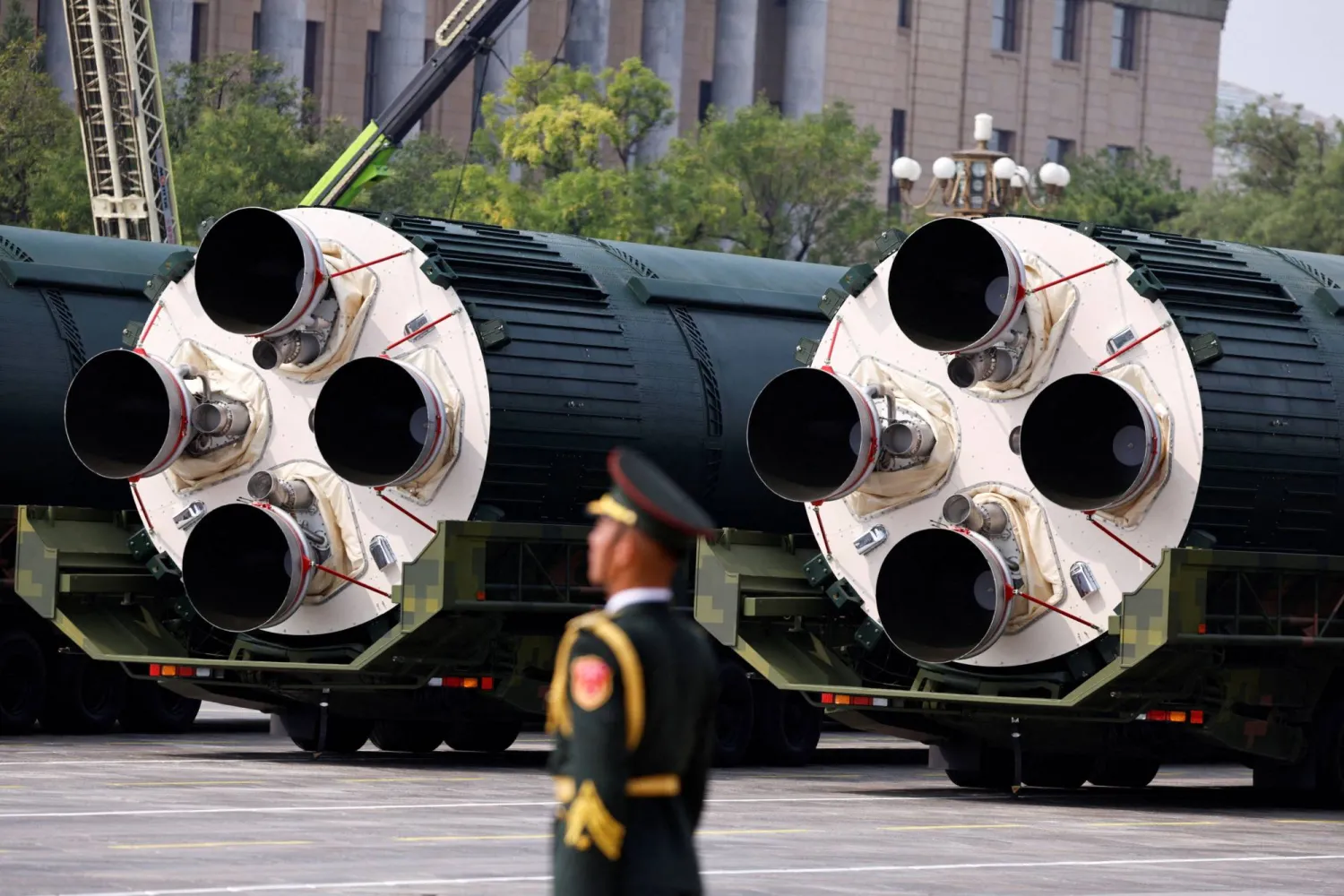
FILE PHOTO: A member of the People's Liberation Army stands as the strategic strike group displays DF-5C nuclear missiles during a military parade to mark the 80th anniversary of the end of World War Two, in Beijing, China, September 3, 2025. REUTERS/Tingshu Wang/File Photo
TT

How China’s Weapons Transfers to Iran Have Evolved Over Decades

FILE PHOTO: A member of the People's Liberation Army stands as the strategic strike group displays DF-5C nuclear missiles during a military parade to mark the 80th anniversary of the end of World War Two, in Beijing, China, September 3, 2025. REUTERS/Tingshu Wang/File Photo

Washington: David Pierson

For much of the last two decades, China has maintained a delicate balance in its military relationship with Iran, offering often indirect assistance instead of arms sales.

That approach is now drawing renewed attention after US officials said intelligence agencies were assessing whether China may have shipped shoulder-fired missiles to Iran in recent weeks. President Trump has said he would impose an additional 50 percent tariff on Chinese goods if the assessment proves accurate. China has denied the claim, calling it “pure fabrication” and has vowed to “resolutely retaliate” if the Trump administration goes through with tariffs.

The American officials said the information obtained by US intelligence agencies was not definitive. But if proven true, it would be a significant tactical change in the way Beijing supports its closest strategic partner in the Middle East.

Chinese arms sales to Iran exploded in the 1980s and have all but vanished in the last decade to comply with a United Nations embargo and US sanctions. Chinese support for Iran in recent years has instead come in the form of components that could be used in both civilian technologies as well as missiles and drones.

China has a major stake in the crisis in Iran. About a third of its total crude oil imports come from the Arabian Gulf.

Here is how China’s military support for Iran has evolved over the years:

The 1980s: The Boom Years

The outbreak of the Iran-Iraq War in 1980 coincided with major market reforms in China when the leader at the time, Deng Xiaoping, ordered state-owned companies to wean themselves off government support and instead seek commercial profit.

Chinese state-run defense companies were suddenly empowered to export their wares. That resulted in a deluge of Chinese missiles, fighter jets, tanks, armored vehicles and assault rifles being sold to Iran starting in 1982 and peaking in 1987, according to the Stockholm International Peace Research Institute.

At the same time, China sold even more arms to Iraq, resulting in a situation in which the two warring sides clashed with each other using the same Chinese weapons.

The Reagan administration opposed China’s arms sales to Iran, particularly Silkworm anti-ship cruise missiles. Tehran used the missiles in attacks in Kuwaiti waters in 1987 that struck an American-owned tanker and an American-registered tanker.

The United States responded by curbing exports of some high-technology products to China. China denied selling arms directly to Iran, but said it would do more to prevent its military exports from reaching Iran through intermediaries.

The 1990s: Technology Transfers

Following the war, Iran set out to develop its own military-industrial base with the help of China. One of its key products was the Noor anti-ship cruise missile, which had been reverse-engineered through purchases of Chinese C-802 cruise missiles.

“China played a major role in supporting Iran’s military modernization for decades, especially in developing Iran’s missile capabilities,” said Brian Hart, a fellow with the China Power Project at the Center for Strategic and International Studies.

Iran also received help from China in building missile-production facilities and even in constructing a missile test range east of Tehran, wrote Bates Gill, a longtime China expert, in the Middle East Review of International Affairs.

Under US pressure to curtail its sale of finished weapons, particularly missiles, to Iran, China began increasing exports of machine tools and components that could be used for both military and civilian purposes.

The 2000s to the Present: Dual-Use Technologies

In 2006, the United Nations imposed sanctions on Iran’s nuclear and ballistic missile programs. China voted in favor of the resolution and largely pivoted away from new, formal arms contracts with Tehran.

The shift was as much about regional strategy as it was about international law. Starting in the mid-2010s, China began deepening its strategic relationships with Gulf countries including Saudi Arabia and the United Arab Emirates, as well as Qatar.

China continued to supply Iran with dual-use technologies and materials that have helped it amass an arsenal of missiles and drones.

That included chemicals used to produce fuel for ballistic missiles and components for drones, such as radio frequency connectors and turbine blades.

But Mr. Hart said China was still “a critical form of support, given Iran’s reliance on ballistic missiles and drones to attack US and Israeli forces and other countries in the region.”

The US Treasury Department has sanctioned Chinese and Hong Kong front companies it says were set up to source parts and ingredients for ballistic missiles and drones for Iran.

Suspicions are also growing that Iran is using its access to China’s BeiDou satellite navigation system, an alternative to the US-owned Global Positioning System, for military purposes. Last month, a US congressional agency said BeiDou may have been used to direct Iran’s drone and missile strikes across the Middle East.

The New York Times


When Does Peace become the Rule Rather than the Exception?

The United Nations needs structural reform (Photo by Reuters)
TT

When Does Peace become the Rule Rather than the Exception?

The United Nations needs structural reform (Photo by Reuters)

It has become common among analysts to say that the world has entered a new global order, where the logic of “might makes right” has replaced the “power of right,” and the old rules-based international system has faded. International relations are increasingly managed through power and influence rather than consensus and multilateralism. This emerging order is shaped by empires of varying scale seeking to expand spheres of influence and sources of wealth through force, rather than relying on international agreements that place large and small states on equal footing.

It is widely understood that the primary goal of any cooperative global order is the pursuit of sustainable peace. In that regard, the Dutch philosopher of Portuguese origin Baruch Spinoza (1632–1677) described peace as “not merely the absence of war but a virtue, a state of mind, a disposition for benevolence, confidence, justice.” Albert Einstein (1879–1955) stressed that “peace cannot be kept by force; it can only be achieved by understanding.” Since antiquity, Plato viewed the establishment of peace and friendship as the highest duty of both citizen and lawgiver, while Aristotle held that victory in war is not enough, and that the real objective is to secure peace. Mahatma Gandhi (1869–1948) asserted that peace does not arise from armed conflict, but from justice upheld even in the face of challenges.

Peace as the exception

Against these perspectives, historical experience shows that peace has been the exception rather than the rule. Over roughly 3,500 to 5,000 years of recorded human history, the world has seen only about 230 to 268 years entirely free of major wars, less than 10 percent of its history. This indicates that conflict has been the dominant feature of human relations, both at the individual and collective levels.

A distinction must be made between the “international system” and the “global order.” The international system describes how the world functions in terms of actors, power, motives, and constraints. The global order, by contrast, is a political, institutional, and cultural structure formed through negotiation, cooperation, or even coercion, as occurred after the First and Second World Wars, each of which ended with victors and defeated parties. The global order is not fixed; it is the result of deliberate choices by active powers to organize and manage the world.

It is fair to say that the global order that emerged after the Second World War achieved notable successes. The likelihood of large-scale global wars declined, traditional empires with vast geographic reach came to an end, and levels of welfare and prosperity rose to unprecedented levels. The foundations of national sovereignty were also reinforced for many states, based on the principles associated with the Peace of Westphalia. However, this order no longer meets the demands of the profound transformations underway today. This helps explain the growing sense of crisis, the widespread global unease, and serious concern about the outbreak of a third world war carrying the risks of nuclear catastrophe.

Shifts and alternative models

In recent decades, influence across the globe has been redistributed, with the rise of new powers challenging Western dominance built on material wealth and scientific and technological advancement. Countries within the BRICS group, for example, are playing an increasingly influential economic and political role. This shift goes beyond the transfer of power; it also involves deep intellectual and cultural changes, as non-Western states seek to assert their identities and present alternative models of governance and development.

This phase, sometimes described as “post-Western,” presents major existential challenges for both the West and its competitors. It requires broader international cooperation, especially in addressing cross-border issues such as climate change, cybersecurity, migration, organized crime, and terrorism. Yet these shifts are not without tension. Rising powers are seeking to advance their interests, leading to friction with established powers, particularly in trade relations and sometimes in direct confrontations, complicating efforts to build a stable global balance.

The rise of nationalist and populist trends adds another layer of instability. These movements, by their nature, tend to question and undermine international cooperation while prioritizing narrow interests, weakening international institutions and threatening global stability. Regional conflicts and great-power competition, such as tensions between the United States and China, further intensify this fragmentation.

Another major challenge lies in balancing universal values with national particularities. International standards cannot be imposed unilaterally without regard for cultural and political diversity. As a result, constructive dialogue and flexible, network-based diplomacy, rather than rigid hierarchical structures, become essential to establishing common ground for building peace.

Strait of Hormuz is a theater for major conflict (Photo by Reuters)

A test of adaptation and cooperation

In sum, the current international system is undergoing a profound transformation shaped by the rise of new powers, the relative decline of Western influence, escalating conflicts, mounting global challenges, and intense competition for economic gains that strengthen position and safeguard sovereignty. The future of this system depends on the ability of international actors to adapt, cooperate, build new partnerships, and embrace multiple perspectives to understand the world’s complexity.

In this context, the emergence of alternative narratives should not be viewed as a threat but as an opportunity for a deeper understanding of a multipolar world. The international system now taking shape reflects a significant historical shift in which the West is no longer the sole center of power, but one among several.

The path toward a more complex and interconnected global order, where different models of governance coexist, is already taking form. Navigating this new reality requires innovative thinking and openness to change, while preserving the structures and institutions that have proven their value, foremost among them the United Nations, which requires structural reform to prevent decline. Ultimately, building a more just, peaceful, and sustainable world depends on a collective will capable of reconciling difference with cooperation.


The Iran War Has Revealed Trump's Pressure Point: The Economy

President Donald Trump waves to reporters as he walks on the South Lawn upon his arrival to the White House, Friday, April 17, 2026, in Washington. (AP Photo/Jose Luis Magana)
TT

The Iran War Has Revealed Trump's Pressure Point: The Economy

President Donald Trump waves to reporters as he walks on the South Lawn upon his arrival to the White House, Friday, April 17, 2026, in Washington. (AP Photo/Jose Luis Magana)

Seven weeks of war have failed to topple Iran’s theocratic rulers or force them to meet all of President Donald Trump's demands, but for US adversaries and allies it has cast a spotlight on one of his central vulnerabilities: economic pressure.

Even with Iran’s announcement on Friday that it was reopening the Strait of Hormuz to shipping, the Middle East crisis has revealed the limits of Trump's willingness to tolerate domestic economic pain.

Trump joined Israel in attacking Iran on February 28 based on what he said were imminent security threats, especially over its nuclear program. But now, with US gasoline prices high, inflation rising and his approval ratings down, Trump is racing to secure a diplomatic deal that could stem the fallout at home.

Iran has taken a beating militarily, but demonstrated it can exact economic costs that Trump and his aides underestimated, unleashing the worst-ever global energy shock, analysts say.

RISING ENERGY COSTS, RECESSION RISK

Trump has often publicly shrugged off domestic economic concerns driven by the war. But he can hardly ignore that though the US does not depend on the one-fifth of global oil shipments that were effectively blocked by Iran’s chokehold on the strait, surging energy costs have hit US consumers. The International Monetary Fund’s warning of a risk of global recession adds to the gloom.

Pressure for a way out of the unpopular war has mounted as Trump’s fellow Republicans defend narrow majorities in Congress in the November midterm elections.

None of this has been lost on Iran's leaders, who have used their grip on the strait to push Trump's team to the negotiating table.

Analysts say US rivals China and Russia may draw their own lesson: while Trump has shown an appetite for military force in his second term, he looks for a diplomatic off-ramp as soon as the economic heat becomes uncomfortable at home.

“Trump is feeling the economic pinch, which is his Achilles heel in this war of choice,” said Brett Bruen, a former foreign policy adviser in the Obama administration who heads the Global Situation Room strategic consultancy.

White House spokesman Kush Desai said that while working toward a deal with Iran to resolve "temporary" energy market problems, the administration "has never lost focus on implementing the president’s affordability and growth agenda."

FEELING THE PRESSURE

Trump’s abrupt shift on April 8 from airstrikes to diplomacy followed pressure from financial markets and parts of his base.

Some of the economic pain is borne by US farmers, a key Trump constituency, due to disrupted fertilizer shipments, and is also reflected in higher airfares from increased jet fuel prices.

With the clock ticking on a two-week ceasefire, it remains to be seen whether a president who embraces unpredictability will reach a deal that meets his war goals, extend the truce beyond April 21, or relaunch the bombing campaign.

But global oil prices fell sharply and financial markets, which Trump often sees as a barometer of his success, flourished on Friday after Iran said the strait would be open for the remainder of a separate US-brokered 10-day truce between Israel and Lebanon.

Trump was quick to declare the strait safe as he touted a deal-in-the-making with Iran that he said would be completed soon and mostly on his terms. But Iranian sources told Reuters gaps remained to be resolved. Experts have warned that even if the war ends soon, the economic damage could take months if not years to fix. A key question is whether any deal achieves the objectives Trump has laid out, including closing Iran’s path to a nuclear weapon, which Tehran has long denied it is seeking.

Iran has a stockpile of highly enriched uranium believed buried by US-Israeli strikes in June. Trump told Reuters on Friday the emerging deal calls for the US to work with Iran to recover the material and bring it to the US. Iran denied agreeing to a transfer anywhere outside its territory.

A senior Trump administration official said the US was maintaining "several redlines" in negotiations with Iran. At the same time, Trump’s call at the war’s outset for Iranians to overthrow their government has gone unheeded. Allies from Europe to Asia were initially stunned by Trump’s decision to go to war without consulting them or seeming to take into account the risk to them of Iran closing the strait.

“The alarm bell ringing for allies right now is how the war has highlighted that the administration can act erratically, without much regard for consequences,” said Gregory Poling, an Asia expert at the Center for Strategic and International Studies in Washington.

After Russia’s 2022 invasion of Ukraine, former Democratic President Joe Biden was cautious about imposing sanctions on Moscow’s energy sector out of concern for reducing oil supplies and inflating US gas prices.

But Trump, who ran for a second term on promises of cheap gas and low inflation, has shown himself sensitive to accusations that his policies raise prices. An example was when he reduced tariffs on China last year after it retaliated.

A motorist fills up his truck for over a $100 at a gas station in Los Angeles on Friday, April 17, 2026. (AP Photo/Damian Dovarganes)

MISCALCULATIONS

Just as Trump misjudged Beijing’s response in a trade war, he seems to have miscalculated how Iran might strike back economically in a shooting war by attacking energy infrastructure in Gulf states and blocking the strategic waterway between them.

Trump mistakenly believed the war would be a limited operation like the January 3 lightning raid in Venezuela and June’s strikes on Iran’s nuclear sites, US officials have said privately. But this time the repercussions are more far-reaching.

The message to Asian allies such as Japan, South Korea and Taiwan may be that Trump, who is looking for warmer ties with China, can be expected to pursue his regional goals with less regard for their geopolitical and economic security.

Analysts believe those governments will adjust for any contingency, such as a Chinese bid to seize Taiwan, out of concern over Trump’s reliability.


In Final Moments Before Truce, Israeli Strike Kills Lebanese Man’s Family

 A woman reacts as emergency personnel search for survivors at the site of an Israeli strike carried out just before a 10-day ceasefire between Lebanon and Israel, in Tyre, Lebanon, April 17, 2026. (Reuters)
A woman reacts as emergency personnel search for survivors at the site of an Israeli strike carried out just before a 10-day ceasefire between Lebanon and Israel, in Tyre, Lebanon, April 17, 2026. (Reuters)
TT

In Final Moments Before Truce, Israeli Strike Kills Lebanese Man’s Family

 A woman reacts as emergency personnel search for survivors at the site of an Israeli strike carried out just before a 10-day ceasefire between Lebanon and Israel, in Tyre, Lebanon, April 17, 2026. (Reuters)
A woman reacts as emergency personnel search for survivors at the site of an Israeli strike carried out just before a 10-day ceasefire between Lebanon and Israel, in Tyre, Lebanon, April 17, 2026. (Reuters)

Hassan Abu Khalil's family miraculously survived six weeks of war in southern Lebanon, but tragedy struck in the final minutes before a ceasefire came into force. An Israeli strike late on Thursday killed 13 of his relatives, leaving him the sole survivor.

Abu Khalil, 36, stepped out to see friends just before midnight, when a US-brokered truce between Lebanon and Israel was meant to halt fighting that had raged since March 2 between Israel and armed group Hezbollah.

“I heard a very powerful strike, and when I came ‌back to the neighborhood, ‌I found this had happened," Abu Khalil told Reuters on ‌Friday ⁠as he watched ⁠a bulldozer dig through the mountains of pulverized concrete that was once his home in the southern Lebanese port city of Tyre.

"In this building, more than 13 members of my family are missing under the rubble. What then, Israel? Just before the ceasefire, it was one massacre after another against us," he said.

Later on Friday, Lebanon's state news agency said rescue teams had recovered 13 bodies and pulled 35 wounded survivors from the ruins ⁠of the building that was hit the previous evening. It ‌reported that 15 other people were unaccounted for.

The ‌Israeli military did not immediately respond to a request for comment on the strike.

Lebanon's health ministry ‌says 2,294 people have been killed between March 2 and Thursday, when the ‌ceasefire came into force. The toll includes 177 children and 274 women.

'MY FUTURE IS GONE'

On Friday, thousands of Lebanese streamed through Tyre on the way to their southern villages. They crossed over a dirt berm that Lebanese soldiers had erected over the ruins of a main bridge ‌destroyed by Israel earlier on Thursday. Many were relieved to return to their southern villages, even if they were destroyed.

But ⁠Abu Khalil spent ⁠the first day of the ceasefire in a haze of despair, unable to eat or sleep.

He stood wringing his hands next to a bulldozer working through the ruins, his eyes locked on the gaping hole that rescuers were searching.

"Since the strike, I've been here and haven't gone anywhere. Every time they pull someone out, we run over to see what happened, who it is - my friend I grew up with, my friend's mother, my friend's father," Abu Khalil said.

He said he had been living in the United Kingdom but returned to Lebanon to be with his extended family.

"Who is left? No one is left. I wish I had never gone out for that coffee and had stayed with them," he said.

“My future is gone here. This was my life, this was my family - what now? What more is there after this?"