

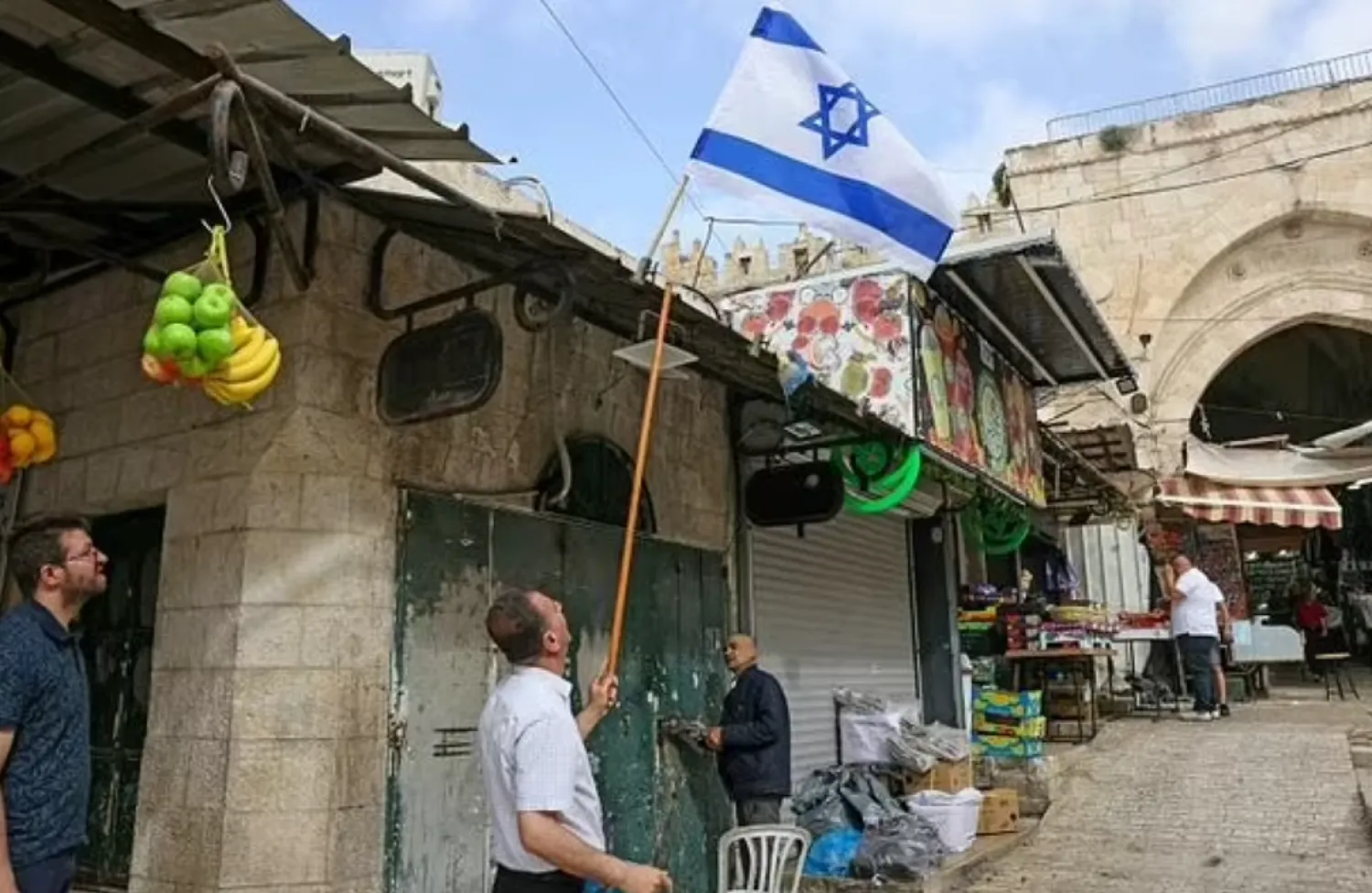

Palestinians Clean up after Israeli Nationalist March in Jerusalem

An Israeli flag is removed from above a Palestinian-owned shop in the wake of Jerusalem Day - AFP
TT

Palestinians Clean up after Israeli Nationalist March in Jerusalem

An Israeli flag is removed from above a Palestinian-owned shop in the wake of Jerusalem Day - AFP

Palestinian traders in Jerusalem's Old City returned to their shops on Tuesday to clean up a day after a march by Israeli nationalists that saw scuffles, insults and acts of vandalism.

Some had to use crowbars, hammers and wirecutters to regain access to their own shops after many were vandalized during the Jerusalem Day march the day before.

Jerusalem Day commemorates Israeli forces taking east Jerusalem during the 1967 Arab-Israeli war.

On Tuesday, metal shutters protecting the shopfronts bore the marks of the parade's passing, with padlocks blocked and stickers slapped upon them, AFP reported.

"No humanitarian aid for Gaza," read one sticker from Otzma Yehudit (Jewish Power).

The far-right party headed by firebrand politician and National Security Minister Itamar Ben Gvir had a major presence in Monday's march.

Ben Gvir visited the Al-Aqsa mosque compound, known to Jews as the Temple Mount, during the Jerusalem Day events.

Israel considers all of Jerusalem, including the annexed Palestinian-majority east, its indivisible capital.

The international community does not recognize this, and Palestinians see east Jerusalem as the capital of a future state.

On Tuesday, when employees of an east Jerusalem electricity supplier arrived at their office they discovered the front windows broken and the door blocked.

- 'Childish acts' -

A company official, Ismail Eshqart, came from headquarters to change the lock and assess the damage.

He told AFP they had expected "a little more tension" than usual this year in the alley in the Muslim Quarter where Palestinians and a few Israeli residents, mostly religious Jews, mingle daily.

He said there had been "deliberate acts of vandalism", but he did not name the suspected perpetrators.

"It's the same story every year," said clothes seller Abu Osama, referring to Jerusalem Day marchers.

"They come and attack shops, make them close, and they break things, they throw firecrackers," he told AFP as a municipal employee arrived with an electric saw to cut the padlock on the door of his sabotaged shop.

"They do what they want and nobody says to them 'what are you doing? That's not allowed'!" Abu Osama added, angry at lost time over "childish acts" that made him open several hours late.

Fruit sellers at stalls in front of the Damascus Gate into the Old City shared his dismay, but shrugged as they unloaded boxes of cherries and peaches.

"The situation is worse and worse," said grandmother Umm Mohammed who was born in the Old City and had come to do her shopping.

- 'It's crazy!' -

"We want to live in peace -- we are kind people," she said, adding that she did not leave the house on Monday.

Umm Mohammed said that last year, one man she knows "came out of his house and they hit him -- and he is a big guy!"

Armed with solvent and sponges, a group of around 10 Israeli and foreign volunteers arrived on Tuesday morning to help clean up in the march's aftermath.

"I came to do what I could, even if it's not much," said one volunteer who asked not to be identified.

They scuttled between the shops, trying to avoid police patrols, but several were briefly stopped for allegedly disturbing the peace.

Contacted by AFP, police did not respond to a request for comment.

"It's really upside down. It's crazy," said 24-year-old Joshua Korn of the Israeli-Palestinian activist group Standing Together.

"It's crazy because these people who are here to protect us... they shout at us that we're provoking... just because we're here to remove racist graffiti and stickers that have been put up by settlers in an act of provocation!" Korn said of the police.


Syria to Start Currency Swap on January 1st, Central Bank Governor Says

Syrian pounds are pictured inside an exchange currency shop in Azaz, Syria February 3, 2020. Picture taken February 3, 2020. REUTERS/Khalil Ashawi/File Photo
TT

Syria to Start Currency Swap on January 1st, Central Bank Governor Says

Syrian pounds are pictured inside an exchange currency shop in Azaz, Syria February 3, 2020. Picture taken February 3, 2020. REUTERS/Khalil Ashawi/File Photo

Syria will start swapping old banknotes for new ones under a ​plan to replace Assad-era notes starting from January 1, 2026, Central Bank Governor Abdelkader Husrieh said on Thursday.

Husrieh announced the introduction of the new Syrian currency, saying the decree "sets January ‌1, 2026, ‌as the start date ‌for ⁠the ​exchange ‌process". Sources familiar with the matter told Reuters in August that the country will issue new banknotes, removing two zeros from its currency in an attempt to restore ⁠public confidence in the severely devalued pound.

The ‌step is intended ‍to strengthen ‍the Syrian pound after its purchasing ‍power collapsed to record lows following a 14-year conflict that ended with President Bashar al-Assad's ouster in December.

Husrieh ​said the operation will take place through a smooth and orderly ⁠swap - a move bankers hope will ease fears that the new currency could fuel inflation and further erode the purchasing power of Syrians already reeling from high prices.

He added that a press conference will soon outline the exact regulations and mechanisms.


Türkiye Begins Black Box Analysis of Jet Crash That Killed Libyan Military Chief and 7 Others

Libyan national flags fly at half-mast in Tripoli on December 24, 2025, after the head of Libya's armed forces and his four aides died in a plane crash in Türkiye. (AFP)
TT

Türkiye Begins Black Box Analysis of Jet Crash That Killed Libyan Military Chief and 7 Others

Libyan national flags fly at half-mast in Tripoli on December 24, 2025, after the head of Libya's armed forces and his four aides died in a plane crash in Türkiye. (AFP)

The technical analysis of the recovered black boxes from a jet crash that killed eight people, including western Libya’s military chief, began as the investigation proceeded in cooperation with Libyan authorities, the Turkish Ministry of Defense said Thursday.

The private jet with Gen. Muhammad Ali Ahmad al-Haddad, four other military officials and three crew members crashed on Tuesday after taking off from Türkiye’s capital, Ankara, killing everyone on board. Libyan officials said the cause of the crash was a technical malfunction on the plane.

The high-level Libyan delegation was on its way back to Tripoli after holding defense talks in Ankara aimed at boosting military cooperation between the two countries.

The wreckage was scattered across an area covering 3 square kilometers (more than a square mile), complicating recovery efforts, according to the Turkish Interior Minister Ali Yerlikaya.

A 22-person delegation, including five family members, arrived from Libya early on Wednesday to assist in the investigation.


Lebanese President: We are Determined to Hold Parliamentary Elections on Time

President Joseph Aoun between Prime Minister Nawaf Salam and Speaker Nabih Berri (Lebanese Presidency file photo)
TT

Lebanese President: We are Determined to Hold Parliamentary Elections on Time

President Joseph Aoun between Prime Minister Nawaf Salam and Speaker Nabih Berri (Lebanese Presidency file photo)

Lebanese President Joseph Aoun reiterated on Thursday that the country’s parliamentary elections are a constitutional obligation that must be carried out on time.

Lebanon’s state-run National News Agency quoted Aoun as saying that he, alongside Prime Minister Nawaf Salam and Parliament Speaker Nabih Berri, is determined to hold the elections on schedule.

Aoun also emphasized that diplomatic efforts have continued unabated to keep the specter of war at bay, noting that "things are heading in a positive direction".

The agency also cited Berri reaffirming that the elections will take place as planned, with "no delays, no extensions".

The Lebanese parliamentary elections are scheduled for May next year.