


UN Chief Calls for Probe into Deaths Near Gaza Aid Site

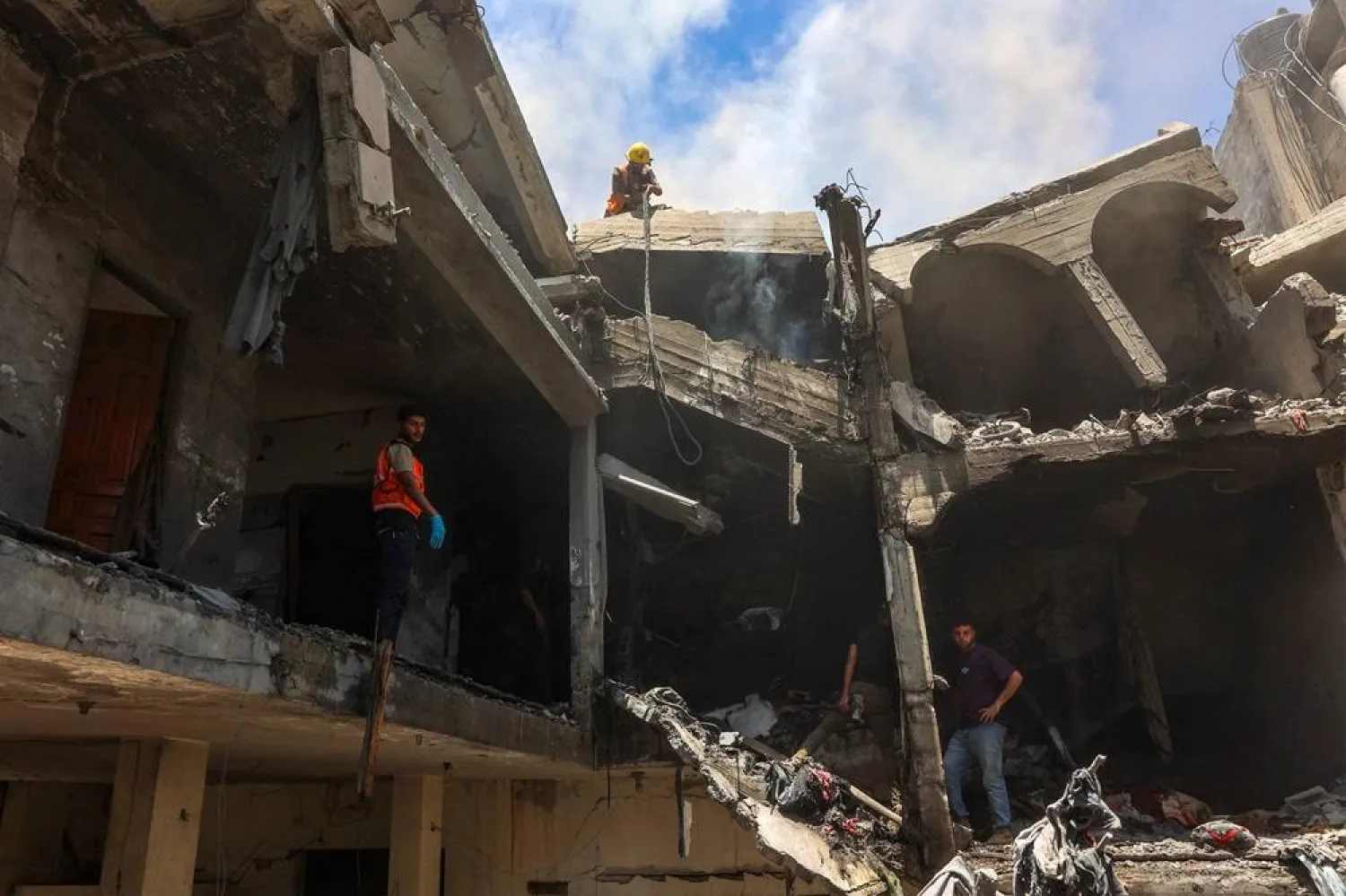
 People look for survivors following an Israeli strike that targeted the home of the Al-Bursh family in Jabalia in the northern Gaza Strip on June 2, 2025. (AFP)
People look for survivors following an Israeli strike that targeted the home of the Al-Bursh family in Jabalia in the northern Gaza Strip on June 2, 2025. (AFP)
TT

UN Chief Calls for Probe into Deaths Near Gaza Aid Site

 People look for survivors following an Israeli strike that targeted the home of the Al-Bursh family in Jabalia in the northern Gaza Strip on June 2, 2025. (AFP)
People look for survivors following an Israeli strike that targeted the home of the Al-Bursh family in Jabalia in the northern Gaza Strip on June 2, 2025. (AFP)

UN chief Antonio Guterres called Monday for an independent investigation into the killing of dozens of Palestinians near a US-backed aid center in Gaza after rescuers blamed the deaths on Israeli fire and the military denied any involvement.

Gaza's civil defense agency said Israeli gunfire killed at least 31 people and wounded 176 near the aid distribution site in the southern city of Rafah, with AFP photos showing civilians at the scene carting away bodies and medics at nearby hospitals reporting a deluge of gunshot wound victims.

The Israeli military, however, denied its troops had fired on civilians in or around the center, and both it and the aid site's administrator accused Hamas of sowing false rumors.

"I am appalled by the reports of Palestinians killed and injured while seeking aid in Gaza yesterday. It is unacceptable that Palestinians are risking their lives for food," Guterres said in a statement, without assigning blame for the deaths.

"I call for an immediate and independent investigation into these events and for perpetrators to be held accountable."

The Israeli government has cooperated with the group running the site, the Gaza Humanitarian Foundation (GHF), to introduce a new mechanism for distributing aid in Gaza that has bypassed the longstanding UN-led system.

The UN has declined to work with the group out of concerns about its neutrality, with some aid agencies saying it appears designed to cater to Israeli military objectives.

- 'Killed right in front of me' -

An eyewitness from the scene in Rafah, Sameh Hamuda, 33, had told AFP he was headed towards the aid site amid a crowd of other Palestinians when "quadcopter drones opened fire on the people, and tanks started shooting".

"Several people were killed right in front of me," he said.

Another witness, Abdullah Barbakh, 58, also told AFP "the army opened fire from drones and tanks".

Following the reports, the Israeli army said an initial inquiry found its troops "did not fire at civilians while they were near or within the humanitarian aid distribution site".

Army spokesman Effie Defrin said in a video message that "Hamas is doing its best, its utmost, to stop us from" distributing aid, and vowed to "investigate each one of those allegations" against Israeli troops.

"I urge you not to believe every rumor spread by Hamas," he added.

GHF also denied any deaths or injuries took place, adding that "these fake reports have been actively fomented by Hamas".

Israel has come under increasing international pressure to improve the humanitarian situation in Gaza following a more than two-month blockade on aid that was only recently eased.

The UN has warned the entire population of the territory is facing the risk of famine.

It has also reported recent incidents of aid being looted, including by armed individuals.

- 'Points of contention' -

Talks aimed at securing a ceasefire and the return of hostages taken by Hamas during its October 2023 attack that triggered the war have failed to produce a breakthrough.

Fighters took 251 hostages during the attack, 57 of whom remain in Gaza, including 34 who the Israeli military says are dead.

After the two sides failed to agree on a new ceasefire proposal last week, Hamas said it was ready to "immediately begin a round of indirect negotiations to reach an agreement on the points of contention".

Israeli Defense Minister Israel Katz, meanwhile, said he had told the army "to continue forward in Gaza against all targets, regardless of any negotiations".

Since a brief truce collapsed in March, Israel has intensified its operations to destroy Hamas.

On Monday, Gaza's civil defense spokesman Mahmud Bassal said 14 people were killed in an Israeli strike on a house in Gaza, "including six children and three women, in addition to more than 20 missing individuals still under the rubble".

"This house has been bombed before... and people were martyred previously," resident Mousa al-Bursh told AFP.

"The house primarily belongs to the Al-Bursh family, but it shelters many others, more than one family, and we don't know the number of victims inside."

The health ministry in Hamas-run Gaza says at least 4,201 people have been killed in the territory since Israel resumed its offensive on March 18, taking the war's overall toll to 54,470, mostly civilians.

Hamas's 2023 attack on Israel resulted in the deaths of 1,218 people, also mostly civilians, according to an AFP tally based on official figures.



Aoun, Hezbollah Ties Cool as Contacts Stay at Minimum

Supporters of Hezbollah hold portraits of its general secretaries on the first anniversary of the assassination of Hassan Nasrallah. (Reuters file)
TT

Aoun, Hezbollah Ties Cool as Contacts Stay at Minimum

Supporters of Hezbollah hold portraits of its general secretaries on the first anniversary of the assassination of Hassan Nasrallah. (Reuters file)

Relations between Lebanese President Joseph Aoun and Hezbollah have grown visibly strained, with contacts confined to what ministerial sources described as “the bare minimum.”

The chill has deepened following Aoun’s recent remarks on Hezbollah’s weapons, which widened the rift between the two sides and triggered pointed criticism from the group at the president.

In a televised interview last week marking the first anniversary of his election, Aoun said that “the role of weapons outside the state has ended with the presence of the army, and their continued existence has become a burden on their own environment and on Lebanon as a whole, with no remaining deterrent role.”

In response, former Hezbollah-aligned minister Mohammed Fneish said in a television interview that the party had “reservations on the president’s recent positions,” adding: “We disagree with him in form and substance in some passages. We are not another party. We are a resistance force that played a major role in liberating Lebanon.”

Cool communication

Ministerial sources familiar with Aoun’s position stressed that “the stances he expressed are not new, but the current circumstances may differ from previous ones.”

Speaking to Asharq Al-Awsat, the sources said the remarks stem from the president’s conviction that weapons outside the framework of the state no longer serve any purpose, that their role has ended, and that they have become a burden on everyone, including the Shiite community and Hezbollah’s own base.

“This is, ultimately, a description of an existing reality,” the sources said.

They added that reactions from Hezbollah’s supporters were expected, but would not prevent communication from continuing, since maintaining contact serves the interests of both sides, particularly Hezbollah.

Aoun and Salam

In recent years, Hezbollah had sought to maintain good relations with Aoun. Its lawmakers voted for him during the presidential election session after months of backing Suleiman Franjieh’s candidacy.

The group’s leadership even opened discreet talks with Aoun on what became known as the “national security strategy,” though these discussions yielded no results. Channels of communication remain open on the issue of weapons north of the Litani River, amid Hezbollah’s refusal to cooperate on this file.

Since the cabinet approved a decision last August restricting weapons to the state, Hezbollah’s leadership and supporters have focused their criticism on the government in which the group is represented.

Ties have worsened between Hezbollah and Prime Minister Nawaf Salam, whom the group did not back during parliamentary consultations that named him as premier last year.

A natural reaction

Political writer Dr. Kassem Kassir, who closely follows Hezbollah’s position, said the reaction of the party's supporters to Aoun’s remarks was “a natural response,” particularly because the president did not take into account what he described as the "role of the resistance in protecting Lebanon."

He added that calls to end the role of weapons were made without offering guarantees for what would follow or proposing alternative options.

Kassir told Asharq Al-Awsat that the stance of Hezbollah’s supporters did not necessarily reflect the position of the leadership. Communication channels remain open, but contacts have failed to produce a unified vision.

He added that Hezbollah has formal reservations about the performance of the government and the state, especially regarding Israeli negotiations and what it views as concessions made without guarantees or tangible results.

Duality in rhetoric

University professor and lawyer Ali Murad said that segments of Hezbollah’s supporters on social media adopt an extreme accusatory tone toward anyone who disagrees with them, leaving no room for nuance.

However, he argued that the problem goes beyond the supporters themselves and lies in the political rhetoric and mobilization Hezbollah has relied on for decades, "which entrenched a culture that recognizes only black and white and promotes accusations of betrayal, either fully with us or fully against us."

Murad told Asharq Al-Awsat that the "real issue lies in Hezbollah’s dual rhetoric."

He said the party "is fully aware that the reality has become extremely difficult following major losses and a military defeat on one hand, and the broader retreat of the Axis of Resistance on the other. As a result, a clear contradiction has emerged between what Hezbollah says and what it actually believes."

This contradiction, Murad said, is evident in the speeches of Hezbollah’s secretary general Sheikh Naim Qassem, which reflect two parallel narratives. "One acknowledges reality to a degree while maintaining rejection of handing over weapons. The other is a mobilizing discourse rooted in an earlier era, before the pager operation and the 'support front' war."

“What Aoun said falls in this direction,” Murad said, arguing that Hezbollah in its former state has ended and has become a burden on Lebanon, the Shiite community, and the residents of the south.

"Persisting with the same rhetoric today amounts to rejecting reality and practicing denial, a form of political arrogance reflected by both supporters and the group’s media circles."

No interest in breaking ties

Murad said what angered Hezbollah’s supporters most was “the truth they do not want to acknowledge,” namely that Hezbollah’s role has ended, that it has exited the deterrence equation, and that it can no longer achieve Lebanon’s objectives on its own.

“The president stated a truth that needed to be said,” he said.

Asked whether the relationship between Hezbollah and Aoun was nearing a breaking point, Murad said it was not in Hezbollah’s interest to sever political ties with the president, or even with the prime minister.

He noted that the group understands that the actions of both officials serve Lebanon’s interests and, in particular, the interests of the south.

In some respects, he added, this approach also spares Hezbollah and its base the risks of "fatal choices that could lead to a bleak outcome if denial or political self-destruction were to prevail."


Palestinian Factions Hold Indirect Talks in Cairo on Second Phase of Gaza Ceasefire

A general view shows destruction in the Bureij camp in the central Gaza Strip on January 9, 2026 following Israeli attacks. Gaza's civil defense agency said Israeli attacks in the Palestinian territory killed at least 13 people, including five children, despite a ceasefire that has largely halted the fighting. (AFP)
TT

Palestinian Factions Hold Indirect Talks in Cairo on Second Phase of Gaza Ceasefire

A general view shows destruction in the Bureij camp in the central Gaza Strip on January 9, 2026 following Israeli attacks. Gaza's civil defense agency said Israeli attacks in the Palestinian territory killed at least 13 people, including five children, despite a ceasefire that has largely halted the fighting. (AFP)

A Palestinian source from the Fatah movement told Asharq Al-Awsat on Tuesday that “indirect” meetings among Palestinian factions have begun in Cairo to discuss advancing the second phase of the Gaza ceasefire agreement, particularly the formation of the committee to run the enclave, ahead of a broader meeting scheduled for Wednesday.

The second phase of the ceasefire, which came into force on Oct. 10, includes key provisions such as the disarmament of Hamas, the formation of a Board of Peace to oversee the peace process in the territory, the establishment of a technocratic committee to run Gaza’s affairs, and the deployment of an international stabilization force.

The Palestinian source stated that eight Palestinian factions are currently in Cairo, including Fatah and Hamas, to explore ways to advance the stalled second phase.

Fatah may skip the factions’ meeting

The source said discussions include the formation of the technocratic committee, the Palestinian police force to be deployed in the enclave, and related structures, noting that differences remain and that Fatah refuses to meet directly with Hamas.

A second informed Fatah source told Asharq Al-Awsat that the movement may not take part in Wednesday’s planned factions’ meeting.

A Palestinian source stated on Monday that consultations in Cairo were expected to finalize the administration committee and present factions with proposed names, particularly following recent developments involving changes to some nominees in response to Israeli objections.

On Tuesday, another informed Palestinian source stated that an agreement had been reached on the names of most members of the technocratic committee.

In televised remarks late on Sunday, Hamas politburo member Mohammed Nazzal said a delegation from the movement would discuss follow-up on the implementation of the ceasefire agreement amid “major difficulties hindering its application and continued Israeli violations.”

Mediators’ contacts

The Gaza administration committee has moved to the forefront of ceasefire mediation efforts, amid anticipation of decisive US decisions on announcing the Board of Peace and the technocratic committee, as well as Wednesday’s factions’ meeting in Cairo.

Those intensive contacts by mediators “require real US pressure and Palestinian consensus to translate them into momentum for the second phase and to overcome Israeli obstacles,” an Egyptian expert told Asharq Al-Awsat.

Qatari Foreign Ministry spokesman Majed Al Ansari said at a press conference on Tuesday that Doha is working with mediators to accelerate progress toward the second phase of the ceasefire, accusing Israel of obstructing the deal.

“Israel must answer one question: why is the Gaza agreement delayed?” Al Ansari said, adding that “the complexities on the table today require moving forward to the second phase of the agreement, and our contacts are continuous and daily to push the deal ahead.”

Qatari Prime Minister Sheikh Mohammed bin Abdulrahman Al Thani and Egyptian Foreign Minister Badr Abdelatty stressed during a phone call the importance of announcing the formation of the temporary Palestinian technocratic committee, in parallel with establishing the international stabilization force, ensuring the flow of humanitarian aid, and creating conditions for early recovery and reconstruction, said a statement by Egypt’s Foreign Ministry on Tuesday.

Abdelatty and Turkish Foreign Minister Hakan Fidan also agreed during a phone call on Tuesday on “the need to intensify regional and international efforts to ensure the consolidation of the ceasefire and to move forward with the transition to the second phase of the US president’s plan.”

In a separate call with Palestinian Vice President Hussein al-Sheikh, Abdelatty reaffirmed Egypt’s support for deploying the international stabilization force and technocratic committee, which would help create the conditions necessary for restoring the Palestinian Authority’s role.

Abdelatty also spoke by phone with German Foreign Minister Johann Wadephul, who is close to Israel, to discuss Gaza.

Mukhtar Ghobashi, Secretary General of the Al-Farabi Center for Strategic Studies, said mediators’ contacts must be followed by genuine and serious US pressure to announce second-phase decisions, whether on forming the administration committee or the Board of Peace.

Ghobashi said Cairo is keen to push the second phase forward, as reflected in the intensive contacts, but that progress hinges on US pressure, Palestinian consensus, and imminent US decisions this week to end the tragedy in the enclave, for which Israel bears full responsibility.


Lebanon Charges Ex-Central Bank Governor Salameh Over Alleged $44.8 Mln Embezzlement

The Lebanese Central Bank in Beirut (NNA) 
TT

Lebanon Charges Ex-Central Bank Governor Salameh Over Alleged $44.8 Mln Embezzlement

The Lebanese Central Bank in Beirut (NNA) 

Lebanese prosecutors have indicted former central bank governor Riad Salameh and two lawyers on charges including embezzlement of public funds, forgery and illicit enrichment, judicial authorities said on Tuesday. 

Salameh, who headed the Lebanese Central Bank for three decades, was detained for about 13 months over alleged financial crimes committed during his tenure and was released in September after paying record bail of more than $14 million. The banker, who remains in Lebanon and is subject to a travel ban, has denied any ‌wrongdoing. 

According to ‌a copy of the indictment issued by Beirut's indictment ‌chamber ⁠seen by ‌Reuters, the panel accused Salameh alongside lawyers Marwan Issa el-Khoury and Michel John Tueni of embezzling $44.8 million from what it described as a central bank "consultancy account". 

It said the chamber also approved a request by the financial public prosecutor to widen investigations into how funds were moved into and out of banks without senior bank managers notifying the central bank's Special Investigation Commission. 

KHOURY SAYS HE HAS NO KNOWLEDGE OF 'CONSULTANCY ⁠ACCOUNT' 

In a statement to Reuters, Khoury said he had no knowledge of the "consultancy account" referenced in ‌the charge, had not been involved in the central ‍bank's financial transactions and had never received ‍funds from the institution. 

He said the indictment itself called for a ‍continuation of the inquiry and that there should not have been an accusation against him before the investigation was complete. 

Khoury said the inquiry had already proved that he had not received any funds from the central bank or any fees in relation to its financial transactions. 

Tueni could not be reached for comment. 

The indictment follows earlier moves by the central bank to file a criminal ⁠complaint against a former senior bank official at the central bank, a former banker and a lawyer over alleged illicit enrichment through misuse of public funds, the bank's acting governor Wassim Mansouri has said. 

Salameh, whose 30-year term ended amid a cascade of domestic and international investigations, has been under scrutiny over allegations that more than $300 million was siphoned off between 2002 and 2015. 

The central bank has said it will act as a principal plaintiff in a state investigation into Forry Associates, a company suspected of receiving commissions from commercial banks and transferring them abroad. The company is controlled by Salameh's brother Raja, who also denies wrongdoing. 

The Salameh ‌brothers are under investigation in France, Germany, Switzerland and other countries over alleged embezzlement.