
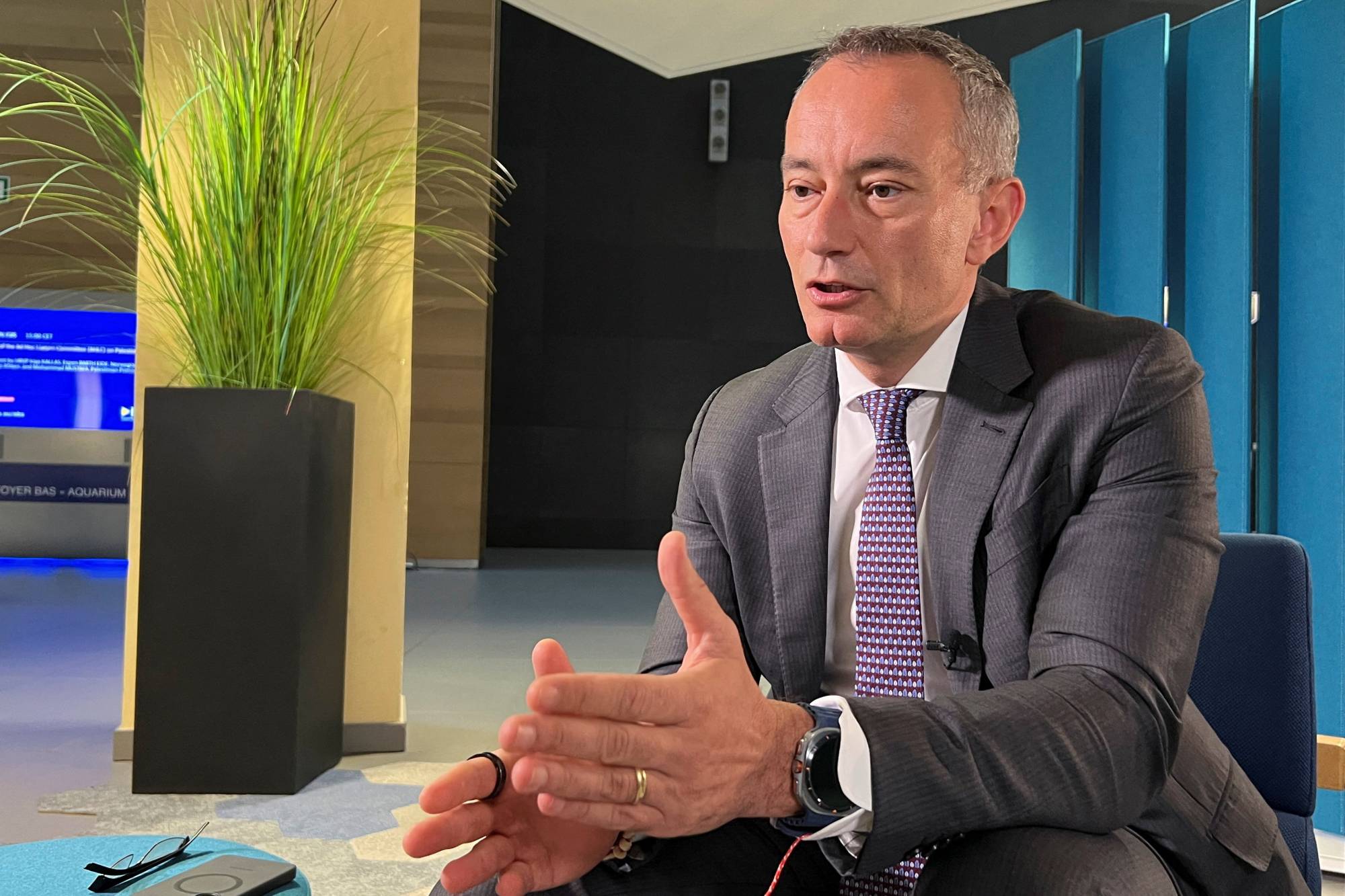
Asharq Al-Awsat has obtained details of a new proposal drafted by representatives of the Board of Peace, including the board’s high representative, Nickolay Mladenov, mediators from Egypt, Qatar and Türkiye, as well as the United States, concerning the Gaza Strip, particularly on the issue of disarmament.
The document - described as a “roadmap” for completing implementation of US President Donald Trump’s comprehensive peace plan for Gaza - has 15 provisions to carry out the second phase of the ceasefire agreement that entered into force on Oct. 10, 2025.
A senior Hamas source told Asharq Al-Awsat the proposal had also been conveyed to Israel, and meetings in Cairo could begin Wednesday to discuss responses from all parties, including Hamas and other factions.
The source declined to clarify Hamas’ position following internal consultations. Other sources said Monday that Mladenov would visit Israel before arriving in Egypt on Tuesday for discussions on Israel’s position on the proposal.
The document calls for establishing a committee known as the Implementation Verification Committee, to be created by the High Representative for Gaza and composed of guarantor states, the International Stabilization Force and the Board of Peace, to ensure all parties fulfill their obligations. The committee would be reinforced through an enhanced monitoring mechanism.
In its first provision, the document stresses the importance of all parties fully implementing UN Security Council Resolution 2803 and Trump’s comprehensive plan, describing them as an agreed international framework to guide the process toward restoring civilian life, enabling Palestinian governance, reconstruction, security and economic recovery, and creating conditions for a credible path to Palestinian self-determination and statehood.
The proposal adopts Palestinian demands recently presented by a Hamas and factional delegation, requiring Israel to complete all outstanding commitments from the first phase in full and without delay before moving to the second phase, under the supervision of the verification committee.
According to the document, movement from one stage of the second phase to the next would be conditional on completing all obligations in the preceding stage, under monitoring by the verification committee.
It grants the Board of Peace a mandate to oversee governance, reconstruction and development in Gaza until a reformed Palestinian authority can resume its responsibilities and conditions are created for a credible path to Palestinian statehood.
The Board of Peace would also be authorized to establish the International Stabilization Force and make arrangements necessary to implement the plan’s objectives.
The document explicitly states Hamas and all Palestinian factions would have no direct or indirect role in governing Gaza. Current civil servants affiliated with Hamas serving in civilian ministries would be dealt with legally and fairly, with full respect for their rights.
It says Gaza must be governed according to the principle of one authority, one law and one weapon, with arms permitted only for individuals authorized by the national committee, while all armed groups would cease military activities.
Newly trained police personnel would be integrated into existing police structures and subjected to security vetting. Those who fail to meet standards would be offered alternative unarmed roles or compensation packages. All police weapons would be transferred to committee control upon its entry into Gaza.
On weapons control, the document outlines a phased disarmament process linked to an agreed implementation timetable, monitored and supported by the office of the High Representative and the verification committee.
The process would be under Palestinian leadership, with weapons transferred to the national committee. All armed groups would participate in inventorying infrastructure and collecting all weapons, though they would not be required to transfer weapons to Israel. The process would be monitored by the verification committee.
The national committee for administering Gaza would have sole authority to register weapons, issue and revoke licenses, and collect unlicensed arms, primarily personal weapons.
Through a gradual process using buyback programs, reintegration assistance and social support, the national committee would oversee weapons collection, with factions committed to cooperating.
The document says surrender of personal weapons by armed members would occur only in parallel with the handover of militia weapons, under conditions ensuring security and police capacity to guarantee personal safety.
It also calls for signing a social peace agreement to prevent internal fighting and violence, ban shows of force, military parades and armed demonstrations, and halt retaliatory acts.
Regarding the International Stabilization Force, the document says it would deploy between areas controlled by Israeli forces and areas under the national committee’s control, but would not conduct policing activities. It would be permitted to support disarmament and humanitarian operations and provide protection for them.
The proposal calls for Israel to complete a phased withdrawal toward Gaza’s borders according to an agreed and implementable timetable, linked to verified progress in the disarmament process.
The national committee would address any security breaches in areas where weapons have been collected.
It also says reconstruction of the enclave would proceed through the entry of building materials into areas where disarmament has been carried out and which are effectively under the administration of the national committee.