Lebanon: Hezbollah ‘Mends’ Ties with Prime Minister

Salam met with a Hezbollah delegation. (Premiership)
TT

Lebanon: Hezbollah ‘Mends’ Ties with Prime Minister

Salam met with a Hezbollah delegation. (Premiership)

A Hezbollah delegation visited Prime Minister Nawaf Salam at the Grand Serail on Wednesday with the aim of “mending” ties with the Premier after the latter’s remarks about the party’s arms.

Parliament Speaker Nabih Berri had met with Salam two days ago in a bid to ease the tension between Salam and Hezbollah and pave the way for the meeting between the two.

The Hezbollah delegation comprised head of the Loyalty to the Resistance bloc MP Mohamed Raad, MPs Hussein Hajj Hassan, Amin Sherri, Hasan Fadlallah and Ibrahim al-Musawi.

According to sources who spoke on condition of anonymity, the meeting has opened a "new path for the relations” between Salam and Hezbollah.

Hezbollah pins high importance on the cessation of Israeli hostilities and the need for Israel to withdraw from five strategic points it still occupies in southern Lebanon, in addition to reconstruction after Israel’s war on the country, the sources stated.

Salam for his part emphasized commitment to the provisions in the ministerial policy statement, said the sources, with emphasis on continued coordination between the two.

Raad told reporters after the meeting that the party has nothing but “good intentions” towards the government, “we are keen for lasting consensus with all the country’s components, and with all the ministries”.

Raad stated that Hezbollah is keen to cooperate with the government, “Nothing can hamper the cooperation between us and the government, which we are part of”.

“We know this phase is a difficult one...We, as government and people, authorities and political forces, must know that our priorities at this stage stand at ending the Israeli occupation, returning the hostages, and stop the daily Israeli aggressions happening daily on roads and in villages in the South, and to begin reconstruction”, stated the MP.

Whether discussions with the PM touched on the party’s armament, Raad said it was not discussed in detail. “The issue of arms must be discussed in an objective manner that preserves the country’s interest, the choices of its people, and deterring the Israeli aggression threatening its security and stability”.

On reports that Hezbollah has conditioned the option of its disarmament to reconstruction, Raad denied saying: “everything will be discussed in truly time”.


UN Probe: Israel's 'Deliberate Targeting' of Children Part of Ongoing Gaza 'Genocide'

Mourners carry the body of Palestinian Raghad Hassan Ashour, 16, during her funeral at Al-Shifa Hospital after she was killed in an Israeli airstrike, in Gaza City, Monday June 22, 2026. (AP Photo/Jehad Alshrafi)
TT

UN Probe: Israel's 'Deliberate Targeting' of Children Part of Ongoing Gaza 'Genocide'

Mourners carry the body of Palestinian Raghad Hassan Ashour, 16, during her funeral at Al-Shifa Hospital after she was killed in an Israeli airstrike, in Gaza City, Monday June 22, 2026. (AP Photo/Jehad Alshrafi)

Israel is deliberately targeting Palestinian children in what has become a key factor in an ongoing "genocide" in Gaza, United Nations investigators charged on Tuesday, in a report slammed by Israel.

According to AFP, the UN Independent International Commission of Inquiry said it had found evidence that "Palestinian children have been deliberately targeted and killed by Israeli security forces.”

This, it said, was a key factor in establishing "the genocidal intent of the Israeli authorities and security forces to destroy the larger Palestinian group in Gaza.”

The three-member investigative team, which does not speak for the UN itself, first determined in a report last September that Israel had committed "genocide" in the war in Gaza -- a finding Israel flatly rejected.

In Tuesday's follow-up report, they said the intense scale and systematic nature of Israeli military operations had continued, resulting in the "unprecedented" death, injury and trauma of Palestinian children.

There were "reasonable grounds" to conclude that Israel's authorities and security forces "have continued to commit the crime of genocide" in Gaza, they said.

Israel, which has long been harshly critical of the commission, slammed the report as "defamatory" and a "libelous sham.”

It accused the investigators of ignoring "the brutal tactics of Hamas, which ruthlessly attacks Israeli children and uses Palestinian children as human shields.”

The commission, which was established by the UN Human Rights Council in 2021, examined for its latest report crimes affecting Palestinian children, and how living conditions imposed by Israel in Gaza were "resulting in preventable mortality of children.”

"Israeli authorities and security forces have deliberately targeted Palestinian children resulting in genocide, crimes against humanity and war crimes in the Gaza Strip, and war crimes in the West Bank," the team said in a statement.

The commission said that severe physical and mental injuries, mass trauma, orphanhood, separation, disability, repeated displacements, starvation, and the collapse of education and healthcare had "erased childhood" in Gaza and would continue to affect the territory's children throughout their lives.

"By targeting children, Israel is attacking the very capacity of the Palestinian people to exist and to determine their future," said Indian judge Srinivasan Muralidhar, who chairs the inquiry.

"Even after the October 2025 ceasefire, children continue to be killed and seriously injured."

The report comes days after the UN children's agency UNICEF said at least 265 children had been killed and hundreds more wounded in Gaza since the ceasefire between Israel and Hamas took effect.

UNICEF said children had been shot, bombed and struck by quadcopters, killed in tents, in schools and while playing football or fishing.

The Hamas October 7, 2023 attack on Israel resulted in the deaths of 1,221 people, according to an AFP tally based on official Israeli figures.

Israel's retaliatory response in Gaza has killed more than 72,800 people, according to the Hamas-run territory's health ministry.

The UN inquiry said that during the first two years of the war at least 20,179 children were killed and 44,143 injured "as a direct result of the hostilities in Gaza.”

The killing and maiming of Palestinian children "was part of a strategy to destroy the biological continuity and future existence of the Palestinian group in Gaza", it said.

By targeting children, the report said, "Israel is eroding the foundational structure of Palestinian society, weakening the demographic vitality.”

Israel was responsible for causing a "severe orphan crisis,” while wounded youngsters "face a lifetime of disability" -- now "a defining demographic reality" among Gaza's children, it said.

The siege of Gaza "directly undermined reproductive and newborn health,” while the collapse of public health programs "eroded the conditions necessary for a healthy next generation.”

The report listed Israeli divisions, brigades and units that may be responsible for killing children, in specific incidents in Gaza and the West Bank.

Besides Gaza, the commission also documented a sharp increase in violence by Israeli settlers against Palestinian children in the West Bank, which Israel has occupied since 1967.

The commission urged all UN member states, including Israel, to ensure accountability for crimes committed.


Russian Delegation, Libya’s GNA Discuss Investment Opportunities

The visit aimed to review the economic and investment potential offered by the free zone and the opportunities available for cooperation and partnership. Photo: Misurata Free Zone
TT

Russian Delegation, Libya’s GNA Discuss Investment Opportunities

The visit aimed to review the economic and investment potential offered by the free zone and the opportunities available for cooperation and partnership. Photo: Misurata Free Zone

Libyan officials have discussed with a high-ranking Russian economic delegation mechanisms to strengthen investment and trade cooperation, as well as the reactivation of the Libyan-Russian joint committee.

Chairman of the Management Committee of the Misurata Free Zone (MFZ) in Libya Mohsen Al-Suqutri met on Monday with Russia’s Ambassador to Libya, Aydar Aganin, in the presence of Libya’s ambassador to Moscow, Emhemed Almaghrawi.

The visit aimed to review the economic and investment potential offered by the free zone and the opportunities available for cooperation and partnership.

The Russian delegation included several businessmen, as well as heads and representatives of companies and institutions active in industrial, commercial, investment, and scientific research sectors.

The Russian ambassador praised the strategic geographic location of the Misurata Free Zone, considering it an important hub connecting regional and international markets, and highlighting its attractiveness for investment in light and heavy industries and other sectors.

Both sides discussed opportunities for economic and investment cooperation and the possibility of establishing partnerships and projects that would contribute to boosting economic development and expanding areas of collaboration between the two countries.

The Minister of Transport and financial adviser to the prime minister in the Government of National Unity (GNA), Mohamed Al-Shahoubi, met with the Russian economic delegation in Tripoli.

The meeting was attended by several ministry officials, the Libyan and Russian ambassadors, as well as representatives from the ministry of foreign affairs and international cooperation.

The meeting addressed several issues of mutual interest, particularly in the sectors of transportation, infrastructure, and logistics services. It also explored opportunities for economic and investment cooperation that would serve shared interests and strengthen the partnership between the two countries.

The two sides also discussed mechanisms for reviving the Libyan-Russian joint committee, in a way that would help advance cooperation and activate agreements and memoranda of understanding previously signed between Libya and Russia.

The conferees stressed the importance of continued coordination, consultation, and exchange of expertise in support of development efforts, and to enhance the transport sector and economic relations between the two states.


Sudanese Army Welcomes RSF Defectors

Sudanese Army commander Abdel Fattah al-Burhan receives Major General Al-Nour Qubba, who defected from the Rapid Support Forces. (Sovereignty Council)
TT

Sudanese Army Welcomes RSF Defectors

Sudanese Army commander Abdel Fattah al-Burhan receives Major General Al-Nour Qubba, who defected from the Rapid Support Forces. (Sovereignty Council)

Sudan’s army is increasingly absorbing defectors from the Rapid Support Forces (RSF), betting that growing divisions within the paramilitary group can help consolidate military gains in a civil war that has become one of the world’s worst humanitarian crises.

The latest sign of that strategy came last month when authorities in Khartoum granted a military rank to Ali Rizqallah, a former RSF commander who defected alongside several other senior figures. The army-backed government welcomed the move as evidence of widening cracks within the RSF.

The conflict erupted on April 15, 2023, after a power struggle between the army and RSF spiraled into open warfare. Since then, the war is believed to have killed hundreds of thousands of people, displaced millions, and fueled famine and disease across large parts of the country.

Some of the worst violence has unfolded in Darfur, an RSF stronghold where the force has been accused of committing atrocities. Alleged abuses during the group’s assault on al-Fashir last October were documented in a Reuters investigation.

Halima, a resident of Darfur now living in the town of Tawila, said she was forced to flee repeatedly as RSF fighters raided villages surrounding al-Fashir. She recounted that she witnessed women being raped and was herself whipped by RSF personnel.

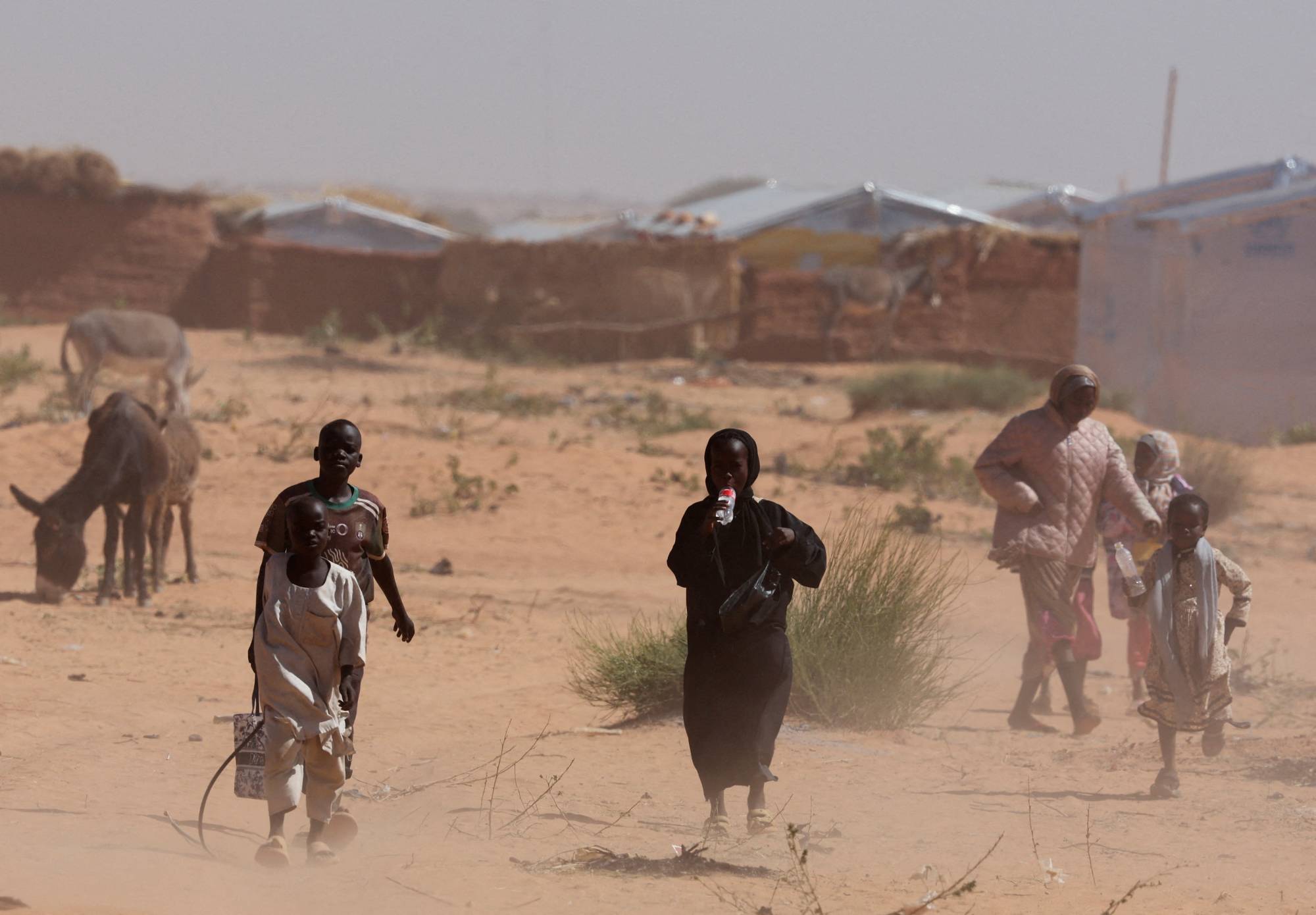
Sudanese refugees from Darfur walk amidst a sandstorm at the Touloum refugee camp, amid ongoing conflict in their country, on the outskirts of the town of Iriba in Wadi Fira province, eastern Chad, November 30, 2025. (Reuters)

“My arm is covered in scars all the way down to here,” she said, pointing toward her leg as she described the marks left on her body.

Anger toward the RSF is also widespread in neighboring Kordofan. A merchant in the town of Al-Nuhud revealed that he plans to file a lawsuit over the looting of warehouses and food stores.

Speaking on condition of anonymity for fear of retaliation, he blamed the RSF for the losses. But Mohamed Salah al-Din, a member of the executive council of the Emergency Lawyers group, said such individual cases are unlikely to gain broad traction amid the turmoil of war.

“This issue cannot be addressed piecemeal,” he stated. “It requires transitional justice.”

His comments contrast with efforts already underway to prosecute alleged collaborators. Emergency Lawyers said it has documented 243 cases referred to the courts involving accusations ranging from supplying intelligence to the RSF to cooking for its fighters.

The army is also seeking to exploit tribal tensions within the RSF’s support base. Several of the group’s senior commanders come from the Arab Rizeigat tribe, where rival clans have become increasingly divided, particularly after an RSF raid earlier this year on the hometown of Musa Hilal, a powerful tribal leader aligned with the military.

Hilal belongs to the Mahamid clan, while critics accuse the RSF of operating through a tribal and ethnic hierarchy that disproportionately benefits the family of its commander, Mohamed Hamdan Dagalo, better known as Hemedti.

“The RSF has become the preserve of a specific group and a single family,” critics said. “The project that builds a state must be a Sudanese national project, not one based on tribal loyalties.”

The Sudanese military is hoping those divisions will trigger further defections, replicating the success it achieved in Al Jazirah State, where the 2024 defection of militia commander Abu Aqla Keikal helped shift momentum decisively in the army’s favor.