


Inside the Tunnel Where Muhammad Sinwar Was Killed

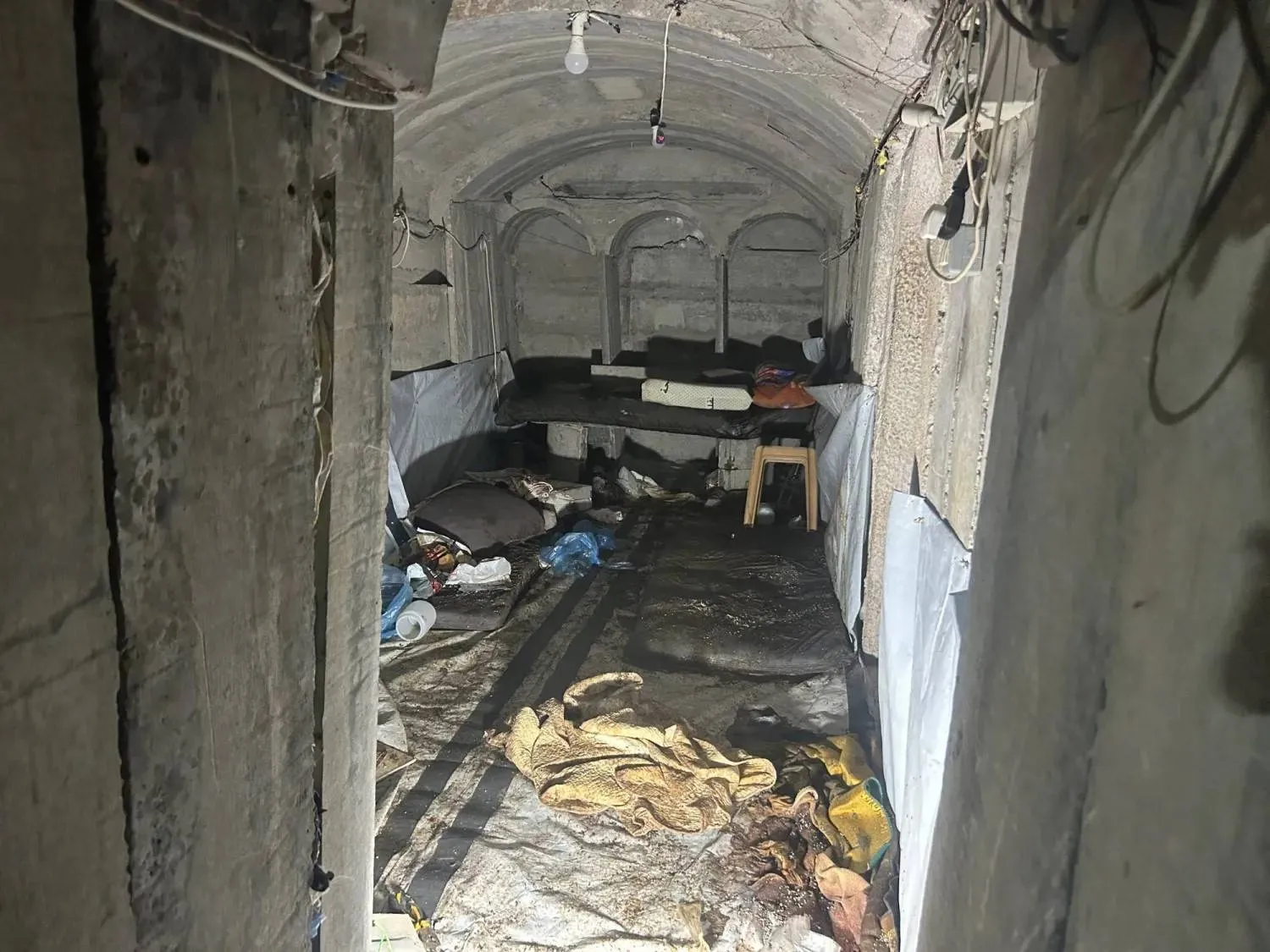
The room in which Muhammad Sinwar and four other militants are said to have died. (Patrick Kingsley/The New York Times) 
TT

Inside the Tunnel Where Muhammad Sinwar Was Killed

The room in which Muhammad Sinwar and four other militants are said to have died. (Patrick Kingsley/The New York Times) 

By Patrick Kingsley*

Two feet wide and less than six feet tall, the tunnel led deep beneath a major hospital in southern Gaza.

The underground air bore the stench of what smelled like human remains. After walking some 40 yards along the tunnel, we found the likely cause.

In a tiny room that the tunnel led to, the floor was stained with blood. It was here, according to the Israeli military, that Muhammad Sinwar - one of Hamas’s top commanders and the younger brother of slain Hamas leader Yahya Sinwar - was killed last month after a nearby barrage of Israeli strikes.

What we saw in that dark and narrow tunnel is one of the war’s biggest Rorschach tests (psychological assessment tool that uses inkblots to evaluate a person's personality), the embodiment of a broader narrative battle between Israelis and Palestinians over how the conflict should be portrayed.

The military escorted a reporter from The New York Times to the tunnel on Sunday afternoon, as part of a brief and controlled visit for international journalists that the Israelis hoped would prove that Hamas uses civilian infrastructure as a shield for military activity.

To Palestinians, Israel’s attack on, and subsequent capture of, the hospital compound highlighted its own disregard for civilian activity.

Body of Muhammad Sinwar

Last month, the military ordered the hospital’s staff and patients to leave the compound, along with the residents of the surrounding neighborhoods.

Then, officials said, they bored a huge hole, some 10 yards deep, in a courtyard within the hospital grounds.

Soldiers used that hole to gain access to the tunnel and retrieve Sinwar’s body, and they later escorted journalists there so we could see what they called his final hiding place.

There are no known entrances to the tunnel within the hospital itself, so we lowered ourselves into the Israeli-made cavity using a rope.

To join this controlled tour, The Times agreed not to photograph most soldiers’ faces or publish geographic details that would put them in immediate physical danger.

To the Israelis who brought us there, this hiding place - directly underneath the emergency department of the European Gaza Hospital - is emblematic of how Hamas has consistently endangered civilians, and broken international law, by directing its military operations from the cover of hospitals and schools.

Hamas has also dug tunnels underneath Al-Shifa hospital in Gaza City and a UN complex elsewhere in that city.

“We were dragged by Hamas to this point,” Brig. Gen. Effie Defrin, the chief Israeli military spokesman, said at the hospital on Sunday afternoon. “If they weren’t building their infrastructure under the hospitals, we wouldn’t be here. We wouldn’t attack this hospital.”

Defrin said that Israel had tried to minimize damage to the hospital by striking the area around its buildings, without a direct hit on the medical facilities themselves. “The aim was not to damage the hospital and, as much as we could, to avoid collateral damage,” he said.

Prioritize Destruction of Hamas

To the Palestinians who were forced from here, the Israeli attack on Sinwar embodied Israel’s willingness to prioritize the destruction of Hamas over the protection of civilian life and infrastructure, particularly the health system.

According to the World Health Organization, Israel has conducted at least 686 attacks on health facilities in Gaza since the start of the war, damaging at least 33 of Gaza’s 36 hospitals.

Many, like the European Gaza Hospital, are now out of service, fueling accusations from rights groups and foreign governments — strongly denied by the Israelis— that Israel is engaged in genocide, in part by wrecking the Palestinian health system.

“It’s morally and legally unacceptable, but Israel thinks it is above the law,” Dr. Salah al-Hams, the hospital spokesman, said in a phone interview from another part of southern Gaza.

Though Israel targeted the periphery of the hospital site, leaving the hospital buildings standing, al-Hams said the strikes had wounded 10 people within the compound, damaged its water and sewage systems and dislodged part of its roof. It killed 23 people in buildings beyond its perimeter, he said, 17 more than were reported the day of the attack.

The tremors caused by the strikes were like an “earthquake,” al-Hams said.

Al-Hams said he had been unaware of any tunnels beneath the hospital. Even if they were there, he said: “This does not justify the attack. Israel should have found other ways to eliminate any wanted commander. There were a thousand other ways to do it.”

Piles of Rubble

Our journey to the hospital revealed much about the current dynamics of the war in Gaza.

In a roughly 20-minute ride from the Israeli border, we saw no Palestinians — the result of Israel’s decision to order the residents of southern Gaza to abandon their homes and head west to the sea.

Many buildings were simply piles of rubble, destroyed either by Israeli strikes and demolitions or Hamas’ booby-traps. Here and there, some buildings survived, more or less intact; on one balcony, someone had left a tidy line of potted cactuses.

We drove in open-top jeeps, a sign that across this swath of southeastern Gaza, the Israeli military no longer fears being ambushed by Hamas fighters.

Until at least the Salah al-Din highway, the territory’s main north-south artery, the Israeli military seemed to be in complete command after the expansion of its ground campaign in March.

The European Gaza Hospital and the tunnel beneath it are among the places that now appear to be exclusively under Israeli control.

Under the laws of war, a medical facility is considered a protected site that can be attacked only in very rare cases. If one side uses the site for military purposes, that may make it a legitimate target, but only if the risk to civilians is proportional to the military advantage created by the attack.

The Israeli military said it had tried to limit harm to civilians by striking only around the edges of the hospital compound. But international legal experts said that any assessment of the strike’s legality needed also to take into account its effect on the wider health system in southern Gaza.

In a territory where many hospitals are already not operational, experts said, it is harder to find legal justification for strikes that put the remaining hospitals out of service, even if militants hide beneath them.

Sinwar and 4 Fellow Militants

When we entered the tunnel on Sunday, we found it almost entirely intact. The crammed room where Sinwar and four fellow militants were said to have died was stained with blood, but its walls appeared undamaged.

The mattresses, clothes and bedsheets did not appear to have been dislodged by the explosions, and an Israeli rifle — stolen earlier in the war, the soldiers said — dangled from a hook in the corner.

It was not immediately clear how Sinwar was killed, and Defrin said he could not provide a definitive answer. He suggested that Sinwar and his allies may have suffocated in the aftermath of the strikes or been knocked over by a shock wave unleashed by explosions.

If Sinwar was intentionally poisoned by gases released by such explosions, it would raise legal questions, experts on international law said.

“It would be an unlawful use of a conventional bomb — a generally lawful weapon — if the intent is to kill with the asphyxiating gases released by that bomb,” said Sarah Harrison, a former lawyer at the US Defense Department and an analyst at the International Crisis Group.

Defrin denied any such intent. “This is something that I have to emphasize here, as a Jew first and then as a human being: We don’t use gas as weapons,” he said.

In other tunnels discovered by the Israeli military, soldiers have used Palestinians as human shields, sending them on ahead to scour for traps.

The general denied the practice. The tunnel was excavated by Israelis, he said.


The New York Times


Syria State Media Says Kurdish Force Shelling Kills One Person in Aleppo City

A view of Aleppo, Syria in February 2018. (AFP)
TT

Syria State Media Says Kurdish Force Shelling Kills One Person in Aleppo City

A view of Aleppo, Syria in February 2018. (AFP)

Syrian state media said Kurdish force shelling in Aleppo killed one person on Monday, after clashes with government forces erupted in Kurdish-majority neighborhoods of the city, with both sides trading blame over who started the violence. 

"A civilian was killed in SDF bombardment with mortar shelling and rocket launchers on a number of neighborhoods of Aleppo," state news agency SANA said, referring to the US-backed, Kurdish-led Syrian Democratic Forces. 

Syria's interior ministry had said Kurdish forces attacked government personnel at joint checkpoints in the Kurdish-majority Sheikh Maqsud and Ashrafiyeh neighborhoods of the northern city of Aleppo. 

Authorities had earlier reported two members of the government forces, three civil defense personnel and several civilians were wounded. 

The SDF instead accused "factions affiliated with the interim government" of carrying out an attack. 

It reported two Kurdish-led security personnel and five civilians wounded in an "ongoing attack" on Sheikh Maqsud and Ashrafiyeh involving "mortars and heavy weapons". 

In October, Syria announced a comprehensive ceasefire with Kurdish forces following deadly clashes in the districts, which have repeatedly witnessed heightened tensions. 

Aleppo has been governed by Syria's new authorities since the toppling of former leader Bashar al-Assad in December last year. 

But Sheikh Maqsud and Ashrafiyeh have remained under the control of Kurdish units linked to the SDF and the Kurds' Asayish domestic security forces, despite the SDF having officially withdrawn in April under a disengagement agreement reached with the government. 


Turkish Foreign Minister Urges Kurds Not to Be Obstacle to Syria’s Stability

This handout photograph released by the Turkish Foreign Ministry press service shows Turkish Foreign Minister Hakan Fidan (2nd-L) and Turkish Minister of National Defense Yasar Guler (L) meeting with Syria's Foreign Minister Asaad al-Shaibani (2nd-R) and Syria's Defense Minister Murhaf Abu Qasra (R) in Damascus on December 22, 2025. (Turkish Foreign Ministry Press Service / AFP)
TT

Turkish Foreign Minister Urges Kurds Not to Be Obstacle to Syria’s Stability

This handout photograph released by the Turkish Foreign Ministry press service shows Turkish Foreign Minister Hakan Fidan (2nd-L) and Turkish Minister of National Defense Yasar Guler (L) meeting with Syria's Foreign Minister Asaad al-Shaibani (2nd-R) and Syria's Defense Minister Murhaf Abu Qasra (R) in Damascus on December 22, 2025. (Turkish Foreign Ministry Press Service / AFP)

Visiting Turkish Foreign Minister Hakan Fidan on Monday urged Kurdish-led forces to integrate into Syria's army and not obstruct the country's stability, as the deadline for implementing a deal between Damascus and the Kurds approaches. 

Türkiye and Syria have developed close ties since the toppling of longtime ruler Bashar al-Assad late last year and Ankara, a key supporter of the new authorities, sees the presence of Kurdish forces on its border with Syria as a security threat. 

Fidan, Turkish Defense Minister Yasar Guler and intelligence chief Ibrahim Kalin met with Syrian President Ahmed al-Sharaa, a presidency statement said. 

The visit aimed to address issues including progress on implementing a March 10 agreement between Damascus and the US-backed, Kurdish-led Syrian Democratic Forces (SDF), Türkiye had said. 

Under the deal, the Kurds' civil and military institutions should be integrated into the central government by year end. 

But differences between the sides have held up the deal's implementation despite international pressure, particularly from Washington. 

"It is important that the SDF be integrated into the Syrian administration through dialogue and reconciliation, in a transparent manner, and that it no longer acts as an obstacle to Syria's territorial integrity and long-term stability," Fidan told a press conference with his Syrian counterpart Asaad al-Shaibani. 

Shaibani said Damascus had received a response from the SDF regarding a draft Syrian defense ministry proposal on integrating the Kurdish-led forces into the army. 

"Work is currently underway to study this response and how it responds to the national interest in achieving the integration and achieving a single unified Syrian territory," Shaibani told Monday's press conference. 

Last week, a Kurdish official told AFP on condition of anonymity that Damascus's proposal included splitting the Kurdish-led forces into three divisions and a number of brigades, including one for women. 

The forces would be deployed under Kurdish commanders in areas of northeast Syria currently under SDF control, the official said. 

- Israel - 

It was the first time Damascus had submitted a written proposal to the SDF since the March agreement was signed, the official added, noting "international and regional efforts" to finalize the agreement by the end of the year. 

Last week, Fidan warned the SDF -- which controls vast swathes of Syria's oil-rich northeast -- that patience among key actors was "running out" and advised against further delays to integrate its forces. 

Türkiye shares a 900-kilometer (550-mile) border with Syria and has launched successive offensives to push the SDF from its frontier. 

On Monday, Fidan said the sides also discussed regional security, noting "Syria's stability means Türkiye’s stability". 

He also expressed hope that talks between Syria and neighboring Israel, which has carried out bombings and incursions in Syria since Assad's fall, would "reach a conclusion". 

"For the stability of the region and for Syria's stability, progress in this regard is important," Fidan said, urging Israel to adopt "an approach based on mutual consent and understanding" rather than "pursuing an expansionist policy". 

Shaibani said the talks also addressed "security issues linked to combating terrorism and preventing" a resurgence of the ISIS group in Syria. 

Last week, US forces said they struck dozens of ISIS targets in Syria following a deadly December 13 attack on American personnel in central Syria's Palmyra. 

With support from the coalition, the SDF spearheaded the offensive that led to ISIS's territorial defeat in Syria in 2019, but the extremists still maintain a presence, particularly in the country's vast desert. 

Syria recently joined the international coalition against ISIS. 


Lebanon Says 3 Killed in Israeli Strike on Vehicle Near Sidon

Smoke rises after an Israeli strike on the Haret Saida neighborhood, Sidon, Lebanon, 27 October 2024. (EPA)
TT

Lebanon Says 3 Killed in Israeli Strike on Vehicle Near Sidon

Smoke rises after an Israeli strike on the Haret Saida neighborhood, Sidon, Lebanon, 27 October 2024. (EPA)

Lebanon said three people were killed Monday in a strike near Sidon that Israel said targeted Hezbollah operatives, days ahead of a deadline for Lebanon's army to disarm the group near the border.

Israel has kept up regular strikes on Lebanon, usually saying it is targeting Hezbollah, despite a November 2024 ceasefire that sought to end more than a year of hostilities with the Iran-backed militant group, which it accuses of rearming.

Lebanon's state-run National News Agency said Monday's strike on a vehicle was carried out by an Israeli drone around 10 kilometres (six miles) from the southern coastal city of Sidon and "killed three people who were inside".

The health ministry reported the same toll.

An Israeli military statement said the army "struck several Hezbollah terrorists in the area of Sidon".

Under heavy US pressure and amid fears of expanded Israeli strikes, Lebanon has committed to disarming Hezbollah, starting with the south.

The Lebanese army plans to carry out the task south of the Litani River -- about 30 kilometres from the border with Israel -- by year's end.

The latest strike came after Lebanese and Israeli civilian representatives on Friday took part in a meeting of the ceasefire monitoring committee for a second time, after holding their first direct talks in decades earlier this month, also under the committee's auspices.

The committee comprises representatives from Lebanon, Israel, the United States, France and the United Nations Interim Force in Lebanon (UNIFIL).

Lebanese President Joseph Aoun said Monday that the goal of the negotiations was to "stop the hostilities, achieve Israel's withdrawal, return prisoners held in Israel and return southern residents to their villages".

- 'Days away' -

Israel has also kept troops in five south Lebanon areas that it deems strategic.

"Lebanon awaits positive steps from the Israeli side," Aoun told visiting Italian Defense Minister Guido Crosetto on Monday, a presidency statement said.

In a separate statement, Crosetto said that "even after UNIFIL, Italy will continue to do its part, supporting with conviction the international presence and supporting the capacity development of the Lebanese armed forces".

Asked by AFP if this meant Italy wanted to maintain a military presence in the country, a ministry spokesman confirmed that was the case.

UNIFIL has acted as a buffer between Israel and Lebanon since 1978, but the UN Security Council voted in August to withdraw the peacekeepers in 2027.

Aoun said Lebanon "welcomes the participation of Italy and other European countries in any force that takes the place" of UNIFIL.

On Saturday, Prime Minister Nawaf Salam said the first phase of the plan to restrict weapons to the state south of the Litani River was "days away from completion", according to a statement from his office.

"The state is ready to move to the second phase, north of the Litani River, based on the plan prepared by the Lebanese army," he added.

More than 340 people have been killed by Israeli fire in Lebanon since the ceasefire, according to an AFP tally of Lebanese health ministry reports.

On Sunday, Israeli strikes in south Lebanon near the border killed one person and wounded another, as Israel also said it targeted Hezbollah members.
