


Lebanon at Risk as Iran Uses Its Airspace, Israel Responds

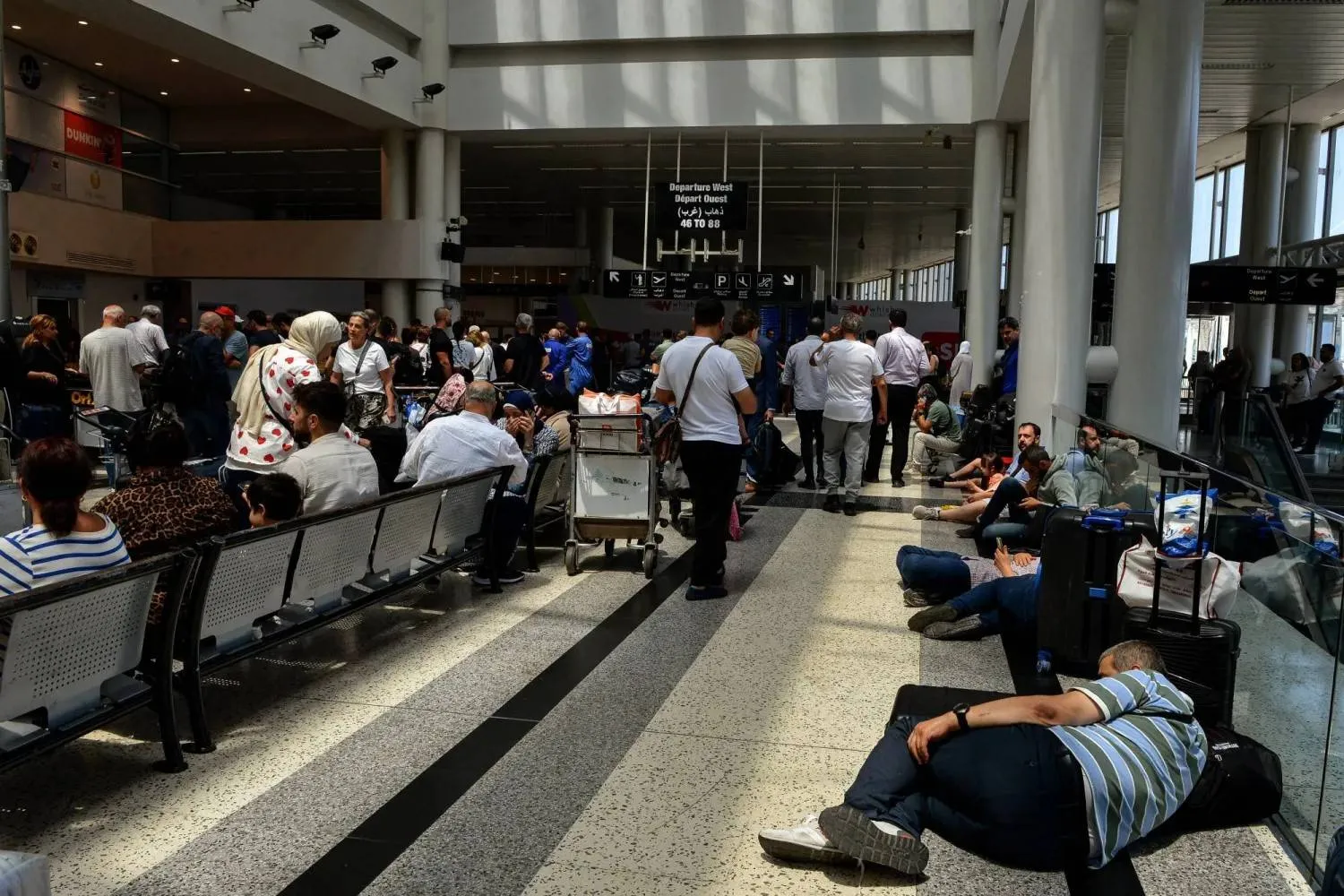
Passengers stranded in the departure hall of Rafik Hariri International Airport following flight delays (DPA)
TT

Lebanon at Risk as Iran Uses Its Airspace, Israel Responds

Passengers stranded in the departure hall of Rafik Hariri International Airport following flight delays (DPA)

Lebanon found itself entangled in the latest flare-up between Israel and Iran, as its skies became a battleground for Iranian missiles and drones, and Israeli interceptor rockets throughout Friday night and into Saturday morning.

Residents across several towns and cities endured a tense and sleepless night, fearing the fallout of missiles potentially crashing into populated areas.

The country’s airspace, which was shut down Friday evening as a security precaution, was reopened at 10 a.m. on Saturday.

Minister of Public Works and Transport, Fayez Rasamny, speaking from Beirut’s international airport during an inspection visit, said the facility would remain open “unless an emergency beyond our control arises”.

The Ministry of Public Works said in a statement that the airspace closure and accompanying emergency measures were taken “strictly for security reasons,” stressing that “the safety of passengers and airport facilities remains a top priority.”

Middle East Airlines (MEA), Lebanon’s national carrier, rescheduled several flights to and from Beirut after passengers were left stranded overnight at the airport due to cancellations and delays.

Lebanon’s skies have become a corridor for conflict in the intensifying Israeli-Iranian standoff, sparking growing fears among Lebanese officials and analysts who warn the country is losing control over its own airspace - and may be paying the price.

Beirut lacks the leverage to deter Iran from using its airspace to launch attacks on Israel, nor can it stop Israeli forces from intercepting drones and missiles mid-flight over Lebanese territory.

With Iranian projectiles and Israeli countermeasures crossing through the same skies, experts warn Lebanon faces mounting military and civilian risks as long as it remains entangled in the regional confrontation.

“The passage of Iranian missiles and drones through Lebanese airspace toward Israel presents serious military and security threats on multiple levels,” retired Brigadier General Saeed Al-Qazaz told Asharq Al-Awsat.

He warned that turning Lebanon into a de facto battleground increases the risk of missiles falling into populated areas -- as seen in the Bekaa Valley during the overnight bombardment between Friday and Saturday.

“Israeli attempts to intercept these threats over Lebanon could result in casualties on the ground, whether due to guidance malfunctions or fuel depletion. The fragmentation of these weapons is just as dangerous as a direct hit,” explained Al-Qazaz.

One missile reportedly landed late Friday in the outskirts of Beit Shama, west of Baalbek, sending shockwaves through the valley and stoking fears of further fallout.

Airspace Safety and Legal Concerns

Al-Qazaz also voiced grave concern over aviation safety, saying Lebanon’s crowded airspace could become a deadly zone for civilian aircraft.

“There is an immediate threat to air navigation, and the risk of a commercial aircraft being struck is real. That justifies the need to close the airspace entirely in such circumstances,” he said.

Using the airspace of a sovereign nation without consent, he added, constitutes “a flagrant violation of international law,” citing the 1944 Chicago Convention on International Civil Aviation, which affirms a state’s sovereignty over its own skies.

He stressed that the Lebanese government bears responsibility and “must not allow missiles and drones to pass through its airspace without taking action”. International legal liability could arise if any damage is caused to third countries by these aerial operations.

At the same time, Al-Qazaz pointed out a double standard: “While Israel uses the airspace of Lebanon, Syria, and Iraq without consequence, these countries fail to respond or prevent such actions. Jordan, however, has recently intercepted projectiles to avoid international accountability”.

Calls for International Action

Despite Lebanon’s limited capacity to influence either side in the conflict, Al-Qazaz said the government could still lodge a formal complaint with the UN Security Council over repeated airspace violations.

“Lebanon can protest to the international community over the use of its skies by both Israel and Iran, even if no concrete outcome is expected,” he said.

“But remaining silent while missiles continue to pass overhead exposes Lebanon to greater danger, undermines its sovereignty, and drags it further into a military confrontation it did not choose”.

As tensions simmer and skies remain contested, Lebanon finds itself navigating a high-stakes crisis with few tools to shield its people, or its sovereignty.


Israeli Settlers Forcibly Enter Palestinian Home and Kill Sheep in Latest West Bank Attack

 This picture shows sheep grazing on a field in Kafr al-Labad with the Israeli settlement of Avnei Hefetz seen in the background, near the city of Tulkarem in the occupied West Bank on December 18, 2025. (AFP)
This picture shows sheep grazing on a field in Kafr al-Labad with the Israeli settlement of Avnei Hefetz seen in the background, near the city of Tulkarem in the occupied West Bank on December 18, 2025. (AFP)
TT

Israeli Settlers Forcibly Enter Palestinian Home and Kill Sheep in Latest West Bank Attack

 This picture shows sheep grazing on a field in Kafr al-Labad with the Israeli settlement of Avnei Hefetz seen in the background, near the city of Tulkarem in the occupied West Bank on December 18, 2025. (AFP)
This picture shows sheep grazing on a field in Kafr al-Labad with the Israeli settlement of Avnei Hefetz seen in the background, near the city of Tulkarem in the occupied West Bank on December 18, 2025. (AFP)

Israeli settlers attacked a Palestinian home in the south of the Israeli-occupied West Bank overnight, breaking in and killing sheep, a Palestinian official said Tuesday. It was the latest in a surge of attacks by settlers against Palestinians in the territory in recent months.

Israeli police said they arrested five settlers.

The settlers killed three sheep and injured four more, smashed a door and a window of the home, and fired tear gas inside, sending three Palestinian children under the age of 4 to the hospital, said Amir Dawood, who directs an office documenting such attacks within a Palestinian governmental body called the Wall and Settlement Resistance Commission.

Police said they arrested the five settlers on suspicion of trespassing onto Palestinian land, damaging property and dispensing pepper spray, not tear gas. They said they are investigating.

CCTV video from the attack in the town of As Samu’, shared by the commission, showed five masked settlers in dark clothing, some with batons, approaching the home and appearing to enter. Sounds of smashing are heard, as well as animal noises. Another video from inside shows masked figures appearing to strike sheep in the stable.

Photos of the aftermath, also shared by the commission, show smashed car windows and a shattered front door. Bloodied sheep lie dead as others stand with blood staining their wool. Inside the home, photos show broken glass and the furniture ransacked.

Dawood said it was the second settler attack on the family in less than two months. He called it “part of a systematic and ongoing pattern of settler violence targeting Palestinian civilians, their property and their means of livelihood, carried out with impunity under the protection of the Israeli occupation.”

During October’s olive harvest, settlers across the territory launched an average of eight attacks daily, the most since the United Nations humanitarian office began collecting data in 2006. The attacks continued in November, with the UN recording at least 136 by Nov. 24.

Israel captured the West Bank, east Jerusalem and Gaza — areas claimed by the Palestinians for a future state — in the 1967 war. It has settled over 500,000 Jews in the West Bank, in addition to over 200,000 in contested east Jerusalem.

Israel’s government is dominated by far-right proponents of the settler movement, including Finance Minister Bezalel Smotrich and Cabinet Minister Itamar Ben-Gvir, who oversees the nation’s police force. Earlier this week, Smotrich said the Israeli cabinet had approved a proposal for 19 new Jewish settlements, another blow to the possibility of a Palestinian state.


Palestinian Authority Says Israel Tightening Control Over West Bank with New Settlements

Israeli bulldozers level land at the evacuated Israeli settlement of Sanur, near the West Bank city of Jenin, 23 December 2025. (EPA)
TT

Palestinian Authority Says Israel Tightening Control Over West Bank with New Settlements

Israeli bulldozers level land at the evacuated Israeli settlement of Sanur, near the West Bank city of Jenin, 23 December 2025. (EPA)

The Palestinian Authority condemned on Tuesday Israel's recent approval of 19 settlements in the occupied West Bank, accusing it of tightening its control over Palestinian land.

On Sunday, Israel's far-right Finance Minister Bezalel Smotrich announced the authorities had greenlit the settlements, saying the move was aimed at preventing the establishment of a Palestinian state.

The Ramallah-based Palestinian foreign ministry decried the approval as a "dangerous step aimed at tightening colonial control over the entirety of Palestinian land", calling it a continuation of "apartheid, settlement, and annexation policies that undermine the inalienable rights of the Palestinian people".

"The decision provides political cover for accelerating the plunder of Palestinian lands, expanding settlement infrastructure... alongside an escalating pace of settler terrorism against members of our people and their properties," it said in a statement.

The latest move brings the total number of settlements approved over the past three years to 69, Smotrich's office said.

Excluding east Jerusalem, which was occupied and annexed by Israel in 1967, more than 500,000 Israelis live in the West Bank, along with about three million Palestinian residents.

Smotrich's office said the 19 newly approved settlements were located in what it described as "highly strategic" areas, adding that two of them -- Ganim and Kadim in the northern West Bank -- would be re-established after being dismantled two decades ago.

Five of the 19 settlements already existed but had not previously been granted legal status under Israeli law, the statement said.

Israel's decision came days after the United Nations said the expansion of Israeli settlements in the West Bank -- all of which are illegal under international law -- had reached its highest level since at least 2017.

US President Donald Trump recently warned that Israel "would lose all of its support from the United States" if it annexed the West Bank.

Israel has occupied the territory since 1967, and violence there has surged following the outbreak of the Gaza war in October 2023 with Hamas's attack on Israel.

Israeli troops or settlers have killed at least 1,028 Palestinians in the West Bank -- both fighters and civilians -- since the start of the fighting in Gaza, according to an AFP tally based on Palestinian health ministry figures.

At least 44 Israelis have been killed in the West Bank in Palestinian attacks or Israeli military operations during the same period, according to Israeli data.


Germany Deports Man to Syria for First Time Since 2011

People attend a protest against reelection of Syria's president Bashar al-Assad, near Syria's embassy, Berlin, Germany May 26, 2021. (Reuters)
TT

Germany Deports Man to Syria for First Time Since 2011

People attend a protest against reelection of Syria's president Bashar al-Assad, near Syria's embassy, Berlin, Germany May 26, 2021. (Reuters)

Germany deported a man to Syria for the first time since the civil war began in that country in 2011, the interior ministry in Berlin announced on Tuesday.

A Syrian immigrant previously convicted of criminal offences in Germany was flown to Damascus and handed over to Syrian authorities on Tuesday morning, the ministry said.
