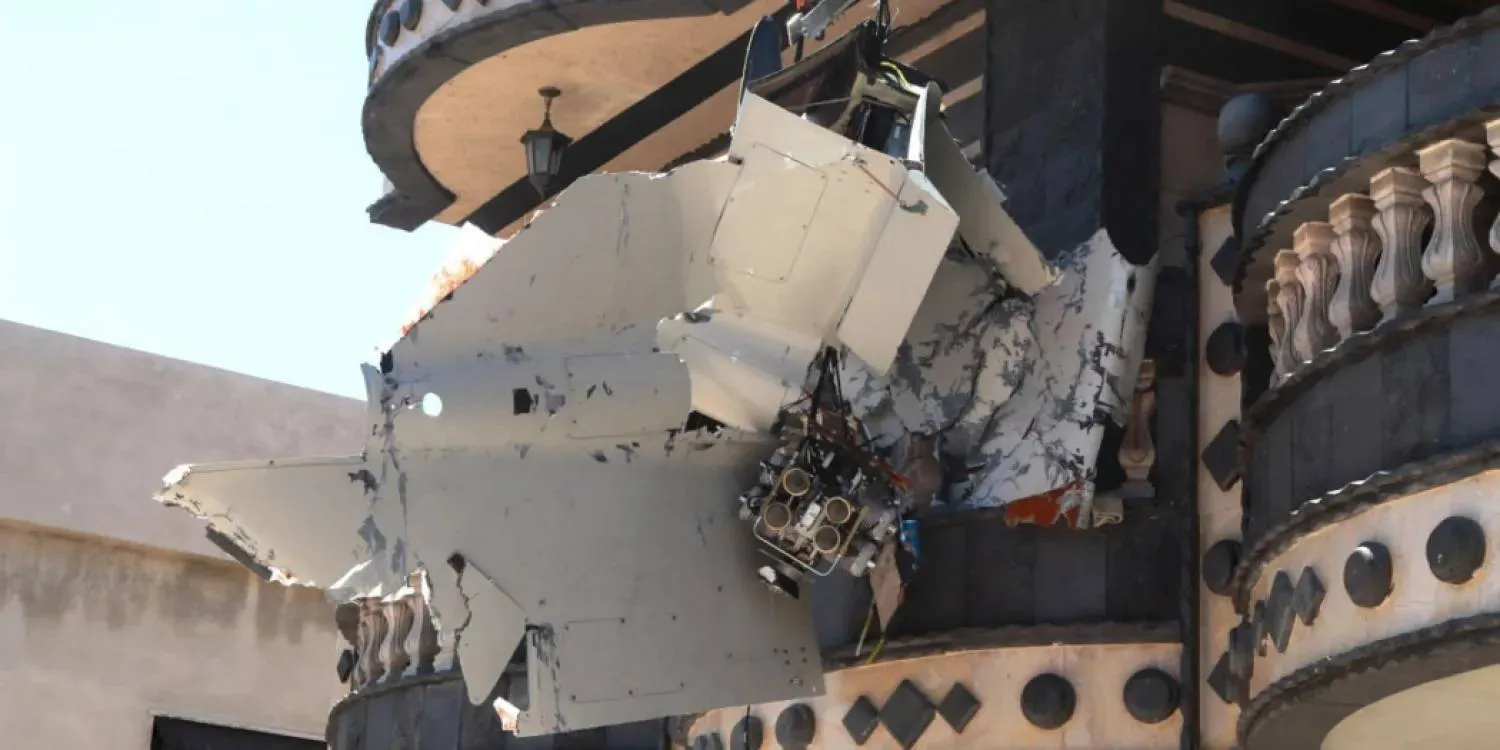
Debris from Iranian Drones, Missiles Hits Homes in Southern Syria

A house in rural Daraa is damaged by debris from Israeli-Iranian crossfire. (SANA)
TT

Debris from Iranian Drones, Missiles Hits Homes in Southern Syria

A house in rural Daraa is damaged by debris from Israeli-Iranian crossfire. (SANA)

Israeli air defenses shot down several Iranian drones over Syria’s southern Daraa province on Monday, causing material damage to residential areas, but no reported casualties, according to Syrian state and local media.

One drone crashed into a house in the northern neighborhood of the city of Nawa in western Daraa after being intercepted by Israeli air defenses, partially damaging the building but causing no injuries, Syria’s state-run Alikhbaria TV reported.

Local outlet Daraa 24 said another Iranian drone went down near a house in the village of Khirbet Qais, also in western Daraa. There were no injuries or material losses, it said.

Separately, the “Horan Free” gathering reported that an Iranian missile intercepted by Israeli forces before dawn landed near the town of Jasim in northern Daraa, igniting a fire in a tent housing a Bedouin family. The blaze was quickly contained and no injuries were reported.

In a third incident, an Israeli warplane shot down a drone over the city of al-Sanamayn in northern Daraa, triggering a fire in the basement of a house near the “National Hospital” and destroying a motorcycle. No casualties were reported.

Speaking to Asharq Al-Awsat, Sheikh Ahmed Arab, an imam and preacher at a mosque in the city of Nawa, said: “Israeli warplanes and Iranian drones and missiles violate Syrian airspace on a near-daily basis since the outbreak of hostilities between the two countries.”

“Their aerial confrontations unfold above our heads, and debris from aircraft and missiles often falls in towns and villages like Nawa, al-Sanamayn, al-Rafid, and Nafaah, causing material damage,” he added.

“It’s deeply troubling and worrisome for us as civilians, but we are powerless to stop it.”

Arab stressed the need for international protection of Syrian airspace, calling for measures to prevent both Israeli and Iranian aircraft and missiles from operating over the country.

“There must be international oversight to stop Israeli warplanes and Iranian drones and missiles from violating Syrian airspace,” he told Asharq Al-Awsat.

Moreover, residents in the Yarmouk Basin region of western Daraa, near the Israeli-occupied Golan Heights, had received warning messages on their mobile phones, believed to be from Israel, he revealed.

The local Horan Free gathering website, which covers developments in southern Syria, posted a screenshot of one such message, titled “Emergency Alert – Maximum Level.”

“In the next few minutes, alerts are expected in your area,” the message read. “You must move to the nearest protected location. If an alert is received, enter a shelter and remain there until further notice.”

Mufleh Salem al-Suleiman, a resident of the town of Koayiah in the Yarmouk Basin region of western Daraa, voiced strong frustration over what he described as Syria’s skies becoming a “battleground” for Iran and Israel.

“The Syrian sky is violated by Israeli warplanes and Iranian aircraft and missiles. Debris from these clashes is falling on our homes and destroying them,” he told Asharq Al-Awsat.

“People, especially children, are terrified. Many are staying indoors or even sheltering in basements out of fear.”

“Israel and Iran are fighting in the skies of other nations, above the heads of their people and at their expense,” he added, calling for international protection of Syrian airspace.


Syria Tightens Grip After Kurdish Pullback, Says ISIS Prisoners Escape

 A member of Syrian military police stands guard near Raqqa prison, after the army took control of the city of Raqqa, Syria January 19, 2026. (Reuters)
A member of Syrian military police stands guard near Raqqa prison, after the army took control of the city of Raqqa, Syria January 19, 2026. (Reuters)
TT

Syria Tightens Grip After Kurdish Pullback, Says ISIS Prisoners Escape

 A member of Syrian military police stands guard near Raqqa prison, after the army took control of the city of Raqqa, Syria January 19, 2026. (Reuters)
A member of Syrian military police stands guard near Raqqa prison, after the army took control of the city of Raqqa, Syria January 19, 2026. (Reuters)

Syrian government troops tightened their grip on Monday across a swathe of northern and eastern territory after it was abruptly abandoned by Kurdish forces in a dramatic shift that has consolidated President Ahmed al-Sharaa's rule. 

A day after the Kurdish-led Syrian Democratic Forces (SDF), once the main US ally in Syria, agreed to quit large areas under a ceasefire, the Syrian army said "a number of" ISIS militants had escaped a prison that had been under SDF control in the eastern city of Shaddadi, accusing the SDF of releasing them. 

The SDF said it had lost control of the prison following an attack by government fighters. The Syrian army denied attacking the jail and said its forces would work to secure the prison and re-arrest the escapees. 

The SDF said Shaddadi prison had held thousands of militants. The army did not say how many ISIS detainees had fled. 

The SDF withdrawals mark the biggest change in Syria's control map since fighters led by Sharaa toppled President Bashar al-Assad in 2024, tilting the power balance Sharaa's way after months of deadlock in talks with the SDF over government demands its forces merge fully with Damascus.  

After days ‌of fighting with ‌government forces, the SDF agreed on Sunday to withdraw from both Raqqa and Deir al-Zor - two Arab-majority ‌provinces ⁠they had controlled for ‌years and the location of Syria's main oil fields. 

GOVERNMENT TROOPS DEPLOY AT OILFIELD, IN RAQQA 

Türkiye, which has repeatedly sent forces into northern Syria to curb Kurdish power since 2016, welcomed the deal signed by its ally Sharaa and SDF commander Mazloum Abdi. Turkish President Recep Tayyip Erdogan urged the swift implementation of the agreement that requires the full integration of Kurdish fighters into Syria's armed forces. 

The SDF, spearheaded by the Kurdish YPG militia, had established control of a quarter or more of Syria during the 2011-2024 civil war, whilst fighting with the support of US troops against ISIS. The United States, which has since established close ties with Sharaa under President Donald Trump, has been closely involved in mediation between the sides. 

The SDF media office said in a statement that the prison at Shaddadi - one of ⁠three under its control in the Hasakah region - had come under repeated attack by "Damascus factions", and that dozens of SDF fighters were killed or wounded defending it. 

The statement added that the ‌US-led coalition against ISIS had not intervened despite repeated appeals to a nearby coalition base. The ‍US military's Central Command did not immediately respond to an emailed ‍request for comment. 

In its denial of the SDF account, the Syrian Ministry of Defense said army forces had bypassed Shaddadi, in line with deployment ‍plans, and offered aid to SDF forces inside. The Syrian army announced it had established control over the city of Shaddadi and the prison. 

The Syrian Defense Ministry also denied an SDF account of clashes between government and SDF forces near a jail in Raqqa, which the SDF said was holding ISIS inmates. It said the army had arrived "at the vicinity of al-Aqtan prison ... and began securing it and its surroundings despite the presence of SDF forces inside". 

The SDF said nine of its fighters were killed and 20 wounded in clashes around al-Aqtan. 

Hasakah province, which largely remains under SDF control, is home to the Kurdish-majority city of Qamishli, the main prisons holding ISIS detainees, and a camp holding thousands of IS-linked prisoners. 

GOVERNMENT FORCES DEPLOY 

Reuters journalists saw ⁠government forces deployed in the city of Raqqa that the SDF had captured from ISIS in 2017, and at oil and gas facilities in the eastern province of Deir Ezzor - both areas the Kurdish forces had held for years. 

It follows the withdrawal of Kurdish forces from districts of Aleppo city they had controlled for years after fighting there earlier this month. 

The 14-point deal published by Syria's presidency showed Abdi's signature alongside Sharaa's. 

It stipulates that the prisons, along with all border crossings and oil and gas fields, would be handed to government control - steps the SDF had long resisted. 

The timing of the handover of the prisons and camps was not announced. 

Abdi, the SDF commander, confirmed on Sunday that the SDF had agreed to withdraw from Deir Ezzor and Raqqa provinces. 

Abdi said he is set to meet Sharaa in Damascus on Monday and would share the details of the agreement with the public after his return to SDF-held territory, Kurdish media reported. 

The deal says that all SDF forces will be merged into the defense and interior ministries as "individuals" and not as units, as the SDF had sought. 

It commits the SDF to expel all non-Syrian figures affiliated to the Kurdistan Workers' Party (PKK), a Kurdish militant group which fought a decades-long insurgency in Türkiye. 

Senior figures ‌from Erdogan’s ruling AK Party said this removed a major obstacle to Türkiye’s peace process with PKK militants. 


Syria Deal Could Remove Main Obstacle to Türkiye -PKK Peace, Turkish Officials Say

A crossing at the Syrian-Turkish borders. (AFP)
TT

Syria Deal Could Remove Main Obstacle to Türkiye -PKK Peace, Turkish Officials Say

A crossing at the Syrian-Turkish borders. (AFP)

A deal under which Kurdish forces abandoned long-held ​territory in Syria to the Syrian government could pave the way for Türkiye to advance its stalled effort to end its decades-long conflict with the PKK, Turkish politicians and officials said on Monday.

After days of fighting, the Syrian government and the Kurdish-led Syrian Democratic Forces (SDF) agreed on Sunday to bring Kurdish authorities under the control of Damascus. By Monday, SDF fighters had pulled out of swathes of territory which were now under control of the Syrian military.

Neighbour Türkiye has long considered the SDF ‌in Syria ‌to be an offshoot of the banned PKK, or ‌Kurdistan ⁠Workers ​Party, which decided ‌in May last year to disarm, disband and end its decades-long war against the Turkish state.

Turkish officials have long said that as long as the SDF controlled a swathe of territory across the border, it was difficult to end the war with the PKK. But now, with the SDF pulling out of two Syrian provinces, Turkish leaders see progress resuming.


EFFORTS TO DERAIL PEACE THWARTED, ERDOGAN'S PARTY SAYS


Omer Celik, spokesman for President Tayyip Erdogan's ruling ⁠AK Party, said Syrian government forces' recent advances had "thwarted" efforts by Kurdish groups to derail Türkiye's peace process.

Feti ‌Yildiz, a deputy leader of the government-allied Turkish nationalist MHP ‍party, said Sunday's agreement in Syria would ‍have "a favorable impact".

"Things will become easier," Yildiz told reporters in the Turkish parliament ‍when asked how the Syrian deal affects the PKK process. "It had been standing like an obstacle, and for now it looks as though that obstacle has been removed."

The PKK itself had yet to comment on the SDF's withdrawal as of Monday afternoon. Türkiye 's pro-Kurdish DEM ​Party, which has previously criticized the Syrian offensive against Kurdish forces, has also not yet reacted.

Turkish security sources, speaking to Reuters on condition of anonymity, ⁠called the deal a historic turning point and said stability in Syria was vital to Ankara's goal of eradicating terrorism in Türkiye, where the PKK has fought an insurgency since 1984 in which more than 40,000 people have been killed.

Though the PKK symbolically burned weapons in July, the peace process has since shown little sign of progress: a months-long parliamentary commission has so far revealed no details on legal or reform measures.

Joshua Landis, director of the Center for Middle East Studies at the University of Oklahoma, said the deal ended the Kurdish hope of retaining a large measure of autonomy and would benefit Turkey.

"Erdogan is undoubtedly rejoicing at the news, which will greatly weaken the PKK and ‌any lingering Kurdish aspiration for an independent Kurdistan. Syria will become stronger economically and militarily, and Türkiye will profit from this," Landis said on X.


Yemen Humanitarian Crisis to Worsen in 2026 amid Funding Cuts, Says UN

Children wait for lunch at their hut in Sanaa, Yemen August 29, 2022 (Reuters)
TT

Yemen Humanitarian Crisis to Worsen in 2026 amid Funding Cuts, Says UN

Children wait for lunch at their hut in Sanaa, Yemen August 29, 2022 (Reuters)

The UN warned on Monday that the humanitarian situation in Yemen is worsening and that gains made to tackle malnutrition ​and health would go into reverse due to funding cuts.

"The context is very concerning... We are expecting things to be much worse in 2026," Julien Harneis, UN Resident and Humanitarian Coordinator for Yemen, told reporters in Geneva.

Some 21 million people will need humanitarian assistance this year, an increase from ‌19.5 million the ‌previous year, according to the ‌UN. ⁠The ​situation ‌has been aggravated by economic collapse and disruption of essential services including health and education, and political uncertainty, Harneis said.

The US slashed its ⁠aid spending this year, and leading Western donors also pared back help ‌as they pivoted to raise defense ‍spending, triggering a funding ‍crunch for the UN.

Yemen has been the ‍focus of one of the world's largest humanitarian operations in a decade of civil war that disrupted food supplies.

"Children are dying and it's ⁠going to get worse," Harneis said. Food insecurity is projected to worsen across the country, with higher rates of malnutrition anticipated, he stated.

"For 10 years, the UN and humanitarian organizations were able to improve mortality and improve morbidity...this year, that's not going to be the case."

He said Yemen’s humanitarian crisis threatened the region with diseases like measles and polio that could cross borders.

In 2025 680 million dollars was afforded to ‌the UN in Yemen, about 28% of the intended target, Harneis said.