


Lebanon Awaits Hezbollah Response to US Demands

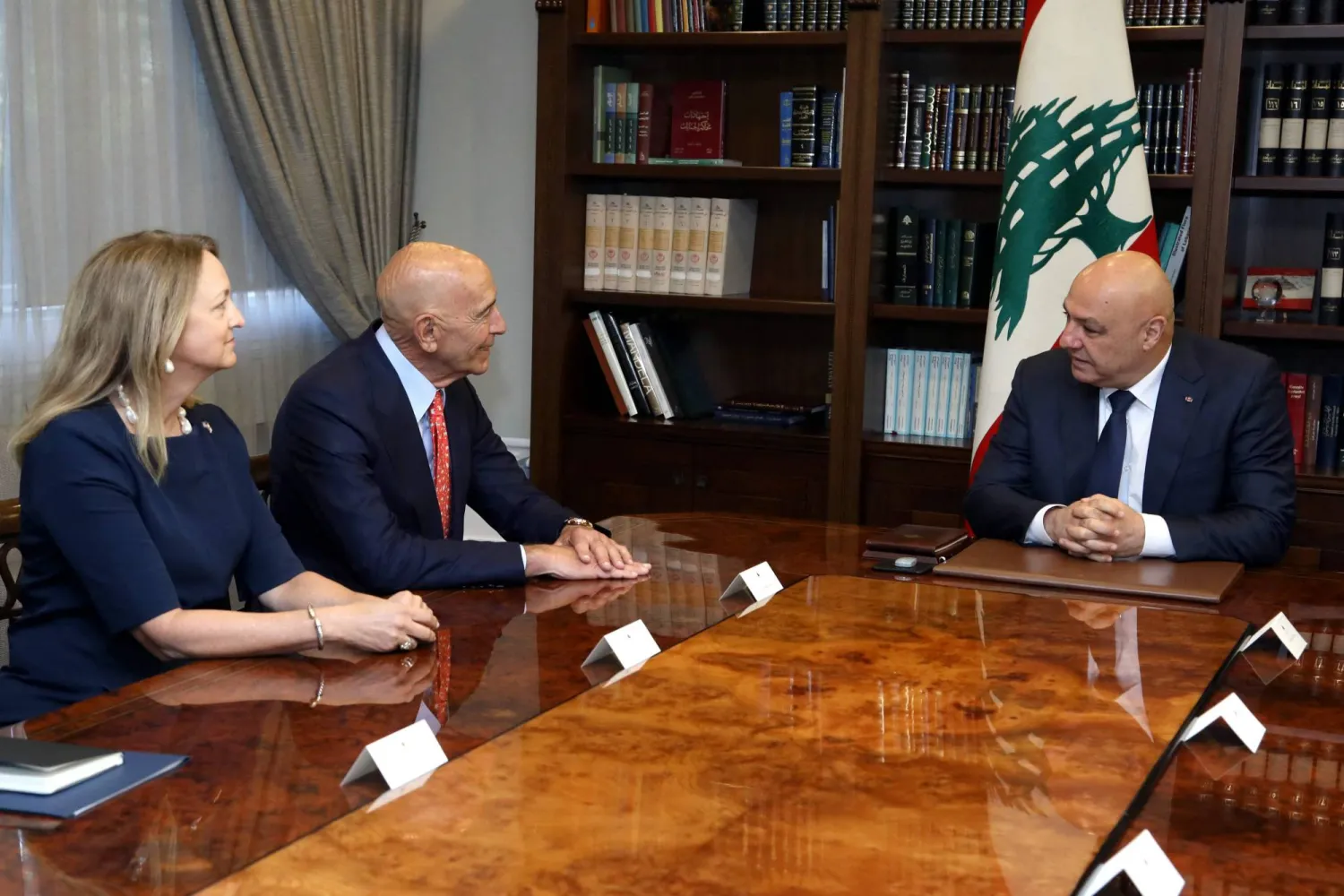
A handout photo released by the Lebanese Presidency press office on June 19, 2025 shows Lebanon's President Joseph Aoun (R) meeting with US negotiator Thomas Barrack at the presidential palace of Baabda east of Beirut. (Photo by Lebanese Presidency / AFP)
TT

Lebanon Awaits Hezbollah Response to US Demands

A handout photo released by the Lebanese Presidency press office on June 19, 2025 shows Lebanon's President Joseph Aoun (R) meeting with US negotiator Thomas Barrack at the presidential palace of Baabda east of Beirut. (Photo by Lebanese Presidency / AFP)

Lebanese officials are racing to draft a unified response to a US proposal that calls for a halt to Israeli attacks and the withdrawal of Israeli forces from Lebanese territory, in exchange for Hezbollah giving up its weapons.

Sources familiar with the discussions told Asharq Al-Awsat that Hezbollah has cautiously opened the door to debating the offer, a subject long considered taboo, though the group has yet to make its position clear.

The sources said Hezbollah is engaged in “difficult internal deliberations,” in parallel with talks held by a committee made up of representatives from President Joseph Aoun, Parliament Speaker Nabih Berri and Prime Minister Nawaf Salam. The committee is reviewing the language of the draft Lebanese response.

Those close to the process say the committee is working to formulate language that aligns with the Lebanese constitution, and that the response will emphasize sequencing and priority-setting for implementing any eventual agreement.

Although Hezbollah has pulled its forces north of the Litani River, the group argues that Israel has not upheld a ceasefire. Its preliminary reaction to the US proposal stressed the need for “credible guarantees” before it can endorse any deal.

Lebanese army officials are said to be preparing a technical document outlining a step-by-step roadmap, detailing what Lebanon can deliver if Israel withdraws, halts its airstrikes, and releases Hezbollah-affiliated detainees.

On the political level, leaders are seeking international guarantees that would enable a phased weapons handover, beginning with heavy weaponry and eventually including medium arms, the sources said.

Two sources told Reuters that Lebanese officials are preparing a formal response to the US proposal, delivered by Thomas Barrack, US Ambassador to Türkİye and Special Envoy for Syria, during a recent visit to Beirut.

The document reportedly lays out a phased disarmament process under which Hezbollah would surrender its weapons across Lebanon in return for a full Israeli pullback from southern areas it currently occupies.

The handover would be completed by November or by the end of the year at the latest, the sources said.

They added that the proposal promises an end to Israeli airstrikes targeting Hezbollah members and would unlock reconstruction funds for areas destroyed by Israeli bombardment last year.

The US has previously stated it would not support Lebanon’s reconstruction unless Hezbollah disarms. According to the sources, the plan also includes a UN-monitored mechanism to ensure Israel releases Hezbollah-linked prisoners.

Barrack is said to have urged Lebanese officials to seize what he described as a “rare opportunity” to resolve the crisis.

A third source told Reuters that Hezbollah has not rejected cooperation with the committee outright and has signaled some willingness to engage — though it has not yet committed to surrendering its weapons.

Calls are growing within Lebanon to enforce UN Security Council Resolution 1701, which mandates a ceasefire and the disarmament of non-state actors in the south.

The Kataeb Party, following its weekly political bureau meeting, reiterated that monopolizing arms must end, calling it a “national priority that cannot be delayed or subject to political maneuvering.”

The party said Hezbollah’s recent statements were provocative and undermined the will of the Lebanese people and the authority of the state.

Lebanese Forces lawmaker Fadi Karam said on Tuesday that Lebanon must prove it is serious in its response to the US proposal aimed at resolving the Hezbollah-Israel standoff, warning that the state can no longer afford delays on the issue of illegal arms.

Speaking in a radio interview, Karam said: “We have to wait and see whether the state is ready to present a serious proposal within clear and short deadlines.”

He added: “It’s clear that officials realize they can no longer ignore this matter or afford the luxury of postponement. We are all being tested today on our ability to resolve the issue of illegal weapons, whether they belong to Lebanese groups or others.”



Paris Meeting Sets Three Priorities to Back Lebanese Army

A convoy of the Spanish battalion of the United Nations Interim Force in Lebanon passes through Qlayaa in southern Lebanon on Oct. 12, 2024 (DPA)
TT

Paris Meeting Sets Three Priorities to Back Lebanese Army

A convoy of the Spanish battalion of the United Nations Interim Force in Lebanon passes through Qlayaa in southern Lebanon on Oct. 12, 2024 (DPA)

Paris will host a four party meeting on Thursday bringing together representatives of France, Saudi Arabia, the United States and Lebanon, amid fears that an Israeli escalation could upend a ceasefire agreement in place for more than a year.

French officials say Paris senses an imminent threat facing Lebanon in light of repeated and public Israeli threats to resume the war.

France is also concerned about uncertainty surrounding the US position on Israel’s intentions, with a prevailing French view that President Donald Trump’s administration is not inclined to restrain Israel.

Israel accuses the Lebanese army of failing to carry out commitments made by the government under the first phase of a plan to disarm Hezbollah in the area south of the Litani River.

Caught between Israeli pressure on one side and Hezbollah’s refusal to hand over its weapons on the other, Paris has been searching for a way out and for a clear, visible means of protecting Lebanon.

French officials want to demonstrate that the Lebanese army, contrary to prevailing claims, is doing what is required of it regarding Hezbollah’s weapons.

A new mechanism to track disarmament

Against this backdrop, France has put forward a proposal to establish a new “mechanism” to clearly document the actions taken by the Lebanese army, based on tangible and verifiable evidence.

Paris has also suggested that elements of the United Nations Interim Force in Lebanon, UNIFIL, accompany army units during inspection and seizure operations, document them and make the results public. The aim is to provide concrete proof of the army’s seriousness and of the outcomes achieved.

French Foreign Minister Jean-Noel Barrot summed up the proposal by saying France is “working on a second mechanism to monitor the disarmament of Hezbollah.”

A large scale tour organized by the army leadership in the south on Dec. 15, led by army commander General Rodolphe Haykal and attended by several ambassadors and military attachés, along with an earlier visit by representatives of UN Security Council member states and a separate tour for Lebanese and international media, were all part of efforts to show the government’s and the army’s commitment to implementing UN Security Council Resolution 1701 and to rebut claims of government foot dragging and military shortcomings.

In recent weeks, Paris has stepped up its engagement on the Lebanese file. Thursday’s meeting caps a diplomatic push that has included, in less than a month, two visits by Anne Claire Legendre, President Emmanuel Macron’s adviser for Middle East and Arab affairs, and Jean-Yves Le Drian, a former foreign minister and Macron’s personal envoy to Lebanon.

As part of this effort, Legendre has made regional visits, most notably to Saudi Arabia.

Macron himself has held a series of key calls focused on two tracks: a conference expected in the coming weeks to support the Lebanese army and security forces, and a separate conference on economic support and reconstruction.

No dates have yet been set for either event.

Importance of Haykal’s participation

Well informed sources in Paris say Thursday’s meeting will focus on three main priorities.

The first is reviewing the work of the “mechanism” tasked with monitoring the cessation of hostilities between Israel and Lebanon, and considering how to enhance it through the new mechanism outlined by Barrot.

Another development concerns the mechanism’s expanded membership, which now includes a Lebanese diplomat, former ambassador Simon Karam, and an Israeli representative, Yuri Resnik, director of foreign policy at Israel’s National Security Council.

Israel and Washington are pressing to broaden the scope of discussions to include economic and political issues, a move that has raised Lebanese concerns and drawn opposition from Hezbollah.

US envoy for Lebanon Morgan Ortagus and Le Drian, both attending the Paris meeting, are expected to travel to Lebanon afterward to take part in a meeting of the mechanism.

That adds to the importance of the five party committee, which has failed, more than a year after its creation, to halt near daily Israeli operations.

The US ambassador to Beirut, Michel Issa, will also attend Thursday’s meeting, his first such gathering since formally taking up his post.

Curbing Israeli escalation in Lebanon is the second priority of the meeting, which Haykal will attend alongside a series of engagements at the foreign ministry, defense ministry and presidential palace.

Haykal’s participation is seen as especially significant, as it will give him the opportunity to present a comprehensive account of the difficulties facing army units in carrying out their missions, foremost among them Israel’s refusal to withdraw from five additional positions it still holds on Lebanese territory.

The Lebanese army commander is also expected to outline the achievements of his forces over the past four months south of the Litani River, as well as his plan for other parts of Lebanon, aimed at restricting weapons to the hands of the Lebanese state.

Attention will also focus on Ortagus’s presentation on US plans for Lebanon, including efforts to push Lebanon toward negotiations with Israel on political and economic issues, as well as the timelines Washington is setting for Lebanon to complete the process of placing weapons exclusively under state control.

The long awaited army support conference

The central theme of Thursday’s Paris meeting, however, is expected to be support for the Lebanese army and security forces as an essential preparatory step that cannot be bypassed ahead of the long promised conference to back the army.

Two key questions remain unanswered: where the conference will be held, whether in Paris or another capital, and when it will take place. It had previously been expected before the end of the year, but that now appears unlikely.

Paris does not hide its concern that confidence in Lebanon has been badly damaged in the past, not only among potential donors in the Gulf but also elsewhere.

As a result, external parties are increasingly insisting on evaluating results and are linking military and economic assistance to concrete outcomes, whether on the security front or in economic reforms.

Another issue that could make its way onto the Paris agenda is the Lebanese Syrian border, which has seen sporadic tensions. Paris believes the border needs to be demarcated to prevent it from being used by Hezbollah as an additional justification for retaining its weapons.

France says it is ready to help both Lebanon and Syria, but stresses the need to rebuild trust between the two. Lebanon wants assurances that Syria will not again become a party that routinely violates its sovereignty, while Damascus fears Hezbollah could play a destabilizing role inside Syria.


Damascus Foils New Weapons Smuggling Attempt into Lebanon

Missiles intended for smuggling found by Syrian forces (Syrian Interior Ministry X Account)
TT

Damascus Foils New Weapons Smuggling Attempt into Lebanon

Missiles intended for smuggling found by Syrian forces (Syrian Interior Ministry X Account)

The new Syrian government is stepping up an aggressive campaign to seal its border with Lebanon, seeking to dismantle smuggling routes that under Bashar al-Assad’s rule served as a critical lifeline for Hezbollah, channeling weapons and money from Iran.

In this context, the Interior Ministry announced on Wednesday that the Internal Security Directorate in the Zabadani area of the Damascus countryside had thwarted an attempt to smuggle a shipment of weapons bound for Lebanon.

The ministry said in a statement published on its Telegram channel that, following close security surveillance of those involved, security forces carried out a tightly planned ambush in the border town of Serghaya, which falls under the Zabadani area, leading to the seizure of the shipment.

It said the cache included large quantities of RPG shells that had been carefully concealed in preparation for smuggling across the border.

The statement said the seized weapons were confiscated in accordance with legal procedures and transferred to the relevant authorities to take the necessary legal action. It added that the operation was part of ongoing efforts by the Interior Ministry to combat smuggling, secure the borders, and protect national security and stability.

Since the overthrow of the Assad regime on Dec. 8 last year, and the near complete end of Iran’s military presence and that of Hezbollah fighters on Syrian territory, the new authorities have sought to tighten control over borders with neighboring countries.

These efforts include pursuing drug smuggling networks, remnants of the Assad regime, and preventing weapons smuggling.

Over the past year since Syria’s liberation, the new authorities have announced the foiling of numerous attempts to smuggle weapons into Lebanon.

Informed sources in the western Qalamoun region along the Lebanese border near the Bekaa said the new Syrian authorities were making sustained efforts to control the border and prevent smuggling in all its forms.

The sources told Asharq Al-Awsat that Syrian authorities currently control most of the border with Lebanon, but said this did not mean all smuggling routes had been sealed.

They noted that Hezbollah, even before the outbreak of the Syrian uprising in 2011 and during years of fighting alongside the Assad regime, built weapons depots and supply tunnels in border areas with the Bekaa, including western Qalamoun, which includes the Zabadani area.

The sources said the new authorities had seized a large number of those depots during their operations, confiscated the weapons inside them, and destroyed supply tunnels.

However, they said most of the depots built by Hezbollah inside Syrian territory were not visible, suggesting that a number of them may not yet have been discovered.

Observers say that following the end of Hezbollah’s presence, and that of Iran, in Syria, the group is attempting through sleeper cells inside Syrian territory to smuggle what remains of its weapons stockpiles from undiscovered depots.

They said this comes amid a decline in Hezbollah’s military capabilities after the war waged against it by Israel last year, and amid reports raising the possibility of a new Israeli war against the group.

In September last year, the head of internal security in the Damascus countryside, Brigadier General Ahmed al-Dalati, said specialized units, in cooperation with the General Intelligence Service, had arrested a Hezbollah cell operating in the towns of Saasaa and Kanaker in western Damascus countryside after close surveillance and intensive fieldwork.

Al-Dalati said initial investigations showed that members of the cell had received training in camps inside Lebanese territory and were planning to carry out operations inside Syria that would threaten the security and stability of citizens.

He said the operation led to the seizure of rocket launch platforms, 19 Grad rockets, anti armor missiles, individual weapons, and large quantities of assorted ammunition.

The case was referred to the competent authorities to pursue legal procedures, while security agencies continued interrogations to uncover all links and objectives, al-Dalati said.

In a separate incident, the Internal Security Directorate in the Qusayr area of the Homs countryside seized a shipment of Kornet missiles on Oct. 11 that was being prepared for smuggling out of the country.

The missiles were being transported on two motorcycles, in the second such operation within two weeks.

The Interior Ministry said at the time that the seizure followed precise intelligence gathering and continuous monitoring of illegal weapons sources, resulting in the full confiscation of the shipment.

It said investigations were ongoing to identify all those involved, determine the sources of the weapons, and take deterrent legal action.

On Nov. 10, Internal Security Command in Homs province arrested a suspect identified as A.S. on charges of trafficking weapons and ammunition, following close field surveillance.

An official statement said the arrest came after precise information was received indicating his involvement in the trade of anti armor missiles and assorted ammunition.

Security sources said units recently discovered a warehouse in the Homs countryside containing light and medium weapons and assorted ammunition. The cache was being used as a supply source for outlawed groups seeking to destabilize the area, according to Sham News Network.

Additional quantities of weapons were also found distributed among villages and towns in western Homs countryside. The weapons were confiscated in accordance with legal regulations after it was determined they had been carefully concealed.

The directorate said the operations fall within the Interior Ministry’s strategy to secure borders and combat smuggling, in a way that supports national security and enhances stability along the border areas with Lebanon.


Lebanese Army Discovers Hezbollah Tunnel in South

Lebanese army members stand on a military vehicle during a Lebanese army media tour, to review the army's operations in the southern Litani sector, in Alma Al-Shaab, near the border with Israel, southern Lebanon, November 28, 2025. (Reuters)
TT

Lebanese Army Discovers Hezbollah Tunnel in South

Lebanese army members stand on a military vehicle during a Lebanese army media tour, to review the army's operations in the southern Litani sector, in Alma Al-Shaab, near the border with Israel, southern Lebanon, November 28, 2025. (Reuters)

The Lebanese army has uncovered a tunnel built by Hezbollah in the southern town of Touline after carrying out an excavation at the request of the ceasefire oversight committee known as the Mechanism, Lebanese media reported. The site had previously been struck by an Israeli attack, according to the reports.

This was not the first time the Lebanese army has inspected sites at the request of the Mechanism or following Israeli threats, as part of coordination between the military, the committee overseeing the cessation of hostilities and the United Nations Interim Force in Lebanon (UNIFIL).

A similar inspection took place last week when the army conducted a thorough search of a building in the southern town of Yanouh after Israel threatened to strike the house.

No weapons were found. After the Lebanese army deployed, the Israeli military announced it had temporarily suspended the strike it had threatened on what it described as Hezbollah military infrastructure in the town.

The developments came as Israeli strikes on southern Lebanon continued, with an air raid on Wednesday hitting the town of Kfar Kila. No casualties were reported, said the state-run National News Agency.

Meanwhile, Deputy Prime Minister Tarek Mitri described the Mechanism as a “platform for discussion and a framework for oversight and verification of compliance with agreements”, stressing that Lebanon has adhered to its commitments since the first day of the 2024 ceasefire, while Israeli violations have continued.

On Hezbollah’s weapons, Mitri said during the opening session of the eighth conference of the Carnegie Middle East Center in Beirut that Lebanese army commander General Rodolphe Haykal had proposed a five-phase plan starting with strengthening the army’s capabilities.

He stressed that extending state authority in the area surrounding the Litani River was making gradual progress, with the army nearing completion of its mission south of the Litani in preparation for moving to later phases.

On reconstruction, Mitri added that the international community was making the extension of state authority a key condition for support. He hoped that Arab states would play a supportive role through their international relations.

The developments come ahead of a new meeting of the Mechanism tasked with monitoring the ceasefire, scheduled for Dec. 19.

It will be the second meeting attended by the head of the Lebanese delegation, Ambassador Simon Karam, after his participation alongside an Israeli civilian in the previous session earlier this month, marking the first direct talks between the two countries.

President Joseph Aoun met Karam on Wednesday and provided him with guidance ahead of the meeting.

The ceasefire monitoring committee includes Lebanon, Israel, France, the United States and the United Nations.

The ceasefire agreement stipulates a halt to hostilities, the withdrawal of Hezbollah north of the Litani River, leading to its disarmament across Lebanon, and the withdrawal of Israeli forces from positions they occupied during the latest war.

Israel, however, maintains a presence at five “strategic” sites inside Lebanese territory, while Hezbollah refuses to disarm.