Lebanon to Seek US Guarantees in Response to Proposal

US envoy to Beirut Tom Barrack in Lebanon last week (Reuters)
TT

Lebanon to Seek US Guarantees in Response to Proposal

US envoy to Beirut Tom Barrack in Lebanon last week (Reuters)

Lebanon plans to seek assurances from Washington on the implementation of any future deal involving Hezbollah’s disarmament, Lebanese political sources told Asharq Al-Awsat, ahead of a visit by US envoy to Beirut Tom Barrack early next week.

The question of US guarantees tops Lebanon’s concerns, which are shared not only by Hezbollah but also by the Lebanese state, the sources said.

The issue is central to the discussions of a tripartite Lebanese committee that includes representatives of President Joseph Aoun, Parliament Speaker Nabih Berri, Prime Minister Nawaf Salam, meeting regularly at the presidential palace to draft a unified response to a US proposal.

In parallel, the Quintet group - comprising the US, France, Saudi Arabia, Egypt, and Qatar - met at the US embassy in Beirut to discuss the situation, local media reported.

Saudi Ambassador Walid Bukhari was absent from the talks, reportedly due to travel.

According to the sources, Barrack’s visit is not solely to receive Lebanon’s response to the US proposal, but also to hold further consultations with the country’s top leaders.

The US paper outlines a phased plan prioritizing the disarmament of Hezbollah, delineation of Lebanon’s land border with Syria, and the implementation of long-delayed financial, economic, and administrative reforms.

“Lebanon views the proposal as the basis for negotiations, not a surrender document,” the sources said, noting that the primary demand to be raised will be related to binding US guarantees.

They cited the bitter experience that followed the previous ceasefire deal, after which Israel allegedly continued attacks, held on to five disputed points in southern Lebanon, and hindered the return of displaced residents—all while international aid for reconstruction failed to materialize.

“The committee is meeting almost daily,” one source said. “There is consensus on the need for an Israeli withdrawal from occupied points and an end to violations as a prerequisite for any deal. These are sovereign principles Lebanon will not abandon.”

Despite Hezbollah’s public resistance to disarmament, sources described the group’s current stance as “constructive.”

Hezbollah is said to be engaging in discussions through the state’s official channels, with party officials expressing concern over the absence of international guarantees and the risk of being sidelined politically once it gives up its arms.

“There are internal concerns that Hezbollah could be pushed out of political life, especially after talks around electoral law reforms,” one source said.

These fears are compounded by delays in international aid, reconstruction plans, and continued Israeli violations—issues that have persisted since the ceasefire in November.

On Wednesday night, Hezbollah Secretary-General Naim Qassem reiterated the party’s rejection of “any threat of force or foreign meddling,” and insisted that Hezbollah would not “surrender land or weapons to the Israeli enemy” or compromise on its rights.

Qassem also accused Israel of violating the ceasefire more than 3,700 times, while the international community “watches silently, calling only for concessions.” He said Hezbollah would continue to resist, as it has done for decades.

A senior Hezbollah lawmaker said the group remains open to cooperating on strengthening the Lebanese state and restoring its authority across the country—provided Israel withdraws from disputed southern points and halts its ongoing violations.

MP Ali Fayyad, a member of Hezbollah’s parliamentary bloc, said the group “has consistently shown a positive willingness to cooperate in all matters related to state-building, institutional reform, and improving operational capacities to help achieve the desired stability.”

Speaking on Thursday, Fayyad added: “This includes supporting the state in extending its authority over all Lebanese territory and enabling it to carry out all its duties—chief among them the protection and defense of the people and sovereignty.” However, he warned, “None of this will be possible unless national efforts unite to achieve a key condition: Israel must withdraw from the five occupied positions it still holds, end its continued violations, and respect Lebanese sovereignty.”

Fayyad’s comments came amid a broader debate on the future of Hezbollah’s weapons and its role within the state.

Opposition lawmaker Fadi Karam from the Lebanese Forces party slammed Hezbollah’s rhetoric in a post on X.

Addressing Hezbollah’s Qassem, he wrote: “Your weapons have destroyed Lebanon and continue to give Israel an excuse to remain on our land. You’ve tied Lebanon to Iran. And now you claim that handing over your weapons to the Lebanese Army means handing them to Israel? That’s delusional and only exposes Lebanon to new wars.”

The statements reflect widening divisions over Hezbollah’s future role and the path toward national sovereignty and stability, as Lebanon grapples with US-led proposals aimed at de-escalating tensions and launching long-delayed reforms.


US Army Names 2 Iowa Guard Members Killed in Attack in Syria

 This undated combo photo created with images released by the Iowa National Guard shows Sgts. William Nathaniel Howard, left, and Edgar Brian Torres-Tovar. (Iowa National Guard via AP)
This undated combo photo created with images released by the Iowa National Guard shows Sgts. William Nathaniel Howard, left, and Edgar Brian Torres-Tovar. (Iowa National Guard via AP)
TT

US Army Names 2 Iowa Guard Members Killed in Attack in Syria

 This undated combo photo created with images released by the Iowa National Guard shows Sgts. William Nathaniel Howard, left, and Edgar Brian Torres-Tovar. (Iowa National Guard via AP)
This undated combo photo created with images released by the Iowa National Guard shows Sgts. William Nathaniel Howard, left, and Edgar Brian Torres-Tovar. (Iowa National Guard via AP)

The two Iowa National Guard members killed in a weekend attack that the US military blamed on the ISIS group in Syria were identified Monday.

The US Army named them as Sgt. Edgar Brian Torres-Tovar, 25, of Des Moines, and Sgt. William Nathaniel Howard, 29, of Marshalltown.

Iowa Gov. Kim Reynolds ordered all flags in Iowa to fly at half-staff in their honor, saying that, “We are grateful for their service and deeply mourn their loss.”

The Pentagon’s chief spokesman, Sean Parnell, has said a civilian working as a US interpreter also was killed. Three other Guard members were wounded in the attack, the Iowa National Guard said Monday, with two of them in stable condition and the other in good condition.

The attack was a major test for the rapprochement between the United States and Syria since the ouster of autocratic leader Bashar al-Assad a year ago, coming as the US military is expanding its cooperation with Syrian security forces. Hundreds of American troops are deployed in eastern Syria as part of a coalition fighting ISIS.

The shooting Saturday in the Syrian desert near the historic city of Palmyra also wounded members of the country's security forces and killed the gunman. The assailant had joined Syria’s internal security forces as a base security guard two months ago and recently was reassigned amid suspicions that he might be affiliated with ISIS, a Syrian official said.

The man stormed a meeting between US and Syrian security officials who were having lunch together and opened fire after clashing with Syrian guards, Interior Ministry spokesperson Noureddine al-Baba said Sunday.

Al-Baba acknowledged that the incident was “a major security breach” but said that in the year since Assad’s fall, “there have been many more successes than failures” by security forces.

The Army said Monday that the incident is under investigation, but military officials have blamed the attack on an ISIS member.

President Donald Trump said over the weekend that “there will be very serious retaliation” for the attack and that Syrian President Ahmed al-Sharaa was “devastated by what happened,” stressing that Syria was fighting alongside US troops.

Trump welcomed Sharaa, who led the lightning opposition offensive that toppled Assad's rule, to the White House for a historic meeting last month.


Western and Arab Diplomats Tour Lebanon-Israel Border to Observe Hezbollah Disarmament Efforts

 UN vehicles drive past buildings destroyed by Israel's air and ground offensive against Hezbollah in southern Lebanon, as seen from Israel's northernmost town of Metula, Sunday, Nov. 30, 2025. (AP)
UN vehicles drive past buildings destroyed by Israel's air and ground offensive against Hezbollah in southern Lebanon, as seen from Israel's northernmost town of Metula, Sunday, Nov. 30, 2025. (AP)
TT

Western and Arab Diplomats Tour Lebanon-Israel Border to Observe Hezbollah Disarmament Efforts

 UN vehicles drive past buildings destroyed by Israel's air and ground offensive against Hezbollah in southern Lebanon, as seen from Israel's northernmost town of Metula, Sunday, Nov. 30, 2025. (AP)
UN vehicles drive past buildings destroyed by Israel's air and ground offensive against Hezbollah in southern Lebanon, as seen from Israel's northernmost town of Metula, Sunday, Nov. 30, 2025. (AP)

Western and Arab diplomats toured an area along Lebanon’s border with Israel Monday where Lebanese troops and UN peacekeepers have been working for months to end the armed presence of the militant Hezbollah group.

The delegation that included the ambassadors of the United States and Saudi Arabia was accompanied by Gen. Rodolphe Haykal, commander of the Lebanese Armed Forces, as well as top officers in the border region.

The Lebanese government has said that by the end of the year, the army should have cleared all the border area south of the Litani river from Hezbollah’s armed presence.

Hezbollah’s leader Sheik Naim Qassem had said that the group will end its military presence south of the Litani River but vowed again over the weekend that they will keep their weapons in other parts of Lebanon.

Parts of the zone south of the Litani River and north of the border with Israel were formerly a Hezbollah stronghold, off limits to the Lebanese national army and UN peacekeepers deployed in the area.

During the tour, the diplomats and military attaches were taken to an army post that overlooks one of five hills inside Lebanon that were captured by Israeli troops last year.

“The main goal of the military is to guarantee stability,” an army statement quoted Haikal as telling the diplomats. Haykal added that the tour aims to show that the Lebanese army is committed to the ceasefire agreement that ended the Israel-Hezbollah war last year.

There were no comments from the diplomats.

The latest Israel-Hezbollah war began Oct. 8, 2023, a day after Hamas attacked southern Israel, after Hezbollah fired rockets into Israel in solidarity with Hamas. Israel launched a widespread bombardment of Lebanon in September last year that severely weakened Hezbollah, followed by a ground invasion.

The war ended in November 2024 with a ceasefire brokered by the US.

Israel has carried out almost daily airstrikes since then, mainly targeting Hezbollah members but also killing 127 civilians, according to the office of the UN High Commissioner for Human Rights.

On Sunday, the Israeli military said it killed three Hezbollah members in strikes on southern Lebanon.

Over the past weeks, the US has increased pressure on Lebanon to work harder on disarming Hezbollah and canceled a planned trip to Washington last month by Haykal.

US officials were angered in November by a Lebanese army statement that blamed Israel for destabilizing Lebanon and blocking the Lebanese military deployment in south Lebanon.

A senior Lebanese army official told The Associated Press Monday that Haykal will fly to France this week where he will attend a meeting with US, French and Saudi officials to discuss ways of assisting the army in its mission. The officer spoke on condition of anonymity because he wasn’t authorized to speak publicly.

The Lebanese army has been severely affected by the economic meltdown that broke out in Lebanon in October 2019.


ICC Rejects Israeli Bid to Halt Gaza War Investigation

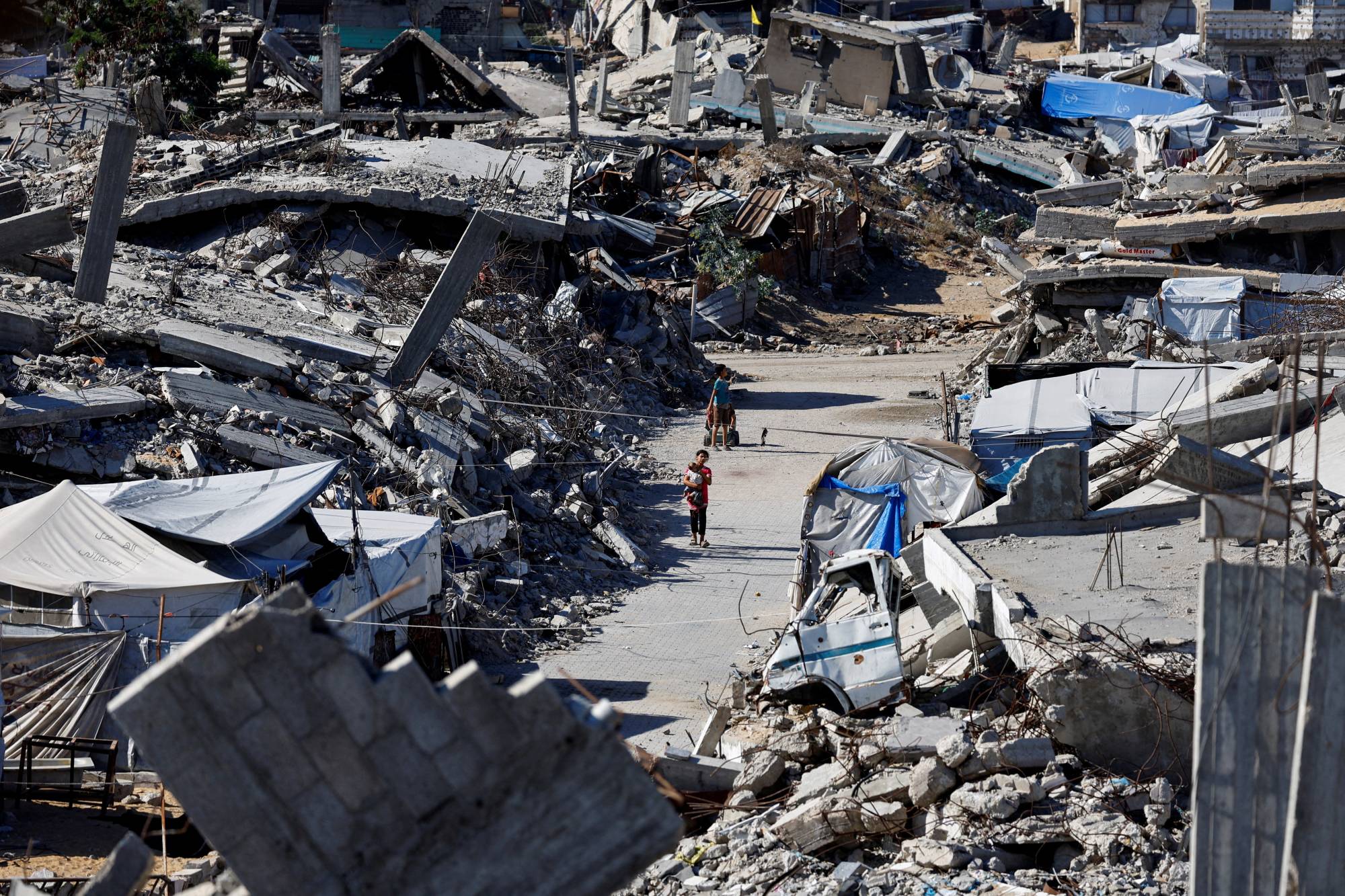
Tents of internally displaced Palestinian families seen among the ruins of destroyed buildings in Al-Zaitun neighborhood during a rainy day in the east of Gaza City on, 12 December 2025, amid a ceasefire between Israel and Hamas. (EPA)
TT

ICC Rejects Israeli Bid to Halt Gaza War Investigation

Tents of internally displaced Palestinian families seen among the ruins of destroyed buildings in Al-Zaitun neighborhood during a rainy day in the east of Gaza City on, 12 December 2025, amid a ceasefire between Israel and Hamas. (EPA)

Appeals judges at the International Criminal Court (ICC) on Monday rejected one in a series of legal challenges brought by Israel against the court's probe into its conduct of the Gaza war.

On appeal, judges refused to overturn a lower court decision that the prosecution's investigation into alleged crimes under its jurisdiction could include events following the deadly attack on Israel by the Palestinian group Hamas on October 7, 2023.

The ruling means the investigation continues and the arrest warrants issued last year for Israeli Prime Minister Benjamin Netanyahu and his former defense chief Yoav Gallant remain in place.

Israel rejects the jurisdiction of the Hague-based court and denies war crimes in Gaza, where it has waged a military campaign it says is aimed at eliminating Hamas following the October 7 attacks.

The ICC initially also issued a warrant for Hamas leader Ibrahim al-Masri for alleged war crimes and crimes against humanity, but withdrew that later following credible reports of his death.

A ceasefire agreement in the conflict took effect on October 10, but the war destroyed much of Gaza’s infrastructure, and living conditions are dire.

According to Gaza health officials, whose data is frequently cited with confidence by the United Nations, some 67,000 Palestinians have been killed by Israel in Gaza.

This ruling focuses on only one of several Israeli legal challenges against the ICC investigations and the arrest warrants for its officials. There is no timeline for the court to rule on the various other challenges to its jurisdiction in this case.