


Netanyahu Meets Trump at White House as Israel, Hamas Discuss Ceasefire

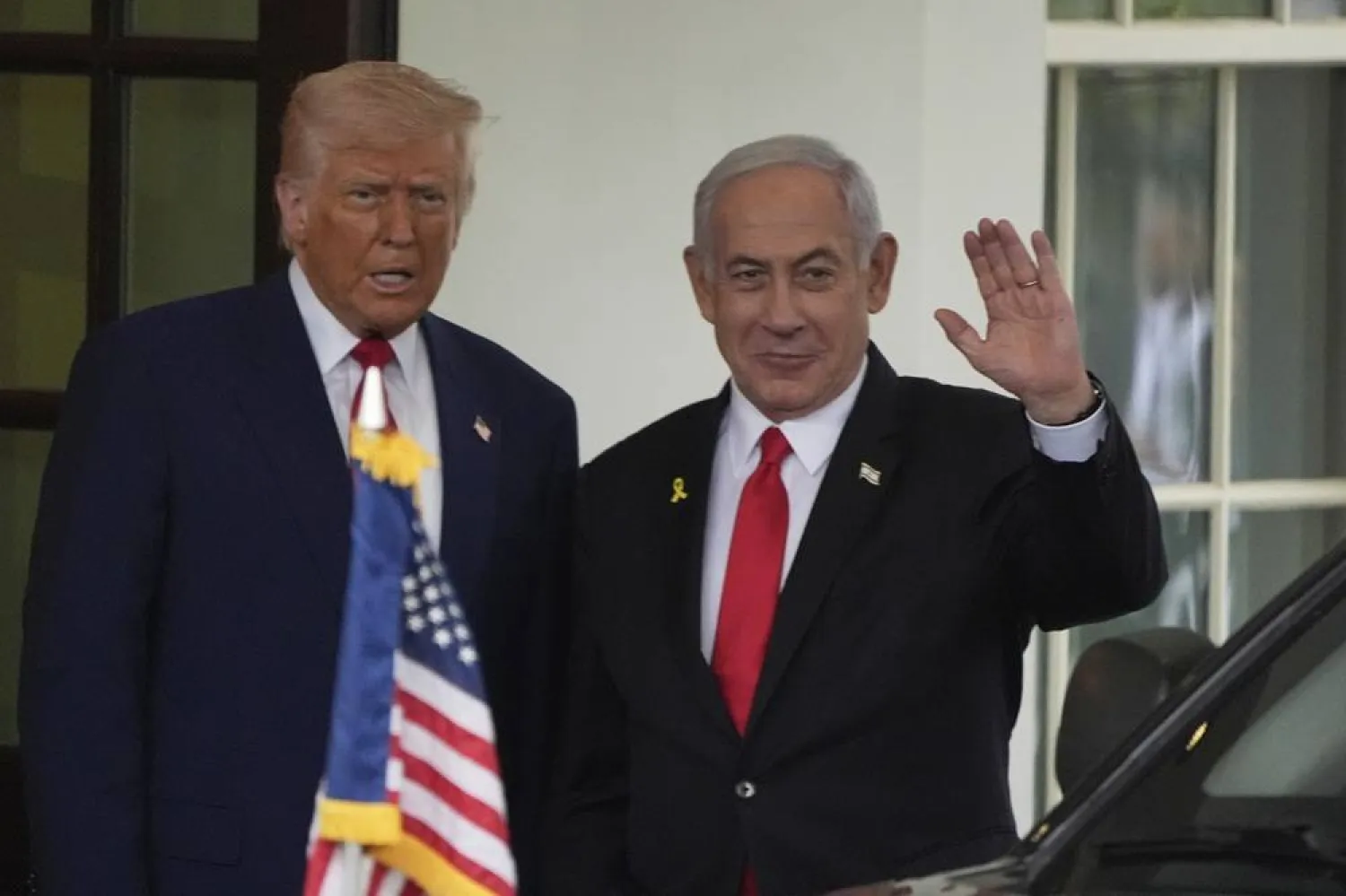
Israel's Prime Minister Benjamin Netanyahu, right, is greeted by President Donald Trump as he arrives at the West Wing of the White House in Washington, April 7, 2025, in Washington. (AP)
TT

Netanyahu Meets Trump at White House as Israel, Hamas Discuss Ceasefire

Israel's Prime Minister Benjamin Netanyahu, right, is greeted by President Donald Trump as he arrives at the West Wing of the White House in Washington, April 7, 2025, in Washington. (AP)

President Donald Trump hosted Israeli Prime Minister Benjamin Netanyahu for White House talks on Monday, while Israeli officials held indirect negotiations with Hamas aimed at securing a US-brokered Gaza ceasefire and hostage-release deal.

Netanyahu's visit follows Trump's prediction, on the eve of their meeting, that such an agreement could be reached this week. Before heading to Washington, the right-wing Israeli leader said his discussions with Trump could help advance negotiations under way in Qatar between Israel and the Palestinian group.

It was Trump's third face-to-face encounter with Netanyahu since returning to office in January, and came just over two weeks after the president ordered the bombing of Iranian nuclear sites in support of Israeli air strikes. Trump then helped arrange a ceasefire in the 12-day Israel-Iran war.

Trump and his aides appeared to be trying to seize on any momentum created by the weakening of Iran, which backs Hamas, to push both sides for a breakthrough in the 21-month Gaza war.

He said he also wants to discuss with Netanyahu the prospects for a "permanent deal" with Iran, Israel's regional arch-foe.

The two leaders were scheduled to have a private dinner instead of formal talks in the Oval Office, where the president usually greets visiting dignitaries. It was not immediately clear why Trump was taking a lower-key approach with Netanyahu this time.

After arriving overnight in Washington, Netanyahu met earlier on Monday with Trump’s Middle East special envoy Steve Witkoff and Secretary of State Marco Rubio in preparation for his talks with the president. He planned to visit the US Capitol on Tuesday to see congressional leaders.

Ahead of the visit, Netanyahu told reporters he would thank Trump for the US air strikes on Iranian nuclear sites, and said Israeli negotiators were driving for a deal on Gaza in Doha, Qatar's capital.

Israeli officials also hope the outcome of the conflict with Iran will pave the way for normalization of relations with more of its neighbors such as Lebanon and Syria, another issue expected to be on the agenda with Trump.

SECOND DAY OF QATAR TALKS

Witkoff, who played a major role in crafting the 60-day ceasefire proposal at the center of the Qatar negotiations, will travel to Doha this week to join discussions there, White House press secretary Karoline Leavitt told reporters on Monday.

In a sign of continued gaps between the two sides, Palestinian sources said Israel's refusal to allow the free and safe entry of humanitarian aid into Gaza remains the main obstacle to progress in the indirect talks. Israel insists it is taking steps to get food into Gaza but seeks to prevent Hamas from diverting supplies.

On the second day of negotiations, mediators hosted one round and talks were expected to resume in the evening, the Palestinian sources told Reuters.

The US-backed proposal envisages a phased release of hostages, Israeli troop withdrawals from parts of Gaza and discussions on ending the war entirely.

Hamas has long demanded a final end to the war before it would free remaining hostages; Israel has insisted it would not agree to halt fighting until all hostages are released and Hamas dismantled.

Trump told reporters last week that he would be “very firm” with Netanyahu on the need for a speedy Gaza deal and that the Israeli leader also wanted to end the war.

Some of Netanyahu's hardline coalition partners oppose halting military operations but, with Israelis having become increasingly weary of the Gaza war, his government is expected to back a ceasefire if he can secure acceptable terms.

A ceasefire at the start of this year collapsed in March, and talks to revive it have so far been fruitless. Meanwhile, Israel has intensified its military campaign in Gaza and sharply restricted food distribution.

Gazans were watching closely for any sign of a breakthrough. “I ask God almighty that the negotiating delegation or the mediators pressure with all their strength to solve this issue, because it has totally became unbearable,” said Abu Suleiman Qadoum, a displaced resident of Gaza city.

The Gaza war erupted when Hamas attacked southern Israel in October 2023, killing around 1,200 people and taking 251 hostages. Some 50 hostages remain in Gaza, with 20 believed to be alive.

Israel's retaliatory war in Gaza has killed over 57,000 Palestinians, according to the enclave's health ministry. Most of Gaza's population has been displaced by the war and nearly half a million people are facing famine within months, according to United Nations estimates.

Trump has been strongly supportive of Netanyahu, even wading into domestic Israeli politics last month by lashing out at prosecutors over a corruption trial against the Israeli leader on bribery, fraud and breach-of-trust charges that Netanyahu denies.



Al-Sharaa: Israel’s Push for a Buffer Zone in Southern Syria Puts the Region at Risk

Syrian President Ahmad al-Sharaa speaks during the 23rd annual Doha Forum (Reuters). 
TT

Al-Sharaa: Israel’s Push for a Buffer Zone in Southern Syria Puts the Region at Risk

Syrian President Ahmad al-Sharaa speaks during the 23rd annual Doha Forum (Reuters). 

Syrian President Ahmad al-Sharaa warned on Saturday that Israel’s effort to establish a demilitarized buffer zone in southern Syria risks pushing the country into a “dangerous place.”

Speaking on the sidelines of the Doha Forum, al-Sharaa said US-mediated negotiations with Israel remain underway to address the “security concerns” of both sides.

Following the ouster of Bashar al-Assad on Dec. 8, Israel has carried out hundreds of airstrikes on Syrian military positions, saying its goal is to prevent the new authorities from seizing the former army’s weapons arsenal.

Over the past year, Israel has repeatedly publicized ground operations and arrests of individuals it accuses of “terrorist” activity in southern Syria. Israeli forces have also entered the Golan Heights disengagement zone established under the 1974 cease-fire agreement.

Al-Sharaa said all major international actors back Syria “in its demand that Israel withdraw and reposition to the lines of Dec. 8.” He emphasized that Damascus insists on full respect for the 1974 accord, describing it as a durable, internationally supported agreement.

“Tampering with this agreement, while proposing alternatives such as a new buffer zone, could drive us into dangerous territory,” he said.

Al-Sharaa accused Israel of “fighting ghosts” and “searching for enemies” in the wake of the Gaza war, adding that since assuming office a year ago he has sent “positive messages about peace and regional stability.”

Thirteen people were killed in late November during an Israeli incursion into the southern town of Beit Jin, a raid Damascus denounced as a “war crime.” Israel said the operation targeted suspects linked to the ISIS group.

Though Syria and Israel maintain no diplomatic relations and remain technically at war, several US-brokered ministerial meetings have been held in recent months.

“Negotiations are ongoing, and the United States is fully engaged,” al-Sharaa said, noting broad international support for addressing “legitimate security concerns so both sides can feel secure.”

He asked: “Syria is the one under attack, so who should be demanding a buffer zone and withdrawal?”

In September, al-Sharaa warned in New York of the risk of renewed Middle East instability if Damascus and Tel Aviv fail to reach a security arrangement, accusing Israel of “delaying negotiations and continuing to violate our airspace and territory.”

Israeli Prime Minister Benjamin Netanyahu visited Israeli forces deployed in the buffer zone outside the occupied Golan Heights in November, a move Damascus condemned as “illegitimate.”

Domestically, al-Sharaa said all segments of Syrian society are now represented in government “on the basis of competence, not sectarian quotas.” Syria, he said, is charting a “new path” for post-conflict governance. He acknowledged the country inherited “deep problems” from the former regime and said investigative bodies are working to address alleged crimes in the coastal region and Sweida.

He stressed that Syria is “a state of law, not a collection of sects,” and that accountability and institutional reform are essential to rebuilding the state.

The Syrian president added that economic revitalization is crucial for lasting stability, which is why Damascus continues to argue for the lifting of the Caesar Act sanctions.


Arab Parliament Backs UNRWA Mandate Renewal, Reaffirms Support for Palestinian Rights

Arab Parliament Backs UNRWA Mandate Renewal, Reaffirms Support for Palestinian Rights
TT

Arab Parliament Backs UNRWA Mandate Renewal, Reaffirms Support for Palestinian Rights

Arab Parliament Backs UNRWA Mandate Renewal, Reaffirms Support for Palestinian Rights

Speaker of the Arab Parliament Mohamed Alyammahi welcomed the UN General Assembly’s decision to renew the mandate of the United Nations Relief and Works Agency for Palestine Refugees in the Near East (UNRWA) for another three years, saying the vote reflects broad international support for Palestinian rights and a clear rejection of efforts to undermine their cause.

Alyammahi stressed that the mandate’s renewal is particularly critical amid the continued aggression and blockade facing Palestinians, ensuring the agency can maintain its essential services. He noted the strong backing for related resolutions calling for an end to the occupation and the establishment of an independent Palestinian state with Jerusalem as its capital.

The speaker urged leveraging this growing international consensus to halt the assault on Gaza, facilitate the entry of humanitarian aid, intensify legal and diplomatic action against the occupation, and advance a credible political process that can help ease the suffering of the Palestinian people.


Israeli Soldiers Kill 55-Year-Old Palestinian and Teenager in West Bank

28 November 2025, Palestinian Territories, Hebron: Israeli forces block Palestinian farmers trying to access to their agricultural fields in the town of Tarqumiyah. (dpa)
TT

Israeli Soldiers Kill 55-Year-Old Palestinian and Teenager in West Bank

28 November 2025, Palestinian Territories, Hebron: Israeli forces block Palestinian farmers trying to access to their agricultural fields in the town of Tarqumiyah. (dpa)

Israeli soldiers killed a Palestinian teenager who was driving a car towards them as well as a Palestinian bystander in the West Bank on Saturday, according to an Israeli security official.

The military said that an "uninvolved person" was hit in addition to the driver of the car who had "accelerated" towards soldiers at a checkpoint in West Bank city of Hebron.

In an earlier statement, the military said two "terrorists" were killed, before later clarifying that only one person was involved.

An Israeli security official, speaking on condition of anonymity, said a 17-year-old was driving the car and a 55-year-old was the bystander.

Palestinian state news agency WAFA reported that 55-year-old Ziad Naim Abu Dawood, a municipal street cleaner, was killed while working. It said another Palestinian was killed but did not report the circumstances that led the soldiers to open fire.

The Palestinian health ministry identified the second Palestinian as 17-year-old Ahmed Khalil Al-Rajabi.

The military did not report any injuries to the soldiers.

The motive for the 17-year-old's actions was not immediately clear, and no armed group claimed responsibility.

Since January, 51 Palestinian minors, aged under 18, have been killed in the West Bank by Israeli forces, according to the Palestinian health ministry.

Violence has surged this year in the Israeli-occupied West Bank. Israeli settler attacks on Palestinians have risen sharply, while the military has tightened movement restrictions and carried out sweeping raids in several cities.

Palestinians have also carried out attacks on Israeli soldiers and civilians, some of them deadly.