


Netanyahu Meets Trump at White House as Israel, Hamas Discuss Ceasefire

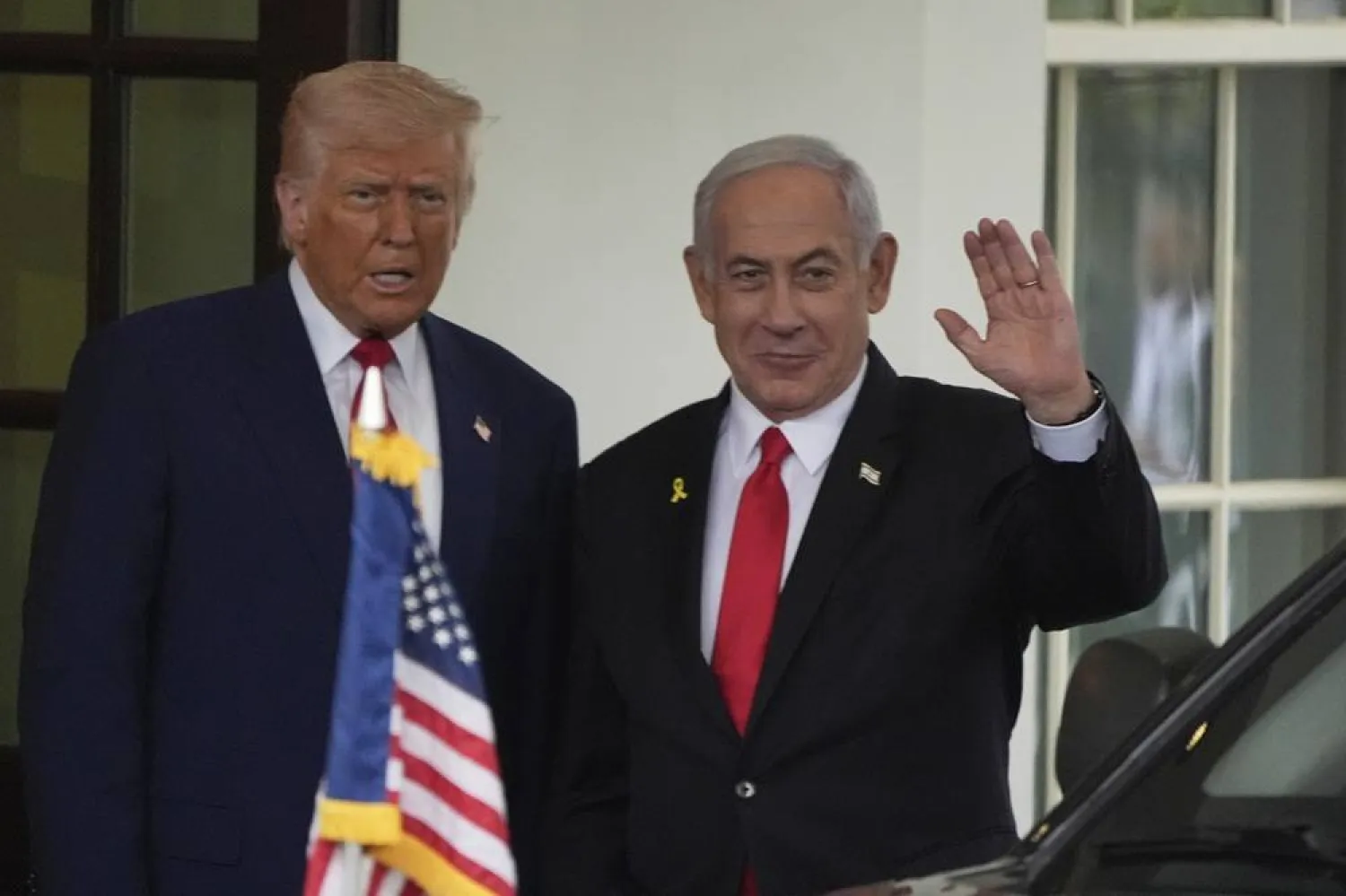
Israel's Prime Minister Benjamin Netanyahu, right, is greeted by President Donald Trump as he arrives at the West Wing of the White House in Washington, April 7, 2025, in Washington. (AP)
TT

Netanyahu Meets Trump at White House as Israel, Hamas Discuss Ceasefire

Israel's Prime Minister Benjamin Netanyahu, right, is greeted by President Donald Trump as he arrives at the West Wing of the White House in Washington, April 7, 2025, in Washington. (AP)

President Donald Trump hosted Israeli Prime Minister Benjamin Netanyahu for White House talks on Monday, while Israeli officials held indirect negotiations with Hamas aimed at securing a US-brokered Gaza ceasefire and hostage-release deal.

Netanyahu's visit follows Trump's prediction, on the eve of their meeting, that such an agreement could be reached this week. Before heading to Washington, the right-wing Israeli leader said his discussions with Trump could help advance negotiations under way in Qatar between Israel and the Palestinian group.

It was Trump's third face-to-face encounter with Netanyahu since returning to office in January, and came just over two weeks after the president ordered the bombing of Iranian nuclear sites in support of Israeli air strikes. Trump then helped arrange a ceasefire in the 12-day Israel-Iran war.

Trump and his aides appeared to be trying to seize on any momentum created by the weakening of Iran, which backs Hamas, to push both sides for a breakthrough in the 21-month Gaza war.

He said he also wants to discuss with Netanyahu the prospects for a "permanent deal" with Iran, Israel's regional arch-foe.

The two leaders were scheduled to have a private dinner instead of formal talks in the Oval Office, where the president usually greets visiting dignitaries. It was not immediately clear why Trump was taking a lower-key approach with Netanyahu this time.

After arriving overnight in Washington, Netanyahu met earlier on Monday with Trump’s Middle East special envoy Steve Witkoff and Secretary of State Marco Rubio in preparation for his talks with the president. He planned to visit the US Capitol on Tuesday to see congressional leaders.

Ahead of the visit, Netanyahu told reporters he would thank Trump for the US air strikes on Iranian nuclear sites, and said Israeli negotiators were driving for a deal on Gaza in Doha, Qatar's capital.

Israeli officials also hope the outcome of the conflict with Iran will pave the way for normalization of relations with more of its neighbors such as Lebanon and Syria, another issue expected to be on the agenda with Trump.

SECOND DAY OF QATAR TALKS

Witkoff, who played a major role in crafting the 60-day ceasefire proposal at the center of the Qatar negotiations, will travel to Doha this week to join discussions there, White House press secretary Karoline Leavitt told reporters on Monday.

In a sign of continued gaps between the two sides, Palestinian sources said Israel's refusal to allow the free and safe entry of humanitarian aid into Gaza remains the main obstacle to progress in the indirect talks. Israel insists it is taking steps to get food into Gaza but seeks to prevent Hamas from diverting supplies.

On the second day of negotiations, mediators hosted one round and talks were expected to resume in the evening, the Palestinian sources told Reuters.

The US-backed proposal envisages a phased release of hostages, Israeli troop withdrawals from parts of Gaza and discussions on ending the war entirely.

Hamas has long demanded a final end to the war before it would free remaining hostages; Israel has insisted it would not agree to halt fighting until all hostages are released and Hamas dismantled.

Trump told reporters last week that he would be “very firm” with Netanyahu on the need for a speedy Gaza deal and that the Israeli leader also wanted to end the war.

Some of Netanyahu's hardline coalition partners oppose halting military operations but, with Israelis having become increasingly weary of the Gaza war, his government is expected to back a ceasefire if he can secure acceptable terms.

A ceasefire at the start of this year collapsed in March, and talks to revive it have so far been fruitless. Meanwhile, Israel has intensified its military campaign in Gaza and sharply restricted food distribution.

Gazans were watching closely for any sign of a breakthrough. “I ask God almighty that the negotiating delegation or the mediators pressure with all their strength to solve this issue, because it has totally became unbearable,” said Abu Suleiman Qadoum, a displaced resident of Gaza city.

The Gaza war erupted when Hamas attacked southern Israel in October 2023, killing around 1,200 people and taking 251 hostages. Some 50 hostages remain in Gaza, with 20 believed to be alive.

Israel's retaliatory war in Gaza has killed over 57,000 Palestinians, according to the enclave's health ministry. Most of Gaza's population has been displaced by the war and nearly half a million people are facing famine within months, according to United Nations estimates.

Trump has been strongly supportive of Netanyahu, even wading into domestic Israeli politics last month by lashing out at prosecutors over a corruption trial against the Israeli leader on bribery, fraud and breach-of-trust charges that Netanyahu denies.



How Gaza Armed Gangs Recruit New Members

Security personnel guard trucks carrying aid as they arrive in Rafah, amid the ongoing conflict between Israel and the Palestinian Islamist group Hamas, in the southern Gaza Strip January 17, 2024. (Reuters)
TT

How Gaza Armed Gangs Recruit New Members

Security personnel guard trucks carrying aid as they arrive in Rafah, amid the ongoing conflict between Israel and the Palestinian Islamist group Hamas, in the southern Gaza Strip January 17, 2024. (Reuters)

As Hamas moves to strike armed gangs operating in areas of the Gaza Strip under Israeli army control, the groups are responding with defiance, stepping up efforts to recruit young men and expand their ranks.

Videos posted on social media show training exercises and other activities, signaling that the gangs remain active despite pressure from Hamas security services.

Platforms affiliated with Hamas security say some members have recently turned themselves in following mediation by families, clans and community leaders. The gangs have not responded to those statements. Instead, they occasionally broadcast footage announcing new recruits.

Among the most prominent was Hamza Mahra, a Hamas activist who appeared weeks ago in a video released by the Shawqi Abu Nasira gang, which operates north of Khan Younis and east of Deir al-Balah.

Mahra’s appearance has raised questions about how these groups recruit members inside the enclave.

Field sources and others within the security apparatus of a Palestinian armed faction in Gaza told Asharq Al-Awsat that Mahra’s case may be an exception. They described him as a Hamas activist with no major role, despite his grandfather being among the founders of Hamas in Jabalia.

His decision to join the gang was driven by personal reasons linked to a family dispute, they said, not by organizational considerations.

The sources said the gangs exploit severe economic hardship, luring some young men with money, cigarettes and other incentives. Some recruits were heavily indebted and fled to gang-controlled areas to avoid repaying creditors.

Others joined in search of narcotic pills, the sources said, noting that some had previously been detained by Hamas-run security forces on similar charges. Economic hardship and the need for cigarettes and drugs were among the main drivers of recruitment, they added, saying the gangs, with Israeli backing, provide such supplies.

Resentment toward Hamas has also played a role, particularly among those previously arrested on criminal or security grounds and subjected to what the sources described as limited torture during interrogations under established procedures.

According to the sources, some founders or current leaders of the gangs previously served in the Palestinian Authority security services.

They cited Shawqi Abu Nasira, a senior police officer; Hussam al-Astal, an officer in the Preventive Security Service; and Rami Helles and Ashraf al-Mansi, both former officers in the Palestinian Presidential Guard.

These figures, the sources said, approach young men in need and at times succeed in recruiting them by promising help in settling debts and providing cigarettes. They also tell recruits that joining will secure them a future role in security forces that would later govern Gaza.

The sources described the case of a young man who surrendered to Gaza security services last week. He said he had been pressured after a phone call with a woman who threatened to publish the recording unless he joined one of the gangs.

He later received assurances from another contact that he would help repay some of his debts and ultimately agreed to enlist.

During questioning, he said the leader of the gang he joined east of Gaza City repeatedly assured recruits they would be “part of the structure of any Palestinian security force that will rule the sector.”

The young man told investigators he was unconvinced by those assurances, as were dozens of others in the same group.

Investigations of several individuals who surrendered, along with field data, indicate the gangs have carried out armed missions on behalf of the Israeli army, including locating tunnels. That has led to ambushes by Palestinian factions.

In the past week, clashes in the Zaytoun neighborhood south of Gaza City and near al-Masdar east of Deir al-Balah left gang members dead and wounded.

Some investigations also found that the gangs recruited young men previously involved in looting humanitarian aid.


Israel Permits 10,000 West Bank Palestinians for Friday Prayers at Al Aqsa

Palestinians attend Friday prayers in a mosque following an attack that local Palestinians said was carried out by Israeli settlers, in the village of Deir Istiya near Salfit in the Israeli-occupied West Bank November 14, 2025. REUTERS/Sinan Abu Mayzer
TT

Israel Permits 10,000 West Bank Palestinians for Friday Prayers at Al Aqsa

Palestinians attend Friday prayers in a mosque following an attack that local Palestinians said was carried out by Israeli settlers, in the village of Deir Istiya near Salfit in the Israeli-occupied West Bank November 14, 2025. REUTERS/Sinan Abu Mayzer

Israel announced that it will cap the number of Palestinian worshippers from the occupied West Bank attending weekly Friday prayers at the Al-Aqsa Mosque in east Jerusalem at 10,000 during the holy month of Ramadan, which began Wednesday.

Israeli authorities also imposed age restrictions on West Bank Palestinians, permitting entry only to men aged 55 and older, women aged 50 and older, and children up to age 12.

"Ten thousand Palestinian worshippers will be permitted to enter the Temple Mount for Friday prayers throughout the month of Ramadan, subject to obtaining a dedicated daily permit in advance," COGAT, the Israeli defense ministry agency in charge of civilian matters in the Palestinian territories, said in a statement, AFP reported.

"Entry for men will be permitted from age 55, for women from age 50, and for children up to age 12 when accompanied by a first-degree relative."

COGAT told AFP that the restrictions apply only to Palestinians travelling from the West Bank, which Israel has occupied since the 1967 Arab-Israeli war.

"It is emphasised that all permits are conditional upon prior security approval by the relevant security authorities," COGAT said.

"In addition, residents travelling to prayers at the Temple Mount will be required to undergo digital documentation at the crossings upon their return to the areas of Judea and Samaria at the conclusion of the prayer day," it said, using the Biblical term for the West Bank.

During Ramadan, hundreds of thousands of Palestinians traditionally attend prayers at Al-Aqsa, Islam's third holiest site, located in east Jerusalem, which Israel captured in 1967 and later annexed in a move that is not internationally recognized.

Since the war in Gaza broke out in October 2023, the attendance of worshippers has declined due to security concerns and Israeli restrictions.

The Palestinian Jerusalem Governorate said this week that Israeli authorities had prevented the Islamic Waqf -- the Jordanian-run body that administers the site -- from carrying out routine preparations ahead of Ramadan, including installing shade structures and setting up temporary medical clinics.

A senior imam of the Al-Aqsa Mosque, Sheikh Muhammad al-Abbasi, told AFP that he, too, had been barred from entering the compound.

"I have been barred from the mosque for a week, and the order can be renewed," he said.

Abbasi said he was not informed of the reason for the ban, which came into effect on Monday.

Under longstanding arrangements, Jews may visit the Al-Aqsa compound -- which they revere as the site of the first and second Jewish temples -- but they are not permitted to pray there.

Israel says it is committed to upholding this status quo, though Palestinians fear it is being eroded.

In recent years, a growing number of Jewish ultranationalists have challenged the prayer ban, including far-right politician Itamar Ben Gvir, who prayed at the site while serving as national security minister in 2024 and 2025.


EU Exploring Support for New Gaza Administration Committee, Document Says

Palestinians push a cart past the rubble of residential buildings destroyed during the two-year Israeli offensives, in Gaza City, February 17, 2026. REUTERS/Mahmoud Issa
TT

EU Exploring Support for New Gaza Administration Committee, Document Says

Palestinians push a cart past the rubble of residential buildings destroyed during the two-year Israeli offensives, in Gaza City, February 17, 2026. REUTERS/Mahmoud Issa

The European Union is exploring possible support for a new committee established to take over the civil administration of Gaza, according to a document produced by the bloc's diplomatic arm and seen by Reuters.

"The EU is engaging with the newly established transitional governance structures for Gaza," the European External Action Service wrote in a document circulated to member states on Tuesday.

"The EU is also exploring possible support to the National Committee for the Administration of Gaza," it added.

European foreign ministers will discuss the situation in Gaza during a meeting in Brussels on February 23.