


Lebanese Parties Warn Against Hezbollah Keeping Light Weapons

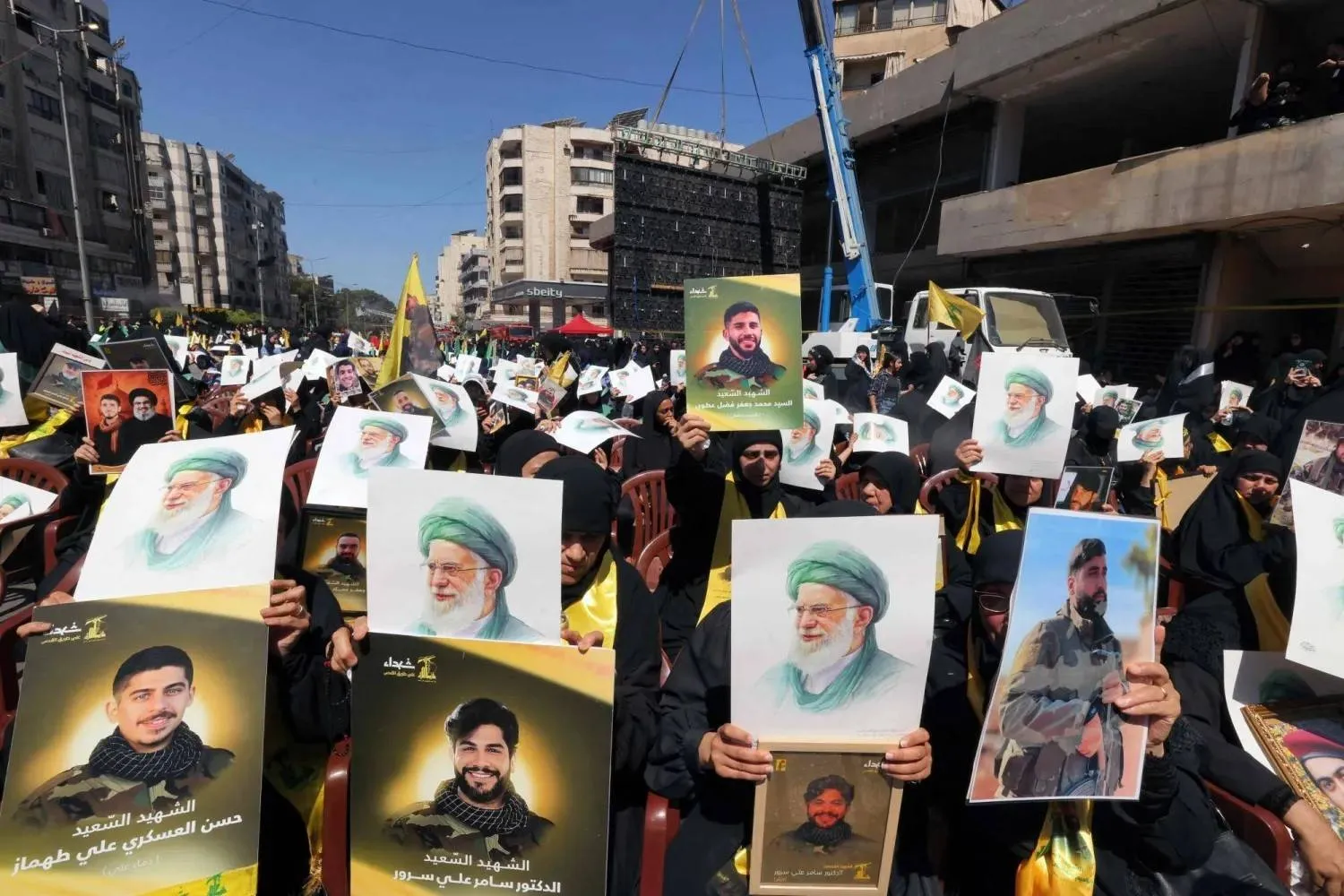
Lebanese Shiite mourners gathered on Monday in Beirut’s southern suburbs to mark Ashura in a ceremony organized by Hezbollah (AFP)
TT

Lebanese Parties Warn Against Hezbollah Keeping Light Weapons

Lebanese Shiite mourners gathered on Monday in Beirut’s southern suburbs to mark Ashura in a ceremony organized by Hezbollah (AFP)

A recent proposal circulating in Lebanon that would allow Hezbollah to retain its light weapons while surrendering heavy and medium arms has triggered widespread political backlash, with critics warning it poses a grave threat to state sovereignty and public safety.

The suggestion, floated amid long-running debate over the group’s arsenal, argues that other political parties and armed groups also possess light weapons for various reasons. But key political factions have rejected the idea outright, citing Lebanon’s bloody past and the potential for renewed violence.

Opponents of the proposal have pointed to the events of May 7, 2008, when Hezbollah fighters overran parts of Beirut and Mount Lebanon in a show of military force, underscoring the dangers of allowing any non-state group to keep arms.

“Classifying weapons as heavy, medium or light is useless,” said Kataeb Party leader Sami Gemayel in a post on X. “If heavy arms threaten Lebanon’s regional security, light weapons are even more dangerous to the foundations of the state.”

Gemayel reiterated that only the Lebanese army and legitimate security forces should bear arms, calling for the country to be entirely free of weapons held by non-state actors.

MP Ghada Ayoub, of the Lebanese Forces-led "Strong Republic" bloc, echoed that view, insisting the state must assert full sovereignty over all Lebanese territory and outlaw any form of armed presence outside the official security apparatus.

“There is only one armed group operating outside the state, and that is Hezbollah,” Ayoub told Asharq al-Awsat. “It must become a purely political party and clearly, unequivocally declare an end to its military activity.”

Ayoub also criticized recent remarks by Hezbollah Deputy Secretary-General Sheikh Naim Qassem, who vowed the group’s “resistance” would continue “without asking anyone’s permission.”

“The Lebanese state is responsible for enforcing a monopoly on the use of arms,” she said. “It must stop playing the role of a mediator or hiding behind the fear of war and internal strife. Time is not on Lebanon’s side.”

Ahmad Al-Kheir, a lawmaker with the “National Moderation” bloc, dismissed the proposal as “stillborn,” warning that light weapons have already been used to intimidate citizens and skew political dynamics.

“We saw yesterday how light arms were paraded through Beirut’s streets in a blatant attempt at provocation and coercion,” he said. “This is the real danger - using these weapons as leverage in political life, as we saw in the May 7 events and the occupation of downtown Beirut.”

“No one in Lebanon will accept this,” Al-Kheir added.

Additionally, critics warn that allowing any non-state entity to retain weapons threatens state authority and risks further destabilizing the country.

Al-Kheir urged Hezbollah and any other party in possession of light weapons to hand them over to the state, citing the recent example set by former Progressive Socialist Party (PSP) leader Walid Jumblatt.

“Jumblatt announced that his party had surrendered its weapons weeks ago. This is the model to follow,” he told Asharq al-Awsat.

MP Waddah Al-Sadek, of the Change Coalition, said he had no objection to a phased disarmament process that begins with heavy and medium weapons, followed by light arms. He dismissed fears of civil war, saying only one side is armed.

“Armed conflict requires two sides. The army will not engage in internal fighting,” he said. “This talk of civil war is just fear-mongering unless Hezbollah resorts again to something like the May 7 scenario to avoid disarming.”

Al-Sadek stressed that Lebanon’s response to the US proposal - reportedly outlining phased disarmament - will be critical. “Does anyone really have an alternative to engaging with this proposal?” he asked.

Deputy head of the Free Patriotic Movement, Naji Hayek, said all weapons must be handed over, rejecting the idea that civilians or political groups should be allowed to keep light arms for self-defense.

“This theory no longer holds,” Hayek told Asharq al-Awsat, adding that training camps used to militarize society should be shut down. “Light and medium weapons are not only with Hezbollah - they exist with other parties that have military structures, and these too must be dismantled.”

Political analyst Qassem Qassir, who is close to Hezbollah’s thinking, said there is no internal consensus, nor any agreement with Hezbollah, to give up its heavy and medium arms while retaining light weapons.

“The party insists the issue is still the Israeli occupation and ongoing aggression,” he said. “For Hezbollah, no discussion on disarmament is possible until those threats end.”

Qassir warned that if a political solution to the weapons issue is not reached, “we will inevitably face military risks and internal conflict.”

Jumblatt announced in late June that his party had handed over its remaining weapons, including light and medium arms that were gradually accumulated after the May 7 clashes in 2008 during a period of heightened tension with Hezbollah.

He said the weapons had been centrally stored and fully turned over to the Lebanese state.


Israel Military Says Soldier Killed in Gaza 

A drone view shows the destruction in a residential neighborhood, after the withdrawal of the Israeli forces from the area, amid a ceasefire between Israel and Hamas in Gaza, in Gaza City, October 21, 2025. (Reuters)
TT

Israel Military Says Soldier Killed in Gaza 

A drone view shows the destruction in a residential neighborhood, after the withdrawal of the Israeli forces from the area, amid a ceasefire between Israel and Hamas in Gaza, in Gaza City, October 21, 2025. (Reuters)

The Israeli military announced that one of its soldiers had been killed in combat in southern Gaza on Wednesday, but a security source said the death appeared to have been caused by "friendly fire".

"Staff Sergeant Ofri Yafe, aged 21, from HaYogev, a soldier in the Paratroopers Reconnaissance Unit, fell during combat in the southern Gaza Strip," the military said in a statement.

A security source, however, told AFP that the soldier appeared to have been "killed by friendly fire", without providing further details.

"The incident is still under investigation," the source added.

The death brings to five the number of Israeli soldiers killed in Gaza since a ceasefire took effect on October 10.


Syria: SDF’s Mazloum Abdi Says Implementation of Integration Deal May Take Time

People sit outdoors surrounded by nature, with the Tigris river flowing in the background, following a long atmospheric depression, near the Syrian-Turkish border in Derik, Syria, February 16, 2026 REUTERS/Orhan Qereman
TT

Syria: SDF’s Mazloum Abdi Says Implementation of Integration Deal May Take Time

People sit outdoors surrounded by nature, with the Tigris river flowing in the background, following a long atmospheric depression, near the Syrian-Turkish border in Derik, Syria, February 16, 2026 REUTERS/Orhan Qereman

Mazloum Abdi, commander of the Syrian Democratic Forces, said the process of merging the SDF with Syrian government forces “may take some time,” despite expressing confidence in the eventual success of the agreement.

His remarks came after earlier comments in which he acknowledged differences with Damascus over the concept of “decentralization.”

Speaking at a tribal conference in the northeastern city of Hasakah on Tuesday, Abdi said the issue of integration would not be resolved quickly, but stressed that the agreement remains on track.

He said the deal reached last month stipulates that three Syrian army brigades will be created out of the SDF.

Abdi added that all SDF military units have withdrawn to their barracks in an effort to preserve stability and continue implementing the announced integration agreement with the Syrian state.

He also emphasized the need for armed forces to withdraw from the vicinity of the city of Ayn al-Arab (Kobani), to be replaced by security forces tasked with maintaining order.


Israeli Far-Right Minister to Push for ‘Migration’ of West Bank, Gaza Palestinians 

A Palestinian man checks leather belts as people prepare for Ramadan, in the old city of Hebron in the Israeli-occupied West Bank, February 17,2026. (Reuters)
TT

Israeli Far-Right Minister to Push for ‘Migration’ of West Bank, Gaza Palestinians 

A Palestinian man checks leather belts as people prepare for Ramadan, in the old city of Hebron in the Israeli-occupied West Bank, February 17,2026. (Reuters)

Israel's far-right Finance Minister Bezalel Smotrich said he would pursue a policy of "encouraging the migration" of Palestinians from the occupied West Bank and Gaza Strip, Israeli media reported Wednesday.

"We will eliminate the idea of an Arab terror state," said Smotrich, speaking at an event organized by his Religious Zionism Party late on Tuesday.

"We will finally, formally, and in practical terms nullify the cursed Oslo Accords and embark on a path toward sovereignty, while encouraging emigration from both Gaza and Judea and Samaria.

"There is no other long-term solution," added Smotrich, who himself lives in a settlement in the West Bank.

Since last week, Israel has approved a series of measures backed by far-right ministers to tighten control over the West Bank, including in areas administered by the Palestinian Authority under the Oslo Accords, in place since the 1990s.

The measures include a process to register land in the West Bank as "state property" and facilitate direct purchases of land by Jewish Israelis.

The measures have triggered widespread international outrage.

On Tuesday, the UN missions of 85 countries condemned the measures, which critics say amount to de facto annexation of the Palestinian territory.

"We strongly condemn unilateral Israeli decisions and measures aimed at expanding Israel's unlawful presence in the West Bank," they said in a statement.

"Such decisions are contrary to Israel's obligations under international law and must be immediately reversed.

"We underline in this regard our strong opposition to any form of annexation."

UN Secretary-General Antonio Guterres on Monday called on Israel to reverse its land registration policy, calling it "destabilizing" and "unlawful".

The West Bank would form the largest part of any future Palestinian state. Many on Israel's religious right view it as Israeli land.

Israeli NGOs have also raised the alarm over a settlement plan signed by the government which they say would mark the first expansion of Jerusalem's borders into the occupied West Bank since 1967.

The planned development, announced by Israel's Ministry of Construction and Housing, is formally a westward expansion of the Geva Binyamin, or Adam, settlement situated northeast of Jerusalem in the West Bank.

The current Israeli government has fast-tracked settlement expansion, approving a record 52 settlements in 2025.

Excluding Israeli-annexed east Jerusalem, more than 500,000 Israelis live in West Bank settlements and outposts, which are illegal under international law.
