


Gaza Doctors Cram Babies into Incubators as Fuel Shortage Threatens Hospitals

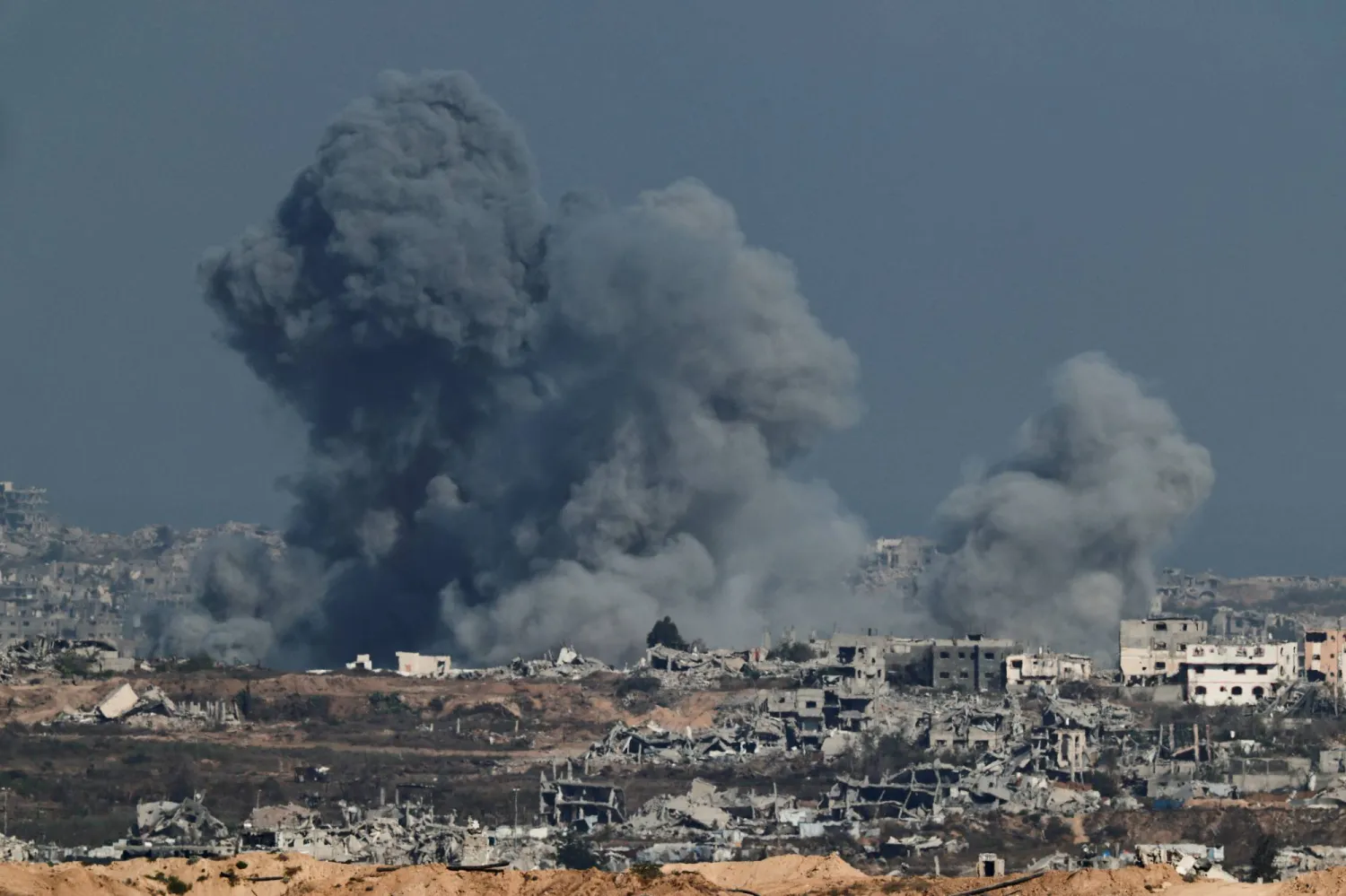
Smoke rises in Gaza after an explosion, as seen from the Israeli side of the Israel-Gaza border, July 7, 2025. REUTERS/Amir Cohen
TT

Gaza Doctors Cram Babies into Incubators as Fuel Shortage Threatens Hospitals

Smoke rises in Gaza after an explosion, as seen from the Israeli side of the Israel-Gaza border, July 7, 2025. REUTERS/Amir Cohen

At Gaza's largest hospital, doctors say crippling fuel shortages have led them to put several premature babies in a single incubator as they struggle to keep the newborns alive while Israel presses on with its military campaign.

Overwhelmed medics say the dwindling fuel supplies threaten to plunge them into darkness and paralyze hospitals and clinics in the Palestinian territory, where health services have been pummeled during 21 months of war.

While Prime Minister Benjamin Netanyahu discussed the fate of Israeli hostages in Gaza with US President Donald Trump in Washington this week, patients at Al Shifa medical center in Gaza City faced imminent danger, doctors there said.

"We are forced to place four, five, or sometimes three premature babies in one incubator," said Dr. Mohammed Abu Selmia, Al Shifa's director.

"Premature babies are now in a very critical condition."

The threat comes from "neither an airstrike nor a missile — but a siege choking the entry of fuel," Dr. Muneer Alboursh, director general of the Gaza Ministry of Health, told Reuters.

The shortage is "depriving these vulnerable people of their basic right to medical care, turning the hospital into a silent graveyard," he said.

Gaza, a tiny strip of land with a population of more than 2 million, was under a long, Israeli-led blockade before the war between Israel and Palestinian group Hamas erupted.

Palestinians and medical workers have accused the Israeli military of attacking hospitals, allegations it rejects.

Israel accuses Hamas of operating from medical facilities and running command centers underneath them, which Hamas denies.

Patients in need of medical care, food and water are paying the price.

There have been more than 600 attacks on health facilities since the conflict began, the WHO says, without attributing blame. It has described the health sector in Gaza as being "on its knees", with shortages of fuel, medical supplies and frequent arrivals of mass casualties.

Just half of Gaza's 36 general hospitals are partially functioning, according to the UN agency.

Abu Selmia warned of a humanitarian catastrophe and accused Israel of "trickle-feeding" fuel to Gaza's hospitals.

COGAT, the Israeli military aid coordination agency, did not immediately respond to a request for comment about fuel shortages at Gaza's medical facilities and the risk to patients.

OXYGEN RISK

Abu Selmia said Al Shifa's dialysis department had been shut down to protect the intensive care unit and operating rooms, which can't be without electricity for even a few minutes.

There are around 100 premature babies in Gaza City hospitals whose lives are at serious risk, he said. Before the war, there were 110 incubators in northern Gaza compared to about 40 now, said Abu Selmia.

"Oxygen stations will stop working. A hospital without oxygen is no longer a hospital. The lab and blood banks will shut down, and the blood units in the refrigerators will spoil," Abu Selmia said, adding that the hospital could become "a graveyard for those inside".

Officials at Nasser Medical Complex in Khan Younis are also wondering how they will cope with the fuel crisis. The hospital needs 4,500 liters of fuel per day and it now has only 3,000 liters, said hospital spokesperson Mohammed Sakr.

Doctors are performing surgeries without electricity or air conditioning. The sweat from staff is dripping into patients' wounds, he said.

Earlier this year, Israel imposed a total blockade on Gaza for nearly three months, before partly lifting it. Israel accuses Hamas of diverting aid, something Hamas denies.

"You can have the best hospital staff on the planet, but if they are denied the medicines and the pain killers and now the very means for a hospital to have light ... it becomes an impossibility," said James Elder, a spokesperson for UN children's agency UNICEF, recently returned from Gaza.

The latest bloodshed in the decades-old Israeli-Palestinian conflict was triggered in October 2023, when Hamas attacked southern Israel, killing around 1,200 people and taking 251 hostages, according to Israeli tallies.

Gaza's health ministry says Israel's response has killed over 57,000 Palestinians. It has also caused a hunger crisis, internally displaced almost all Gaza's population and prompted accusations of genocide and war crimes, which Israel denies.



'Land Without laws': Israeli Settlers Force Bedouins from West Bank Community

AFP visited Ahmed Kaabneh weeks before he was forced to flee his home in the al-Hathrura area. Menahem Kahana / AFP
TT

'Land Without laws': Israeli Settlers Force Bedouins from West Bank Community

AFP visited Ahmed Kaabneh weeks before he was forced to flee his home in the al-Hathrura area. Menahem Kahana / AFP

As relentless harassment from Israeli settlers drove his brothers from their Bedouin community in the central occupied West Bank, Ahmed Kaabneh remained determined to stay on the land his family had lived on for generations.

But when a handful of young settlers constructed a shack around 100 meters above his home and started intimidating his children, 45-year-old Kaabneh said he had no choice but to flee too.

As with scores of Bedouin communities across the West Bank, the small cluster of wood and metal houses where Kaabneh's father and grandfather had lived now lies empty.

"It is very difficult... because you leave an area where you lived for 45 years. Not a day or two or three, but nearly a lifetime," Kaabneh told AFP at his family's new makeshift house in the rocky hills north of Jericho.

"But what can you do? They are the strong ones and we are the weak, and we have no power."

Israel has occupied the West Bank since 1967, and violence there has soared since the Gaza war erupted in October 2023 following Hamas's attack on Israel.

Some 3,200 Palestinians from dozens of Bedouin and herding communities have been forced from their homes by settler violence and movement restrictions since October 2023, the UN's humanitarian agency OCHA reported in October.

The United Nations said this October was the worst month for settler violence since it began recording incidents in 2006.

Almost none of the perpetrators have been held to account by the Israeli authorities.

'Terrifying'

Kaabneh, four of his brothers and their families, now live together some 13 kilometers (eight miles) northeast of their original homes, which sat in the al-Hathrura area.

Outside his freshly constructed metal house, boys kicked a football while washing hung from the line. But Kaabneh said the area didn't feel like home.

"We are in a place we have never lived in before, and life here is hard," he said.

Alongside surging violence, the number of settler outposts has exploded in the West Bank.

While all Israeli settlements are illegal under international law, outposts are also prohibited under Israeli law. But many end up being legalized by the Israeli authorities.

AFP had visited Kaabneh in the al-Hathrura area weeks before he was forced to flee.

On the dirt road to his family's compound, caravans and an Israeli flag atop a hill marked an outpost established earlier this year -- one of several to have sprung up in the area.

On the other side of the track, in the valley, lay the wreckage of another Bedouin compound whose residents had recently fled.

While in Kaabneh's cluster of homes, AFP witnessed two settlers driving to the top of a hill to surveil the Bedouins below.

"The situation is terrifying," Kaabneh said at the time, with life becoming almost untenable because of daily harassment and shrinking grazing land.

Less than three weeks later, the homes were deserted.

Kaabneh said the settlers "would shout all night, throw stones, and walk through the middle of the houses."

"They didn't allow us to sleep at night, nor move freely during the day."

'Thrive on chaos'

These days, only activists and the odd cat wander the remnants of Kaabneh's former life -- where upturned children's bikes and discarded shoes reveal the chaotic departure.

"We are here to keep an eye on the property... because a lot of places that are abandoned are usually looted by the settlements," said Sahar Kan-Tor, 29, an Israeli activist with the Israeli-Palestinian grassroots group Standing Together.

Meanwhile, settlers with a quadbike and digger were busy dismantling their hilltop shack and replacing it with a sofa and table.

"They thrive on chaos," Kan-Tor explained.

"It is, in a way, a land without laws. There (are) authorities roaming around, but nothing is enforced, or very rarely enforced."

A report by Israeli settlement watchdogs last December said settlers had used shepherding outposts to seize 14 percent of the West Bank in recent years.

NGOs Peace Now and Kerem Navot said settlers were acting "with the backing of the Israeli government and military".

Some members of Israel's right-wing government are settlers themselves, and far-right ministers have called for the West Bank's annexation.

Kan-Tor said he believed settlers were targeting this stretch of the West Bank because of its significance for a contiguous Palestinian state.

But Kaabneh said the threat of attacks loomed even in his new location in the east of the territory.

He said settlers had already driven along the track leading to his family's homes and watched them from the hill above.

"Even this area, which should be considered safe, is not truly safe," Kaabneh lamented.

"They pursue us everywhere."


Security Council Delegation in First Visit to Damascus Since 1945

President of Syria's interim government Ahmed Al-Sharaa (C) attends a reception with the UN Security Council delegation at the presidential palace in Damascus, Syria, 04 December 2025. EPA/MOHAMMED AL RIFAI
TT

Security Council Delegation in First Visit to Damascus Since 1945

President of Syria's interim government Ahmed Al-Sharaa (C) attends a reception with the UN Security Council delegation at the presidential palace in Damascus, Syria, 04 December 2025. EPA/MOHAMMED AL RIFAI

Syrian President Ahmad al-Sharaa received on Monday a UN Security Council delegation and several UN officials at the People’s Palace in Damascus.

“Al-Sharaa and the UN delegation discussed the Israeli aggressions on the country’s territory,” said Syria's permanent representative to the United Nations, Ibrahim Olabi.

Olabi described the delegation’s visit as a historic moment, marking the Council’s first unified stance in support of Syria.

He told the state-run news channel, Al-Ikhbariy, that the timing of the visit reflects the Security Council’s recognition of the significant achievements made during the first year of liberation that marked the fall of former Syrian president Bashar Assad.

“The Israeli aggression on Syrian territory was one of the main points discussed by the Syrian President with the UN delegation,” he said.

Olabi stressed that the shift from international division to consensus about Syria represents a major turning point that will move the country from being a source of crisis to a stable nation capable of restoring its role in supporting global peace and security.

The visit of the delegation of representatives from the 15 member states of the Security Council is the first since the council’s founding in 1945.

Syria’s state-run SANA news agency said the delegation visited the heavily war-damaged Damascus suburb of Jobar and historic sites in old Damascus, accompanied by Olabi and Deputy UN Special Envoy for Syria, Najat Rochdi.

The diplomats are to visit neighboring Lebanon on Friday and Saturday.

The visit comes as the UN is working to reestablish itself in Syria and after the Security Council has recently lifted sanctions against al-Sharaa, whose forces led the offensive that toppled Assad in December last year.

In brief remarks to journalists in Damascus, Samuel Zbogar, permanent representative of Slovenia to the UN and president of the Security Council, said the delegation came to Syria to build trust, to support Syria’s efforts toward a better future, and to strengthen the trust of the Syrian people in the work of the Security Council and the United Nations.”

“The international community stands ready to support you whatever you believe that we can be helpful,” Zbogar said, adding: “We want to help build a bridge to this better future for all Syrians.”

He also stressed that the presence of a UN team inside Syria helps provide the country with the necessary tools and expertise to advance toward a more stable and prosperous future.

ON Monday, Zbogar said that “the visit to Syria and Lebanon is the first official visit of the Security Council to the Middle East in six years, the first visit to Syria ever.”

The trip comes “at a crucial time for the region” and for both countries, Zbogar said, noting the new authorities' efforts towards Syria's transition as well as a year-old ceasefire in Lebanon between Israel and Hezbollah “which we see daily that is being challenged.”

He noted that “there's still a bit of lack of trust in the UN-Syria relationship, which we try to breach with this visit.”

UN Secretary-General Antonio Guterres's spokesman Stephane Dujarric said on Tuesday that “we very much hope that the visit will increase the dialogue between the United Nations and Syria.”


Iraq ‘Mistakenly Lists’ Iran Allies as Terrorists, Unsettling Coordination Bloc

Iraqi Prime Minister Mohammed Shia al-Sudani beside Nouri al-Maliki during a religious event in Baghdad (Government Media)
TT

Iraq ‘Mistakenly Lists’ Iran Allies as Terrorists, Unsettling Coordination Bloc

Iraqi Prime Minister Mohammed Shia al-Sudani beside Nouri al-Maliki during a religious event in Baghdad (Government Media)

Iraq on Thursday stunned observers by abruptly adding Hezbollah and Yemen’s Houthi movement to a terrorism list that triggers immediate asset freezes, only to retract the move within hours by claiming the two names had appeared in an “unedited list” slated for correction.

The whiplash decision set off confusion and disbelief in Baghdad.

The Official Gazette, which is run by the Ministry of Justice, had published last month and formally announced on Thursday a list of entities subject to asset freezes that included Hezbollah and the Houthis.

Observers said the step was expected to win praise from Washington and tighten pressure on Tehran before the government withdrew it.

The paper said a government committee had decided to freeze the assets of individuals and entities linked to the Houthis and Hezbollah, and that the Iraqi announcement, later deleted, covered more than one hundred entities and individuals worldwide.

It said the terrorism list update came in accordance with resolutions of the committee tasked with freezing funds for identifying entities and individuals subject to counter terrorism and counter terrorism financing measures.

The developments came a day after s, urged Iraqi partners to undermine Iranian militias and prevent them from threatening Iraqis and Americans.

Asset freeze for terrorists

The text in the Official Gazette shows that the Anti-Money Laundering and Counter Terrorism Financing Committee had submitted in March 2025 a list of terrorist individuals and entities for asset freezes before the Committee for Freezing Terrorists’ Funds endorsed it in October 2025.

The Ministry of Justice website published the edition that carried the decision before deleting it following a wave of outrage among pro Iran circles in Iraq.

Hossein Moanes, the head of Kataib Hezbollah affiliate group Harakat Hoquq (The Rights Movement), attacked the government as lacking dignity.

Ali Al-Asadi, head of the political council of the Harakat al-Nujaba movement, said listing Hezbollah and Ansar Allah, the Houthis, as terrorists was an act of treason, adding that the government does not represent the Iraqi people.

A confidential letter from the Central Bank of Iraq said the publication of the two names was an oversight, and that pursuant to Committee for Freezing Terrorists’ Funds Decision 61 of 2025, paragraphs 18 and 19 should be deleted because the committee did not approve them.

The bank requested that an official amendment be issued in the Official Gazette.

Iraqi bloggers reposted paragraphs from the law governing publication in the Official Gazette, which states that ignorance of what is published in the Official Gazette does not excuse its content.

However, legal experts said rescinding what is published in the Official Gazette is possible and permissible from a legal standpoint, noting that the publication law allows corrections through a statement issued by the authority that produced the decision.

Iraq’s state news agency said Baghdad would fix the list after Hezbollah and the Iran backed Houthis were added.

The asset freeze committee said the publication dated November 17 applied solely to individuals and entities linked to ISIS and Al-Qaeda, in line with a Malaysian request and with United Nations Security Council Resolution 1373. It said adding other groups occurred before the final review was completed and would be deleted in a corrected version.

Iraqi regulations state that the only way to amend or cancel what is published in the Official Gazette is through a new law that repeals or modifies the earlier one, and until then anything published is considered an official and binding announcement.

A technical step

Legal expert Ali Al-Tamimi said the Committee for Freezing Funds of Terrorist Groups is attached to the General Secretariat of the Council of Ministers and chaired by the central bank governor, with members from counter terrorism and counter narcotics agencies, the interior and communications ministries, and the Integrity Commission.

It was established under the 2012 Anti Money Laundering Law.

He told Asharq al-Awsat that the committee’s mandate is to implement Security Council decisions and that the measure is financial and economic rather than political, noting that Security Council Resolution 2140 of 2025 calls for freezing the funds of Hezbollah and the Houthis.

The controversy quickly fed into political jockeying over whether Prime Minister Mohammed Shia al-Sudani should serve a second term. Yasser Al-Maliki, secretary general of the Al Bashaer Movement, wrote on X that respect for the dead requires their burial, in a remark widely interpreted as a declaration that Sudani’s term had ended.

Yasser Al-Maliki is close to Nouri Al-Maliki, leader of the State of Law coalition and a prominent opponent of Sudani remaining in office.

Government probe

The government responded with a statement saying Sudani had ordered an urgent investigation, identification of those responsible and accountability for the negligence related to the committee’s decision.

It said Iraq’s political and humanitarian positions toward the aggression against its people in Lebanon and Palestine are principled and not subject to political point scoring.

Arab media outlets quoted what they described as informed sources as saying Hezbollah in Lebanon was displeased by the uproar in Iraq over its appearance on the terrorism list.

They said a senior Hezbollah figure contacted Baghdad to clarify the mistake and urged Iraqi authorities to hold those responsible to account.

Washington has for years sought to curb Iran’s influence in Iraq and other parts of the Middle East, where Tehran aligned factions operate under what is known as the axis of resistance, which has come under heavy Israeli strikes since the Gaza war erupted in 2023.

Iran, a neighbor and key economic lifeline for Iraq under sanctions, is vital to Baghdad, which continues to balance its partnership with Washington against its complex ties with Tehran at a time when Iran’s regional sway has ebbed after a string of Israeli attacks on its allies over the past year.