
Washington Furious over Drone Attacks in Iraq

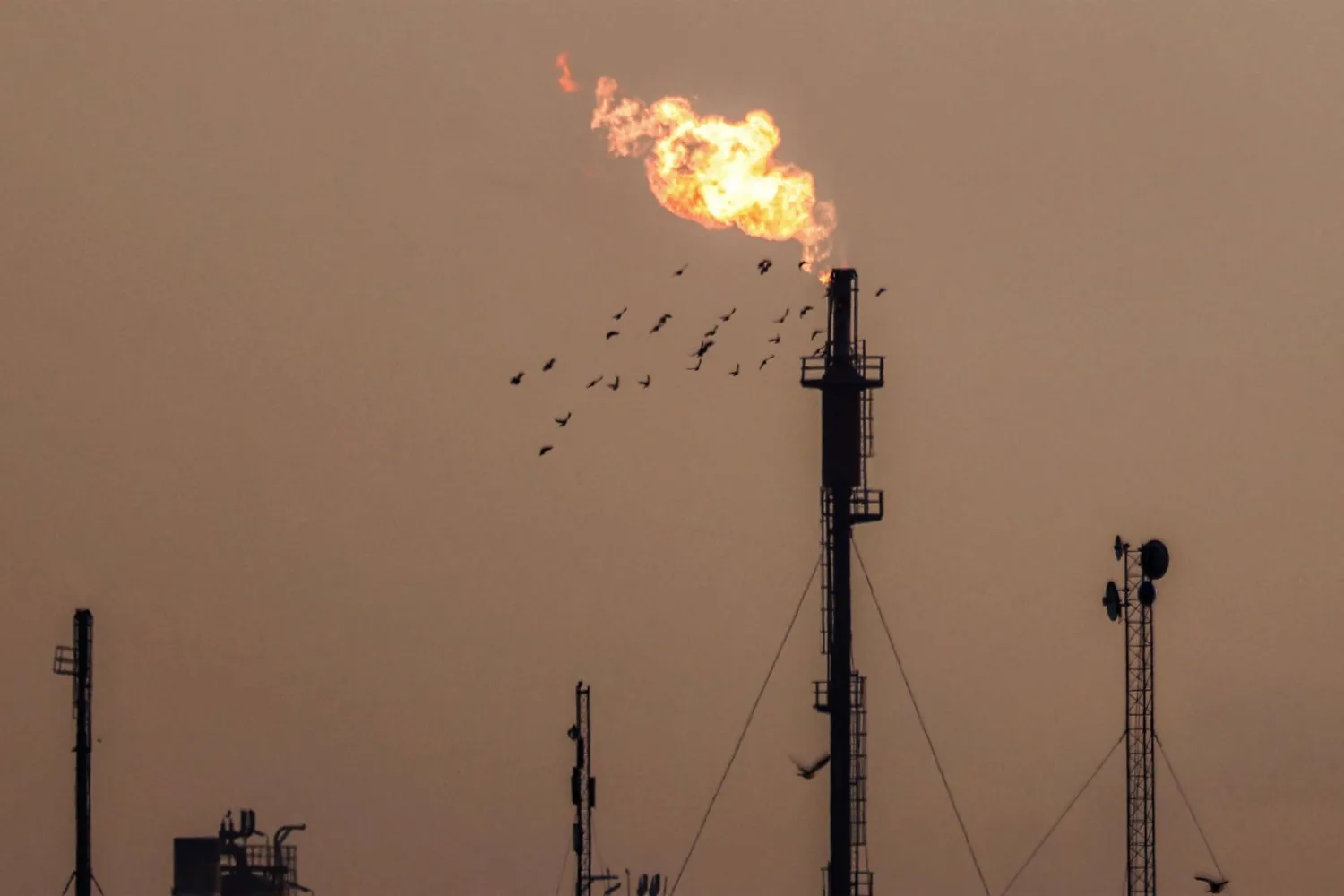
A flock of birds flies past burning gas flares at the Dora (Daura) Oil Refinery Complex in Baghdad on July 15, 2025. (Photo by AHMAD AL-RUBAYE / AFP)
TT

Washington Furious over Drone Attacks in Iraq

A flock of birds flies past burning gas flares at the Dora (Daura) Oil Refinery Complex in Baghdad on July 15, 2025. (Photo by AHMAD AL-RUBAYE / AFP)

While the US embassy in Baghdad on Tuesday denounced recent drone attacks, including ones that hit “critical infrastructure” across the country, Iraqi Prime Minister Mohammed Shia Al-Sudani welcomed the operations of American companies in Iraq, particularly in the oil sector.

Al-Sudani spoke following a meeting with Matthew Zais, Vice President of the American oil company HKN Energy, in the presence of the US Chargé d’Affaires in Iraq.

The two sides signed a memorandum of principles to invest in the Hamrin oil fields, with the aim of reaching promising development frameworks to optimize their exploitation.

Baghdad and Washington share a complex relationship as the two sides have different perspectives on many issues, including armed factions, reconstruction, the future of the Popular Mobilization Forces and Baghdad's relationship with Tehran.

On Tuesday, as the Iraqi Oil Minister was signing an understanding with HKN Energy, the US embassy in Baghdad issued a statement denouncing recent drone attacks in Iraq, including ones that hit oil fields in the autonomous Kurdistan region.

Last month, drone strikes targeted radar systems at two military bases near Baghdad and in southern Iraq. The attacks are believed to be launched by armed militias loyal to Iran.

In its statement, the US embassy said: “The United States condemns the recent drone attacks throughout Iraq, including the July 14 and July 15 drone attacks on critical infrastructure at the Khormala and Sarsang oil fields in the Iraqi Kurdistan Region.”

It urged the Iraqi government to exercise its authority to prevent armed actors from launching these attacks against sites within its own territory, including locations where Iraqi and international companies have invested in Iraq's future.

“These attacks are unacceptable, undermine Iraq's sovereignty, and hurt Iraq's efforts to attract foreign investment. We urge the Government of Iraq to investigate who is behind these attacks and hold them accountable,” the statement noted.

In a similar statement, the US Consulate General in Erbil also strongly condemned the recent drone attacks, calling the assaults a violation of Iraqi sovereignty and a threat to the country’s economic stability.

Despite the official Iraqi condemnations and the government’s efforts to investigate the drone attacks, observers say Baghdad is too weak to prevent militias from attacking several military sites and bases at Camp Taji, north of Baghdad, and in the southern Nasiriyah city.

“The Iraqi government does not seek to open a decisive battle with the factions,” according to a source close to the forces of the Coordination Framework.

In an interview with Asharq Al-Awsat published on Monday, Al-Sudani commented on the drone attacks in Baghdad and Nasiriyah saying there is an investigation by a specialized technical committee.

“I am closely following this probe. It was a clear attack using drones. As you know, it's not easy to detect these aircraft. Today, this technology is used in attacks and to create instability. But this matter will definitely not pass without consequences.”

On Tuesday, the drone attack halted production at the Sarsang oilfield in Iraq’s Kurdistan region.

Ghias Sorchi, a leading member at the Patriotic Union of Kurdistan (PUK) urged parties to wait for the results of the investigations.

He noted that “those involved in the attacks do not want stability in the region, and if they are known, we will sue them in Baghdad and in international forums.”

However, Dr. Firas Elias, a professor of International Relations at the University of Mosul, said the drone attacks on vital oil and gas sites in the Kurdistan Region carries a political dimension due to the escalating disputes between Baghdad and Erbil over key issues, most notably the salaries of the Region’s civil servants.

“The drone attacks came as Erbil hinted it could withdraw from the political process, which means more problems with Baghdad and less potential to solve conflicting issues, especially with regard to the oil file in general and the issue of salaries,” Elias said.

Last May, tensions were high between Erbil and Baghdad after Iraq’s Federal Finance Minister, Taif Sami, ordered the suspension of salary payments to employees in the Kurdistan Region.

Elias said every time Erbil tries to increase its pressure on Baghdad, such attacks will escalate.


Will Lebanon Be the Biggest Loser After the Ceasefire?

Smoke rises after an Iranian missile is intercepted over the Sahel Alma area in Mount Lebanon. (Reuters)
TT

Will Lebanon Be the Biggest Loser After the Ceasefire?

Smoke rises after an Iranian missile is intercepted over the Sahel Alma area in Mount Lebanon. (Reuters)

Political sources in Beirut warned Lebanon could emerge as the biggest loser when the current regional war ends, outlining their concerns to Asharq Al-Awsat.

Lebanon is heading toward a severe internal crisis, the sharpest in its modern history with the dispute centering on Hezbollah’s weapons.

The majority of Shiites in the country insists on keeping them, while most other segments say Lebanon’s survival depends on implementing government decisions to limit arms to the state, in line with Lebanese, Arab, and international positions.

The sources noted that Hezbollah has again entered a regional war it cannot influence, risking burdens Lebanon cannot bear.

Hefty price

The war is proving costly for those involved and for countries hit by its spillover.

A ceasefire would likely show Iran suffered heavy damage to its defense, industrial sectors, and infrastructure, potentially setting it back decades. But its size, energy resources, and experience with economic hardship may help it manage the aftermath, unless losses destabilize the system.

Iranian missiles are expected to have caused damage to Israeli institutions and infrastructure, despite a high interception rate. The cost of interception is steep, but Israel appears ready to absorb it, calling the conflict an existential war and relying on strong US support.

Lebanon will struggle the most. Its economy is already near collapse. The country faces a catastrophic situation, with about one million displaced and heavy destruction along the border with Israel.

Israel has said it intends to establish a “buffer zone” inside Lebanese territory, signaling a return of occupation to parts of the country “pending guarantees for the safety of Galilee residents.”

The most dangerous scenario is that Israel’s campaign on the Lebanese front continues even if a ceasefire is reached between the US and Israel on one side and Iran on the other.

The fallout is worsened by a deepening rift among Lebanon’s components, raising the risk of internal conflict.

The role of parliament Speaker Nabih Berri appears diminished as the conflict widens. The current crisis over the expulsion of the Iranian ambassador reflects a deeper divide between the Shiite camp and others over weapons, the war, and Lebanon’s regional role.

Hezbollah described the expulsion as a “sin”, demanding that the government reverse it.

‘Impossible to coexist’

Voices are rising in Lebanon, warning that it was “impossible to coexist” between a “quasi-state” and a “Hezbollah’s statelet.”

Countries that once backed Lebanon’s reconstruction, especially in the Gulf, are now focused on their own losses from Iranian attacks. They have also made clear that they will not help unless the Lebanese state takes full control over decisions of war and peace.

The sources reiterated their warning that Lebanon risks being the biggest loser, especially if Israel expands its ground offensive and internal divisions deepen to the point of questioning the country’s very formula of coexistence.


Netanyahu Says Israel Is Expanding ‘Buffer Zone’ in Lebanon

Smoke billows from an Israeli strike on Marjeyoun in southern Lebanon on Wednesday. (AFP)
TT

Netanyahu Says Israel Is Expanding ‘Buffer Zone’ in Lebanon

Smoke billows from an Israeli strike on Marjeyoun in southern Lebanon on Wednesday. (AFP)

Israeli Prime Minister Benjamin Netanyahu said on Wednesday that his country's forces were expanding a "buffer zone" in southern Lebanon as the military pressed ahead with its campaign against Hezbollah.

"We have created a genuine security zone preventing any infiltration toward the Galilee and the northern border," Netanyahu said in a video statement.

"We are expanding this zone to push the threat from anti-tank missiles further away and to establish a broader buffer zone."

Netanyahu said that dismantling Hezbollah "remains central" to Israel's objectives in Lebanon.

"It is connected to the broader confrontation with Iran," he said.

"We are determined to profoundly transform the situation in Lebanon," he added.

Lebanon was pulled into the Middle East war when Iran-backed Hezbollah began firing rockets into Israel on March 2 to avenge the killing of Iran's supreme leader Ali Khamenei.


Strike on Western Iraq Kills Seven Security Personnel

Members of Iraq's PMF carry the coffin of the PMF operations commander for Al-Anbar, Saad Dawai alongside others during a mass funeral in Baghdad on March 24, 2026. (AFP)
TT

Strike on Western Iraq Kills Seven Security Personnel

Members of Iraq's PMF carry the coffin of the PMF operations commander for Al-Anbar, Saad Dawai alongside others during a mass funeral in Baghdad on March 24, 2026. (AFP)

A strike on a base in western Iraq killed seven security personnel, the defense ministry said Wednesday, a day after an attack on the same base targeted the Popular Mobilization Forces.

"This resulted in the death of seven of our heroic fighters and the injury of 13 others," the ministry said of the strike in Anbar province, saying it specifically targeted the base's military healthcare clinic.

Rescue operations were ongoing, it added.

The base hosts Iraqi police, soldiers from the regular army and PMF, a security official told AFP.

It was hit by a deadly strike on Tuesday that the former paramilitaries blamed on the United States.

Iraq said late on Tuesday it would summon the US charge d'affaires and the Iranian ambassador after deadly strikes blamed on their countries, as Iraqi authorities granted the targeted groups the "right to respond".

Iraq has been pulled into the war sparked by US and Israeli strikes on Iran on February 28, and which has since engulfed much of the region.

Iraq has long been a proxy battleground for the United States and Iran, and has struggled to balance diplomatic ties with both countries.

Since the war began, pro-Iran armed groups have claimed responsibility for attacks on US interests in Iraq and across the region, while strikes have also targeted these groups, including state-linked positions.

In the statement from the prime minister's office, however, Iraq granted former paramilitaries within the official armed forces the right to "respond to military attacks" by drones and aircraft that targeted their headquarters.