


Syria Reportedly Believed it Had Green Light from US, Israel to Deploy Troops to Sweida

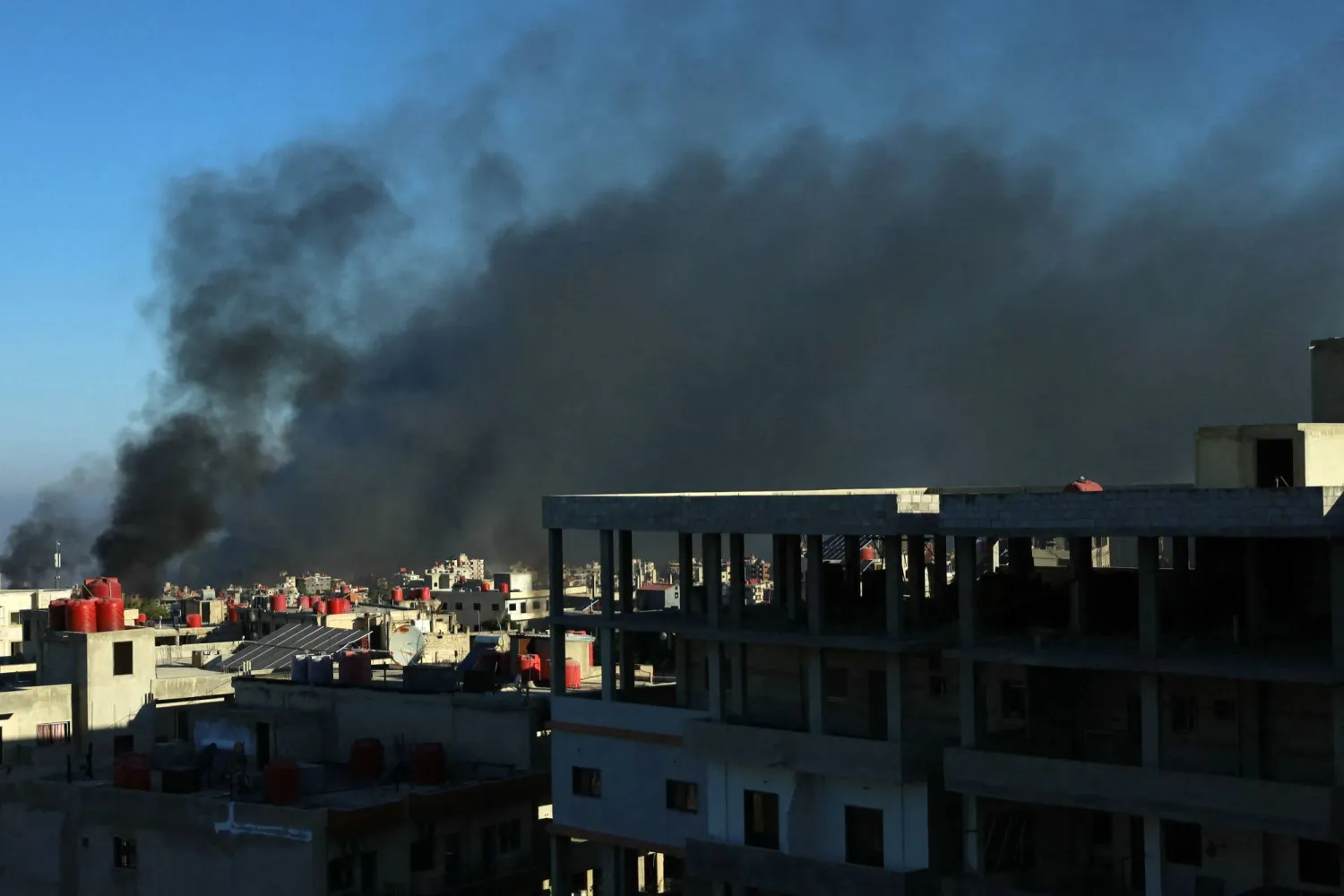
Black smoke rises above buildings in southern Syria's city of Sweida on July 19, 2025. (Photo by Shadi AL-DUBAISI / AFP)
TT

Syria Reportedly Believed it Had Green Light from US, Israel to Deploy Troops to Sweida

Black smoke rises above buildings in southern Syria's city of Sweida on July 19, 2025. (Photo by Shadi AL-DUBAISI / AFP)

Syria's government misread how Israel would respond to its troops deploying to the country's south this week, encouraged by US messaging that Syria should be governed as a centralized state, eight sources familiar with the matter told Reuters.

Israel carried out strikes on Syrian troops and on Damascus on Wednesday in an escalation that took the leadership by surprise, the sources said, after government forces were accused of killing scores of people in the Druze city of Sweida.

Damascus believed it had a green light from both the US and Israel to dispatch its forces south despite months of Israeli warnings not to do so, according to the sources, which include Syrian political and military officials, two diplomats, and regional security sources.

That understanding was based on public and private comments from US special envoy for Syria Thomas Barrack, as well as on nascent security talks with Israel, the sources said. Barrack has called for Syria to be centrally administered as "one country" without autonomous zones.

Syria's understanding of US and Israeli messages regarding its troop deployment to the south has not been previously reported.

A State Department spokesperson declined to comment on private diplomatic discussions but said the United States supported the territorial unity of Syria.

"The Syrian state has an obligation to protect all Syrians, including minority groups," the spokesperson said, urging the Syrian government to hold perpetrators of violence accountable.

In response to Reuters questions, a senior official from Syria's ministry of foreign affairs denied that Barrack's comments had influenced the decision to deploy troops, which was made based on "purely national considerations" and with the aim of "stopping the bloodshed, protecting civilians and preventing the escalation of civil conflict.”

Damascus sent troops and tanks to Sweida province on Monday to quell fighting between Bedouin tribes and armed factions within the Druze community.

Syrian forces entering the city came under fire from Druze fighters, according to Syrian sources.

Subsequent violence attributed to Syrian troops triggered Israeli strikes on Syrian security forces, the defense ministry in Damascus and the environs of the presidential palace.

Prime Minister Benjamin Netanyahu said Israel intervened to block Syrian troops from entering southern Syria - which Israel has publicly said should be a demilitarized zone - and to uphold a longstanding commitment to protect the Druze.

Syrian leader Ahmed al-Sharaa has vowed to hold accountable those responsible for violations against the Druze. He blamed "outlaw groups" seeking to inflame tensions for any crimes against civilians and did not say whether government forces were involved.

The US and others quickly intervened to secure a ceasefire by Wednesday evening. US Secretary of State Marco Rubio described the flare-up as a "misunderstanding" between Israel and Syria.

A Syrian and a Western source familiar with the matter said Damascus believed that talks with Israel as recently as last week in Baku produced an understanding over the deployment of troops to southern Syria to bring Sweida under government control.

Netanyahu's office declined to comment in response Reuters' questions.

Israel said on Friday it had agreed to allow limited access by Syrian forces into Sweida for the next two days. Soon after, Syria said it would deploy a force dedicated to ending the communal clashes, which continued into Saturday morning.



War Fears Cloud Iraq’s Drive to Bring Arms Under State Control

Members of Asaib Ahl al-Haq take part in a Quds Day march in Baghdad on July 1, 2016. (AP)
TT

War Fears Cloud Iraq’s Drive to Bring Arms Under State Control

Members of Asaib Ahl al-Haq take part in a Quds Day march in Baghdad on July 1, 2016. (AP)

The issue of weapons outside state control has returned to the center of Iraq’s political and security scene after Akram al-Kaabi, secretary-general of Harakat Hezbollah al-Nujaba, rejected any understandings with what he called “international forces backing Israel” and reaffirmed his movement’s commitment to “force and weapons.”

His comments came as the Iraqi government presses on with efforts to confine arms to the state, despite complex political and military challenges.

Kaabi’s remarks were made in a statement issued on Tuesday after recent regional developments and the military escalation between Iran and Israel.

He praised Iran’s missile strike against Israel earlier this week, calling it “discipline for the Zionist entity,” and commended Yemen’s Houthis for also firing at Israel, saying they delivered “a surprise slap to the enemy.”

Nujaba is an Iran-aligned Iraqi armed faction and one of the main pillars of an alliance of factions calling itself the Islamic Resistance in Iraq, which became directly involved in regional escalation after Hamas’ Oct. 7, 2023, attack on Israel.

Iraqi sources had said the government contacted leaders of armed factions to prevent them from joining the latest escalation, drawing on support from several factions for its plan to confine weapons to the state.

Kaabi said his movement was warning “anyone who imagines that Iraq can reach understandings with the supporters of” Israel and the United States.

“The logic of force and weapons” was the only option in dealing with them and that the movement “will never deviate from it,” he vowed.

The remarks come as debate grows in Iraq over the future of armed factions and whether all armed formations can be brought under state authority, now one of the most main issues tackled by Prime Minister Ali al-Zaidi's government.

The government has repeatedly said it is committed to the rule of law and to confining weapons to official institutions.

Influential cleric Moqtada al-Sadr announced on May 27 the integration of his military wing, Saraya al-Salam, into the state and called on the Popular Mobilization Forces factions to hand over their weapons. Asaib Ahl al-Haq and Kataib al-Imam Ali later also announced their separation from the PMF.

Split over mechanism

Figures close to armed factions rejected proposals to hand over weapons, saying they were driven by external pressure.

Abdul al-Rahman al-Jazairi, a leader in the PMF, said in remarks carried by local media that “the decision to confine weapons is not an individual decision,” calling for legislative authority to have a say over the “fateful” matter.

The remarks reflect the split over how to handle the armed factions file, which has grown more complicated after years in which armed groups expanded their influence, built military arsenals and secured independent funding sources.

Shakhawan Abdullah, head of the Kurdistan Democratic Party bloc, cited further obstacles to any disarmament plan, saying some weapons held by factions are not directly under their control.

He said one problem was that some factions “may decide to hand over their weapons, but the weapons originally belong to a regional state that considers them its property.” He added that those states may refuse to surrender such weapons, including drones.

Abdullah said some groups could transfer weapons to other formations rather than hand them over to the state. He said about 30% of armed groups fall under the PMF, while the rest are outside its framework.

Observers say the weapons file is not only a security issue. It also intersects with the economic and political interests of armed factions that have built networks of influence and their own financial institutions in recent years, making disarmament more complicated than legislation or government decisions.

Analysts say weapons for many factions are not only a military tool, but also a guarantee of political influence and a source of economic protection. That makes any response to calls for surrendering them limited unless they are paired with broader political and security arrangements.


Jordan Military Says Shot Down 5 Missiles from Iran

 A drone view shows military engineering teams working at the site where an Iranian missile, according to local authorities, fell in the countryside near Damascus, Syria, June 9, 2026. (Reuters)
A drone view shows military engineering teams working at the site where an Iranian missile, according to local authorities, fell in the countryside near Damascus, Syria, June 9, 2026. (Reuters)
TT

Jordan Military Says Shot Down 5 Missiles from Iran

 A drone view shows military engineering teams working at the site where an Iranian missile, according to local authorities, fell in the countryside near Damascus, Syria, June 9, 2026. (Reuters)
A drone view shows military engineering teams working at the site where an Iranian missile, according to local authorities, fell in the countryside near Damascus, Syria, June 9, 2026. (Reuters)

The Jordanian military said on Wednesday it shot down five missiles launched from Iran, as Tehran and Washington engaged in tit-for-tat strikes after the downing of a US helicopter.

"We intercepted and shot down five missiles launched from Iran towards Azraq. The interception resulted in debris falling, but there were no casualties or material damage," the Jordanian Armed Forces said in a statement.

The United States launched airstrikes early Wednesday against Iran after blaming Tehran for the crash of an American attack helicopter. Iran responded with attacks targeting Bahrain, Kuwait and Jordan, part of a widening round of retaliatory strikes that threaten to derail talks to reach an end to the Iran war.

Since the US and Israel began striking Iran on Feb. 28, the war has shaken the global economy, driven up energy prices around the world and made many basics, including food, more expensive.

Officials have been unable to turn the April ceasefire into a deal to permanently end the conflict, particularly as Israel intensifies and expands its military campaign in Lebanon against the Iranian-backed Hezbollah group.

The downing of the Apache attack helicopter and the strikes by the US military further strained the ceasefire a day after Iran and Israel exchanged fire for the first time since the fragile truce took effect.

Iranian state television said Tuesday that the Israeli attacks killed at least two members of the country’s air-defense units.


Eight Killed in Israeli Strike on Lebanon’s Tyre

Smoke rises following an Israeli airstrike in the southern city of Tyre on June 9, 2026. (AFP)
TT

Eight Killed in Israeli Strike on Lebanon’s Tyre

Smoke rises following an Israeli airstrike in the southern city of Tyre on June 9, 2026. (AFP)

Israel struck the historic port city of Tyre in southern Lebanon on Tuesday, killing at least eight people, in an escalation that adds strain to efforts to broker a peace deal to end the wider Middle East war.

On Monday, Israel and Iran halted direct attacks on each other after an appeal by US President Donald Trump, but Tehran warned it would resume hostilities if Israel continued to attack its ally Hezbollah in Lebanon.

The raids were the deadliest on Tyre since fighting erupted in Lebanon in early March, when Hezbollah launched rockets at Israel in support of Tehran after Israel and the United States began their war against Iran.

Israel had issued an evacuation order for the city earlier on Tuesday.

Residents fled and civil defense teams transported elderly residents into temporary shelters, state media reported.

The eight victims were killed in a ‌single strike on ‌the city's eastern edge, Lebanon's health ministry said.

A video verified by Reuters showed debris strewn ‌across ⁠a road at the ⁠site of the attack.

Israel's refusal to end its campaign in Lebanon, as Iran demands, has hindered Trump's efforts to extend a tenuous ceasefire in the wider US-Israeli war with Iran into a durable settlement.

US and Israeli officials said Trump and Israeli Prime Minister Benjamin Netanyahu had spoken on Monday.

In an interview with Axios, Trump said he had warned the Israeli leader not to return to war with Iran: "I said, 'Bibi, you better be careful, or you will be on your own very soon.'"

Tehran has long said any peace deal with the US depends in part on an end to fighting in Lebanon, which Israel invaded in March in pursuit of Hezbollah fighters who had fired across the border.

In northern Israel on Tuesday, Israeli troops operating in the Ramim Ridge area close to Lebanon's border killed one person in an incident in which they returned fire, the military said.

Israel has never halted its Lebanon campaign, which has killed thousands of people, saying the conflict should be treated separately from any US-Iranian ceasefire. Hezbollah has also continued its attacks.