


Barrack Says Lebanon Has an Opportunity; Israel, Not US, Setting Deadline for Hezbollah Disarmament

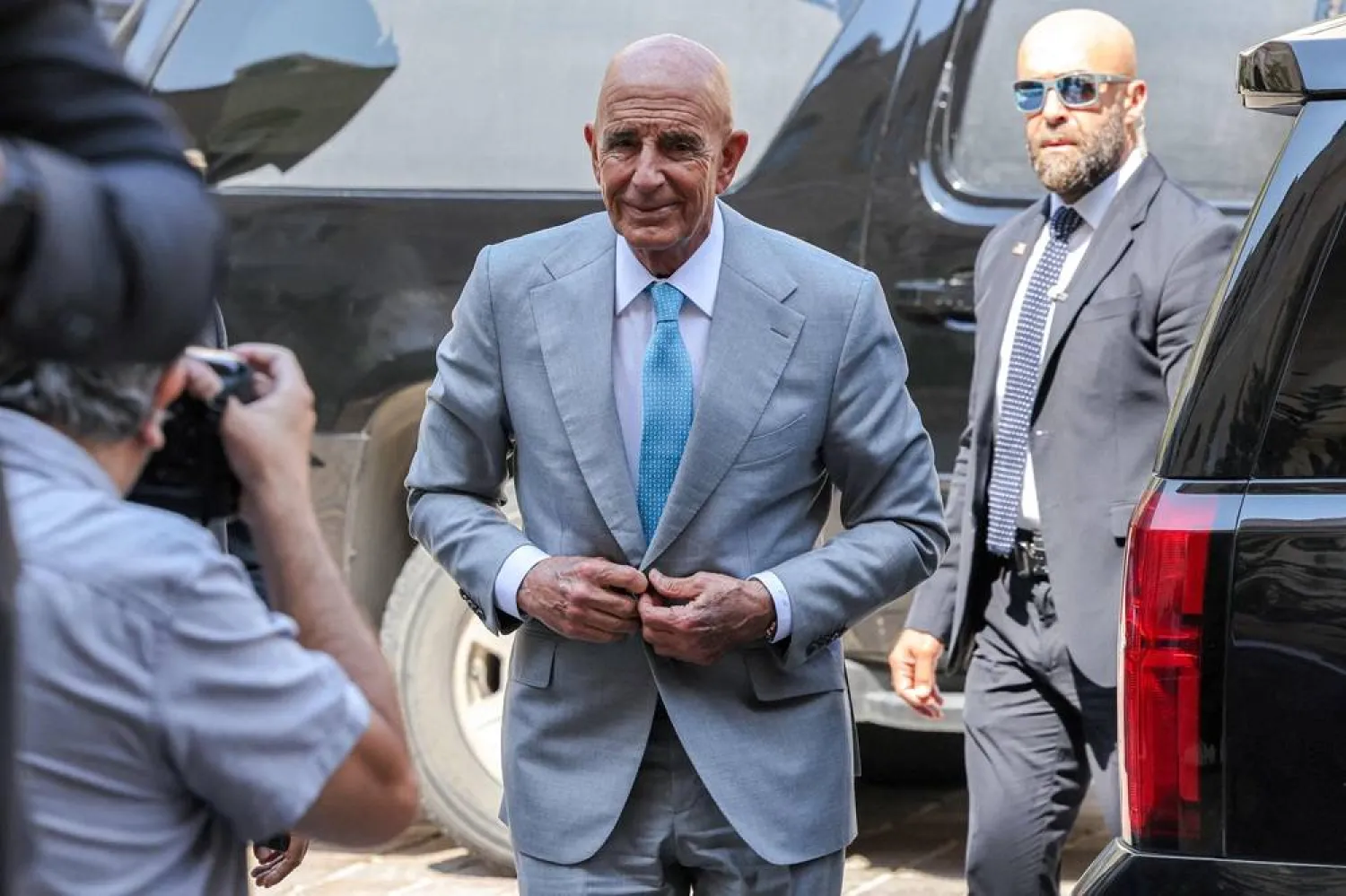
US Ambassador to Türkiye and Special Envoy for Syria Tom Barrack arrives for his meeting with Lebanon's Prime Minister at the government palace in Beirut on July 21, 2025. (AFP)
TT

Barrack Says Lebanon Has an Opportunity; Israel, Not US, Setting Deadline for Hezbollah Disarmament

US Ambassador to Türkiye and Special Envoy for Syria Tom Barrack arrives for his meeting with Lebanon's Prime Minister at the government palace in Beirut on July 21, 2025. (AFP)

US envoy Tom Barrack concluded his visit to Beirut on Wednesday by reiterating Washington’s stances related to the disarmament of Hezbollah, which he said is the responsibility of the Lebanese government that is obligated to limit the possession of weapons in the country to the state.

He warned that its failure to carry out tangible steps in this regard means that the current situation will persist, including Israeli strikes on southern Lebanon and drones flying over Beirut.

During a small meeting with a group of journalists, including Asharq Al-Awsat, Barrack said he was optimistic about everything.

It is time for the Lebanese government to assume its responsibility towards the agreements it struck in the past, he went on to say.

The government agreed to a number of conditions that may or may not have pleased everyone, he added. He said half of those he is referring to are saying that the current situation is good and will never change. So, let Hezbollah and Israel fight each other down there. That is their business; Beirut is fine.

He added that on the other hand, he saw some people who want change and so they must decide what this change demands.

Lebanon has embarked on a path; it elected a new president, chose a new prime minister and boasts a competent parliament speaker, remarked Barrack.

Lebanon has a new group of ministers who are very competent. Hold them to account, he urged. If there is a law, then someone must implement it. If the law is harsh on a segment of the population, then they must be informed that they are not above the law.

The reason for Lebanon’s success in the past was because everyone worked outside the system. Over time, since the 1970s, people came up with their own interpretations of the law. Courage lies in implementing the law, stressed the envoy.

Failure to do so in all likelihood means that Israeli strikes and drones will not stop. “It’s that simple,” Barrack said.

Surprisingly, he revealed that he sensed during his meetings with a Lebanese “readiness” to normalize relations with Israel. He clarified that none of the officials said this, as the government will always say that it never talks to Israel.

Moreover, Barrack said that Israel has no ambitions in Lebanon. “Who would be dumb enough to believe otherwise?” If Israel really wanted to swallow up Lebanon, it would have done so in a heartbeat. Everybody knows that. The government knows that. This is not what Israel wants, he asserted.

Barrack added that he had the opportunity to sit down with Lebanese ministers and senior officials, expressing his admiration of them.

He said that he believes that everyone, deep down, certainly wants to reach a solution to the conflict in this region.

Asked whether Lebanon has a timeframe to disarm Hezbollah, he replied: “Yes.” Lebanon’s neighbor, Israel, not the United States, is the one who sets that timeframe.

The envoy reiterated that Lebanon stands before an opportunity. “We believe we have an opportunity and that we can help,” he continued. Lebanon can be a link to all neighbors when it is in a good place. With Gulf friends and friends in the West, as well as France, “we can have a real impact on this path.”

But the message remains the same: Lebanon must implement its laws. As long as they are not implemented, then it doesn't matter what it does. Lebanon will not get a single cent in foreign capital, he cautioned.
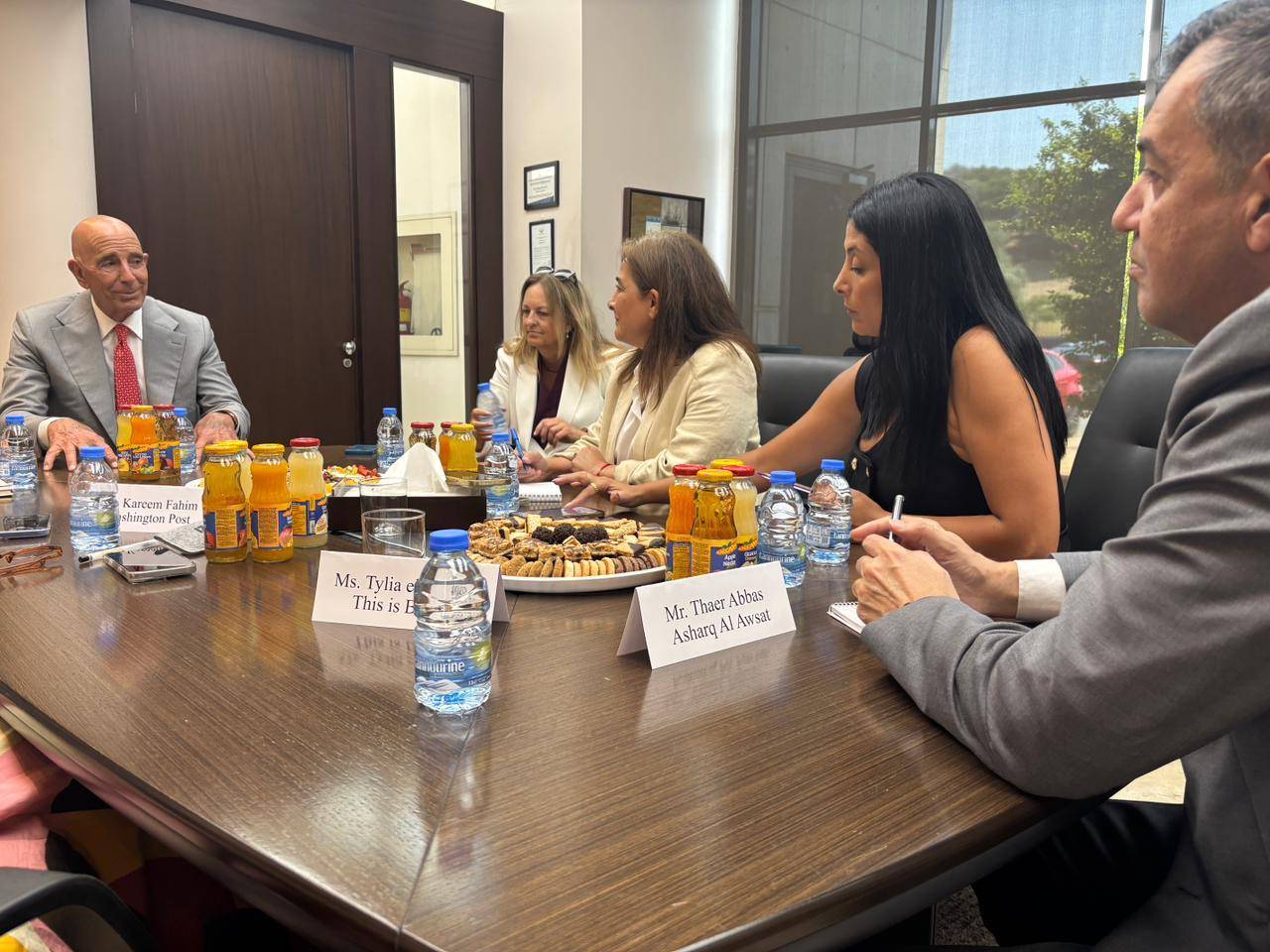
Barrack speaks to a group of journalists in Beirut, including Asharq Al-Awsat's Thaer Abbas. (Asharq Al-Awsat)

Hezbollah ‘propaganda’

Barrack mocked Hezbollah’s “propaganda” on social media that said the party will not lay down its weapons so that it will be able to “protect” the Lebanese from the “evil Syrians”.

The “evil Syrians” can’t even make it outside of Damascus, he said.

Addressing the Lebanese people, he assured them not be concerned with Iran, Israel or Syria. They should instead be worried about their own internal affairs. If they stick together, then they can control the region.

Barrack also said there was an opportunity to strike a deal now between Hezbollah and Israel. Were he able to talk to Hezbollah, he would have told them so, he remarked.

Furthermore, he said the chances of Iran and the US failing to strike a deal are very slim, so the Lebanese must think about what points related to Hezbollah, Hamas and the Houthis must be included in the deal.

On reforms, he hailed Lebanon’s efforts, saying the banking crisis can be resolved after determining who is to blame for the losses. This happened in the US in 1989 and in other places around the world.

In the past, Lebanon had a group of elites who owned the banks and ran the country. They were the ones who benefited from all the money, even personally. That is why no one took any decision to address the crisis. But now, it seems that Lebanon has a number of people who are ready to do so, said the envoy.

Turning to Syria, Barrack expressed his support to the new Syrian leadership, calling on skeptics to present an alternative.

On Lebanese-Syrian relations, he said the two parties were never enemies. The new leadership has never thought about seizing Lebanese territories as they can barely handle developments taking place in Damascus.

Lebanon, meanwhile, has an opportunity, Barrack stated. Given the Lebanese capabilities, there is an opportunity for development in Syria through Gulf funds.

He noted that the Gulf is pouring funds into the new Syria. Even though interim President Ahmed al-Sharaa had a bad reputation in the beginning, now is the time to move forward.

Perhaps corruption will crop up in the future, but it isn’t there now, he said.
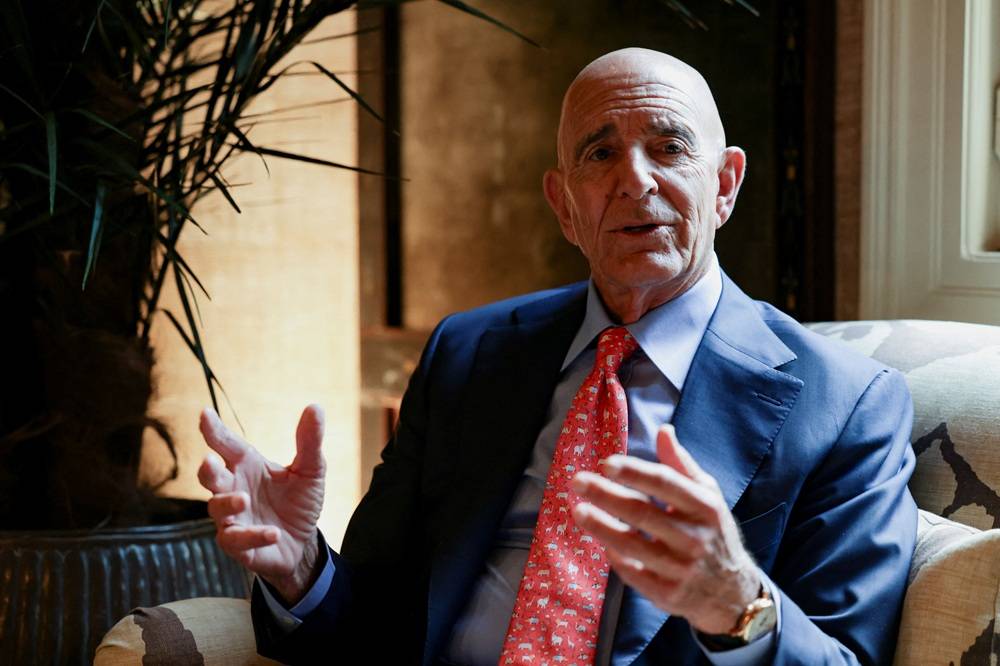
US Ambassador to Türkiye and Special Envoy for Syria Thom Barrack attends an interview with Reuters in Beirut, Lebanon July 22, 2025. (Reuters)

Lebanon, on the other hand, is seen as very complicated for the Arabs, so they decided that they will invest in Syria and shape a new country. Lebanon will benefit the most from this because Saudi Arabia, Qatar, and the United Arab Emirates will pump funds there.

As usual, however, the Lebanese have to decide what to do, he stressed.

Ultimately, relations between Lebanon and Syria boil down to a lack of trust, Barrack said. Agreement between the two sides will be very important. The current leadership is in no way affiliated with the ousted regime, so, from that standpoint, there should be no issue with it.

Patriarch Rahi

Barrack had met on Wednesday with Maronite Patriarch Beshara al-Rahi, who told his guest that the Lebanese people were awaiting the outcomes of his visit.

Barrack responded that he doesn’t know what the ending will look like, but efforts are underway to achieve stability.

He said his visit carried hope, which should be the focus, instead of statements made here and there.

He said he can offer hope, money and support because the Gulf and world stand with Lebanon, while reiterating the demand to limit the possession of arms in the country to the state.

Barrack acknowledged that the situation is complicated for the Lebanese leaders, adding that he will return to Lebanon when the need arises.

The government, meanwhile, must decide what it needs to do. The US is not the only one that wants to help Lebanon, but the Gulf and neighbors too, but to do so, the Lebanese people must achieve stability, he urged.



Fidan, Barrack Discuss Merging of SDF in Syrian Army, Erdogan Warns of Israeli Violations

Turkish Foreign Minister Hakan Fidan and US special envoy to Syria Tom Barrack meet on Tuesday. (Turkish Foreign Ministry)
TT

Fidan, Barrack Discuss Merging of SDF in Syrian Army, Erdogan Warns of Israeli Violations

Turkish Foreign Minister Hakan Fidan and US special envoy to Syria Tom Barrack meet on Tuesday. (Turkish Foreign Ministry)

Turkish Foreign Minister Hakan Fidan and US special envoy to Syria Tom Barrack held talks on Tuesday on the latest developments in Syria a year after the ouster of Bashar al-Assad's regime.

They discussed the measures needed to establish stability in Syria and maintain its territorial integrity.

Turkish sources said the meeting focus primarily on the implementation of the agreement between Syrian interim President Ahmed al-Sharaa and Syrian Democratic Forces (SDF) leader Abdi Mazloum on the merger of the Kurdish forces in the Syrian army.

The agreement was signed in Damascus in March and should have been completed by December.

Fidan and Barrack also tackled the Israeli violations and attacks against Syria and their “negative impact on its stability and unity.” They discussed sanctions on Syria and the support for political steps during the country’s transition, added the sources.

Fidan had on Saturday accused Israel of “encouraging” the SDF to renege on the March agreement.

In a televised interview, he warned that the developments in southern Syria were the “greatest danger.” He explained that the problem isn’t in the extent of the developments, but in how Israel has intervened in them.

The danger in Syria could impact Türkiye, he added.

He stressed the need for the SDF to fulfill its commitments to the March agreement and to dissolve itself and for its foreign fighters to leave Syria.

Turkish President Recep Tayyip Erdogan condemned on Tuesday the Israeli violations in Syria, saying they were the “greatest obstacle” to the country’s security and stability at the time and for the long-term.

Speaking before ambassadors to Türkiye, he vowed that Ankara will continue to support Damascus “as it has always done”.

He echoed Fidan’s demand on the SDF to commit to the March agreement, saying any delay will lead to a new crisis in Syria.

He also slammed the international silence over the “massacres that were committed in Syria” during its 13 years of civil war.

Throughout those years, “except for a few with a real conscience, we didn’t hear anything from the supporters of democracy and defenders of human rights,” he added.


Sudanese Powers Sign Declaration of Principles to End the War 

The gatherers in Nairobi held the warring parties and their allies fully responsible for any violations and war crimes. (Asharq Al-Awsat)
TT

Sudanese Powers Sign Declaration of Principles to End the War 

The gatherers in Nairobi held the warring parties and their allies fully responsible for any violations and war crimes. (Asharq Al-Awsat)

The political and civilian parties of Sudan’s Somoud alliance signed in Nairobi on Tuesday a joint declaration of principles with the Sudan Liberation Movement/Army, led by Abdul Wahid al-Nur, and the Arab Socialist Baath Party to end the war in Sudan and completely eliminate the Islamic movement from politics.

The declaration is the first act of rapprochement between Sudanese parties that are opposed to the ongoing war between the army and Rapid Support Forces (RSF). Former Prime Minister and Somoud leader Abdalla Hamdok was among the signatories.

The declaration said that “there can be no military solution to the crisis”, urging the immediate end to the war.

It called for greater pressure to be applied on the military and RSF to end the conflict and commit to the roadmap drafted by the international Quad that includes Saudi Arabia, the US, United Arab Emirates and Egypt in August.

The declaration called for the swift implementation of a proposed three-month humanitarian truce and for an unconditional ceasefire.

Sudan Liberation Movement/Army deputy leader Abdullah Harran said the signatories of the declaration agreed on the need to expand it further and to bring in more parties to sign it, excluding the ousted National Congress.

Harran told a press conference that the declaration aims to establish a wide popular civilian base that will embark on a transitional phase, leading up to holding free and transparent elections.

The Sudan Liberation Movement/Army holds some regions in central Darfur and has extended its influence in northern parts of the province. It has received tens of thousands of refugees from el-Fasher in areas under its control.

Leading member of the Arab Socialist Baath Party Wajdi Saleh said the gatherers in Nairobi agreed on a “unified vision” to end the war.

They signed three documents, he revealed. The first is the declaration of principles to build a new nation, the second is a roadmap to stop the war and the third aims to designate the National Congress and Islamic movement as terrorist.

Moreover, he declared that the warring parties would be barred from taking part in the democratic transition.

The gatherers held the warring parties and their allies fully responsible for any violations and war crimes, calling on regional and international powers, led by the Quad, to intervene decisively to implement a humanitarian truce.


Israeli Settler Kills 16-Year-Old Palestinian in West Bank, Mayor Says

Friends and family gather around the body of Ammar Yasser Sabbah, 16, ahead of his funeral at a morgue in Bethlehem on December 16, 2025, after he was killed by Israeli forces in the town of Tuqu’, east of Bethlehem during a military raid the day before. (AFP)
TT

Israeli Settler Kills 16-Year-Old Palestinian in West Bank, Mayor Says

Friends and family gather around the body of Ammar Yasser Sabbah, 16, ahead of his funeral at a morgue in Bethlehem on December 16, 2025, after he was killed by Israeli forces in the town of Tuqu’, east of Bethlehem during a military raid the day before. (AFP)

An Israeli settler shot dead a 16-year-old Palestinian in Tuqu' on Tuesday after the funeral of another teenager, the town's mayor said.

Violence has escalated in the West Bank since the beginning of the war in Gaza in October 2023. Attacks by Israeli settlers against Palestinians in the West Bank have increased sharply, with the UN reporting the highest number of attacks on record in October.

The Israeli military did not immediately respond to a request for comment on Muheeb Jibril's death on Tuesday.

"Today, after the funeral of 16-year-old Ammar Sabah, who was killed yesterday by the Israeli army in the town center, a number of youths were gathered by the main street when a settler shot 16-year-old Muheeb Jibril in the head," Tuqu' Mayor Mohammed al-Badan told Reuters by telephone.

Israeli forces killed Sabah on Monday during a military raid on the town, the Palestinian health ministry said. The military said the incident was under review. It said rocks were thrown at soldiers who used riot dispersal means and later responded with fire.

The West Bank is home to 2.7 million Palestinians who have limited self-rule under Israeli military occupation. Hundreds of thousands of Israelis have settled there.

Most world powers deem Israel's settlements, on land it captured in a 1967 war, illegal, and numerous UN Security Council resolutions have called on Israel to halt all settlement activity.

Israel denies the illegality of the settlements, citing biblical and historical connections to the land.