


Dozens of Children and Adults in Gaza Have Starved to Death in July as Hunger Surges 

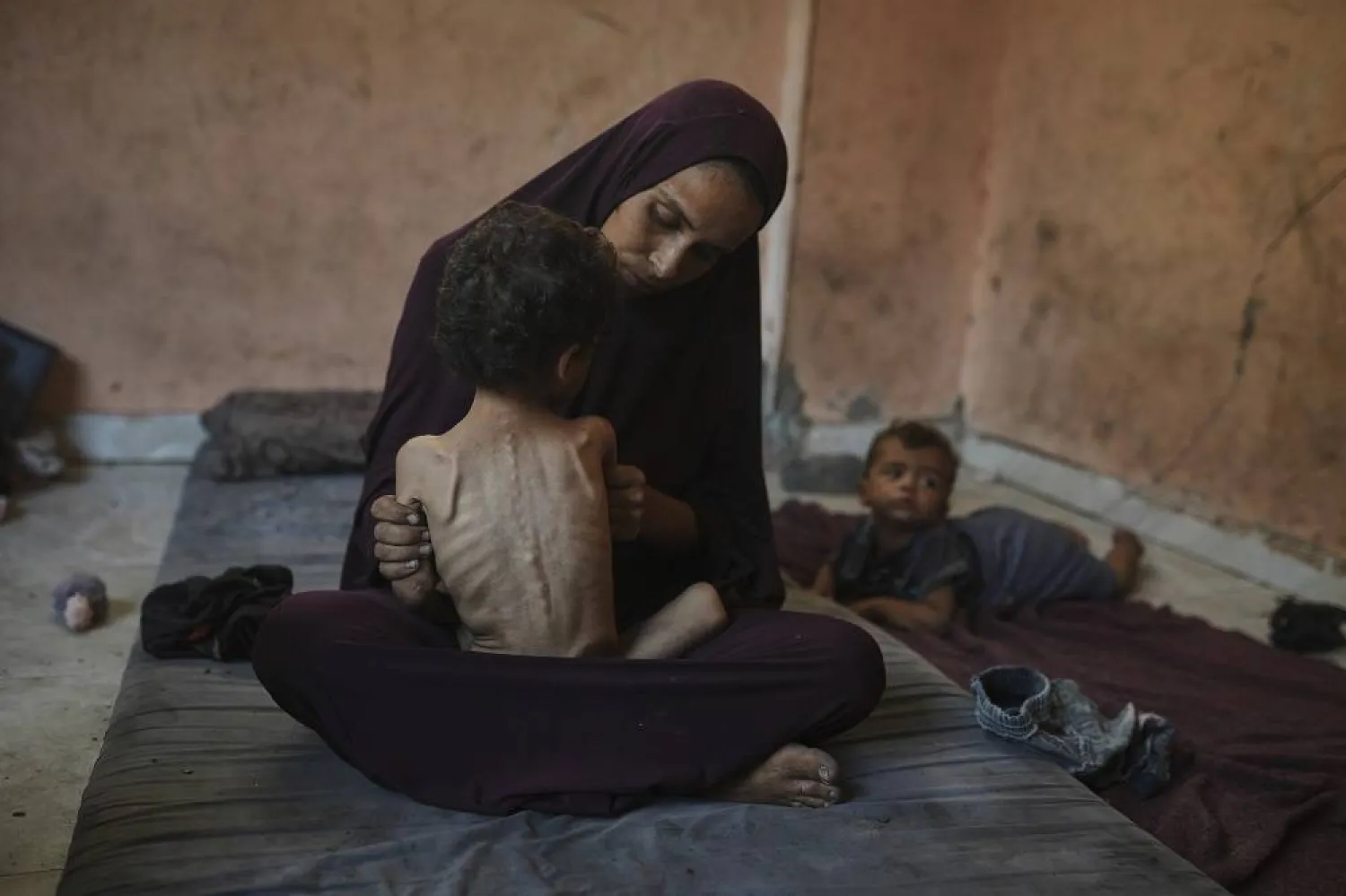
Naima Abu Ful holds her malnourished 2-year-old child, Yazan, at their home in the Shati refugee camp in Gaza City on Wednesday, July 23, 2025. (AP)
TT

Dozens of Children and Adults in Gaza Have Starved to Death in July as Hunger Surges 

Naima Abu Ful holds her malnourished 2-year-old child, Yazan, at their home in the Shati refugee camp in Gaza City on Wednesday, July 23, 2025. (AP)

Five starving children at a Gaza City hospital were wasting away, and nothing the doctors tried was working. The basic treatments for malnourishment that could save them had run out under Israel's blockade. The alternatives were ineffective. One after another, the babies and toddlers died over four days.

In greater numbers than ever, children hollowed up by hunger are overwhelming the Patient's Friends Hospital, the main emergency center for malnourished kids in northern Gaza.

The deaths last weekend also marked a change: the first seen by the center in children who had no preexisting conditions. Symptoms are getting worse, with children too weak to cry or move, said Dr. Rana Soboh, a nutritionist. In past months, most improved, despite supply shortages, but now patients stay longer and don't get better, she said.

“There are no words in the face of the disaster we are in. Kids are dying before the world ... There is no uglier and more horrible phase than this,” said Soboh, who works with the US-based aid organization Medglobal, which supports the hospital.

This month, the hunger that has been building among Gaza’s more than 2 million Palestinians passed a tipping point into accelerating death, aid workers and health staff say. Not only children — usually the most vulnerable — are falling victim under Israel’s blockade since March, but also adults.

In the past three weeks, at least 48 people died of causes related to malnutrition, including 28 adults and 20 children, the Gaza Health Ministry said Thursday. That’s up from 10 children who died in the five previous months of 2025, according to the ministry.

The UN reports similar numbers. The World Health Organization said Wednesday it has documented 21 children under 5 who died of causes related to malnutrition in 2025. The UN humanitarian office, OCHA, said Thursday at least 13 children's deaths were reported in July, with the number growing daily.

“Humans are well developed to live with caloric deficits, but only so far,” said Dr. John Kahler, Medglobal's co-founder and a pediatrician who volunteered twice in Gaza during the war. “It appears that we have crossed the line where a segment of the population has reached their limits”

“This is the beginning of a population death spiral," he said.

The UN’s World Food Program says nearly 100,000 women and children urgently need treatment for malnutrition. Medical workers say they have run out of many key treatments and medicines.

Israel, which began letting in only a trickle of supplies the past two months, has blamed Hamas for disrupting food distribution. The UN counters that Israel, which has restricted aid since the war began, simply has to allow it to enter freely.

Hundreds of malnourished kids brought daily

The Patient's Friends Hospital overflows with parents bringing in scrawny children – 200 to 300 cases a day, said Soboh.

On Wednesday, staff laid toddlers on a desk to measure the circumference of their upper arms — the quickest way to determine malnutrition. In the summer heat, mothers huddled around specialists, asking for supplements. Babies with emaciated limbs screamed in agony. Others lay totally silent.

The worst cases are kept for up to two weeks at the center's 10-bed ward, which this month has had up to 19 children at a time. It usually treats only children under 5, but began taking some as old as 11 or 12 because of worsening starvation among older children.

Hunger gnaws at staff as well. Soboh said two nurses put themselves on IV drips to keep themselves going. “We are exhausted. We are dead in the shape of the living,” she said.

The five children died in succession last Thursday, Saturday and Sunday.

Four of them, aged 4 months to 2 years, had suffered gastric arrest: Their stomachs shut down. The hospital no longer had the right nutrition supplies for them.

The fifth — 4 1/2-year-old Siwar — had alarmingly low potassium levels, a growing problem. She was so weak she could barely move her body. Medicine for potassium deficiency has largely run out across Gaza, Soboh said. The center had only a low-concentration potassium drip.

The little girl didn’t respond. After three days in the ICU, she died Saturday.

“If we don’t have potassium (supplies), we will see more deaths,” she said.

A 2-year-old is wasting away

In the Shati Refugee Camp in Gaza city, 2-year-old Yazan Abu Ful’s mother, Naima, pulled off his clothes to show his emaciated body. His vertebrae, ribs and shoulder-blades jutted out. His buttocks were shriveled. His face was expressionless.

His father Mahmoud, who was also skinny, said they took him to the hospital several times. Doctors just say they should feed him. “I tell the doctors, ‘You see for yourself, there is no food,’” he said,

Naima, who is pregnant, prepared a meal: Two eggplants they bought for $9 cut up and boiled in water. They will stretch out the pot of eggplant-water – not even a real soup – to last them a few days, they said. Several of Yazan’s four older siblings also looked thin and drained.

Holding him in his lap, Mahmoud Abu Ful lifted Yazan’s limp arms. The boy lies on the floor most of the day, too weak to play with his brothers. “If we leave him, he might just slip away from between our fingers, and we can’t do anything.”

Adults, too, are dying

Starvation takes the vulnerable first, experts say: children and adults with health conditions.

On Thursday, the bodies of an adult man and woman with signs of starvation were brought to Gaza City's Shifa Hospital, hospital director Mohammed Abu Selmia said. One suffered from diabetes, the other from a heart condition, but they showed severe deficiencies of nutrients, gastric arrest and anemia from malnutrition.

Many of the adults who have died had some sort of preexisting condition, like diabetes or heart or kidney trouble, worsened by malnutrition, Abu Selmia said. “These diseases don’t kill if they have food and medicine,” he said.

Deaths come after months of Israeli siege

Israel cut off entry of food, medicine, fuel and other supplies completely to Gaza for 2 ½ months starting in March, saying it aimed to pressure Hamas to release hostages. During that time, food largely ran out for aid groups and in marketplaces, and experts warned Gaza was headed for an outright famine.

In late May, Israel slightly eased the blockade. Since then, it has allowed in around 4,500 trucks for the UN and other aid groups to distribute, including 2,500 tons of baby food and high-calorie special food for children, the Israeli Foreign Ministry said Wednesday.

That is an average of 69 trucks a day, far below the 500-600 trucks a day the UN says are needed. The UN has been unable to distribute much of the aid because hungry crowds and gangs take most of it from its trucks. Separately, Israel has also backed the Gaza Humanitarian Foundation, which opened four centers distributing boxes of food supplies. Hundreds of Palestinians have been killed trying to reach the sites.

On Tuesday, David Mencer, spokesman for the Israeli Prime Minister’s office, denied there is a “famine created by Israel” in Gaza and blamed Hamas for creating “man-made shortages” by looting aid trucks.

The UN denies Hamas siphons off significant quantities of aid. Humanitarian workers say Israel just needs to allow aid to flow in freely, saying looting stops whenever aid enters in large quantities.



Syrian Government Forces and Druze Factions Exchange Prisoners in Sweida

A delegation from the Sweida Governorate inspects the service situation in the villages of the western countryside (SANA)
TT

Syrian Government Forces and Druze Factions Exchange Prisoners in Sweida

A delegation from the Sweida Governorate inspects the service situation in the villages of the western countryside (SANA)

The Syrian government and Druze factions controlling the southern city of Sweida on Thursday carried out ‌their first ‌prisoner exchange ‌since ⁠deadly clashes in the ⁠predominantly Druze city last summer, according to the Syrian ⁠government's Sweida media office.

The ‌swap ‌involved Damascus ‌releasing 61 ‌prisoners from the Druze factions detained in Adra ‌Central Prison near the capital, in ⁠return ⁠for the Druze's National Guard Forces freeing 25 Syrian government personnel, the media office said.


Syrian Interior Ministry: Conditions in Al-Hol Camp ‘Shocking’

Al-Hol camp in Hasakah province, northeastern Syria, on Feb. 24, after Syrian authorities closed the camp, which had been under Kurdish control (AFP)
TT

Syrian Interior Ministry: Conditions in Al-Hol Camp ‘Shocking’

Al-Hol camp in Hasakah province, northeastern Syria, on Feb. 24, after Syrian authorities closed the camp, which had been under Kurdish control (AFP)

Interior Ministry spokesperson Noureddine al-Baba said Syrian forces were surprised by the withdrawal of the Kurdish-led Syrian Democratic Forces (SDF) from Al-Hol camp more than six hours before the Syrian army arrived to assume control.

Al-Hol, the largest camp for relatives of suspected ISIS militants in northeastern Syria, had been under the control of the SDF. But last month, Syrian troops drove Kurdish forces from swathes of the north, sparking questions over the fate of the ISIS prisoners and their families.

Al-Baba noted that much of what has been reported about Al-Hol camp requires careful verification due to what he described as “exaggerations.” He confirmed that a number of those who had fled the camp were returned and had their legal status regularized.

His remarks came as the Interior Ministry announced the launch of two security operations against ISIS cells in the provinces of Raqqa and Deir Ezzor, following several attacks by the group on Syrian forces.

Security Plan in Hasakah

At a press conference, al-Baba said the ministry had prepared a comprehensive security deployment plan to secure Hasakah province, coinciding with the entry of Syrian army units last month.

The move was part of the implementation of an agreement between the Syrian government and the SDF aimed at ensuring stability and enforcing the terms of their understanding.

However, shortly before Syrian army units reached the outskirts of Al-Hol camp, “we were surprised” by what he described as an uncoordinated SDF withdrawal more than six hours earlier.

Al-Baba said the ministry followed up on the cases of those who left the camp in an unorganized manner, adding that most had been returned and their legal status settled. The families have been transferred to an alternative site offering improved humanitarian conditions and easier access.

He added that coordination is ongoing with relevant international and local organizations to verify the identities of individuals who lost documentation, determine where the documents were lost, and match records with civil registries. Work is also underway to establish a unified national database covering all of Syria.

European Concerns

A memo, sent from the Cyprus presidency of the Council of the European Union to member states and dated February 23, said the status of third-country nationals who had fled Al-Hol remained unclear and that it was reported that a majority of them had escaped.

"This raises concerns about how terrorist groups might seek to capitalize on the current situation to increase recruitment efforts among escapees," said the memo, which was reviewed by Reuters.

Earlier, Human Rights Watch cautioned that the security vacuum had allowed suspected ISIS affiliates to escape, exposing women and children to serious risks, including trafficking, exploitation, and recruitment by armed groups.

“Children, Women and the Elderly”

Al-Baba described conditions inside the camp upon its handover as “shocking and resembling a forced detention camp,” where thousands of people had been held for years under harsh conditions in a semi-desert area lacking basic infrastructure.

He said that 70 percent of detainees were children, women and elderly people, most of them Syrians and Iraqis. “They are civilians displaced from areas of fighting and were forcibly detained on the pretext of affiliation with ISIS,” he stated.

Al-Baba added that around 6,500 detainees from 44 non-Syrian nationalities were being held at the camp, noting discrepancies between commonly circulated figures and the actual numbers.

He stressed that all information circulated about the camp requires thorough investigation and verification due to what he described as exaggerations regarding the number of residents. Accurate figures and data, he said, will be disclosed once the verification process is completed.

Background on Al-Hol

Al-Hol camp, located in Hasakah province near the Iraqi border, has been one of the main detention centers for families of ISIS fighters captured during the US-led international coalition campaign against the group in Syria.

The camp had been under SDF control from 2015 until January 20 of this year, when it was handed over to the Syrian government following its takeover of most areas in eastern and northern Syria.

Al-Baba said that from the first moment of assuming control, the Syrian government has been working to address the humanitarian situation, restore security, and prevent disorder.

He revealed that more than 138 breaches were recorded along the 17-kilometer section of the perimeter fence, adding that it will now be placed under the supervision of the relevant authorities.


Prince Harry and Meghan Visit Hospitalized Children from Gaza, Refugee Camp during Jordan Trip

Britain's Prince Harry and Meghan, the Duke and Duchess of Sussex, attend a World Health Organisation roundtable hosted by Tedros Adhanom Ghebreyesus and regional WHO leadership, along with key donors and humanitarian partners, in Amman, Jordan, February 25, 2026. World Health Organisation (WHO)/Handout via REUTERS
TT

Prince Harry and Meghan Visit Hospitalized Children from Gaza, Refugee Camp during Jordan Trip

Britain's Prince Harry and Meghan, the Duke and Duchess of Sussex, attend a World Health Organisation roundtable hosted by Tedros Adhanom Ghebreyesus and regional WHO leadership, along with key donors and humanitarian partners, in Amman, Jordan, February 25, 2026. World Health Organisation (WHO)/Handout via REUTERS

Prince Harry and Meghan visited a refugee camp and hospital in Jordan on Wednesday to kick off a trip spotlighting organizations that help civilians affected by war and displacement.

The Duke and Duchess of Sussex also joined World Health Organization Director-General Tedros Adhanom Ghebreyesus for a roundtable with the WHO's regional leaders, some of their humanitarian partners and key donors, The Associated Press said.

“It is an honor and a privilege to be in a room full of people with such big hearts,” Harry told the group. “I don’t know how many times you get thanked for all the work that you do — probably not enough.”

Since stepping aside as working royals in 2020, the couple has prioritized support for projects that assist civilians affected by war, especially injured and displaced children. Their nonprofit, Archewell Philanthropies, recently supported WHO efforts to evacuate children from Gaza and bring them to Jordan for treatment.

Harry and Meghan met some of those children Wednesday at Specialty Hospital in Amman. They also visited Za’atari Refugee Camp, home to thousands of Syrians who remain displaced after more than a decade of conflict in their home country.

The couple were scheduled Thursday to visit the Amman office of World Central Kitchen, which organizes and sends food and other humanitarian assistance to Gaza. Harry and Meghan are longtime supporters of World Central Kitchen, their nonprofit's first philanthropic partner.