


USAID Analysis Finds No Evidence of Massive Hamas Theft of Gaza Aid 

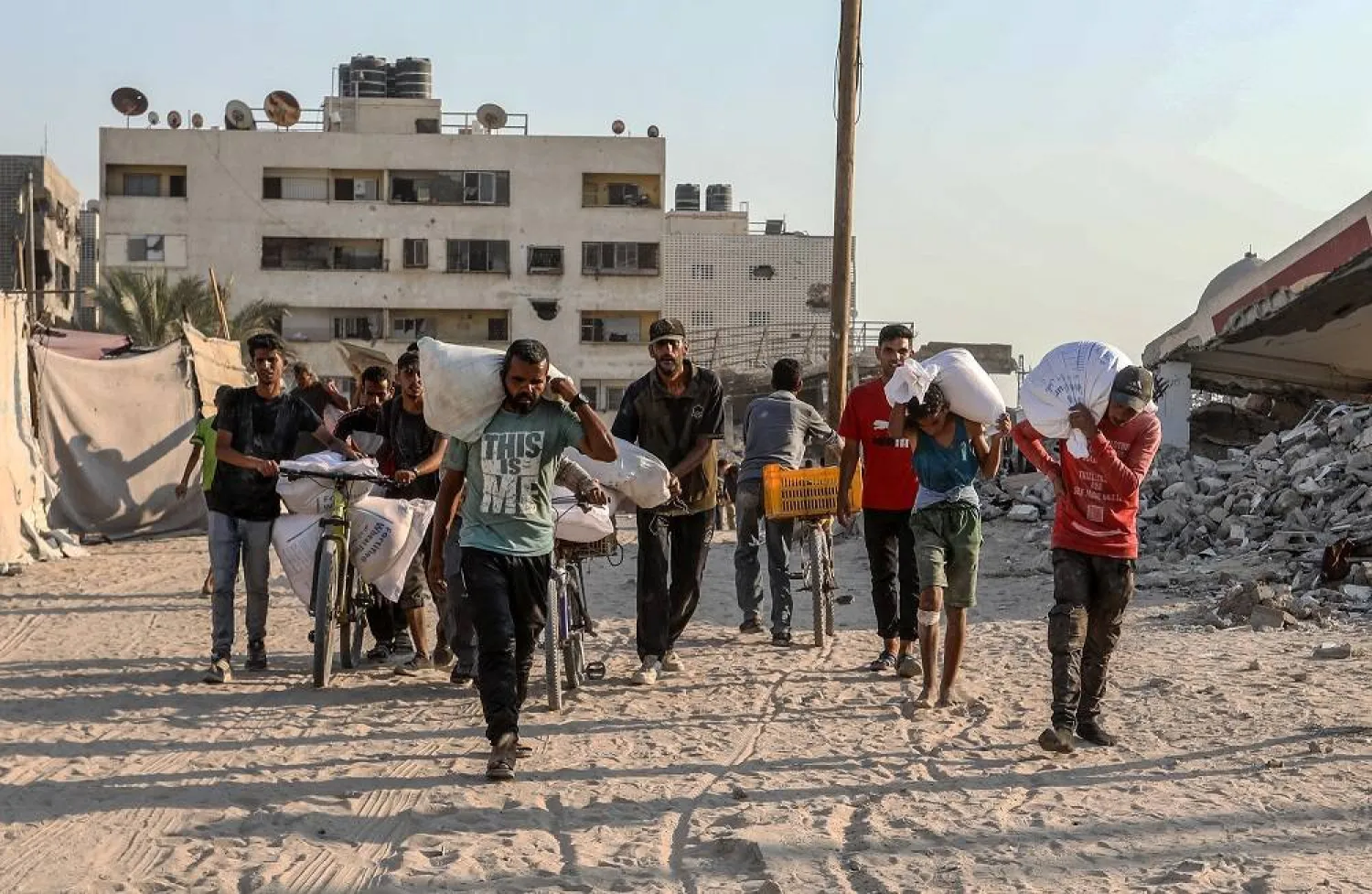
24 July 2025, Palestinian Territories, Khan Younis: Palestinians carrying bags of flour walk along a street in Khan Younis after trucks carrying humanitarian aid entered the southern Gaza Strip through the Israeli-controlled Kerem Shalom border crossing. (dpa)
TT

USAID Analysis Finds No Evidence of Massive Hamas Theft of Gaza Aid 

24 July 2025, Palestinian Territories, Khan Younis: Palestinians carrying bags of flour walk along a street in Khan Younis after trucks carrying humanitarian aid entered the southern Gaza Strip through the Israeli-controlled Kerem Shalom border crossing. (dpa)

An internal US government analysis found no evidence of systematic theft by the Palestinian group Hamas of US-funded humanitarian supplies, challenging the main rationale that Israel and the US give for backing a new armed private aid operation.

The analysis, which has not been previously reported, was conducted by a bureau within the US Agency for International Development and completed in late June. It examined 156 incidents of theft or loss of US-funded supplies reported by US aid partner organizations between October 2023 and this May.

It found "no reports alleging Hamas" benefited from US-funded supplies, according to a slide presentation of the findings seen by Reuters.

A State Department spokesperson disputed the findings, saying there is video evidence of Hamas looting aid, but provided no such videos. The spokesperson also accused traditional humanitarian groups of covering up "aid corruption."

The findings were shared with the USAID's inspector general's office and State Department officials involved in Middle East policy, said two sources familiar with the matter, and come as dire food shortages deepen in the devastated enclave.

Israel says it is committed to allowing in aid but must control it to prevent it from being stolen by Hamas, which it blames for the crisis.

The UN World Food Program says nearly a quarter of Gaza’s 2.1 million Palestinians face famine-like conditions, thousands are suffering acute malnutrition, and the World Health Organization and doctors in the enclave report starvation deaths of children and others.

The UN also estimates that Israeli forces have killed more than 1,000 people seeking food supplies, the majority near the militarized distribution sites of the Gaza Humanitarian Foundation (GHF), the new private aid group that uses a for-profit US logistics firm run by a former CIA officer and armed US military veterans.

The study was conducted by the Bureau of Humanitarian Assistance (BHA) of USAID, which was the largest funder of assistance to Gaza before the Trump administration froze all US foreign aid in January, terminating thousands of programs. It has also begun dismantling USAID, whose functions have been folded into the State Department.

The analysis found that at least 44 of the 156 incidents where aid supplies were reported stolen or lost were "either directly or indirectly" due to Israeli military actions, according to the briefing slides.

Israel's military did not respond to questions about those findings.

The study noted a limitation: because Palestinians who receive aid cannot be vetted, it was possible that US-funded supplies went to administrative officials of Hamas, the rulers of Gaza.

One source familiar with the study also cautioned that the absence of reports of widespread aid diversion by Hamas "does not mean that diversion has not occurred."

The war in Gaza began after Hamas attacked Israel in October 2023, killing 1,200 people and capturing 251 hostages, according to Israeli tallies. Nearly 60,000 Palestinians have been killed since the Israeli assault began, according to Palestinian health officials.

ISRAEL SAYS HAMAS DIVERTS HUMANITARIAN AID

Israel, which controls access to Gaza, has said that Hamas steals food supplies from UN and other organizations to use to control the civilian population and boost its finances, including by jacking up the prices of the goods and reselling them to civilians.

Asked about the USAID report, the Israeli military told Reuters that its allegations are based on intelligence reports that Hamas fighters seized cargoes by "both covertly and overtly" embedding themselves on aid trucks.

Those reports also show that Hamas has diverted up to 25% of aid supplies to its fighters or sold them to civilians, the Israeli military said, adding that GHF has ended the group's control of aid by distributing it directly to civilians.

Hamas denies the allegations. A Hamas security official said that Israel has killed more than 800 Hamas-affiliated police and security guards trying to protect aid vehicles and convoy routes. Their missions were coordinated with the UN.

Reuters could not independently verify the claims by Hamas and Israel, which has not made public proof that the fighters have systematically stolen aid.

GHF also accuses Hamas of massive aid theft in defending its distribution model. The UN and other groups have rejected calls by GHF, Israel and the US to cooperate with the foundation, saying it violates international humanitarian principles of neutrality.

In response to a request for comment, GHF referred Reuters to a July 2 Washington Post article that quoted an unidentified Gazan and anonymous Israeli officials as saying Hamas profited from the sales and taxing of pilfered humanitarian aid.

AID GROUPS REQUIRED TO REPORT LOSSES

The 156 reports of theft or losses of supplies reviewed by BHA were filed by UN agencies and other humanitarian groups working in Gaza as a condition of receiving US aid funds.

The second source familiar with the matter said that after receiving reports of US-funded aid thefts or losses, USAID staff followed up with partner organizations to try to determine if there was Hamas involvement.

Those organizations also would "redirect or pause" aid distributions if they learned that Hamas was in the vicinity, the source said. Aid organizations working in Gaza also are required to vet their personnel, sub-contractors and suppliers for ties to extremist groups before receiving US funds, a condition that the State Department waived in approving $30 million for GHF last month.

The slide presentation noted that USAID partners tended to over-report aid diversion and theft by groups sanctioned or designated by the US as foreign terrorist organizations - such as Hamas and Palestinian Islamic Jihad - because they want to avoid losing US funding.

Of the 156 incidents of loss or theft reported, 63 were attributed to unknown perpetrators, 35 to armed actors, 25 to unarmed people, 11 directly to Israeli military action, 11 to corrupt subcontractors, five to aid group personnel "engaging in corrupt activities," and six to "others," a category that accounted for "commodities stolen in unknown circumstances," according to the slide presentation.

The armed actors "included gangs and other miscellaneous individuals who may have had weapons," said a slide. Another slide said "a review of all 156 incidents found no affiliations with" US-designated foreign terrorist organizations, of which Hamas is one.

"The majority of incidents could not be definitively attributed to a specific actor," said another slide. "Partners often largely discovered the commodities had been stolen in transit without identifying the perpetrator."

It is possible there were classified intelligence reports on Hamas aid thefts, but BHA staff lost access to classified systems in the dismantlement of USAID, said a slide.

However, a source familiar with US intelligence assessments told Reuters that they knew of no US intelligence reports detailing Hamas aid diversions and that Washington was relying on Israeli reports.

The BHA analysis found that the Israeli military "directly or indirectly caused" a total of 44 incidents in which US-funded aid was lost or stolen. Those included the 11 attributed to direct Israeli military actions, such as airstrikes or orders to Palestinians to evacuate areas of the war-torn enclave.

Losses indirectly attributed to Israeli military included cases where they compelled aid groups to use delivery routes with high risks of theft or looting, ignoring requests for alternative routes, the analysis said.



Israeli Settler Kills 16-Year-Old Palestinian in West Bank, Mayor Says

Friends and family gather around the body of Ammar Yasser Sabbah, 16, ahead of his funeral at a morgue in Bethlehem on December 16, 2025, after he was killed by Israeli forces in the town of Tuqu’, east of Bethlehem during a military raid the day before. (AFP)
TT

Israeli Settler Kills 16-Year-Old Palestinian in West Bank, Mayor Says

Friends and family gather around the body of Ammar Yasser Sabbah, 16, ahead of his funeral at a morgue in Bethlehem on December 16, 2025, after he was killed by Israeli forces in the town of Tuqu’, east of Bethlehem during a military raid the day before. (AFP)

An Israeli settler shot dead a 16-year-old Palestinian in Tuqu' on Tuesday after the funeral of another teenager, the town's mayor said.

Violence has escalated in the West Bank since the beginning of the war in Gaza in October 2023. Attacks by Israeli settlers against Palestinians in the West Bank have increased sharply, with the UN reporting the highest number of attacks on record in October.

The Israeli military did not immediately respond to a request for comment on Muheeb Jibril's death on Tuesday.

"Today, after the funeral of 16-year-old Ammar Sabah, who was killed yesterday by the Israeli army in the town center, a number of youths were gathered by the main street when a settler shot 16-year-old Muheeb Jibril in the head," Tuqu' Mayor Mohammed al-Badan told Reuters by telephone.

Israeli forces killed Sabah on Monday during a military raid on the town, the Palestinian health ministry said. The military said the incident was under review. It said rocks were thrown at soldiers who used riot dispersal means and later responded with fire.

The West Bank is home to 2.7 million Palestinians who have limited self-rule under Israeli military occupation. Hundreds of thousands of Israelis have settled there.

Most world powers deem Israel's settlements, on land it captured in a 1967 war, illegal, and numerous UN Security Council resolutions have called on Israel to halt all settlement activity.

Israel denies the illegality of the settlements, citing biblical and historical connections to the land.


Family of Bondi Hero in Syria Says His Home Country Is Proud of Him

 Uncle and cousin of Ahmed al-Ahmed, both named Mohammed al-Ahmed, look at the footage of Ahmed al-Ahmed, the bystander who disarmed a gunman during a shooting at a Hanukkah event at Sydney's Bondi Beach, in the town of Nayrab in the northwestern province of Idlib, Syria, December 16, 2025. (Reuters)
Uncle and cousin of Ahmed al-Ahmed, both named Mohammed al-Ahmed, look at the footage of Ahmed al-Ahmed, the bystander who disarmed a gunman during a shooting at a Hanukkah event at Sydney's Bondi Beach, in the town of Nayrab in the northwestern province of Idlib, Syria, December 16, 2025. (Reuters)
TT

Family of Bondi Hero in Syria Says His Home Country Is Proud of Him

 Uncle and cousin of Ahmed al-Ahmed, both named Mohammed al-Ahmed, look at the footage of Ahmed al-Ahmed, the bystander who disarmed a gunman during a shooting at a Hanukkah event at Sydney's Bondi Beach, in the town of Nayrab in the northwestern province of Idlib, Syria, December 16, 2025. (Reuters)
Uncle and cousin of Ahmed al-Ahmed, both named Mohammed al-Ahmed, look at the footage of Ahmed al-Ahmed, the bystander who disarmed a gunman during a shooting at a Hanukkah event at Sydney's Bondi Beach, in the town of Nayrab in the northwestern province of Idlib, Syria, December 16, 2025. (Reuters)

As Australia's worst mass shooting in nearly 30 years unfolded, a Sydney shop owner was captured on camera charging at one of the gunmen and disarming him. Halfway around the world in Syria, a group of men watching the footage recognized a familiar face.

Ahmed al-Ahmed, 43, left his hometown in Syria's northwest province of Idlib nearly 20 years ago to seek work in Australia. On Sunday, he was wounded after wrestling a rifle away from a man attacking a Jewish holiday event at Sydney's Bondi Beach, in which 15 people were killed.

SYRIA IS 'PROUD OF HIM'

His uncle, Mohammed al-Ahmed, recognized him from footage circulating online.

"We learned through social media. I called his father and he told me that it was Ahmed. Ahmed is a hero, we're proud of him. Syria in general is proud of him," the uncle told Reuters.

The family hails from the town of Nayrab, which was bombed heavily during Syria's nearly 14-year war, which ended when longtime leader Bashar al-Assad was ousted in an opposition offensive launched from Idlib last year.

Ahmed said his nephew left Syria in 2006 after completing a degree at Aleppo University. He hasn't been back since.

"Since he was young, he was gallant and a hero," his uncle said, describing him as a happy and passionate person.

"He acted impulsively without thinking who the people were that were being killed - without knowing their religion, if they were Muslim or Christian or Jewish. That's what made him jump up and carry out this heroic act."

'PEACEMAKERS, NOT WARMONGERERS'

Ahmed, who now holds Australian citizenship and has two daughters, remains in a Sydney hospital with gunshot wounds. He has been hailed as a hero around the world, including by US President Donald Trump.

A GoFundMe campaign set up for him has raised more than A$2.2 million ($1.5 million).

Back at home, the Ahmed family home remains in ruins. Piles of smashed cinderblocks ring the concrete carcass of the two-storey house, whose walls are punctured by shelling.

"This is Ahmed's father's home. It got destroyed during the war. Bombing, bombing from planes, missiles - every type of weapon," Ahmed's cousin, who is also named Mohammad al-Ahmed, told Reuters.

He said his cousin "was the reason that many innocent people who did nothing wrong were saved."

"He will prove to the world that Muslims are peacemakers, not warmongers," said Ahmed.


Barrack Presses Netanyahu to Accept a Turkish Role in Gaza

Photo of the meeting between the US Special Envoy to Syria, Tom Barrack, and Israeli Prime Minister Benjamin Netanyahu on Monday (Israeli Government). 
TT

Barrack Presses Netanyahu to Accept a Turkish Role in Gaza

Photo of the meeting between the US Special Envoy to Syria, Tom Barrack, and Israeli Prime Minister Benjamin Netanyahu on Monday (Israeli Government). 

Hebrew-language media reported that Israeli Prime Minister Benjamin Netanyahu met on Monday in Jerusalem with US envoy Tom Barrack, amid what were described as unusually blunt private messages from the administration of President Donald Trump ahead of a planned US–Israel summit later this month in Florida.

According to the reports, the talks focused on three files: Gaza, Syria and Netanyahu’s expected meeting with Trump.

On Gaza, Israeli daily Yedioth Ahronoth said Barrack sought to allay Netanyahu’s concerns about a Turkish role in any international force deployed to the enclave during a prospective second phase of a fragile ceasefire that began in October. Barrack, the paper reported, argued that Türkiye has the greatest leverage over Hamas and is best placed to persuade the group to disarm.

The newspaper said Barrack reminded Netanyahu that Ankara had endorsed the Trump administration’s ceasefire framework for Gaza and had pledged, on Hamas’s behalf, to provisions related to weapons handover. He reportedly said that Turkish participation would also encourage other hesitant countries to join an international force.

According to Yedioth Ahronoth, Barrack warned that excluding Türkiye would cause those states to step back, adding that Trump would not allow the initiative to fail. Netanyahu’s public statements questioning whether Hamas would ever relinquish its weapons — and his assertion that only Israel could enforce that outcome — were described by Barrack as “unacceptable” and as jeopardizing the plan.

Israel’s Channel 12 also reported that the White House delivered a “private and sharp” message to Netanyahu, asserting that the killing of a senior Hamas military figure, Raed Saad, constituted a breach of the ceasefire brokered with Trump’s mediation.

The channel cited growing tension between the Trump administration and Netanyahu’s government over moving to the deal’s second phase and over Israel’s broader regional policies.

Two US officials were quoted as saying that Secretary of State Marco Rubio, White House envoy Steve Witkoff, and Jared Kushner, the president’s son-in-law, were “deeply frustrated” with Netanyahu’s conduct.

One senior US official was quoted as telling Israeli media that the message to Netanyahu was explicit: if he chose to damage his own credibility, that was his decision, “but we will not allow you to damage President Trump’s reputation after he mediated the Gaza agreement.”

US officials were also cited as expressing rising concern over settler violence against Palestinians in the West Bank and what they termed Israeli “provocations” that undermine Washington’s efforts to expand the Abraham Accords. The United States, one official said, was not asking Israel to compromise its security, but to avoid steps perceived in the Arab world as inflammatory.

On Syria, Israeli assessments quoted in the press said Barrack outlined US “red lines,” stressing Trump’s desire to see stability there and warning that frequent Israeli operations could risk destabilizing the country. Reports added that Washington favors reaching a security understanding and wants to avoid actions it views as undermining the Syrian leadership.

Regarding Lebanon, Trump was said to support continued pressure on Hezbollah through limited operations, while opposing a broader escalation.

Despite recent criticism by Netanyahu of Barrack — including remarks questioning his impartiality — the envoy’s visit went ahead. Columnist Nahum Barnea wrote in Yedioth Ahronoth that US officials increasingly believe Netanyahu is not serious about advancing Trump’s peace plan and is intent on prolonging the war, language he said has sparked intense anger inside the White House.

Israeli analysts suggested Netanyahu is unlikely to reject all US requests outright, instead seeking partial accommodation to ensure a successful meeting with Trump on December 29. Yet, in a show of independence, Israeli forces reportedly carried out an airstrike in Syria shortly before Barrack arrived.

Netanyahu also announced a trilateral summit with Greece and Cyprus, a move widely interpreted in Israel as a political signal directed at Türkiye.

At the close of the meeting, Barrack was quoted as saying the talks were a “constructive dialogue aimed at achieving regional peace and stability.”