


Defying US Pressure, Iraqi Factions Insist on Passing PMF Law

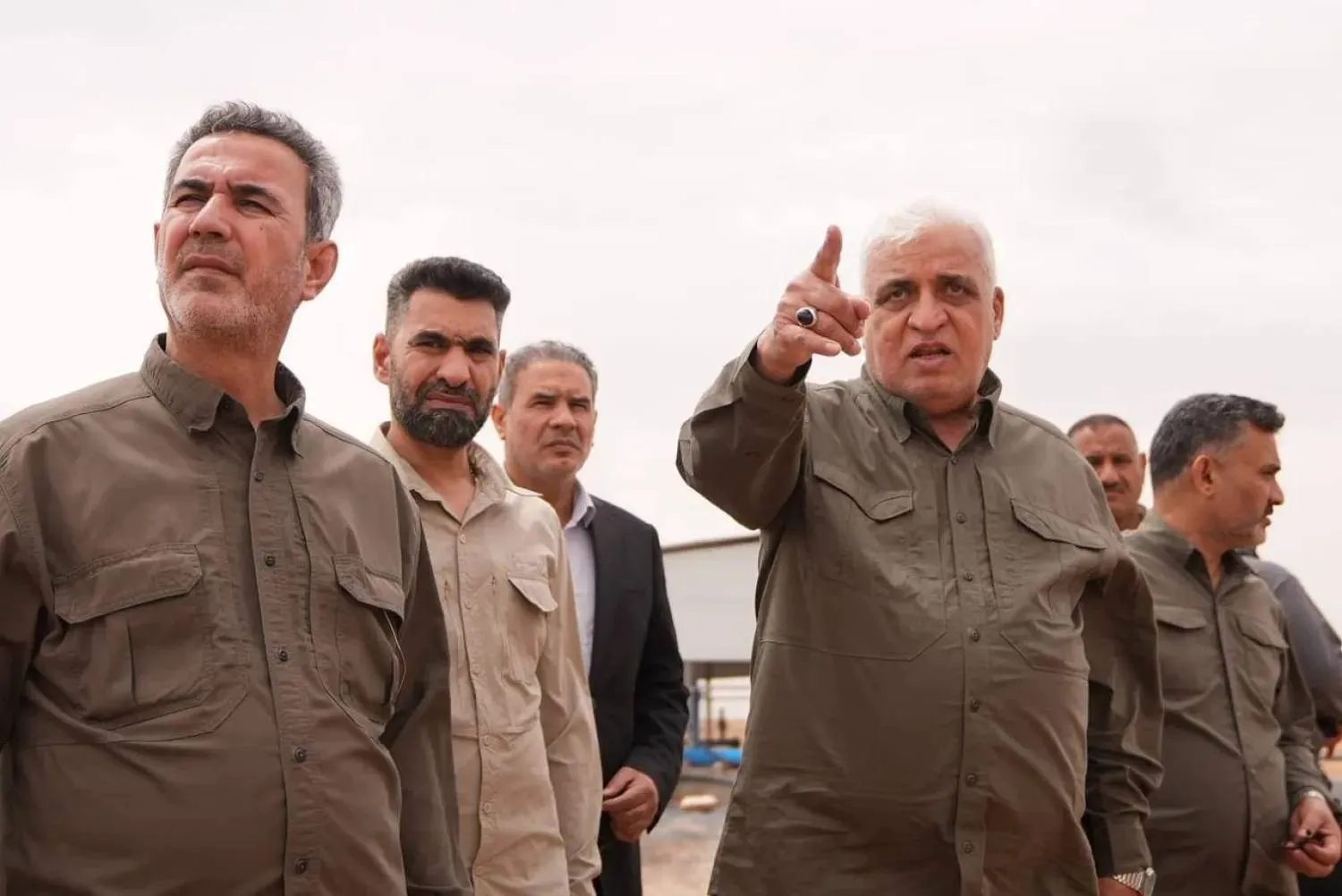
PMF leader and his chief of staff Abu Fadak Al-Mohammedawi. (PMF media)
TT

Defying US Pressure, Iraqi Factions Insist on Passing PMF Law

PMF leader and his chief of staff Abu Fadak Al-Mohammedawi. (PMF media)

Iran-aligned Iraqi factions slammed the United States following its rejection of a law on the legalization of the Popular Mobilization Forces (PMF).

US Secretary of State Marco Rubio held telephone talks on Wednesday with Iraqi Prime Minister Mohammed Shia al-Sudani to express his concern about the law.

A State Department statement said Rubio "reiterated serious US concerns with the Popular Mobilization Commission (PMC) bill currently pending in the Council of Representatives (COR), emphasizing that any such legislation would institutionalize Iranian influence and armed terrorist groups undermining Iraq’s sovereignty."

The Iraqi factions responded to Rubio’s remarks by reiterating demands for the US to pull out its troops from the country.

Head of the Asaib Ahl al-Haq faction and a leading member of the pro-Iran Coordination Framework Qais al-Khazali condemned the "flagrant American meddling in Iraqi affairs, which goes beyond diplomatic violations, but is a clear attack on national sovereignty and the essence of the democratic process that the West has long boasted about."

"Preventing the parliament from carrying out its legislative role, under American pressure, obstructs state institutions and is a form of political blackmail, which is unacceptable," he went on to say.

Kazali, who also leads an armed branch of the Coordination Framework, warned that succumbing to the US pressure is tantamount to abandoning national decision-making power and the will of the people.

Remaining silent over the issue will also "officially lead to the death of democracy in Iraq," he claimed.

The security official of the Kataib Hezbollah, known as "Abou Ali al-Askari", said Sudani is obligated to fulfill the agreement with the armed factions about the withdrawal of US troops from Iraq.

In a post on X, he noted that two months remain until its implementation and that the PM is obligated to ensure the withdrawal of the troops from Baghdad airport and the Ain al-Asad base.

"We have given the prime minister enough opportunity to commit to the agreement (...) the factions will have something to say about this," he added without elaborating.

Washington and Baghdad agreed in September 2024 on ending the mission of the anti-ISIS international coalition in Iraq within 12 months.

Meanwhile, the Coordination Framework did not make an official comment about Washington’s rejection of the PMF legislation, but it held a meeting to discuss the telephone call between Sudani and Rubio.

In a brief statement, it condemned the recent drone attacks on oil facilities in Iraqi Kurdistan.

Local media reported on an "American message, which was presented at the Coordination Framework meeting, and that warned that Iraq will suffer severe consequences should it approve the PMF legislation."

"Sponsors of the draft-law are jeopardizing their country’s sovereignty in favor of Iranian influence, warned the message," they added.

The message has not been verified.

MP Majid Shankali told local media that the parliament will not convene to discuss the PMF law, citing the American pressure.

The US will not allow this law to pass, he stated, warning that it may impose gradual sanctions if it is.


US Puts $10 Million Bounty on Iraq’s Kataib Sayyid al-Shuhada Leader

Members of Iraq's pro-Iran Hezbollah Brigades (Kataib Hezbollah) gather in a mourning procession for one of their comrades who was killed the previous day in a strike in Basra, during the funeral in Baghdad on April 8, 2026. (Photo by AHMAD AL-RUBAYE / AFP)
TT

US Puts $10 Million Bounty on Iraq’s Kataib Sayyid al-Shuhada Leader

Members of Iraq's pro-Iran Hezbollah Brigades (Kataib Hezbollah) gather in a mourning procession for one of their comrades who was killed the previous day in a strike in Basra, during the funeral in Baghdad on April 8, 2026. (Photo by AHMAD AL-RUBAYE / AFP)

The United States has placed a $10 million bounty on the leader of an Iranian-backed Shiite group in Iraq.

The US State Department’s Rewards for Justice program issued a notice it sought the leader of Kataib Sayyid al-Shuhada.

It said Hashim Finyan Rahim al-Saraji led the group, whose members “killed
Iraqi civilians and attacked US diplomatic facilities in Iraq.”

It also said Kataib Sayyid al-Shuhada attacked US military bases and personnel in Iraq and Syria.

Iraq has several Shiite groups backed by Iran that are part of the country’s Popular Mobilization Forces.


Lebanon-Israel Ceasefire Extended by 3 Weeks after White House Meeting

US President Donald Trump speaks to the media in the Oval Office of the White House in Washington, DC, USA, 23 April 2026. President Trump met with Lebanese and Israeli envoys at the White House for a new round of peace talks.  EPA/WILL OLIVER / POOL
US President Donald Trump speaks to the media in the Oval Office of the White House in Washington, DC, USA, 23 April 2026. President Trump met with Lebanese and Israeli envoys at the White House for a new round of peace talks. EPA/WILL OLIVER / POOL
TT

Lebanon-Israel Ceasefire Extended by 3 Weeks after White House Meeting

US President Donald Trump speaks to the media in the Oval Office of the White House in Washington, DC, USA, 23 April 2026. President Trump met with Lebanese and Israeli envoys at the White House for a new round of peace talks.  EPA/WILL OLIVER / POOL
US President Donald Trump speaks to the media in the Oval Office of the White House in Washington, DC, USA, 23 April 2026. President Trump met with Lebanese and Israeli envoys at the White House for a new round of peace talks. EPA/WILL OLIVER / POOL

Lebanon and Israel extended their ceasefire for three weeks after a high-level meeting at the White House, US President Donald Trump said on Thursday.

Trump hosted Israel's ambassador to Washington Yechiel Leiter and Lebanese ambassador to the US Nada Moawad in the Oval Office for a second round of US-facilitated talks.

"The Meeting went very well! The United States is going to work with Lebanon in order to help it protect itself from Hezbollah," Trump wrote on Truth Social.

Trump added that he looked forward to hosting Israeli Prime Minister Benjamin Netanyahu and Lebanese President Joseph Aoun in the near future.

Trump also spoke to reporters in the Oval Office alongside the participants in the meeting, saying he hoped the leaders would meet during the three-week cessation of hostilities. He said there was "a great chance" the two countries would reach a peace agreement this year.

Vice President JD Vance, Secretary of State Marco Rubio, US Ambassador to Israel Mike Huckabee and U.S. Ambassador to Lebanon Michel Issa also attended the meeting.

The ceasefire, reached after talks between the two nations' ambassadors ⁠to Washington ⁠last week, was set to expire on Sunday. It has yielded a significant reduction in violence, but attacks have continued in southern Lebanon, where Israeli troops have seized a self-declared buffer zone.

The Lebanese president said a day earlier that during the talks Moawad would ask for an end to Israeli home demolitions in villages and towns occupied by Israel after the latest war broke out on March 2.

Moawad thanked Trump for hosting the talks. "I think with your help, with your support, we can make Lebanon great again," she said.

Asked how the US would help Lebanon to fight Hezbollah, Trump did not provide details but said Washington had "a great relationship with Lebanon."

Trump said Israel had to be able to defend itself against attacks from Hezbollah.

He also called for Lebanon to abolish laws against engagement with Israel.

"Well, I'm pretty sure that that will be ended very quickly. I'll make sure of that," Trump said.


Iraq Ruling Alliance Nears Critical Constitutional Deadline

 From a Coordination Framework alliance meeting in Baghdad (INA)
From a Coordination Framework alliance meeting in Baghdad (INA)
TT

Iraq Ruling Alliance Nears Critical Constitutional Deadline

 From a Coordination Framework alliance meeting in Baghdad (INA)
From a Coordination Framework alliance meeting in Baghdad (INA)

Iraq’s Coordination Framework is set to meet on Friday, the final day of the constitutional deadline to name a prime minister-designate, as disputes persist among Shiite factions over both the selection mechanism and the final nominee, threatening to push the country into a new constitutional crisis.

In that context, the Reconstruction and Development Coalition, led by Mohammed Shia al-Sudani, denied any US objection to his serving a second term and rejected reports that Ihsan al-Awadi had been proposed as an alternative candidate to form a government, reaffirming its backing for al-Sudani as the “sole candidate.”

The Coordination Framework has postponed its decisive meeting more than once before announcing in an official statement that the session would be moved to Friday “to allow more time for dialogue and to reach a conclusion within the constitutional period.”

Hardening positions

Mushriq al-Furaiji, a member of the Reconstruction and Development Coalition, said divisions inside the Framework were marked by “hardening positions.”

He said a proposal to adopt a two-thirds vote of Framework lawmakers to choose the nominee had been rejected by Nouri al-Maliki. He added that about 114 lawmakers backed Sudani’s nomination, compared with around 50 supporting Maliki.

Firas al-Musallamawi, spokesman for the coalition, said Framework leaders had discussed adopting the principle of a two-thirds majority, but disagreement remained over whether that should be calculated from the total number of Framework leaders or from the number of their lawmakers in parliament.

By contrast, Hassan Fadam, a member of the Hikma Movement, said the final contest was likely to narrow to Sudani and Bassem al-Badri, while Zuhair al-Jalabi of the State of Law Coalition said Maliki had “not officially withdrawn,” adding that his continued candidacy was limiting the possibility of putting forward other nominees.

Saqr al-Mohammadawi, a lawmaker from the Sadiqoun bloc, said in a press statement that Framework leaders were moving to settle the nominee’s name at the upcoming meeting, adding that the option of a compromise candidate would remain on the table if differences persisted.

Fallout from the delay

The developments come after Nizar Amidi was elected president, triggering a 15-day constitutional deadline for the designation of a candidate from the largest parliamentary bloc to form a government, under Article 76 of the constitution.

During a meeting with Maliki, Amidi urged Framework forces to quickly settle on their nominee “within the constitutional timelines,” warning of the consequences of delay for political stability.

The dispute within the Framework centers on the definition of the “largest bloc” and the mechanism for choosing the nominee: either relying on a decision by Framework leaders or resorting to a vote by its roughly 185 lawmakers.

A legal debate has also emerged over what would happen if the deadline expired without a nominee being presented, given the absence of any explicit constitutional text addressing such a case.

Observers say failure to reach agreement at Friday’s meeting could return the country to political deadlock and leave the president facing complex constitutional choices, at a time when Shiite factions are confronting, for the first time since 2003, a sharp split that threatens their political cohesion.

The political crisis comes amid US pressure on Baghdad. Sources said Washington had halted a cash shipment worth about $500 million that had been headed to Iraq and had suspended parts of its security cooperation with Baghdad, in a move aimed at pressuring the Iraqi government over the actions of Iran-backed militias, according to Reuters.

Western sources also told Asharq Al-Awsat that coordination between Washington and Baghdad was currently “at its lowest level.”
