


France Calls on the EU to Pressure Israel to Come to the Table on Palestinian Two-State Solution 

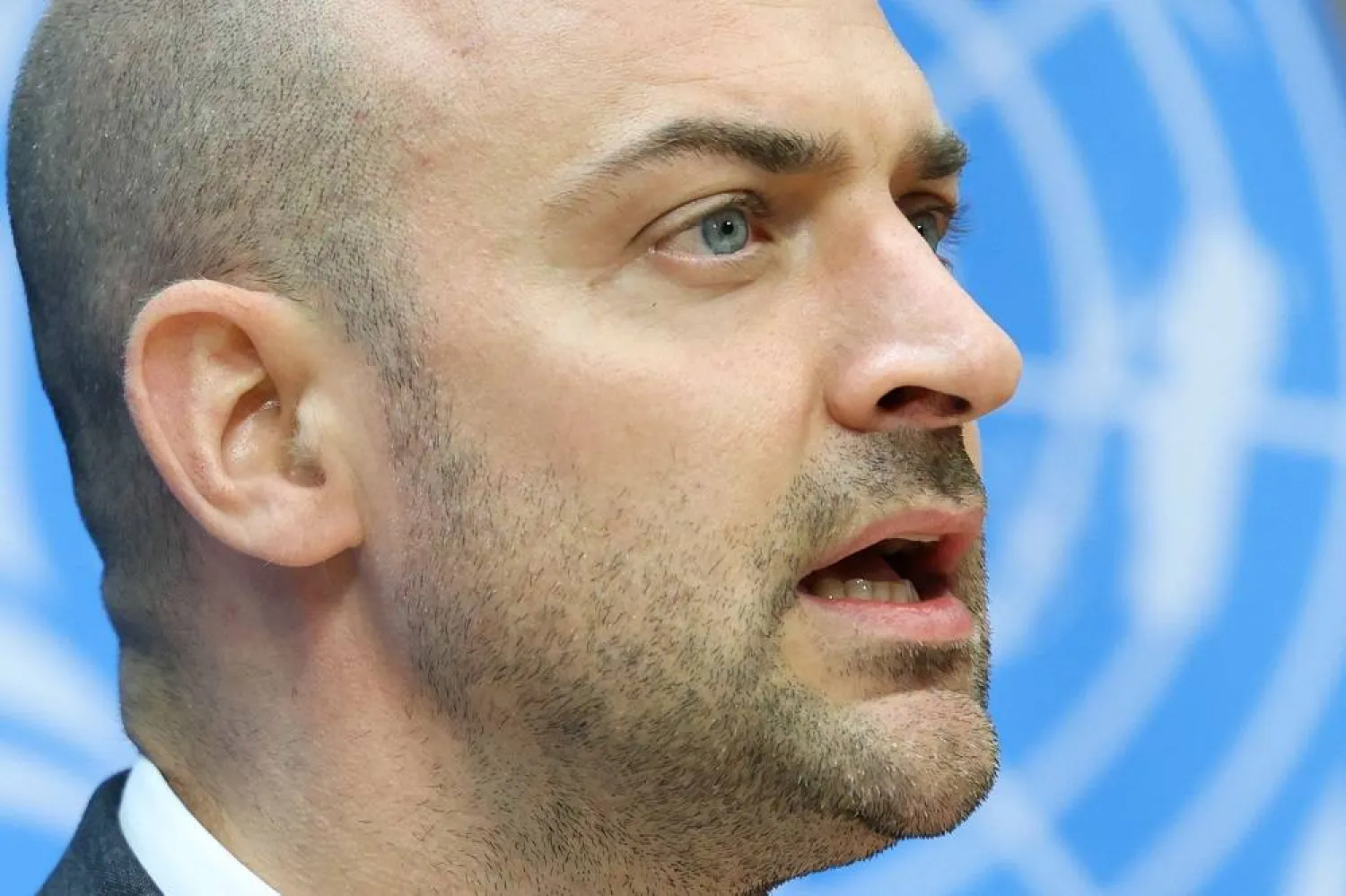
French Foreign Minister Jean-Noel Barrot speaks during a conference on a two-state solution for Israel and the Palestinians at UN headquarters on July 28, 2025 in New York City. (AFP)
TT

France Calls on the EU to Pressure Israel to Come to the Table on Palestinian Two-State Solution 

French Foreign Minister Jean-Noel Barrot speaks during a conference on a two-state solution for Israel and the Palestinians at UN headquarters on July 28, 2025 in New York City. (AFP)

France on Monday called on the European Union to pressure Israel to agree to a two-state solution with the Palestinians, the latest escalation from the French as they seek an end to the deadly Gaza war days after pledging to recognize Palestine as a state.

Jean-Noel Barrot, the French foreign minister, told reporters at the United Nations that while there is international consensus that the time for a political solution to the Israeli-Palestinian conflict is now, world powers need to back up their words with actions.

“The European Commission, on behalf of the EU, has to express its expectations and show the means that we can incentivize the Israeli government to hear this appeal,” he said.

Barrot spoke on the first day of a high-level UN meeting on a two-state solution to the decades-old Palestinian-Israeli conflict, which is being co-chaired by Saudi Arabia and France.

The conference, which was postponed from June and downgraded to the ministerial level, is taking place in New York as international condemnation of Israel’s handling of the war in Gaza reaches a fever pitch. Both Israel and its closest ally, the United States, refused to participate in the meeting, which Barrot said is being attended by representatives of 125 countries, including 50 ministers.

The aim of the conference, Barrot said, is “to reverse the trend of what is happening in the region — mainly the erasure of the two-state solution, which has been for a long time the only solution that can bring peace and security in the region.”

He urged the European Commission to call on Israel to lift a financial blockade on 2 billion euros he says the Israeli government owes the Palestinian Authority, stop settlement building in the West Bank, which threatens the territorial integrity of a future Palestinian state, and end the “militarized” food delivery system in Gaza by the Israeli-backed US Gaza Humanitarian Foundation, which has resulted in hundreds of killings.

Dubravka Šuica, the European Commissioner for the Mediterranean, told the meeting the EU is examining new sanctions and said it’s “imperative” that Israel transfer money owed to the Palestinians, and allow the delivery of food and other aid to Gaza.

She said the EU has been a long-term partner promoting reforms of the Palestinian Authority and welcomed the recent announcement of presidential and general elections within a year across the Palestinian territories. “We are keeping the Palestinian Authority from financial collapse,” she said, underscoring that the EU is supporting it with 161.6 billion euros for the next three years.

Israeli Prime Minister Benjamin Netanyahu has rejected the two-state solution on both nationalistic and security grounds. The US has echoed that sentiment and on Monday called the conference “unproductive and ill-timed.”

Ahead of the meeting, French President Emmanuel Macron announced that France would recognize Palestine as a state at the annual gathering of world leaders at the UN General Assembly in September. The bold but mostly symbolic move is aimed at adding diplomatic pressure on Israel.

France is now the biggest Western power and the only member of the Group of Seven major industrialized nations to recognize the state of Palestine, and the move could pave the way for other countries to do the same. More than 140 countries recognize a Palestinian state, including more than a dozen in Europe.

At the conference opening, Palestinian Prime Minister Mohammed Mustafa called for all countries that have not yet recognized Palestine as a state to do so “without delay.”

“The path to peace begins by recognizing the state of Palestine and preserving it from destruction,” he said.

With global anger rising over desperately hungry people in Gaza starting to die from starvation, US President Donald Trump on Monday called for increasing aid to Palestinians, a rare glimpse of daylight between him and Netanyahu, who has said there is no starvation.

Both Saudi Foreign Minister Prince Faisal bin Farhan bin Abdullah and Barrot said Monday that the US is an essential actor in the region and that it was the American president in January who secured the only ceasefire in the 21-month war.

“I am firmly in the belief that Trump’s engagement can be a catalyst for an end to the immediate crisis in Gaza and potentially a resolution of the Palestinian-Israeli conflict in the long term,” Prince Faisal said.



Hamas Says Israeli Strikes on Gaza ‘Cannot Happen without American Cover’

 Palestinians inspect damaged tents at a displacement camp following an Israeli strike in Gaza City, Friday, Jan. 9, 2026. (AP)
Palestinians inspect damaged tents at a displacement camp following an Israeli strike in Gaza City, Friday, Jan. 9, 2026. (AP)
TT

Hamas Says Israeli Strikes on Gaza ‘Cannot Happen without American Cover’

 Palestinians inspect damaged tents at a displacement camp following an Israeli strike in Gaza City, Friday, Jan. 9, 2026. (AP)
Palestinians inspect damaged tents at a displacement camp following an Israeli strike in Gaza City, Friday, Jan. 9, 2026. (AP)

A Hamas official said Friday that Israeli strikes on Gaza "cannot happen without American cover", the day after Israeli attacks killed at least 13 people according to the Palestinian territory's civil defense agency.

Since October 10, a fragile US-sponsored truce in Gaza has largely halted the fighting between Israeli forces and Hamas, but both sides have alleged frequent violations.

Gaza's civil defense agency -- which operates as a rescue force under Hamas authority -- said Israeli attacks across the territory on Thursday killed at least 13 people, including five children.

In a statement on Friday morning, the Israeli military said it "precisely struck Hamas terrorists and terror infrastructure" in response to a "failed projectile" launch.

"Just yesterday, 13 people were killed in different areas of the Strip on fabricated pretexts, in addition to the hundreds of killed and wounded who preceded them after the ceasefire," Hamas political bureau member, Bassem Naim, wrote on Telegram.

"This cannot happen without American cover or a green light."

Israeli forces have killed at least 439 Palestinians in Gaza since the ceasefire took effect, according to the health ministry in the Hamas-run territory.

The Israeli military said gunmen have killed three of its soldiers during the same period.

Media restrictions in Gaza and difficulties in accessing many areas mean AFP is unable to independently verify the tolls and details provided by both sides.

Naim also accused Israeli Prime Minister Benjamin Netanyahu of "evading his commitments and escalating in order to sabotage the agreement and return to war".

He said the Palestinian movement had "complied with all its obligations under the agreement" and was "ready to engage positively and constructively with the next steps of the plan".

Israel has previously said it is awaiting the return of the last hostage body held in Gaza before beginning talks on the second phase of the ceasefire and has insisted that Hamas disarm.

Hamas officials told AFP that search operations for the remains of deceased hostage Ran Gvili resumed on Wednesday after a two-week pause due to bad weather.


Germany Calls on Israel to Halt E1 Settlement Plan

A view of Israeli settlement of Maale Adumim, in the West Bank, Sunday, June 18, 2023. (AP)
TT

Germany Calls on Israel to Halt E1 Settlement Plan

A view of Israeli settlement of Maale Adumim, in the West Bank, Sunday, June 18, 2023. (AP)

Germany calls on Israel to halt its controversial ​E1 settlement project, said a foreign ministry spokesperson in Berlin on Friday, warning that construction carries the risk of ‌creating more ‌instability in the ‌West ⁠Bank ​and ‌the region.

"The plans for the E1 settlement project, it must be said, are part of a comprehensive ⁠intensification of settlement policy in ‌the West Bank, ‍which ‍we have recently ‍observed," said the spokesperson at a regular government press conference.

"It carries the ​risk of creating even more instability, as it ⁠would further restrict the mobility of the Palestinian population in the West Bank," as well as jeopardize the prospects of a two-state solution, the spokesperson added.


Israel Army Says Struck Hezbollah Targets in ‘Several Areas’ of Lebanon

Lebanese army soldiers and paramedics inspect the wreckage of a car that was targeted in an Israeli airstrike in the town of Qanarit, near the coastal city of Sidon in southern Lebanon on January 8, 2026. (AFP)
TT

Israel Army Says Struck Hezbollah Targets in ‘Several Areas’ of Lebanon

Lebanese army soldiers and paramedics inspect the wreckage of a car that was targeted in an Israeli airstrike in the town of Qanarit, near the coastal city of Sidon in southern Lebanon on January 8, 2026. (AFP)

Israel's military said it struck Hezbollah targets in several areas of Lebanon on Friday, a day after the Lebanese army said it had completed the first phase of its plan to disarm the group in the south.

Under heavy US pressure and amid fears of expanded Israeli strikes, Lebanon has committed to disarming the Iran-backed group, which was weakened by more than a year of hostilities with Israel including two months of all-out war that ended with a November 2024 ceasefire.

Despite the truce, Israel has kept up regular strikes in Lebanon, usually saying it is targeting Hezbollah sites and operatives, and has maintained troops in five south Lebanon areas it deems strategic, accusing the group of rearming.

In a statement on Friday, the Israeli military said it struck "several areas in Lebanon", targeting "weapons storage facilities and a weapons production site that were used for the rehabilitation and military build-up of the Hezbollah terrorist organization".

"Additionally, several launch sites and rocket launchers, along with military structures, were struck," it added.

Lebanese official news agency NNA reported strikes on southern Lebanon in areas far from the border, as well as in the eastern Bekaa area where Hezbollah has a strong presence.
No casualties were immediately reported.

"The targets that were struck, and Hezbollah's reestablishment activity in these sites, constitute a violation of the understandings between Israel and Lebanon, and pose a threat to the State of Israel," the military statement said.

Lebanon's army said Thursday it had "achieved the objectives of the first phase" of its plan to disarm Hezbollah, covering the area south of the Litani River -- around 30 kilometers (20 miles) from the Israeli border -- with the intention to extend it to the rest of the country.
Israel said the efforts were encouraging but not enough.

"The ceasefire agreement... states clearly, Hezbollah must be fully disarmed," the office of Prime Minister Benjamin Netanyahu said in a statement.

"Efforts made toward this end by the Lebanese government and the Lebanese armed forces are an encouraging beginning, but they are far from sufficient," it added.

Lebanese official media said a strike on Thursday killed one person near the southern city of Sidon, as Israel's army said it targeted a Hezbollah operative.

Under the ceasefire, Hezbollah was to withdraw its forces north of the Litani River and have its military infrastructure dismantled in the evacuated areas.

The group has refused to surrender its weapons.