


Gaza Death Toll Hits 60,000 as Global Monitor Demands Action to Avert Famine 

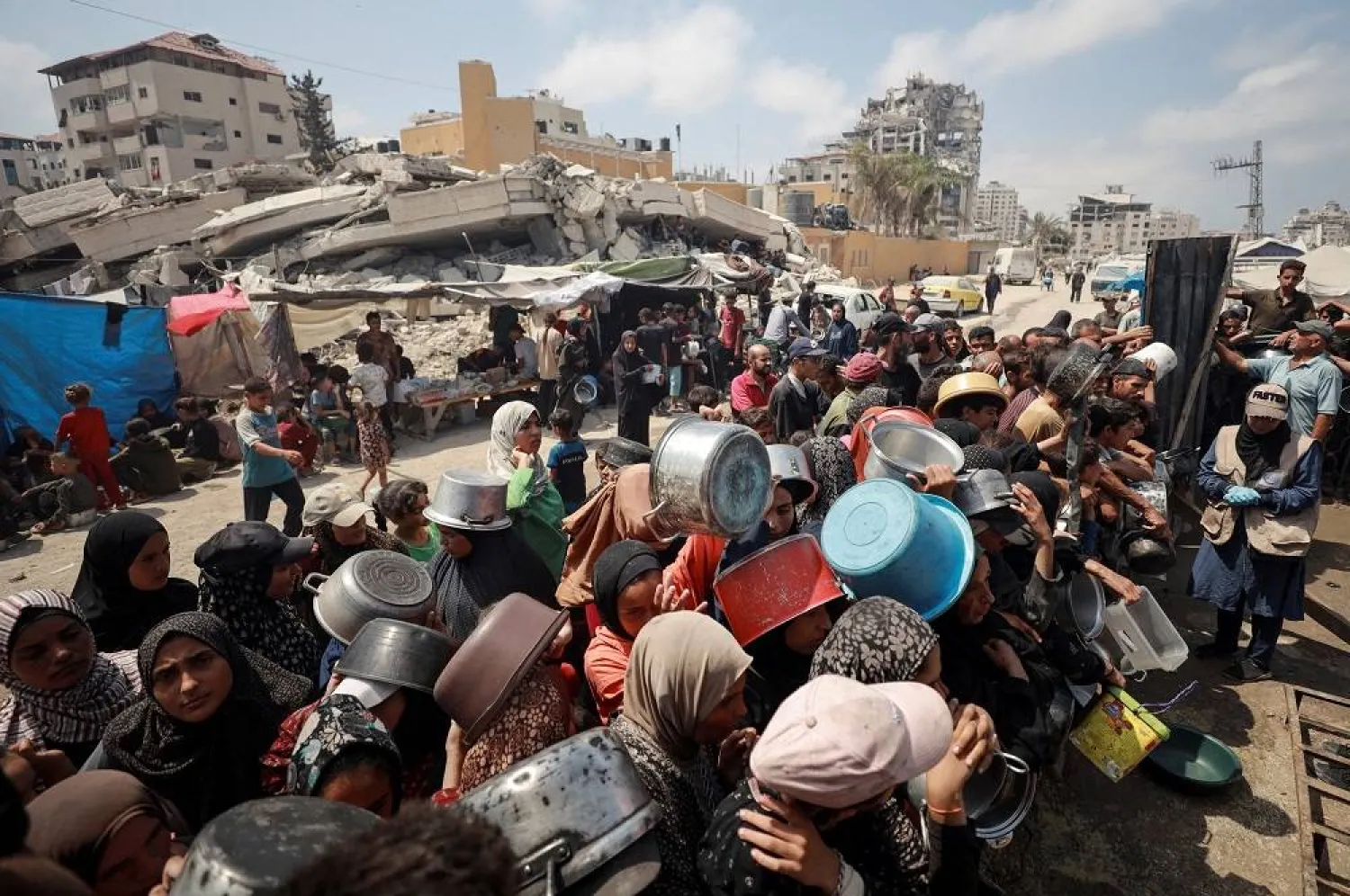
Palestinians wait to receive food from a charity kitchen, amid a hunger crisis, in Gaza City, July 28, 2025. (Reuters)
TT

Gaza Death Toll Hits 60,000 as Global Monitor Demands Action to Avert Famine 

Palestinians wait to receive food from a charity kitchen, amid a hunger crisis, in Gaza City, July 28, 2025. (Reuters)

A worst-case scenario of famine is unfolding in Gaza and immediate action is needed to end fighting and allow unimpeded aid access, a global hunger monitor warned on Tuesday, saying failure to act now would result in widespread death. 

Its alert coincided with a statement from Gaza health authorities saying Israel's military campaign had now killed more than 60,000 Palestinians. 

The Integrated Food Security Phase Classification (IPC) raised the prospect that the manmade starvation crisis could be formally classified as a famine, in the hope that this might raise the pressure on Israel to let far more food deliveries in. 

"Mounting evidence shows that widespread starvation, malnutrition, and disease are driving a rise in hunger-related deaths," the IPC said. 

It added that it would quickly carry out the formal analysis that could allow it to classify Gaza as "in famine". 

But it is unclear whether any such announcement would help to remove the main obstacle to food reaching Gaza's 2.1 million people: Israel's refusal to allow more than a trickle of trucks in. 

NOT ENOUGH FOOD GETTING INTO GAZA 

"We're getting about approximately 50% of what we're requesting into Gaza since these humanitarian pauses started on Sunday," Ross Smith of the World Food Program told reporters in Geneva by video. 

The WFP says almost 470,000 people are enduring famine-like conditions, with 90,000 women and children in need of specialist nutrition. Gaza's health ministry says at least 147 people have died of hunger including 88 children, most in the last few weeks.  

Images of emaciated children have shocked the world and fueled international criticism of Israel, prompting it at the weekend to announce daily humanitarian pauses to fighting in three areas of Gaza and new safe corridors for aid convoys. 

Yet the supply remains far short of what aid agencies say is the bare minimum required. 

The IPC alert said this meant 62,000 metric tons of staple food a month, but that according to the Israeli aid coordination agency COGAT, only 19,900 tons entered in May and 37,800 in June. 

Smith said the WFP lacked the stocks or permissions to reopen the bakeries and community kitchens that had been a lifeline before a total Israeli blockade began in May.  

Israeli Foreign Minister Gideon Saar said on Tuesday that that the situation in Gaza was "tough" but that there were lies about starvation.  

He said 5,000 aid trucks had entered Gaza in the last two months, and that Israel would assist those wanting to conduct airdrops - a delivery method that aid groups say is ineffective and tokenistic. 

Israel has consistently said its actions are justified as self-defense. It says the Palestinian group Hamas, which ruled Gaza, is to blame for refusing to release hostages and surrender, and for operating in civilian areas, which Hamas denies. 

IPC CALLS FOR END TO CATASTROPHIC SUFFERING 

The IPC alert said that "immediate action must be taken to end the hostilities and allow unimpeded, large-scale, life-saving humanitarian response. 

"This is the only path to stopping further deaths and catastrophic human suffering." The IPC partners with governments, international aid groups and UN agencies and assesses the extent of hunger suffered by a population. 

Its famine classification requires at least 20% of people to be suffering extreme food shortages, with one in three children acutely malnourished and two people out of every 10,000 dying every day from starvation or malnutrition and disease. 

The IPC's latest data indicated that formal famine thresholds have already been reached for food consumption in most of Gaza, and for acute malnutrition in Gaza City. 

But David Miliband, head of the International Rescue Committee aid group, said that "formal famine declarations always lag reality". 

"By the time that famine was declared in Somalia in 2011, 250,000 people - half of them children under 5 - had already died of hunger," he said in a statement. "By the time famine is declared, it will already be too late." 

War has raged in Gaza between Israel and Hamas for 22 months. 

After an 11-week Israeli blockade, limited UN-led aid operations resumed on May 19 and a week later the obscure new US-based Gaza Humanitarian Foundation - backed by Israel and the United States - began distributing food aid. 

CRITICISM OF ISRAELI-BACKED GHF AID GROUP 

The rival aid efforts have sparked a war of words - pitting Israel, the US and the GHF against the UN, international aid groups and dozens of governments from around the world. 

Israel and the US accuse Hamas of stealing aid - which the group denies - and the UN of failing to prevent it. The UN says it has not seen evidence of Hamas diverting much aid. 

The IPC said 88% of Gaza was now under evacuation orders or within militarized areas, and was critical of GHF efforts. 

It said most of the GHF food items "require water and fuel to cook, which are largely unavailable". 

The IPC's Famine Review Committee said: "Our analysis of the food packages supplied by the GHF shows that their distribution plan would lead to mass starvation." 

The GHF was not immediately available for comment. It has previously said it has so far distributed more than 96 million meals. 

Jolien Veldwijk, CARE Palestine Country Director, said that Palestinians were suffering a "manmade famine, caused by Israel’s siege and the deliberate obstruction of aid, fueled by the inaction of world leaders". 

"The haunting images of emaciated children are evidence of a failure of humanity to act." 

The war in Gaza began on October 7, 2023, when Hamas killed 1,200 people in southern Israel and took some 250 hostages, according to Israeli tallies. 


Germany’s Wadephul Says Aid to Gaza Must Be Improved

German Foreign Minister Johann Wadephul (R) and Israeli Foreign Minister Gideon Saar shake hands as they attend a news conference after their talks in Berlin, Germany, 05 May 2026. (EPA)
TT

Germany’s Wadephul Says Aid to Gaza Must Be Improved

German Foreign Minister Johann Wadephul (R) and Israeli Foreign Minister Gideon Saar shake hands as they attend a news conference after their talks in Berlin, Germany, 05 May 2026. (EPA)

German Foreign Minister Johann Wadephul said on Tuesday aid deliveries to Gaza had to be improved and he repeated Berlin's ‌position that ‌any de ‌facto annexation ⁠of parts of ⁠the occupied West Bank by Israel would not be acceptable to Germany.

"The ⁠plight of the ‌more ‌than two ‌million people whose situation ‌has not improved must not be overlooked amidst the conflict ‌in Iran. Humanitarian aid must ⁠be ⁠improved as a matter of urgency," Wadephul said at a joint news conference in Berlin with his visiting Israeli counterpart Gideon Saar.


Gaza Factions Prepare Defensive Plans as Fears of War Rise

 First responders inspect the site of an Israeli strike on a police station in Gaza City on May 5, 2026. (AFP)
First responders inspect the site of an Israeli strike on a police station in Gaza City on May 5, 2026. (AFP)
TT

Gaza Factions Prepare Defensive Plans as Fears of War Rise

 First responders inspect the site of an Israeli strike on a police station in Gaza City on May 5, 2026. (AFP)
First responders inspect the site of an Israeli strike on a police station in Gaza City on May 5, 2026. (AFP)

Palestinian factions in the Gaza Strip have raised their level of alert among fighters as Israeli threats grow over a possible return to war.

Field sources in Hamas and Islamic Jihad told Asharq Al-Awsat that factions are working on “clear defensive plans” in case Israel resumes fighting along the same lines as its previous military operations in Gaza.

Residents are increasingly concerned about a broad resumption of war months after a ceasefire agreement between the two sides in October, which has been marked by repeated Israeli violations that have killed more than 800 people.

Four sources from the two groups said the plans are based on self-defense if Israel carries out its threats, stressing there are “no plans or intentions to initiate any attack.”

Israeli newspaper Maariv quoted Israeli Chief of Staff Eyal Zamir as saying during a visit to troops in Lebanon days ago that the next battle could be in the Gaza Strip, because it has not ended yet, warning that if Hamas obstructs efforts to disarm it, the army would have to resume the war “with full force.”

Avoiding provocations

Two Hamas sources said instructions have been issued to avoid any provocative actions and maintain the current calm despite Israeli violations. A third source said the primary goal is to confront any Israeli military incursions into cities, as was the case before the ceasefire.

For months, Palestinian factions have deployed armed members at night across various areas of the enclave, especially in locations where Israeli special forces or armed groups aligned with Israel could infiltrate, aiming to confront them.

Fighters rotate shifts under a system that requires each member to participate in security duties once or twice a week.

Since a ceasefire was announced under a plan proposed by US President Donald Trump, a boundary known as the “yellow line” has divided the Gaza Strip.

Areas east of the line are held by Israel and make up about 55% of the territory, while areas to the west remain under the control of Hamas and other factions.

Factions accuse Israel of using armed groups cooperating with its military to expand the scope of the yellow line and force residents in non-occupied areas to flee.

Killings of Hamas members

Israel has recently targeted security checkpoints manned by faction members, as well as police and security forces affiliated with the Hamas-run government, killing at least 33 police and security personnel since the ceasefire.

The latest victim was a lieutenant colonel in Hamas’s internal security service, Mohammad al-Ghandour, who was killed in an airstrike in Sheikh Radwan neighborhood shortly after midnight between Monday and Tuesday.

Gaza’s Interior Ministry said al-Ghandour was killed when his vehicle was struck, while field sources told Asharq Al-Awsat that the attack targeted him and another member of the Qassam Brigades, Hamas’s armed wing, who was critically wounded as they were stationed at a checkpoint on Al-Jalaa Street in Sheikh Radwan.

Sources said al-Ghandour, who was also active in the Qassam Brigades, had previously survived two assassination attempts, one by drone and another in a strike on his home.

The strike came days after Israeli attacks had paused in deeper western areas beyond the yellow line, where Hamas maintains control.

The Israeli military also announced on Tuesday it had killed what it described as a “Nukhba commander” in Hamas, Anas Mohammad Ibrahim Hammad, accusing him of taking part in the Oct. 7, 2023, attack.

Israeli strikes have decreased in recent days at the request of mediators and the senior Gaza representative to the “Board of Peace,” Nickolay Mladenov, to allow room for negotiations underway in Cairo on a new roadmap for the ceasefire agreement.


Israeli Strikes Kill Three Palestinians, Including a Child, in Gaza, Medics Say

 Palestinians inspect the site of an Israeli strike that targeted a police post, in Gaza City, May 5, 2026. (Reuters)
Palestinians inspect the site of an Israeli strike that targeted a police post, in Gaza City, May 5, 2026. (Reuters)
TT

Israeli Strikes Kill Three Palestinians, Including a Child, in Gaza, Medics Say

 Palestinians inspect the site of an Israeli strike that targeted a police post, in Gaza City, May 5, 2026. (Reuters)
Palestinians inspect the site of an Israeli strike that targeted a police post, in Gaza City, May 5, 2026. (Reuters)

Israeli strikes killed at least three Palestinians, including a child, and wounded several others in the Gaza Strip on Tuesday, health officials said.

Medics said a Palestinian was killed and two others were wounded by an Israeli airstrike near the Sheikh Radwan neighborhood in Gaza City, while another was killed and several others were wounded by Israeli tank shelling near the central area of the enclave.

Later on Tuesday, an Israeli strike targeted a police station in northern Gaza, killing a 15-year-old child, medics said. The Hamas-run interior ministry said ‌some policemen ‌were also wounded in the attack.

Reuters has previously reported ‌that ⁠Israel has intensified its ⁠attacks on Gaza's Hamas-run police force, which the group has used to reinforce its hold in the areas it controls in the strip.

There was no immediate Israeli comment on any of the incidents.

Violence in Gaza has persisted despite an October 2025 ceasefire, with Israel conducting almost daily attacks on Palestinians. Israel and Hamas have blamed each ⁠other for ceasefire violations.

At Al Shifa Hospital, the largest ‌medical facility still partially functional in the ‌enclave, relatives and friends arrived to bid farewell to one of those ‌killed on Tuesday, Mohammed Al-Ghandour. Two girls were crying and being ‌comforted by a woman outside the hospital's morgue.

"The Zionist enemy doesn't know anything called truce and does not commit to international treaties or laws or humanitarian laws," said the victim's uncle, Abu Omar Al-Naffar.

At least 830 Palestinians ‌have been killed since the ceasefire deal took effect, according to local medics, while Israel says fighters have ⁠killed four ⁠of its soldiers over the same period.

Israel says its strikes are aimed at thwarting attempts by Hamas and other Palestinian fighters to stage attacks against its forces.

More than 72,500 Palestinians have been killed since the Gaza war started in October 2023, most of them civilians, according to Gaza health authorities.

Since the truce last October, Israel still occupies more than half of Gaza, where it has ordered residents out and demolished almost all remaining structures. Nearly the entire population of more than 2 million Palestinians now lives in a narrow strip along the coast, mainly in tents and damaged buildings, under the de facto control of Hamas.
