

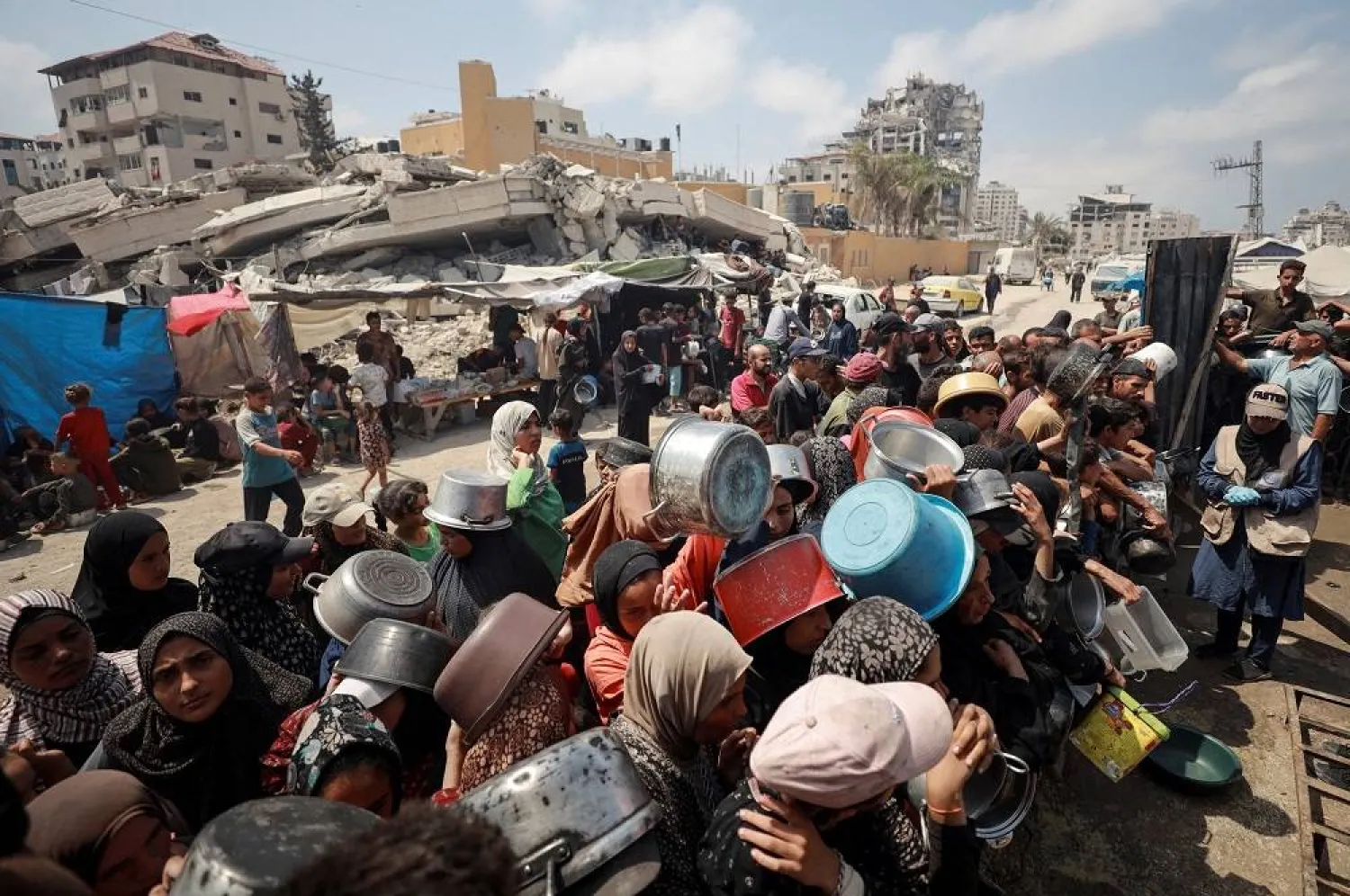

Gaza Death Toll Hits 60,000 as Global Monitor Demands Action to Avert Famine 

Palestinians wait to receive food from a charity kitchen, amid a hunger crisis, in Gaza City, July 28, 2025. (Reuters)
TT

Gaza Death Toll Hits 60,000 as Global Monitor Demands Action to Avert Famine 

Palestinians wait to receive food from a charity kitchen, amid a hunger crisis, in Gaza City, July 28, 2025. (Reuters)

A worst-case scenario of famine is unfolding in Gaza and immediate action is needed to end fighting and allow unimpeded aid access, a global hunger monitor warned on Tuesday, saying failure to act now would result in widespread death. 

Its alert coincided with a statement from Gaza health authorities saying Israel's military campaign had now killed more than 60,000 Palestinians. 

The Integrated Food Security Phase Classification (IPC) raised the prospect that the manmade starvation crisis could be formally classified as a famine, in the hope that this might raise the pressure on Israel to let far more food deliveries in. 

"Mounting evidence shows that widespread starvation, malnutrition, and disease are driving a rise in hunger-related deaths," the IPC said. 

It added that it would quickly carry out the formal analysis that could allow it to classify Gaza as "in famine". 

But it is unclear whether any such announcement would help to remove the main obstacle to food reaching Gaza's 2.1 million people: Israel's refusal to allow more than a trickle of trucks in. 

NOT ENOUGH FOOD GETTING INTO GAZA 

"We're getting about approximately 50% of what we're requesting into Gaza since these humanitarian pauses started on Sunday," Ross Smith of the World Food Program told reporters in Geneva by video. 

The WFP says almost 470,000 people are enduring famine-like conditions, with 90,000 women and children in need of specialist nutrition. Gaza's health ministry says at least 147 people have died of hunger including 88 children, most in the last few weeks.  

Images of emaciated children have shocked the world and fueled international criticism of Israel, prompting it at the weekend to announce daily humanitarian pauses to fighting in three areas of Gaza and new safe corridors for aid convoys. 

Yet the supply remains far short of what aid agencies say is the bare minimum required. 

The IPC alert said this meant 62,000 metric tons of staple food a month, but that according to the Israeli aid coordination agency COGAT, only 19,900 tons entered in May and 37,800 in June. 

Smith said the WFP lacked the stocks or permissions to reopen the bakeries and community kitchens that had been a lifeline before a total Israeli blockade began in May.  

Israeli Foreign Minister Gideon Saar said on Tuesday that that the situation in Gaza was "tough" but that there were lies about starvation.  

He said 5,000 aid trucks had entered Gaza in the last two months, and that Israel would assist those wanting to conduct airdrops - a delivery method that aid groups say is ineffective and tokenistic. 

Israel has consistently said its actions are justified as self-defense. It says the Palestinian group Hamas, which ruled Gaza, is to blame for refusing to release hostages and surrender, and for operating in civilian areas, which Hamas denies. 

IPC CALLS FOR END TO CATASTROPHIC SUFFERING 

The IPC alert said that "immediate action must be taken to end the hostilities and allow unimpeded, large-scale, life-saving humanitarian response. 

"This is the only path to stopping further deaths and catastrophic human suffering." The IPC partners with governments, international aid groups and UN agencies and assesses the extent of hunger suffered by a population. 

Its famine classification requires at least 20% of people to be suffering extreme food shortages, with one in three children acutely malnourished and two people out of every 10,000 dying every day from starvation or malnutrition and disease. 

The IPC's latest data indicated that formal famine thresholds have already been reached for food consumption in most of Gaza, and for acute malnutrition in Gaza City. 

But David Miliband, head of the International Rescue Committee aid group, said that "formal famine declarations always lag reality". 

"By the time that famine was declared in Somalia in 2011, 250,000 people - half of them children under 5 - had already died of hunger," he said in a statement. "By the time famine is declared, it will already be too late." 

War has raged in Gaza between Israel and Hamas for 22 months. 

After an 11-week Israeli blockade, limited UN-led aid operations resumed on May 19 and a week later the obscure new US-based Gaza Humanitarian Foundation - backed by Israel and the United States - began distributing food aid. 

CRITICISM OF ISRAELI-BACKED GHF AID GROUP 

The rival aid efforts have sparked a war of words - pitting Israel, the US and the GHF against the UN, international aid groups and dozens of governments from around the world. 

Israel and the US accuse Hamas of stealing aid - which the group denies - and the UN of failing to prevent it. The UN says it has not seen evidence of Hamas diverting much aid. 

The IPC said 88% of Gaza was now under evacuation orders or within militarized areas, and was critical of GHF efforts. 

It said most of the GHF food items "require water and fuel to cook, which are largely unavailable". 

The IPC's Famine Review Committee said: "Our analysis of the food packages supplied by the GHF shows that their distribution plan would lead to mass starvation." 

The GHF was not immediately available for comment. It has previously said it has so far distributed more than 96 million meals. 

Jolien Veldwijk, CARE Palestine Country Director, said that Palestinians were suffering a "manmade famine, caused by Israel’s siege and the deliberate obstruction of aid, fueled by the inaction of world leaders". 

"The haunting images of emaciated children are evidence of a failure of humanity to act." 

The war in Gaza began on October 7, 2023, when Hamas killed 1,200 people in southern Israel and took some 250 hostages, according to Israeli tallies. 


Egypt Urges Int’l Support for Lebanese Army to Ensure State Exclusivity over Arms

Egyptian Foreign Minister Badr Abdelatty (3rd L) speaks before representatives of participating countries during the preparatory meeting for the international conference in support of the Lebanese Armed Forces (LAF) and the Internal Security Forces (ISF) in Cairo on February 24, 2026. (AFP)
TT

Egypt Urges Int’l Support for Lebanese Army to Ensure State Exclusivity over Arms

Egyptian Foreign Minister Badr Abdelatty (3rd L) speaks before representatives of participating countries during the preparatory meeting for the international conference in support of the Lebanese Armed Forces (LAF) and the Internal Security Forces (ISF) in Cairo on February 24, 2026. (AFP)

Egypt on Tuesday urged the international community to better support Lebanon's armed forces to ensure that all weapons in the country come under the exclusive authority of the state.

Speaking at a preparatory meeting in Cairo ahead of next month's Paris conference in support of the Lebanese army, Egypt's Foreign Minister Badr Abdelatty praised "the success of the Lebanese army in completing the first phase of the plan".

"This achievement reflects the efficiency of the military institution and requires intensifying international support to complete the remaining phases of the plan," Abdelatty said.

Last year, Lebanon's government committed to disarming Hezbollah, which was severely weakened in its recent war with Israel, and tasked the army with drafting a plan to implement the decision.

In January, and in line with the 2024 truce, the army announced it had completed the first phase of the disarmament plan, covering the area between the Litani River and the Israeli border about 30 kilometers (20 miles) further south.

Abdelatty said that Tuesday's meeting aimed "to enable the Lebanese state to ensure that all weapons are held exclusively by the state".

The meeting brought together Lebanon's top security chiefs, including Army Commander General Rodolphe Haykal and Internal Security Forces Director-General Major General Raed Abdallah.

They were joined by representatives of the Quintet Committee on Lebanon, among them Qatar's Minister of State for Foreign Affairs Mohammed bin Abdulaziz al-Khulaifi, the French President's personal envoy Jean-Yves Le Drian and Saudi Arabia's envoy to Beirut Prince Yazid bin Farhan, along with senior officials from the United States.

The second phase of the plan focuses on the area between the Litani and Awali rivers, around 40 kilometers south of Beirut.

Hezbollah has so far refused to hand over its weapons north of the Litani.

The government said last week that the army would need at least four months to implement the plan's second phase to disarm Hezbollah in the country's south,


About 6.5 Million People in Somalia Face Acute Hunger Due to Drought, Govt and UN Say

 Lime is displayed for sale at an open-air grocery market as Muslims start the fasting month of Ramadan within Bakara market in Mogadishu, Somalia February 18, 2026. (Reuters)
Lime is displayed for sale at an open-air grocery market as Muslims start the fasting month of Ramadan within Bakara market in Mogadishu, Somalia February 18, 2026. (Reuters)
TT

About 6.5 Million People in Somalia Face Acute Hunger Due to Drought, Govt and UN Say

 Lime is displayed for sale at an open-air grocery market as Muslims start the fasting month of Ramadan within Bakara market in Mogadishu, Somalia February 18, 2026. (Reuters)
Lime is displayed for sale at an open-air grocery market as Muslims start the fasting month of Ramadan within Bakara market in Mogadishu, Somalia February 18, 2026. (Reuters)

About 6.5 million people in Somalia ‌face acute hunger due to drought, the government and the United Nations said on Tuesday, sounding the alarm days after the UN's food agency warned that food aid could grind to a halt by April without new funding.

Somalia declared a national drought emergency in November after years of failed rains, and other countries in the region have also been hit.

More than a third of those facing acute malnutrition are children, Somalia's government and the United Nations Somalia said in a joint statement. The crisis has forced tens of thousands of ‌people to ‌flee their homes, with many crowding into camps ‌in ⁠Mogadishu and other ⁠cities.

"The drought ... has deepened alarmingly, with soaring water prices, limited food supplies, dying livestock, and very little humanitarian funding," George Conway, the UN's Humanitarian Coordinator for Somalia, said in a statement.

Hawo Abdi said she lost two children to illness after the drought laid waste to her homeland in Somalia's Bay region.

"When I saw that the suffering ⁠was getting worse, I fled my home and ‌came to ... Mogadishu," she told Reuters ‌from her shelter on the outskirts of the capital.

Last week, the UN World Food Program put the number of those facing acute hunger ‌at 4.4 million, and said it had already cut back its assistance to just over 600,000 people from 2.2 million earlier this year.

It was not clear whether the new figure reflected a sharp increase in those ‌at risk or different counting methods.

The government and United Nations figures tally with those also released on ⁠Tuesday by ⁠the Integrated Food Security Phase Classification (IPC), which sets the global standard for determining the severity of a food crisis.

While rainfall in the April to June season could offer some relief, some 5.5 million people were expected to remain in the crisis level or worse, with 1.6 million people in the emergency level, the statement said.

Abdiyo Ali was forced to abandon her farm in the Lower Shabelle region.

"Our farms were destroyed, our livestock died, and water sources became too far away. We have nothing left to bring with us," Ali told Reuters last week while preparing her food in a displaced people's camp outside Mogadishu.


Lebanon Fears Israeli Strikes if Iran Situation Escalates

 Lebanese Foreign Minister Youssef Raggi addresses the Human Rights Council in Geneva, Switzerland, Tuesday, Feb. 24, 2026. (AP)
Lebanese Foreign Minister Youssef Raggi addresses the Human Rights Council in Geneva, Switzerland, Tuesday, Feb. 24, 2026. (AP)
TT

Lebanon Fears Israeli Strikes if Iran Situation Escalates

 Lebanese Foreign Minister Youssef Raggi addresses the Human Rights Council in Geneva, Switzerland, Tuesday, Feb. 24, 2026. (AP)
Lebanese Foreign Minister Youssef Raggi addresses the Human Rights Council in Geneva, Switzerland, Tuesday, Feb. 24, 2026. (AP)

Lebanon's foreign minister said Tuesday his country feared its infrastructure could be hit by Israeli strikes if the situation with Iran escalates, as Israel has intensified its attacks on Tehran-backed Hezbollah.

Also on Tuesday, Lebanon's army accused the Israeli military of firing near a position it was setting up in the country's south, saying it had instructed troops to return fire.

"There are signs that the Israelis could strike very hard in the event of an escalation, potentially including strategic infrastructure such as the airport," foreign minister Youssef Raggi told reporters in Geneva.

His comments came amid a massive US military buildup in the Middle East that suggested Washington was prepared to wage a potentially sustained campaign against Iran.

Iran vowed on Monday to retaliate "ferociously" against any attack from the United States, and repeated its warning of a regional conflagration in response to President Donald Trump's latest threat of strikes.

"We are currently conducting diplomatic efforts to request that, even in the event of retaliation, Lebanese civilian infrastructure not be targeted," Raggi said.

He stressed that his country's leadership had been very clear: "This war does not concern us."

A Lebanese official who requested anonymity said "what the Lebanese fear is a chain reaction: an American strike against Iran, a Hezbollah retaliatory strike against Israel, followed by a massive Israeli response."

- Israeli strikes -

Israel has kept up regular strikes on Lebanon despite a November 2024 ceasefire that sought to halt more than a year of hostilities with Iran-backed Hezbollah, usually saying it was targeting the group.

Last Friday, Israel carried out deadly strikes on what it called Hezbollah positions in eastern Lebanon and targets linked to the Palestinian group Hamas in the south.

Hezbollah said Saturday that eight of its fighters had been killed, and vowed "resistance".

Its leader Sheikh Naim Qassem stated last month that any attack on Tehran would also be an attack on Hezbollah.

On Monday, Washington ordered non-emergency personnel to leave its embassy in Lebanon's capital Beirut as anticipation rose of a possible conflict with Iran.

On Tuesday, Lebanon's army said it was "establishing a new observation post on the southern border" when "the area surrounding the post was subjected to gunfire from the Israeli side".

"The army command issued orders to reinforce the post, remain there, and return fire."

On the same day in Cairo, a preparatory meeting was held ahead of a conference in Paris next month to back Lebanon's army, which is facing heavy pressure from Washington and Israel to disarm Hezbollah.

Egyptian Foreign Minister Badr Abdelatty said that Tuesday's meeting aimed "to enable the Lebanese state to ensure that all weapons are held exclusively by the state".

Lebanon's government last year committed to disarming Hezbollah, which was badly weakened in a recent war with Israel, and tasked the army with drawing up a plan to do so.

The army, which has limited capabilities, declared in January the completion of the first phase of its plan near the border with Israel.

It said last week it would need at least four months to complete the second phase.

Israel, which accuses Hezbollah of rearming, has criticized the army's progress as insufficient.
