

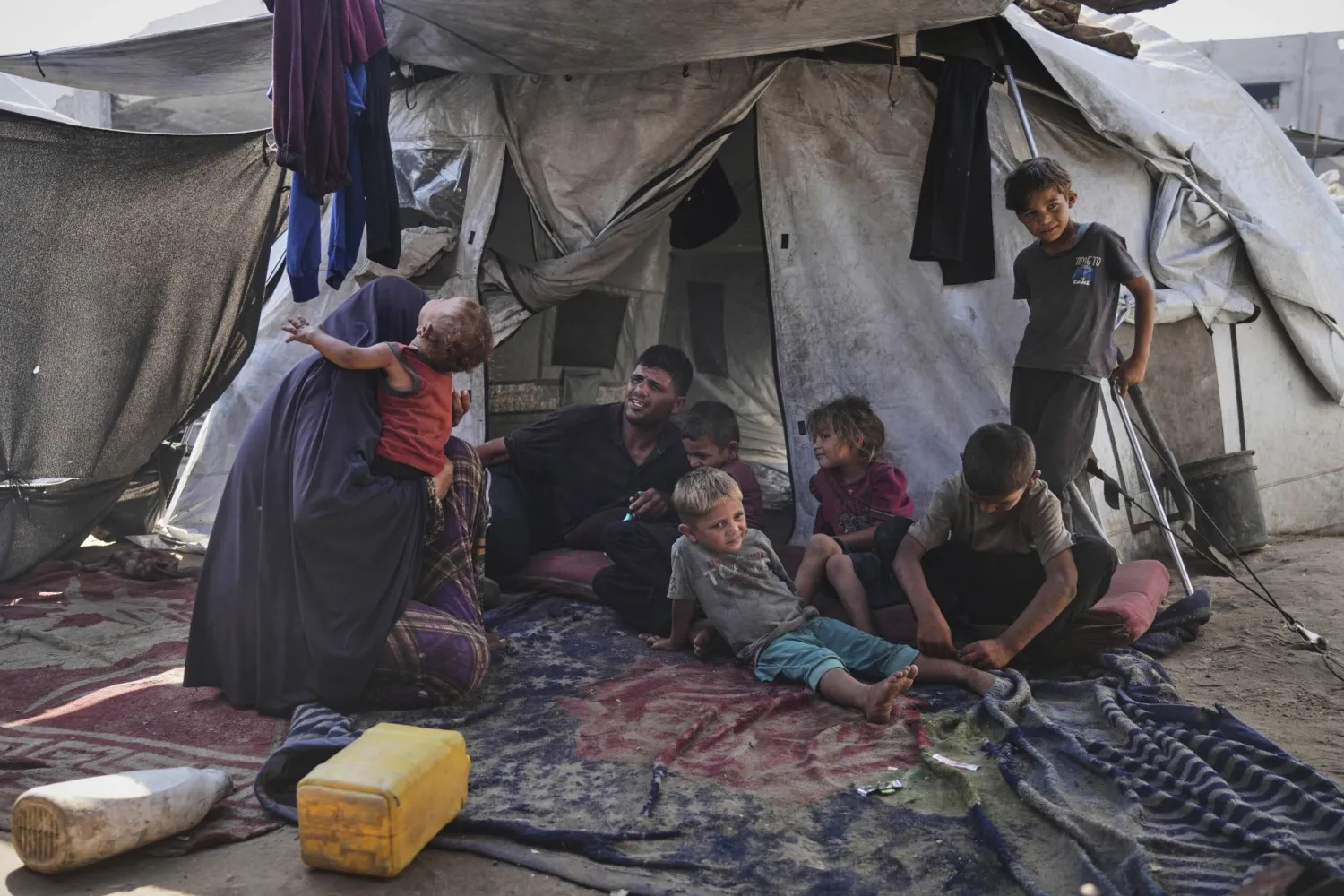

From Dawn to Dusk, a Gaza Family Focuses on One Thing: Finding Food

Abeer and Fadi Sobh gather in their tent with their children at a camp for displaced Palestinians in Gaza City, Thursday, July 24, 2025. (AP Photo/Jehad Alshrafi)
TT

From Dawn to Dusk, a Gaza Family Focuses on One Thing: Finding Food

Abeer and Fadi Sobh gather in their tent with their children at a camp for displaced Palestinians in Gaza City, Thursday, July 24, 2025. (AP Photo/Jehad Alshrafi)

Every morning, Abeer and Fadi Sobh wake up in their tent in the Gaza Strip to the same question: How will they find food for themselves and their six young children?

The couple has three options: Maybe a charity kitchen will be open and they can get a pot of watery lentils. Or they can try jostling through crowds to get some flour from a passing aid truck. The last resort is begging.

If those all fail, they simply don't eat. It happens more and more these days, as hunger saps their energy, strength and hope, reported The Associated Press.

The predicament of the Sobhs, who live in a seaside refugee camp west of Gaza City after being displaced multiple times, is the same for families throughout the war-ravaged territory.

Hunger has grown throughout the past 22 months of war because of aid restrictions, humanitarian workers say. But food experts warned earlier this week the “worst-case scenario of famine is currently playing out in Gaza.”

Israel enforced a complete blockade on food and other supplies for 2½ months beginning in March. It said its objective was to increase pressure on Hamas to release dozens of hostages it has held since its attack on Israel on Oct. 7, 2023.

Though the flow of aid resumed in May, the amount is a fraction of what aid organizations say is needed.

A breakdown of law and order has also made it nearly impossible to safely deliver food. Much of the aid that does get in is hoarded or sold in markets at exorbitant prices.

Here is a look at a day in the life of the Sobh family:

A morning seawater bath

The family wakes up in their tent, which Fadi Sobh, a 30-year-old street vendor, says is unbearably hot in the summer.

With fresh water hard to come by, his wife Abeer, 29, fetches water from the sea.

One by one, the children stand in a metal basin and scrub themselves as their mother pours the saltwater over their heads. Nine-month-old Hala cries as it stings her eyes. The other children are more stoic.

Abeer then rolls up the bedding and sweeps the dust and sand from the tent floor. With no food left over from the day before, she heads out to beg for something for her family’s breakfast. Sometimes, neighbors or passersby give her lentils. Sometimes she gets nothing.

Abeer gives Hala water from a baby bottle. When she’s lucky, she has lentils that she grinds into powder to mix into the water.

“One day feels like 100 days, because of the summer heat, hunger and the distress,” she said.

A trip to the soup kitchen Fadi heads to a nearby soup kitchen. Sometimes one of the children goes with him.

“But food is rarely available there,” he said. The kitchen opens roughly once a week and never has enough for the crowds. Most often, he said, he waits all day but returns to his family with nothing “and the kids sleep hungry, without eating.”

Fadi used to go to an area in northern Gaza where aid trucks arrive from Israel. There, giant crowds of equally desperate people swarm over the trucks and strip away the cargo of food. Often, Israeli troops nearby open fire, witnesses say. Israel says it only fires warning shots, and others in the crowd often have knives or pistols to steal boxes.

Fadi, who also has epilepsy, was shot in the leg last month. That has weakened him too much to scramble for the trucks, so he’s left with trying the kitchens.

Meanwhile, Abeer and her three eldest children — 10-year-old Youssef, 9-year-old Mohammed and 7-year-old Malak — head out with plastic jerrycans to fill up from a truck that brings freshwater from central Gaza’s desalination plant.

The kids struggle with the heavy jerrycans. Youssef loads one onto his back, while Mohammed half-drags his, his little body bent sideways as he tries to keep it out of the dust of the street.

A scramble for aid Abeer sometimes heads to Zikim herself, alone or with Youssef. Most in the crowds are men — faster and stronger than she is. “Sometimes I manage to get food, and in many cases, I return empty-handed,” she said.

If she’s unsuccessful, she appeals to the sense of charity of those who succeeded. “You survived death thanks to God, please give me anything,” she tells them. Many answer her plea, and she gets a small bag of flour to bake for the children, she said.

She and her son have become familiar faces. One man who regularly waits for the trucks, Youssef Abu Saleh, said he often sees Abeer struggling to grab food, so he gives her some of his. “They’re poor people and her husband is sick,” he said. “We’re all hungry and we all need to eat.”

During the hottest part of the day, the six children stay in or around the tent. Their parents prefer the children sleep during the heat — it stops them from running around, using up energy and getting hungry and thirsty.

Foraging and begging in the afternoon

As the heat eases, the children head out. Sometimes Abeer sends them to beg for food from their neighbors. Otherwise, they scour Gaza’s bombed-out streets, foraging through the rubble and trash for anything to fuel the family’s makeshift stove.

They’ve become good at recognizing what might burn. Scraps of paper or wood are best, but hardest to find. The bar is low: plastic bottles, plastic bags, an old shoe — anything will do.

One of the boys came across a pot in the trash one day — it’s what Abeer now uses to cook. The family has been displaced so many times, they have few belongings left.

“I have to manage to get by,” Abeer said. “What can I do? We are eight people.”

If they're lucky, lentil stew for dinner

After a day spent searching for the absolute basics to sustain life — food, water, fuel to cook — the family sometimes has enough of all three for Abeer to make a meal. Usually it’s a thin lentil soup.

But often there is nothing, and they all go to bed hungry.

Abeer said she’s grown weak and often feels dizzy when she’s out searching for food or water.

“I am tired. I am no longer able,” she said. “If the war goes on, I am thinking of taking my life. I no longer have any strength or power.”



Sisi Says he Values Trump Offer to Mediate Egypt-Ethiopia Dispute on GERD

FILE PHOTO: US President Donald Trump points as he attends a meeting with oil industry executives, at the White House in Washington, D.C., US, January 9, 2026. REUTERS/Evelyn Hockstein/File Photo
TT

Sisi Says he Values Trump Offer to Mediate Egypt-Ethiopia Dispute on GERD

FILE PHOTO: US President Donald Trump points as he attends a meeting with oil industry executives, at the White House in Washington, D.C., US, January 9, 2026. REUTERS/Evelyn Hockstein/File Photo

Egyptian President Abdel Fattah al-Sisi said he valued an offer by US President Donald Trump to mediate ⁠a dispute over Nile River waters between Egypt and Ethiopia.

In a post on ⁠X, Sisi said on Saturday that he addressed Trump's letter by affirming Egypt's position and concerns about the country's water ⁠security in regards to Ethiopia's Grand Ethiopian Renaissance Dam (GERD).

"I am ready to restart US mediation between Egypt and Ethiopia to responsibly resolve the question of 'The Nile Water Sharing' once and for all," Trump wrote to Sisi in the letter that was also posted on Trump’s Truth Social account.

Addis Ababa's September 9 inauguration of GERD has been a source of anger ⁠in Cairo, which is downstream on the Nile.

Ethiopia sees the $5 billion dam on a tributary of the Nile as central to its economic ambitions.

Egypt says the dam violates international treaties and could cause both droughts ⁠and flooding.

Sudan, another ​downstream country, has expressed concern about the regulation and safety of ⁠its own water supplies and dams.

Sudan's army leader Abdel Fattah al-Burhan also welcomed Trump's mediation offer on Saturday.


Kurds Say Sharaa's Decree Falls Short, Syrian Government Forces Enter Deir Hafer

Syrian army convoys enter the Deir Hafer area in the eastern Aleppo countryside, Syria, after the Kurdish-led Syrian Democratic Forces (SDF) announced the handover of the area west of the Euphrates to the Syrian government, 17 January 2026. EPA/AHMAD FALLAHA
TT

Kurds Say Sharaa's Decree Falls Short, Syrian Government Forces Enter Deir Hafer

Syrian army convoys enter the Deir Hafer area in the eastern Aleppo countryside, Syria, after the Kurdish-led Syrian Democratic Forces (SDF) announced the handover of the area west of the Euphrates to the Syrian government, 17 January 2026. EPA/AHMAD FALLAHA

Syria's Kurds on Saturday said a presidential decree recognizing the minority's rights and making Kurdish an official language fell short of their expectations as Syrian government forces entered the outskirts of a northern town.

In a statement, the Kurdish administration in Syria's north and northeast said the decree issued by President Ahmed al-Sharaa on Friday was "a first step, however it does not satisfy the aspirations and hopes of the Syrian people".

It added that "rights are not protected by temporary decrees, but... through permanent constitutions that express the will of the people and all components" of society.

Al-Sharaa’s decree affirmed that Syrian citizens of Kurdish origin are an integral and original part of the Syrian people, and that their cultural and linguistic identity is an inseparable component of Syria’s inclusive national identity.

The decree commits the state to protecting cultural and linguistic diversity and guarantees Kurdish citizens the right to preserve their heritage, arts, and mother tongue within the framework of national sovereignty.

It recognizes Kurdish as a national language and allows it to be taught in public and private schools in areas where Kurds make up a significant proportion of the population.

It also grants Syrian nationality to all residents of Kurdish origin living on Syrian territory, including those previously unregistered, while ensuring full equality in rights and duties.

The decree further designates Nowruz, celebrated annually on March 21, as an official public holiday.

Syrian government forces entered the outskirts of the northern town of Deir Hafer Saturday morning after the command of Kurdish-led fighters said it would evacuate the area in an apparent move to avoid conflict.

This came after deadly clashes erupted earlier this month between government troops and the US-backed and Kurdish-led Syrian Democratic Forces in the city of Aleppo, Syria’s largest.

It ended with the evacuation of Kurdish fighters from three neighborhoods taken over by government forces.

An Associated Press reporter saw on Saturday government tanks, armored personnel carriers and other vehicles, including pickup trucks with heavy machine-guns mounted on top of them, rolling toward the town of Deir Hafer from nearby Hamima after bulldozers removed barriers. There was no SDF presence on the edge of the town.

Meanwhile, the Syrian military said Saturday morning its forces were in full control of Deir Hafer, captured the Jarrah airbase east of the town, and were working on removing all mines and explosives. It added that troops would also move toward the nearby town of Maskana.

On Friday night, after government forces started pounding SDF positions in Deir Hafer, the Kurdish-led fighters’ top commander Mazloum Abdi posted on X that his group would withdraw from contested areas in northern Syria. Abdi said SDF fighters would relocate east of the Euphrates River starting 7 a.m. (0400 gmt) Saturday.

The easing of tension came after US military officials visited Deir Hafer on Friday and held talks with SDF officials in the area.

The United States has good relations with both sides and has urged calm.


US Names Rubio, Tony Blair, Kushner to Gaza Board under Trump's Plan

Palestinians move past the rubble of residential buildings destroyed during the war, in Gaza City, January 16, 2026. REUTERS/Dawoud Abu Alkas
TT

US Names Rubio, Tony Blair, Kushner to Gaza Board under Trump's Plan

Palestinians move past the rubble of residential buildings destroyed during the war, in Gaza City, January 16, 2026. REUTERS/Dawoud Abu Alkas

The White House on Friday announced some members of a so-called "Board of Peace" that is to supervise the temporary governance of Gaza, which has been under a fragile ceasefire since October.

The names include US Secretary of State Marco Rubio, President Donald Trump's special envoy Steve Witkoff, former British Prime Minister Tony Blair and Trump's son-in-law, Jared Kushner. Trump is the chair of the board, according to a plan his White House unveiled in October.

Israel and Hamas signed off on Trump's plan, which says a Palestinian technocratic body will be overseen by the international board, which will ⁠supervise Gaza's governance for a transitional period.

The White House did not detail the responsibilities of each member of the "founding Executive board." The names do not include any Palestinians. The White House said ⁠more members will be announced over the coming weeks.

The board will also include private equity executive and billionaire Marc Rowan, World Bank President Ajay Banga and Robert Gabriel, a Trump adviser, the White House said, adding that Nickolay Mladenov, a former UN Middle East envoy, will be the high representative for Gaza.

Army Major General Jasper Jeffers, a US special operations commander, was appointed commander of the International Stabilization Force, the White House said. A UN Security Council resolution, adopted in mid-November, authorized the board and countries working with it to establish that force in Gaza.

The White House also named an 11-member "Gaza Executive Board" that will include Turkish Foreign Minister Hakan Fidan, the UN special coordinator for the Middle East ⁠peace process, Sigrid Kaag, the United Arab Emirates minister for international cooperation, Reem Al-Hashimy, and Israeli-Cypriot billionaire Yakir Gabay, along with some members of the executive board.

This additional board will support Mladenov's office and the Palestinian technocratic body, whose details were announced this week, the White House said.

Israel and Hamas have accused each other of ceasefire violations in Gaza, where more than 450 Palestinians, including over 100 children, and three Israeli soldiers have been reported killed during the truce.

Israel's assault on Gaza since October 2023 has killed tens of thousands, caused a hunger crisis and internally displaced Gaza's entire population.