
Israeli Fire Kills More than a Dozen in Gaza

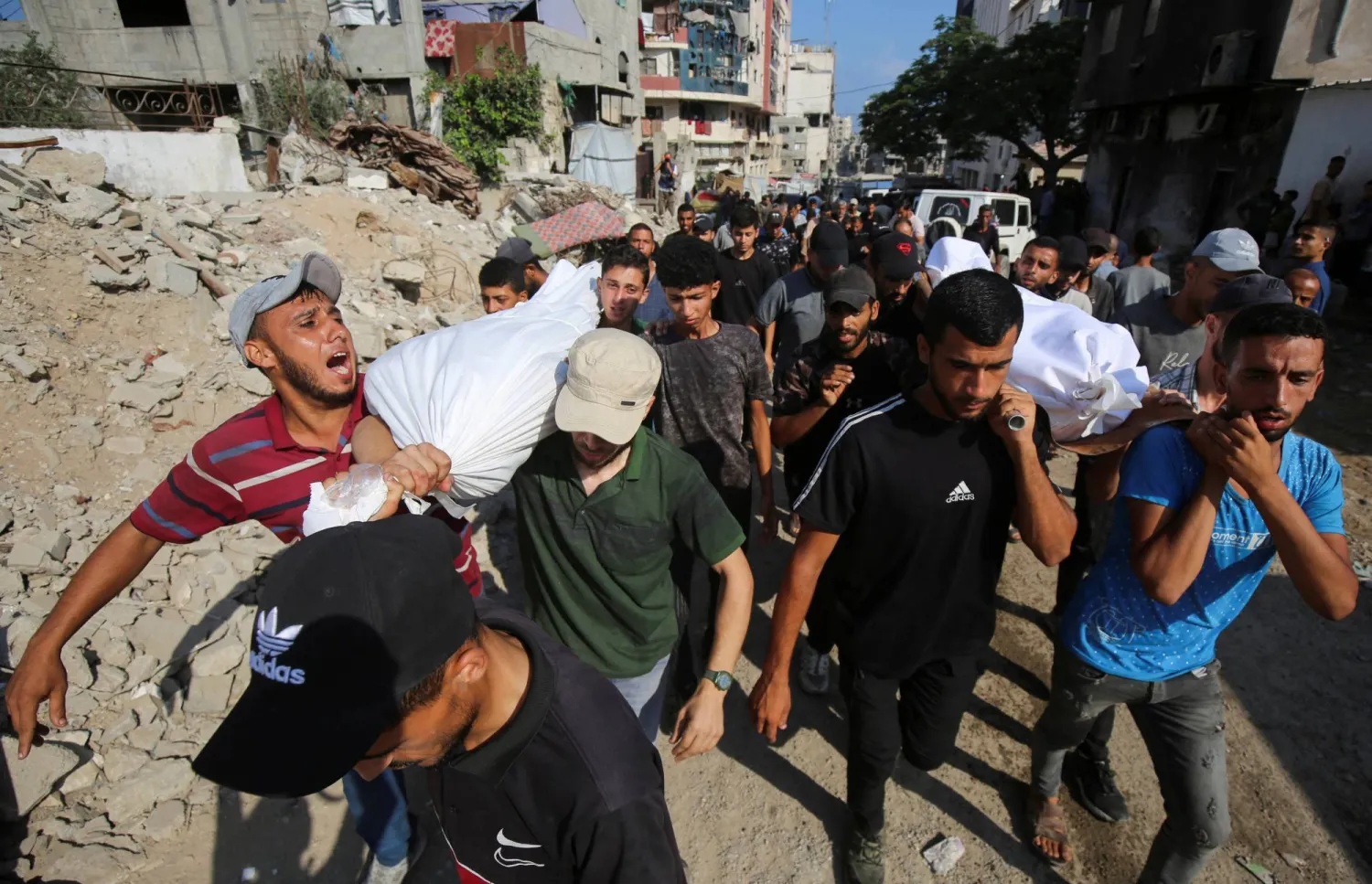
People carry bodies of Palestinians, who were killed by Israeli fire while trying to receive aid on Friday, according to medics, at Al-Shifa Hospital, in Gaza City, August 2, 2025. REUTERS/Mahmoud Issa
TT

Israeli Fire Kills More than a Dozen in Gaza

People carry bodies of Palestinians, who were killed by Israeli fire while trying to receive aid on Friday, according to medics, at Al-Shifa Hospital, in Gaza City, August 2, 2025. REUTERS/Mahmoud Issa

Hospitals in Gaza reported the killing of more than a dozen people, eight of them food-seekers, by Israeli fire on Saturday as Palestinians endured severe risks in their search for food amid airdrops and restrictions on overland aid delivery.

Near a Gaza Humanitarian Foundation distribution site, Yahia Youssef, who had come to seek aid Saturday morning, described a panicked scene now grimly familiar. After helping carry out three people wounded by gunshots, he said he looked around and saw many others lying on the ground bleeding, reported The Associated Press said.

“It’s the same daily episode,” Youssef said.

In response to questions about several eyewitness accounts of violence at the northernmost of the Israeli-backed American contractor’s four sites, the GHF media office said “nothing (happened) at or near our sites.”

The episode came a day after US officials visited one site and US Ambassador to Israel Mike Huckabee called GHF’s distribution “an incredible feat.” International outrage has mounted as the group’s efforts to deliver aid to hunger-stricken Gaza have been marred by violence and controversy.

“We weren’t close to them (the troops) and there was no threat,” Abed Salah, a man in his 30s who was among the crowds close to the GHF site near Netzarim corridor, said. “I escaped death miraculously.”

The danger facing aid seekers in Gaza has compounded what international hunger experts this week called a “worst-case scenario of famine” in the besieged enclave. Israel’s nearly 22-month military offensive against Hamas has shattered security in the territory of some 2 million Palestinians and made it nearly impossible to deliver food safely to starving people.

From May 27 to July 31, 859 people were killed in the vicinity of GHF sites, according to a United Nations report published Thursday. Hundreds more have been killed along the routes of food convoys.

Israel and GHF have said they have only fired warning shots and that the toll has been exaggerated.

GHF says its armed contractors have only used pepper spray or fired warning shots to prevent deadly crowding. Israel ’s military has said it has only fired warning shots at people who approach its forces, though on Friday said it was working to make the routes under its control safer.

Health officials reported that Israeli airstrikes and gunfire killed at least 18 Palestinians on Saturday, including three whose bodies were transported from the vicinity of a distribution site to a central Gaza hospital along with 36 others who were wounded.

Officials said 10 of Saturday's casualties were killed by strikes in central and southern Gaza. Nasser Hospital said it received the bodies of five people killed in two separate strikes on tents sheltering displaced people. The dead include two brothers and a relative, who were killed when a strike hit their tent close to a main thoroughfare in Khan Younis.

The Gaza health ministry’s ambulance and emergency service said an Israeli strike hit a family house in an area between the towns of Zawaida and Deir al-Balah, killing two parents and their three children.

Another strike hit a tent close to the gate of a closed prison where the displaced have sheltered in Khan Younis, killing a mother and her daughter, they said.

The hospital said Israeli forces killed five other Palestinians who were among crowds awaiting aid near the newly constructed Morag corridor in Rafah and between Rafah and Khan Younis.

Israel's military did not immediately respond to questions about the strikes or deaths near the aid sites.

Hostage families protest to end war

Meanwhile in Tel Aviv, families of Israeli hostages protested and urged Israel's government to push harder for the release of their loved ones, including those shown in footage released by militant groups earlier this week.

US President Donald Trump's special envoy Steve Witkoff joined them a day after visiting Gaza and a week after walking away from ceasefire talks in Qatar, blaming Hamas's intransigence and pledging to find other ways to free hostages and make Gaza safe.

Of the 251 hostages who were abducted when Hamas led an attack on southern Israel on Oct. 7, 2023, around 20 are believed to be alive in Gaza. Hamas and Islamic Jihad, the second-largest militant group in Gaza, released separate videos of individual hostages this week, triggering outrage among hostage families and Israeli society.

Israeli media hasn't broadcast the videos, calling them propaganda, but the family of 21-year-old Rom Braslavski allowed for the release of a photograph showing him visibly emaciated in an unknown location. After viewing the video, Tami Braslavski, his mother, blamed top Israeli officials and demanded they meet with her.

"They broke my child, I want him home now,” Braslavski told Ynet on Thursday. “Look at him: Thin, limp, crying. All his bones are out.”

Hostage families and their supporters protesting in Tel Aviv called on Israel's government to make a deal to end the war, imploring them to "stop this nightmare and bring them out of the tunnels”

“Do the right thing and just do it now,” Lior Chorev ,the Hostages Family Forum's Chief Strategy Officer said.

Airdrops expand despite limited impact

To circumvent restrictions on aid trucks crossing overland into Gaza, additional countries joined the Jordan-led coalition orchestrating parcels being dropped from the skies.

Alongside Israel, several European countries announced plans this week to join airdrop efforts, though most acknowledge the strategy is woefully insufficient

“If there is political will to allow airdrops — which are highly costly, insufficient & inefficient, there should be similar political will to open the road crossings,” Philippe Lazzarini, the head of the UN agency for Palestinian refugees, wrote on X on Saturday. “Let’s go back to what works & let us do our job.”

The war in Gaza began when Hamas attacked southern Israel on Oct. 7, 2023, killing around 1,200 people, mostly civilians. Israel’s retaliatory offensive has killed more than 60,000 Palestinians, according to Gaza’s Health Ministry, which doesn’t distinguish between militants and civilians and operates under the Hamas government. The UN and other international organizations see it as the most reliable source of data on casualties.


Libya’s Ramadan Celebrations Tempered by Economic Woes

A family walks on their way to shop for Ramadan decorations ahead of the holy month of Ramadan in Benghazi, Libya, February 16, 2026. (Reuters)
TT

Libya’s Ramadan Celebrations Tempered by Economic Woes

A family walks on their way to shop for Ramadan decorations ahead of the holy month of Ramadan in Benghazi, Libya, February 16, 2026. (Reuters)

Libyans have been enjoying Ramadan with feasts and fireworks -- but soaring prices, a devalued currency and political divisions have left many with little to celebrate.

Fifteen years on from the fall of longtime leader Moammar al-Gaddafi, the country remains split between east and west, while shortages of goods, including fuel, disrupt daily life, despite Libya sitting atop vast oil and gas reserves.

During the holy month of Ramadan, shoppers stock up on treats, as families gather for lavish meals before and after the daytime fast that stretches from sunrise to sunset.

But this year supermarkets have been rationing their goods, while many petrol stations are short of gas. In the capital Tripoli, most ATMs were out of cash this week.

Firas Zreeg, 37, told AFP while weaving through a crowded supermarket that the economy was deteriorating, blaming currency speculators for the fall in the dinar, "which has negative repercussions on our daily lives".

The price of cooking oil has doubled in recent weeks, while meat and poultry prices rose by half.

Refills of gas cylinders, officially priced at 1.5 dinars ($0.24) but often unavailable through state-run distributors, now sell for 75 dinars ($11.85) on the black market and at times more.

- 'Burden on citizens' -

Libya has struggled to recover from the chaos that erupted following the 2011 uprising that toppled Gaddafi.

It remains divided between the Government of National Unity (GNU) based in Tripoli and an eastern administration backed by Libyan National Army (LNA) commander Khalifa Haftar.

The country has largely been stable in recent years although there have been bouts of deadly violence, including the killing of Gaddafi's son and heir apparent Seif al-Islam this month.

With security holding, many Libyans are more focused on their livelihoods.

Last month, the central bank in the western territory devalued the dinar -- the second time in less than a year -- by nearly 15 percent, "aimed at preserving financial and monetary stability and ensuring the sustainability of public resources".

In an address this week, GNU leader Abdulhamid Dbeibah acknowledged that the devaluation had once again "put the burden on citizens".

Hanna Tetteh, head of the United Nations Support Mission in Libya, warned on Wednesday that "poverty and pressure on society [are] increasing".

"The situation, in addition to the fragile security landscape, should be a matter for concern as such conditions can lead to unexpected political and security challenges," she told the UN Security Council.

Libya's other economic problems included the absence of a unified national budget, in light of its political divide, as well as uncoordinated public spending due to parallel state institutions, Tetteh said.

Revenues from the oil industry were also declining, she added, while the central bank has said public spending is growing at an unsustainable pace.

On Tuesday, Libya marked 15 years since the start of the uprising, with fireworks lighting up the sky in Tripoli, but for many Libyans life remains a struggle.

"Minor improvements in security were made over the past three years," Zreeg told AFP, but Libyans are still faced with huge economic challenges.


Libya PM Undergoes 'Successful' Treatment at Heart Hospital

Head of Libya's Government of National Unity (GNU) Abdulhamid Dbeibah. (GNU)
TT

Libya PM Undergoes 'Successful' Treatment at Heart Hospital

Head of Libya's Government of National Unity (GNU) Abdulhamid Dbeibah. (GNU)

Libya's Prime Minister Abdulhamid Dbeibah has undergone "successful" treatment at a heart hospital, his office said Saturday, but his specific ailment was not disclosed.

"I assure you that I am fine, by God's grace," said a statement posted on social media overnight.

The treatment was carried out at a facility in the northwestern Libyan city of Misrata on an undisclosed date, said AFP.

Dbeibah said he later travelled abroad for "additional medical checkups for reassurance", though this was not the primary reason for his trip.

Italian media outlets previously reported he had been admitted to a leading cardiac facility in Milan on Thursday for a general check-up.

"The matter is simply that I underwent some additional medical checkups for reassurance while I was abroad due to a prior external commitment," he said.

"The results confirmed the success of the treatment I received in Libya, praise be to God."

The prime minister leads a UN-recognized government based in Tripoli that controls western Libya, while the country's east is run by another administration backed by military strongman Khalifa Haftar.

Libya has remained divided since chaos erupted following the 2011 Arab Spring uprising that toppled longtime leader Muammar Gaddafi.


Eight Hezbollah Members Killed in Israel’s Friday Strikes on Lebanon

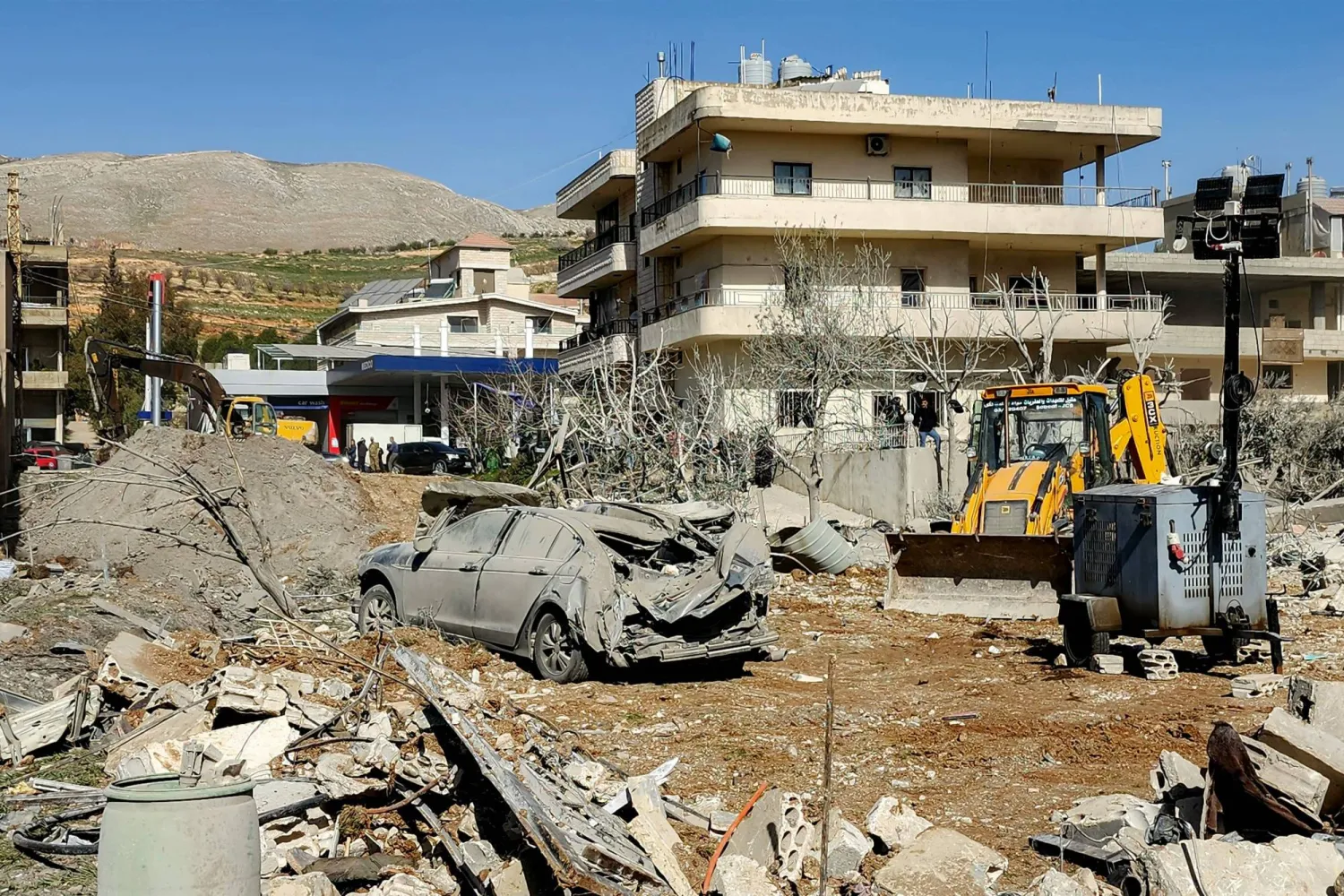
A bulldozer clears debris near heavily-damaged buildings in the village of Bednayel in Lebanon's eastern Bekaa Valley region on February 21, 2026, following Israeli strikes. (AFP)
TT

Eight Hezbollah Members Killed in Israel’s Friday Strikes on Lebanon

A bulldozer clears debris near heavily-damaged buildings in the village of Bednayel in Lebanon's eastern Bekaa Valley region on February 21, 2026, following Israeli strikes. (AFP)

Attacks carried out by Israel on Friday in eastern Lebanon killed eight members of Hezbollah, an official from the group told AFP on Saturday.

Lebanon's health ministry said Friday that a total of 10 people were killed in strikes that hit the eastern Bekaa region.

The Israeli military said it targeted "several terrorists of Hezbollah's missile array in three different command centers in the Baalbek area".

Lebanon's president on Saturday condemned the attacks, the latest despite a ceasefire with Hezbollah.

In a statement, Joseph Aoun called the attacks "a blatant act of aggression aimed at thwarting diplomatic efforts" by the United States and other nations to establish stability.

A lawmaker from Hezbollah called on Beirut to suspend meetings of a multinational committee tasked with monitoring the truce.

Washington is one of five members on the committee overseeing the ceasefire implemented in November 2024, with the body scheduled to meet again next week.

Israel has repeatedly bombed Lebanon despite the ceasefire, usually saying it is targeting Hezbollah but occasionally also the group's Palestinian ally Hamas.

The Friday attacks on southern and eastern Lebanon killed 12 people, according to the health ministry, 10 of them in the east of the country.

Israel's military said it struck "several terrorists of Hezbollah's missile array in three different command centers in the Baalbek area".

Hezbollah said a commander was killed in the raids. Its lawmaker Rami Abu Hamdan said on Saturday the group "will not accept the authorities acting as mere political analysts, dismissing these as Israeli strikes we have grown accustomed to before every meeting of the committee".

He called on Beirut to "suspend the committee's meetings until the enemy ceases its attacks".

Hezbollah, while weakened following war with Israel, remains a strong political force in Lebanon represented in parliament.

Lebanon's government last year committed to disarming the Iran-backed group, with the army saying last month it had completed the first phase of the plan covering the area near the Israeli border.

Israel, which accuses Hezbollah of rearming since the war, has called the Lebanese army's progress on disarming the group insufficient.