
US Envoy Urges Calm and Dialogue to Resolve Syria Disputes

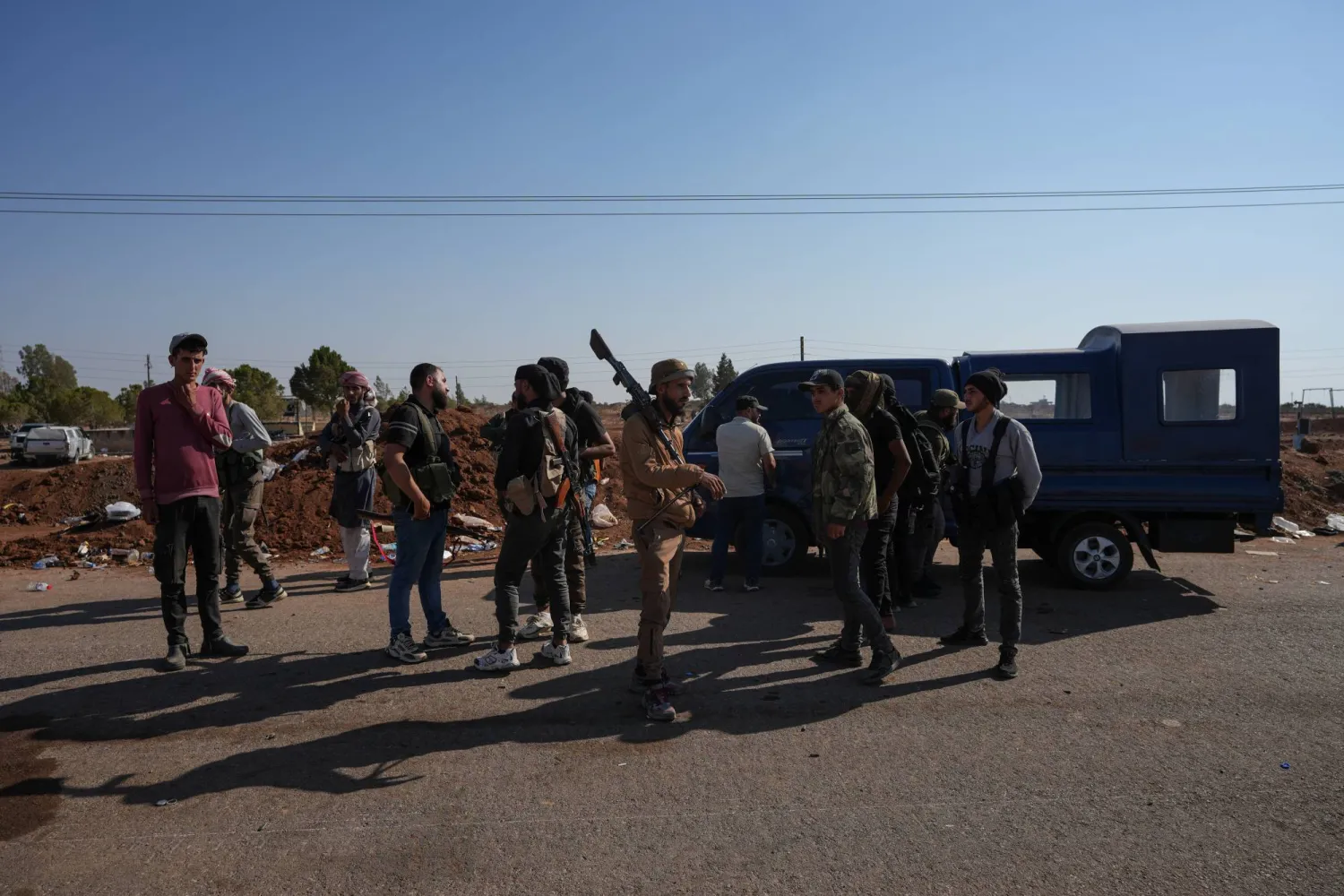
21 July 2025, Syria, Daraa: Syrian security forces stand near the earthen berms they erected near the town of Busra al-Harir in the Daraa countryside to prevent tribal forces from advancing towards the Druze villages in the Sweida Governorate, after an agreement between the Syrian government and the Druze forces Photo: Maowia Atrash/dpa
TT

US Envoy Urges Calm and Dialogue to Resolve Syria Disputes

21 July 2025, Syria, Daraa: Syrian security forces stand near the earthen berms they erected near the town of Busra al-Harir in the Daraa countryside to prevent tribal forces from advancing towards the Druze villages in the Sweida Governorate, after an agreement between the Syrian government and the Druze forces Photo: Maowia Atrash/dpa

The US special envoy for Syria, Tom Barrack, on Monday voiced concern over fresh outbreaks of violence in Sweida in southern Syria and Manbij in the northeast, calling for dialogue to resolve disputes.

“Disturbing violence erupted yesterday in Sweida, and in Manbij. Diplomacy is the best way to stop violence and build a peaceful, lasting solution,” Barrack wrote on X.

“The path ahead belongs to Syrians — urging all sides to uphold calm and resolve differences through dialogue, not bloodshed. Syria deserves stability. Syrians deserve peace,” he added.

Meanwhile, Syrian authorities reopened a humanitarian corridor in Busra al-Sham in southern Daraa province after securing the area from what state media described as “mutinous al-Hijri gangs,” who reportedly violated a ceasefire in Sweida the day before.

According to the state-run SANA news agency, the armed groups attacked internal security forces at several points and shelled villages in Sweida’s western countryside, leaving several security personnel dead or wounded.

The Interior Ministry had temporarily closed the crossing on Sunday, citing concerns for civilian safety, SANA reported. The ministry said security forces repelled the attacks on positions in Tal al-Hadid, Rimat Hazm, and Walgha, retaking control and restoring calm to preserve the ceasefire.

Relief and humanitarian aid resumed delivery to Sweida through Busra al-Sham on Monday as part of government efforts to meet residents’ needs.

On Sunday, Sweida’s internal security chief, Ahmad al-Dalati, said armed groups had launched deadly attacks in the province’s countryside before security forces regained control.

A commander in Sweida’s “Joint Operations Room” claimed coordination was underway with US and Israeli counterparts to secure international protection and establish an investigative committee into last month’s violence.

He described ties with Israel as “positive,” calling it “an important player in the region” and crediting it with repelling attacks on Sweida. “We are asking for its protection,” he said.

The remarks were made to Asharq al-Awsat after the first meeting of the Syrian investigative committee into the recent Sweida violence, which erupted between local and tribal armed groups.

Tareq al-Maghoush, a prominent figure in the local opposition, reiterated rejection of the Syrian government’s investigative committee, citing both factional and popular opposition.

He said Sweida’s “Operations Room” had barred the committee from operating in the province, branding it “illegitimate,” and would inform its members to leave “politely.”

The “Operations Room,” composed of local Druze factions, was formed in December 2024 at the launch of the “Deterrence of Aggression” campaign, which it claims expelled the Assad regime from several provinces, starting in Aleppo and reaching the outskirts of Damascus.

Maghoush, who says he works under the spiritual leadership of Druze cleric Sheikh Hikmat al-Hijri, said the Sheikh personally approved the creation of the “Operations Room” and tasked him with various files.

A ceasefire agreement on July 20 ended a week-long conflict between Druze fighters and tribal militants. The Syrian Network for Human Rights said at least 814 people were killed and over 903 wounded in Sweida between July 13 and 20.

The toll includes civilians—among them women, children, and medical staff—as well as fighters from tribal armed groups and local factions outside government control. Members of the Syrian opposition's internal security forces and defense ministry were also among the casualties.

The violence displaced 176,000 people, according to United Nations data. Shelling reached central Damascus, hitting sites near the defense ministry, the presidential palace compound, and the national library.

On Thursday, the Syrian justice ministry announced the formation of an official committee to “investigate the causes and circumstances” behind the violence, look into “assaults and violations,” and refer perpetrators to the judiciary.

But protests broke out the next day in Sweida, with demonstrators demanding an independent international investigation and rejecting the Syrian committee. Some protesters waved the Israeli flag.

Judge Hatim al-Nassan, head of the official inquiry, said during the committee’s first meeting that they were open to engaging with the people of Sweida, calling them “an essential component of the country.” But he warned that raising the Israeli flag on Syrian soil “is a crime that must be punished.”

The committee said it would immediately begin meetings with officials in Sweida and Daraa, as well as those affected by the violence.

According to Syria TV, the committee insisted that an international inquiry was unnecessary as long as the Syrian state remained capable of investigating on its own.


Israel Military Says Soldier Killed in Gaza 

A drone view shows the destruction in a residential neighborhood, after the withdrawal of the Israeli forces from the area, amid a ceasefire between Israel and Hamas in Gaza, in Gaza City, October 21, 2025. (Reuters)
TT

Israel Military Says Soldier Killed in Gaza 

A drone view shows the destruction in a residential neighborhood, after the withdrawal of the Israeli forces from the area, amid a ceasefire between Israel and Hamas in Gaza, in Gaza City, October 21, 2025. (Reuters)

The Israeli military announced that one of its soldiers had been killed in combat in southern Gaza on Wednesday, but a security source said the death appeared to have been caused by "friendly fire".

"Staff Sergeant Ofri Yafe, aged 21, from HaYogev, a soldier in the Paratroopers Reconnaissance Unit, fell during combat in the southern Gaza Strip," the military said in a statement.

A security source, however, told AFP that the soldier appeared to have been "killed by friendly fire", without providing further details.

"The incident is still under investigation," the source added.

The death brings to five the number of Israeli soldiers killed in Gaza since a ceasefire took effect on October 10.


Syria: SDF’s Mazloum Abdi Says Implementation of Integration Deal May Take Time

People sit outdoors surrounded by nature, with the Tigris river flowing in the background, following a long atmospheric depression, near the Syrian-Turkish border in Derik, Syria, February 16, 2026 REUTERS/Orhan Qereman
TT

Syria: SDF’s Mazloum Abdi Says Implementation of Integration Deal May Take Time

People sit outdoors surrounded by nature, with the Tigris river flowing in the background, following a long atmospheric depression, near the Syrian-Turkish border in Derik, Syria, February 16, 2026 REUTERS/Orhan Qereman

Mazloum Abdi, commander of the Syrian Democratic Forces, said the process of merging the SDF with Syrian government forces “may take some time,” despite expressing confidence in the eventual success of the agreement.

His remarks came after earlier comments in which he acknowledged differences with Damascus over the concept of “decentralization.”

Speaking at a tribal conference in the northeastern city of Hasakah on Tuesday, Abdi said the issue of integration would not be resolved quickly, but stressed that the agreement remains on track.

He said the deal reached last month stipulates that three Syrian army brigades will be created out of the SDF.

Abdi added that all SDF military units have withdrawn to their barracks in an effort to preserve stability and continue implementing the announced integration agreement with the Syrian state.

He also emphasized the need for armed forces to withdraw from the vicinity of the city of Ayn al-Arab (Kobani), to be replaced by security forces tasked with maintaining order.


Israeli Far-Right Minister to Push for ‘Migration’ of West Bank, Gaza Palestinians 

A Palestinian man checks leather belts as people prepare for Ramadan, in the old city of Hebron in the Israeli-occupied West Bank, February 17,2026. (Reuters)
TT

Israeli Far-Right Minister to Push for ‘Migration’ of West Bank, Gaza Palestinians 

A Palestinian man checks leather belts as people prepare for Ramadan, in the old city of Hebron in the Israeli-occupied West Bank, February 17,2026. (Reuters)

Israel's far-right Finance Minister Bezalel Smotrich said he would pursue a policy of "encouraging the migration" of Palestinians from the occupied West Bank and Gaza Strip, Israeli media reported Wednesday.

"We will eliminate the idea of an Arab terror state," said Smotrich, speaking at an event organized by his Religious Zionism Party late on Tuesday.

"We will finally, formally, and in practical terms nullify the cursed Oslo Accords and embark on a path toward sovereignty, while encouraging emigration from both Gaza and Judea and Samaria.

"There is no other long-term solution," added Smotrich, who himself lives in a settlement in the West Bank.

Since last week, Israel has approved a series of measures backed by far-right ministers to tighten control over the West Bank, including in areas administered by the Palestinian Authority under the Oslo Accords, in place since the 1990s.

The measures include a process to register land in the West Bank as "state property" and facilitate direct purchases of land by Jewish Israelis.

The measures have triggered widespread international outrage.

On Tuesday, the UN missions of 85 countries condemned the measures, which critics say amount to de facto annexation of the Palestinian territory.

"We strongly condemn unilateral Israeli decisions and measures aimed at expanding Israel's unlawful presence in the West Bank," they said in a statement.

"Such decisions are contrary to Israel's obligations under international law and must be immediately reversed.

"We underline in this regard our strong opposition to any form of annexation."

UN Secretary-General Antonio Guterres on Monday called on Israel to reverse its land registration policy, calling it "destabilizing" and "unlawful".

The West Bank would form the largest part of any future Palestinian state. Many on Israel's religious right view it as Israeli land.

Israeli NGOs have also raised the alarm over a settlement plan signed by the government which they say would mark the first expansion of Jerusalem's borders into the occupied West Bank since 1967.

The planned development, announced by Israel's Ministry of Construction and Housing, is formally a westward expansion of the Geva Binyamin, or Adam, settlement situated northeast of Jerusalem in the West Bank.

The current Israeli government has fast-tracked settlement expansion, approving a record 52 settlements in 2025.

Excluding Israeli-annexed east Jerusalem, more than 500,000 Israelis live in West Bank settlements and outposts, which are illegal under international law.