


Terrible Thirst Hits Gaza with Polluted Aquifers and Broken Pipelines 

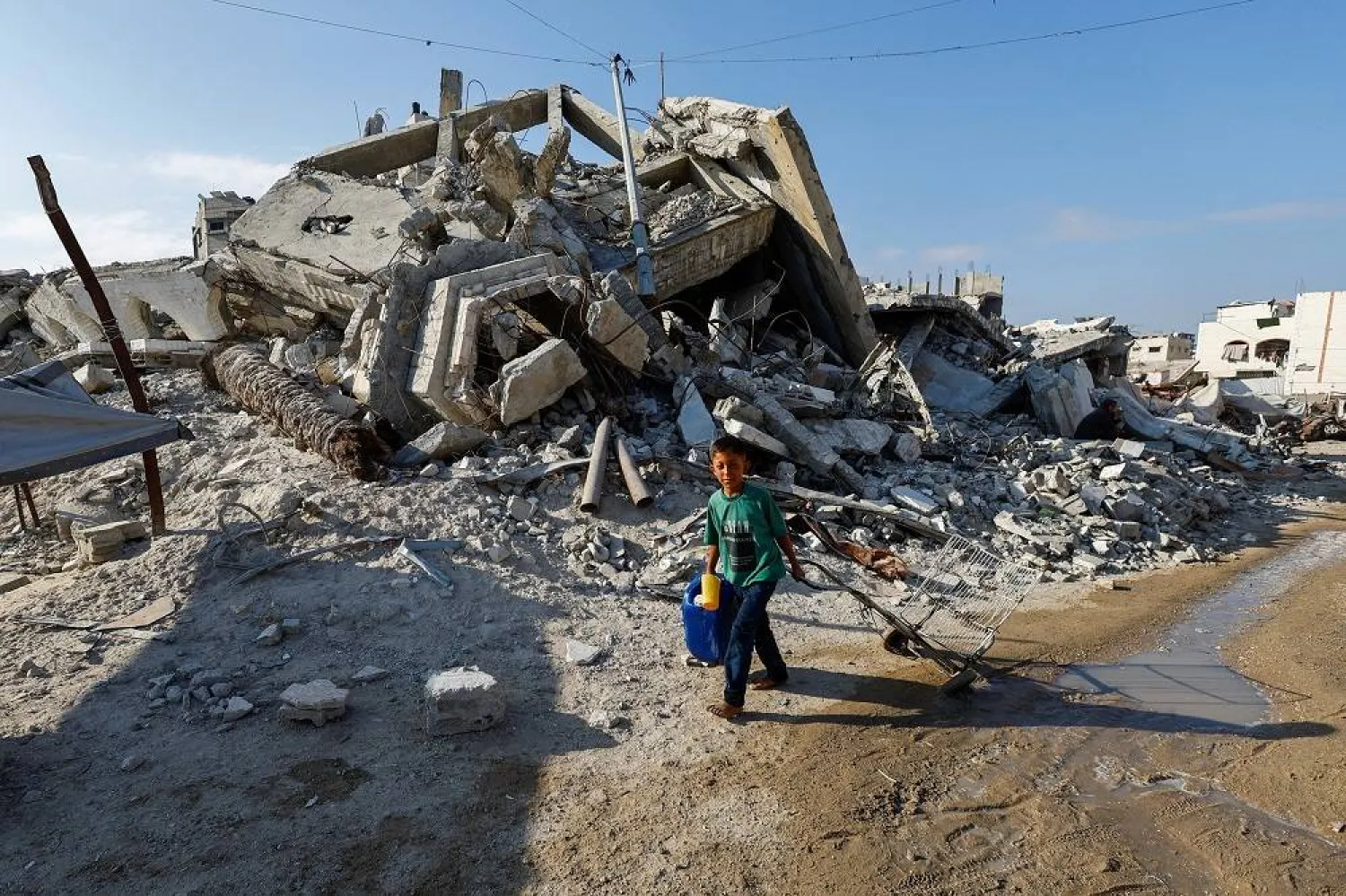
A Palestinian boy walks with a container of water amid shortages, in Gaza City August 6, 2025. (Reuters)
TT

Terrible Thirst Hits Gaza with Polluted Aquifers and Broken Pipelines 

A Palestinian boy walks with a container of water amid shortages, in Gaza City August 6, 2025. (Reuters)

Weakened by hunger, many Gazans trek across a ruined landscape each day to haul all their drinking and washing water - a painful load that is still far below the levels needed to keep people healthy.

Even as global attention has turned to starvation in Gaza, where after 22 months of a devastating Israeli military campaign a global hunger monitor says a famine scenario is unfolding, the water crisis is just as severe according to aid groups.

Though some water comes from small desalination units run by aid agencies, most is drawn from wells in a brackish aquifer that has been further polluted by sewage and chemicals seeping through the rubble, spreading diarrhea and hepatitis.

Israeli pipelines that once supplied Gaza with much of its clean water are now dry. Israel stopped all water and electricity supply to Gaza early in the war. Although it resumed some supply later, pipelines were damaged and Gaza water officials say none has entered recently.

COGAT, the Israeli military aid coordination agency, did not respond to a request for comment on whether Israel is supplying water.

Most water and sanitation infrastructure has been destroyed and pumps from the aquifer often rely on electricity from small generators - for which fuel is rarely available.

Moaz Mukhaimar, aged 23 and a university student before the war, said he has to walk about a kilometer, queuing for two hours, to fetch water. He often goes three times a day, dragging it back to the family tent over bumpy ground on a small metal handcart.

"How long will we have to stay like this?" he asked, pulling two larger canisters of very brackish water to use for cleaning and two smaller ones of cleaner water to drink.

His mother, Umm Moaz, 53, said the water he collects is needed for the extended family of 20 people living in their small group of tents in Deir al-Balah in the central Gaza Strip.

"The children keep coming and going and it is hot. They keep wanting to drink. Who knows if tomorrow we will be able to fill up again," she said.

Their struggle for water is replicated across the tiny, crowded territory where nearly everybody is living in temporary shelters or tents without sewage or hygiene facilities and not enough water to drink, cook and wash as disease spreads.

The United Nations says the minimum emergency level of water consumption per person is 15 liters a day for drinking, cooking, cleaning and washing. Average daily consumption in Israel is around 247 liters a day according to Israeli rights group B'Tselem.

Bushra Khalidi, humanitarian policy lead for aid agency Oxfam in the Israeli-occupied Palestinian territories said the average consumption in Gaza now was 3-5 liters a day.

Oxfam said last week that preventable and treatable water-borne diseases were "ripping through Gaza", with reported rates increasing by almost 150% over the past three months.

Israel blames Hamas for the suffering in Gaza and says it provides adequate aid for the territory's 2.3 million inhabitants.

QUEUES FOR WATER

"Water scarcity is definitely increasing very much each day and people are basically rationing between either they want to use water for drinking or they want to use a lot for hygiene," said Danish Malik, a global water and sanitation official for the Norwegian Refugee Council.

Merely queuing for water and carrying it now accounts for hours each day for many Gazans, often involving jostling with others for a place in the queue. Scuffles have sometimes broken out, Gazans say.

Collecting water is often the job of children as their parents seek out food or other necessities.

"The children have lost their childhood and become carriers of plastic containers, running behind water vehicles or going far into remote areas to fill them for their families," said Munther Salem, water resources head at the Gaza Water and Environment Quality Authority.

With water so hard to get, many people living near the beach wash in the sea.

A new water pipeline funded by the United Arab Emirates is planned, to serve 600,000 people in southern Gaza from a desalination plant in Egypt. But it could take several more weeks to be connected.

Much more is needed, aid agencies say. UNICEF spokesperson James Elder said the long-term deprivations were becoming deadly. "Starvation and dehydration are no longer side effects of this conflict. They are very much frontline effects."

Oxfam's Khalidi said a ceasefire and unfettered access for aid agencies was needed to resolve the crisis.

"Otherwise, we will see people dying from the most preventable diseases in Gaza - which is already happening before our eyes."



Lebanon Ex-central Bank Chief's Corruption Case Being Dent to Top Court

The BDL headquarters in Beirut (NNA) 
TT

Lebanon Ex-central Bank Chief's Corruption Case Being Dent to Top Court

The BDL headquarters in Beirut (NNA) 

The corruption case of Lebanon's former central bank governor, who is widely blamed for the country’s economic meltdown, has been transferred to the country's highest court, judicial officials told The Associated Press on Tuesday.

Riad Salameh was released on $14 million bail in September after a year in prison while awaiting trial in Lebanon on corruption charges, including embezzlement and illicit enrichment.

The trial of Salameh, 75, and his two legal associates, Marwan Khoury and Michel Toueini, will now be heard at the Court of Cassation, according to a copy of the notice obtained by the AP. Salameh and the others will be issued with arrest warrants if they don't show up for trial at the court.

No trial date has been set yet. Salameh denies the charges. The court’s final ruling can't be appealed, according to the four officials who spoke on condition of anonymity, because they weren't authorized to speak with the media.

In September 2024, he was charged with the embezzlement of $42 million, with the court later adding charges of illicit enrichment over an apartment rented in France, supposedly to be a substitute office for the central bank if needed. Officials have said that Salameh had rented from his former romantic partner for about $500,000 annually.

He was once celebrated for steering Lebanon’s economic recovery, after a 15-year civil war, upon starting his long tenure in 1993 and keeping the fragile economy afloat during long spells of political gridlock and turmoil.

But in 2023, he left his post after three decades with several European countries investigating allegations of financial crimes. Meanwhile, much of the Lebanese blame his policies for sparking a fiscal crisis in late 2019 where depositors lost their savings, and the value of the local currency collapsed.

On top of the inquiry in Lebanon, he is being investigated by a handful of European countries over various corruption charges. In August 2023, the United States, United Kingdom and Canada imposed sanctions on Salameh.

Salameh has repeatedly denied allegations of corruption, embezzlement and illicit enrichment. He insists that his wealth comes from inherited properties, investments and his previous job as an investment banker at Merrill Lynch.

Lebanon’s current central bank governor, Karim Souaid, announced last week that he's filing legal complaints against a former central bank governor and former banking official who diverted funds from the bank to what he said were four shell companies in the Cayman Islands. He didn't name either individual.

But Souaid said that Lebanon's central bank would become a plaintiff in the country's investigation into Forry Associates. The US Treasury, upon sanctioning Salameh and his associates, described Forry Associates as “a shell company owned by Raja (Salameh’s brother) in the British Virgin Islands” used to divert about $330 million in transactions related to the central bank.

Several European countries, among them France, Germany, and Luxembourg, have been investigating the matter, freezing bank accounts and assets related to Salameh and his associates, with little to no cooperation from the central bank and Lebanese authorities.

Souaid said that he will travel later this month to Paris to exchange “highly sensitive” information as France continues its inquiries.


Howling Winds Collapse Walls on Gaza Tent Camps, Killing 4, Child Dies of Hypothermia

Palestinians walk past tents used by displaced people, during a windy winter day, in Gaza City, January 13, 2026. (Reuters)
TT

Howling Winds Collapse Walls on Gaza Tent Camps, Killing 4, Child Dies of Hypothermia

Palestinians walk past tents used by displaced people, during a windy winter day, in Gaza City, January 13, 2026. (Reuters)

At least four people died overnight in Gaza from walls collapsing onto their tents as strong winds lashed the Palestinian coastal territory, hospital authorities said Tuesday. 

Dangerous living conditions persist in Gaza after more than two years of devastating Israeli bombardment and aid shortfalls. A ceasefire has been in effect since Oct. 10. But aid groups say that Palestinians broadly lack the shelter necessary to withstand frequent winter storms. 

The dead include two women, a girl and a man, according to Shifa hospital, Gaza City’s largest hospital, which received the bodies. 

Meanwhile, the child death toll in Gaza ticked up. The Gaza Health Ministry said Tuesday a 1-year-old boy died of hypothermia overnight, while the spokesman for the UN’s children agency said over 100 children and teenagers have been killed in the territory by “military means" since the ceasefire began. 

Family mourns 

Three members of the same family — 72-year-old Mohamed Hamouda, his 15-year-old granddaughter and his daughter-in-law — were killed when an 8-meter-high (26-foot-high) wall collapsed onto their tent in a coastal area along the Mediterranean shore of Gaza City, Shifa hospital said. At least five others were injured in that collapse. 

Their relatives on Tuesday began removing the rubble that had buried their loved ones and rebuilding the tent shelters for survivors. 

“The world has allowed us to witness death in all its forms,” Bassel Hamouda said after the funeral. “It’s true the bombing may have temporarily stopped, but we have witnessed every conceivable cause of death in the world in the Gaza Strip.” 

A second woman was killed when a wall fell on her tent in the western part of the city, Shifa hospital said. 

The majority of Palestinians live in makeshift tents since their homes were reduced to rubble during the war. When storms now strike the territory, Palestinian rescue workers warn people against seeking shelter inside damaged buildings, saying they could fall down on top of them. Aid groups say not enough shelter materials are entering Gaza during the truce. 

In the central town of Zawaida, Associated Press footage showed inundated tents Tuesday morning, with people trying to rebuild their shelters. 

Yasmin Shalha, a displaced woman from the northern town of Beit Lahiya, stood against winds that lifted the tarps of tents around her as she stitched hers back together with needle and thread. She said it had fallen on top of her family the night before, as they slept. 

“The winds were very, very strong. The tent collapsed over us,” the mother of five told the AP. “As you can see, our situation is dire.” 

Mohamed al-Sawalha, a 72-year-old man from the northern refugee camp of Jabaliya, criticized the conditions that most Palestinians in Gaza endure. 

“It doesn’t work neither in summer nor in winter,” he said of the tent. “We left behind houses and buildings (with) doors that could be opened and closed. Now we live in a tent. Even sheep don’t live like we do.” 

Israel’s bombing campaign has reduced entire neighborhoods to rubble and half-standing structures. Residents aren’t able to return to their homes in Israeli-controlled areas of the Gaza Strip. 

Child death toll in Gaza rises  

The Gaza Health Ministry said Tuesday a 1-year-old boy died of hypothermia in the central town of Deir al-Balah, the seventh fatality due to the cold conditions since winter started, including a baby just seven days old and a 4-year-old girl whose deaths were announced the day before. 

The ministry, part of the Hamas-run government, says more than 440 people were killed by Israeli fire and their bodies brought to hospitals since the ceasefire went into effect just over three months ago. The ministry maintains detailed casualty records that are seen as generally reliable by UN agencies and independent experts. 

Meanwhile, UNICEF spokesman James Elder said Tuesday at least 100 children under the age of 18 — 60 boys and 40 girls — have been killed in Gaza since the truce began due to military operations, including drone strikes, airstrikes, tank shelling and use of live ammunition.  

Those figures, he said, reflect incidents where enough details have been compiled to warrant recording, but the total toll is expected to be higher. He also said hundreds of children have been wounded. 

While “bombings and shootings have slowed” during the ceasefire, they have not stopped, Elder told reporters at a UN briefing in Geneva by video from Gaza City. 

“So what the world now calls calm would be considered a crisis anywhere else,” he told 

The Palestinian territory's population of more than 2 million people has been struggling to keep the cold weather and storms at bay, amid shortages of humanitarian aid and a lack of more substantial temporary housing, which is badly needed during the winter months.  

It's the third winter since the war between Israel and Hamas started on Oct. 7, 2023, when gunmen stormed into southern Israel and killed around 1,200 people and abducted 251 others into Gaza. 

Gaza’s Health Ministry says more than 71,400 Palestinians have been killed since Israel's retaliatory offensive began in the territory. 


Syrian Army Tells Kurdish Forces to Withdraw from Area East of Aleppo City

Buses carrying displaced residents drive past a building in ruins as they return to the Achrafieh neighborhood after days of fighting between government forces and Kurdish fighters in the northern city of Aleppo, Syria, Monday, Jan. 12, 2026. (AP)
TT

Syrian Army Tells Kurdish Forces to Withdraw from Area East of Aleppo City

Buses carrying displaced residents drive past a building in ruins as they return to the Achrafieh neighborhood after days of fighting between government forces and Kurdish fighters in the northern city of Aleppo, Syria, Monday, Jan. 12, 2026. (AP)

Syria's army told Kurdish forces on Tuesday to withdraw from an area they control east of Aleppo after dislodging fighters from two neighborhoods in the city in deadly clashes last week.

State television published an army statement with a map declaring a large area a "closed military zone" and said "all armed groups in this area must withdraw to east of the Euphrates" River.

The area begins near Deir Hafer, around 50 kilometers (30 miles) east of Aleppo city and extends to the Euphrates further east, as well as towards the south.

On Monday, Syria accused the US-backed, Kurdish-led Syrian Democratic Forces of sending reinforcements to Deir Hafer and said it sent its own personnel there in response.

The SDF denied any build-up of its forces in the region.

An AFP correspondent saw government forces bringing military reinforcements including artillery to the Deir Hafer area on Tuesday.

On the weekend, Syria's government took full control of Aleppo city after taking over its Kurdish neighborhoods and evacuating fighters there to Kurdish-controlled areas in the country's northeast following days of clashes.

The violence started last Tuesday after negotiations stalled on integrating the Kurds' de facto autonomous administration and forces into the country's new government.

The SDF controls swathes of the country's oil-rich north and northeast, much of which they captured during Syria's civil war and the fight against the ISIS group.