


Indonesia Readies Island Medical Facility for 2,000 Wounded Gazans

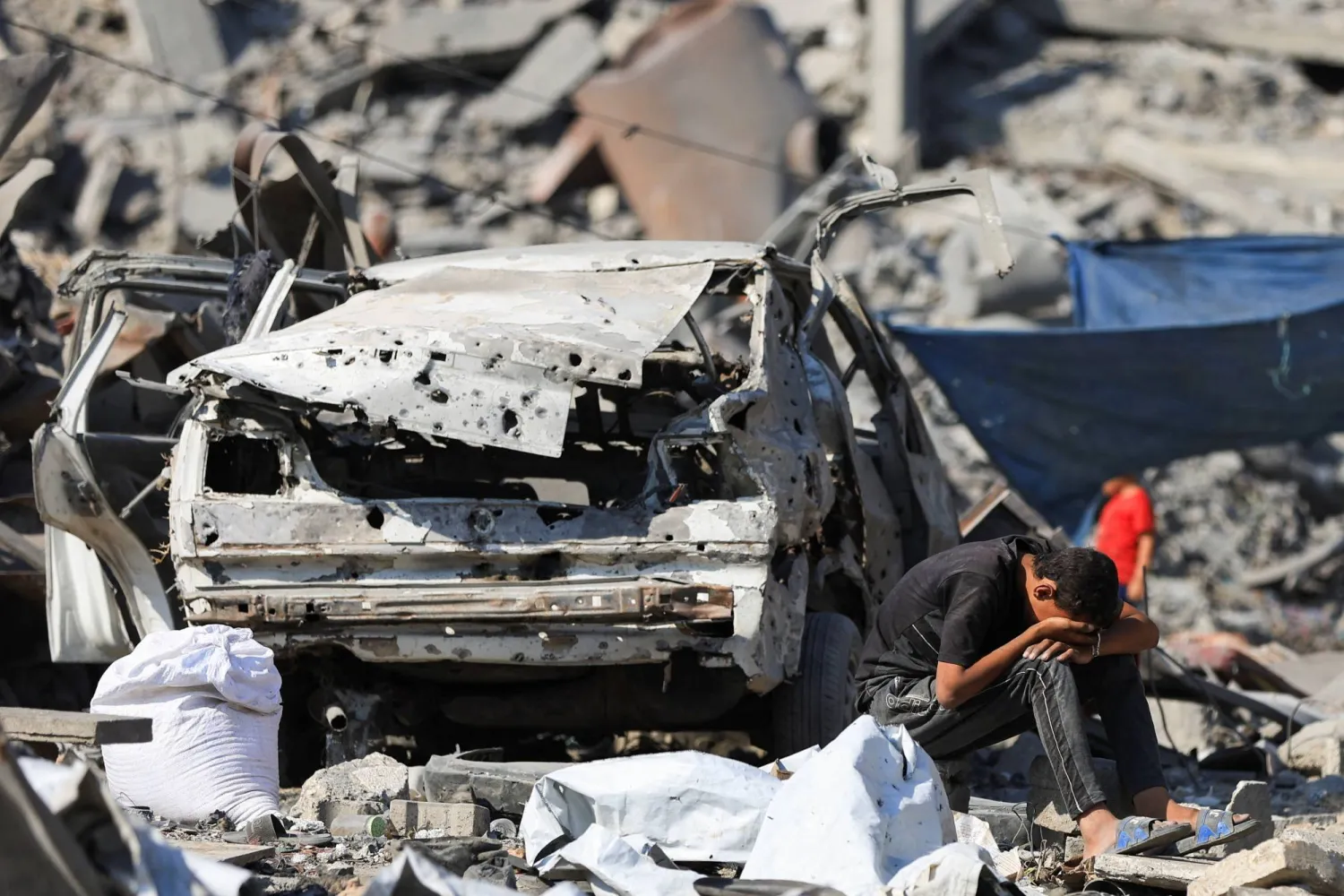
A Palestinian boy reacts at the site surrounding an evacuated UNRWA clinic where displaced people were taking shelter, following an overnight Israeli strike, in Gaza City August 6, 2025. REUTERS/Dawoud Abu Alkas
TT

Indonesia Readies Island Medical Facility for 2,000 Wounded Gazans

A Palestinian boy reacts at the site surrounding an evacuated UNRWA clinic where displaced people were taking shelter, following an overnight Israeli strike, in Gaza City August 6, 2025. REUTERS/Dawoud Abu Alkas

Indonesia will convert a medical facility on its currently uninhabited island of Galang to treat about 2,000 wounded residents of Gaza, who will return home after recovery, a presidential spokesperson said on Thursday.

Indonesia has sent humanitarian aid to Gaza after Israel started an offensive in October 2023 that Gaza health officials say has killed more than 60,000 Palestinians, whether fighters or non-combatants.

"Indonesia will give medical help for about 2,000 Gaza residents who became victims of war, those who are wounded, buried under debris," the spokesperson, Hasan Nasbi, told reporters, adding that the exercise was not an evacuation.

Indonesia plans to allocate the facility on Galang island, off its island of Sumatra and south of Singapore, to treat wounded Gaza residents and temporarily shelter their families, he said, adding that nobody lived around it now.

The patients would be taken back to Gaza after they had healed, Reuters quoted him as saying.

Hasan did not give a timeframe or further details, referring questions to Indonesia's foreign and defense ministries, which did not immediately respond to Reuters' requests for comment.

The plan comes months after President Prabowo Subianto's offer to shelter wounded Palestinians drew criticism from Indonesia's top clerics for seeming too close to US President Donald Trump's suggestion of permanently moving Palestinians out of Gaza.

In response to Trump's suggestion, the foreign ministry of Indonesia, which backs a two-state solution to resolve the Middle East crisis, said at the time it "strongly rejects any attempt to forcibly displace Palestinians".

A hospital to treat victims of the COVID-19 pandemic opened in 2020 on Galang, which had been until 1996 a sprawling refugee camp run by the United Nations, housing 250,000 of those who fled the Vietnam War.


Sudanese Slowly Rebuild Their War-Ravaged Capital

A view of Sudan's Ministry of Finance building after nearly three years of devastation caused by the war, as efforts to restore the city's infrastructure resumes, in the capital Khartoum on January 17, 2025. (AFP)
TT

Sudanese Slowly Rebuild Their War-Ravaged Capital

A view of Sudan's Ministry of Finance building after nearly three years of devastation caused by the war, as efforts to restore the city's infrastructure resumes, in the capital Khartoum on January 17, 2025. (AFP)

A jungle of weeds fills the Sudanese finance ministry's courtyard in central Khartoum, where the army-backed government says it plans a gradual return after nearly three years of war.

Abandoned cars, shattered glass and broken furniture lie beneath vines climbing the red-brick facades, built in the British colonial style that shaped the city's early 20th-century layout.

"The grounds haven't been cleared of mines," a guard warns at the ruined complex, located in an area still classified as "red" or highly dangerous by the United Nations Mine Action Service (UNMAS).

Even as war rages in the southern Kordofan region, Prime Minister Kamil Idris has announced that the government will return to Khartoum after operating from the Red Sea city of Port Sudan some 700 kilometers (440 miles) away for nearly three years.

Main roads have been cleared and cranes now punctuate the skyline of a capital scarred by the war between the Rapid Support Forces (RSF) and the army, which retook the city last March.

Since then, officials have toured reconstruction sites daily, promising a swift return to normal life.

Government headquarters, including the general secretariat and cabinet offices, have been refurbished. But many ministries remain abandoned, their walls pockmarked by bullets.

The central bank is a blackened shell, its windows blown out. Its management announced last week that operations in Khartoum State would resume, according to the official news agency SUNA.

A member of security stands in front of a destroyed high-rise building, as efforts to restore the city's infrastructure resumes after nearly three years of devastation caused by war, in the Sudanese capital Khartoum on January 17, 2025. (AFP)

- 'Still empty' -

At a ruined crossroads nearby, a tea seller has reclaimed her usual spot beneath a large tree.

Halima Ishaq, 52, fled south when the fighting began in April 2023 and came back just three weeks ago.

"Business is not good. The neighborhood is still empty," the mother of five told AFP.

Ishaq earns between 4,000 and 5,000 Sudanese pounds a day, less than two euros and about a third of her pre-war income.

More than a third of Khartoum's nine million residents fled when the RSF seized it in 2023. Over a million have returned since the army retook the city.

The UN estimates that rebuilding infrastructure will cost at least $350 million.

"We sell very little," glazier Abdellah Ahmed told AFP.

"People have no money and the big companies haven't come back yet."

Khartoum's international airport has been renovated, but remains closed after an RSF drone strike last September, just weeks before its planned reopening.

Near the city's ministries, workers clear debris from a gutted bank.

"Everything must be finished in four months," said the site manager.

Optimism is also on display at the Grand Hotel, which once hosted Queen Elizabeth II. Management hopes to welcome guests again by mid-February.

While its chandeliered lobby survived, much of the neo-classical building's rear was destroyed, just a few years after it was renovated during Sudan's oil boom in the late 2000s.

Elsewhere, symbols of Khartoum's former ambitions lie in ruins.

Men walk in front of a destroyed high-rise building as efforts to restore the city's infrastructure resumes after nearly three years of devastation caused by war, in the Sudanese capital Khartoum on January 17, 2025. (AFP)

The tower of the Greater Nile Petroleum Operating Company, unveiled when the city aspired to become "Africa's Dubai", stands charred and hollow.

Sudan lost half of its oil revenues during the war, on top of losses following South Sudan's secession in 2011, which removed about a third of the country's oil production.

Life is returning more quickly to the commercial districts of Khartoum's twin city Omdurman. On Liberty Street, Khartoum's main commercial avenue, only a few of the looted shops have reopened.

"Many shopkeepers aren't coming back," said Osman Nadir, an appliance seller.

"Suppliers are demanding repayment for goods destroyed during the fighting," added Nadir, who himself faces legal action.

For residents, restoring water and electricity remains the most urgent task.

- Dark streets -

At night, the streets are "dark and deserted," said Taghreed Awad al-Reem Saeed.

"You don't feel safe," the 26-year-old medical intern told AFP.

Men have returned to work alone, leaving their families elsewhere.

"Before I could go with my friends," Saeed said.

"I want my social life back," she added. "Like before."

"Like before and even better than before," hopes former National Theater director Abdel Rafea Hassan Bakhit, a retiree deeply involved in restoring the building.

Near the Nile, volunteers are repairing the National Theater, once graced by performers such as Umm Kulthum and Louis Armstrong.

The stage remains intact, but sound and lighting systems were destroyed. In recent weeks, official visits have multiplied, each bringing fresh promises of aid.

A few kilometers away, workers are clearing fallen trees from the red and yellow stands of Al-Merreikh Stadium, nicknamed "the Red Castle" and home to one of Africa's oldest football clubs.

Burnt-out cars still line the street outside. The pitch has been levelled, but machinery lies idle. The last match was played a week before the war. Since then, the club has competed in Rwanda's top division.


Qassem's Threat of New War Sparks Outrage in Lebanon 

 Supporters watch a televised speech by Hezbollah chief Sheikh Naim Qassem during a rally to show their solidarity with Iran, in the southern suburb of Beirut on January 26, 2026. (AFP)
Supporters watch a televised speech by Hezbollah chief Sheikh Naim Qassem during a rally to show their solidarity with Iran, in the southern suburb of Beirut on January 26, 2026. (AFP)
TT

Qassem's Threat of New War Sparks Outrage in Lebanon 

 Supporters watch a televised speech by Hezbollah chief Sheikh Naim Qassem during a rally to show their solidarity with Iran, in the southern suburb of Beirut on January 26, 2026. (AFP)
Supporters watch a televised speech by Hezbollah chief Sheikh Naim Qassem during a rally to show their solidarity with Iran, in the southern suburb of Beirut on January 26, 2026. (AFP)

Hezbollah Secretary-General Sheikh Naim Qassem's statements that the party will not remain on the sidelines should Iran come under attack sparked outrage in Lebanon over dragging the country yet again into regional conflicts.

He made his remarks as the Lebanese state has been under intense international and internal pressure to come up with a plan to impose state monopoly over arms, including Hezbollah's arsenal, to avert a new conflict.

Qassem's statements, however, undermined those efforts by declaring that the party will come to Iran's aid in a new war.

Ministerial sources close to the presidency questioned Qassem's statements, saying they give Israel an excuse to escalate its attacks against Lebanon.

They told Asharq Al-Awsat: "He is obviously speaking of a new 'support war'... Hasn't Qassem seen what the first support war did to Lebanon and his party's environment in particular?"

Lebanon is still suffering from the consequences of that war, added the sources, asking: "Should it be dragged into another destructive conflict?"

Hezbollah launched its support war against Israel in 2023 in solidarity with Hamas in Gaza. Israel escalated its attacks against the party in 2024, turning into an all-out war that decimated Hezbollah's leadership. The war ended in a November 2024 ceasefire.

Qassem's statements give Israel an excuse to continue to violate the ceasefire that will in turn delay reconstruction efforts and the return of the displaced to their homes, warned the sources.

Outrage

Officials were quick to slam Qassem's renewed war threat. During a parliament session on Tuesday, MP Firas Hamdan urged against "using the residents of the South and Lebanese people for Iran's interests."

Head of the Kataeb party MP Sami Gemayel said on X: "You want to defend your master [Iran], then go there. You want to commit suicide, then do so alone, but just leave Lebanon alone!"

Kataeb MP Ziad Hawat said: "Sheikh Naim Qassem did not learn anything from the support war and the catastrophe that he brought to Lebanon."

"The time of dragging Lebanon to ruin and destruction is over."

Dismissed

Political analyst and Hezbollah critic Ali al-Amine said Qassem wants to wage a new support war this time in support of Iran's supreme leader Ali Khamenei.

He told Asharq Al-Awsat: "He is proving that his party is helpless against the humiliating blows it has been receiving from Israel for over a year."

"He is declaring his embarrassing helplessness against the Israeli attacks on his party and Lebanon, while at the same time saying he is ready to support Iran. This demonstrates that his party is nothing more than an Iranian pawn," he went on to say.

On how Qassem's speech was received by Shiites, who form Hezbollah's widest support base, al-Amine said: "Some Shiites believe that such statements can no longer be taken seriously and that they no longer have any actual impact."

"There are others who react with real concern over such statements, not because they believe them," but because they could drag Lebanon and its people to a new war, he added.

He said that on the surface, Shiites may still be supporting Hezbollah, but this support has not reached the extent to demand it to seriously retaliate to Israel's repeated violations against Lebanon and the party.

"So how would they possibly react to dragging Lebanon to a new conflict because of Iran? Such a step will be met with greater resistance," he noted.

"In general, it's safe to say that the Lebanese people, especially the Shiites, are in agreement that they do not want to be fodder in the wars of others. This position played out on social media where users were quick to dismiss and mock Qassem's statements," al-Amine said.

"Ultimately, Qassem's speech was not convincing to Hezbollah's immediate supporters or Shiites in general. He appeared to be carrying out foreign orders, more so than expressing Lebanon's national interest or even the actual concerns of the environment he should be addressing," he stated.


Trump Praises Syria’s Sharaa After Offensive in Kurdish Area

Syria's President Ahmed al-Sharaa speaks after signing an agreement at the Presidential Palace in Damascus on January 18, 2026. (AFP / Handout)
TT

Trump Praises Syria’s Sharaa After Offensive in Kurdish Area

Syria's President Ahmed al-Sharaa speaks after signing an agreement at the Presidential Palace in Damascus on January 18, 2026. (AFP / Handout)

US President Donald Trump said Tuesday he spoke to Syrian leader Ahmed al-Sharaa and was pleased by developments on the ground, after an offensive by Damascus against Kurdish fighters long backed by Washington.

The two spoke by telephone a day before the Syrian leader visits Russia, the key backer of former president Bashar al-Assad, toppled in late 2024 by Sharaa's opposition forces.

"I had a great conversation with the highly respected president of Syria, and all of the things having to do with Syria and that area," Trump told reporters.

"It's working out very well, so we're very happy about it."

Trump's show of support contrasts with earlier threats by one of his key backers in Congress, Senator Lindsey Graham, to reimpose sanctions on Syria in response to the recent offensive.

Shifting away from his threats, Graham on Tuesday instead credited Trump with restoring stability.

Syria's national army launched the operation to regain control over the country's north and east, where Kurdish fighters had created a de facto separate state during the brutal civil war, before reaching a fragile ceasefire.

Sharaa told Trump of "Syria's full commitment to its territorial integrity and its national sovereignty and the state's keenness to preserve its institutions and promote civil peace," according to a statement by the Syrian presidency.

The United States had allied with the Kurdish-led Syrian Democratic Forces (SDF) beginning over a decade ago to fight the ISIS extremist group, which had gained control over vast swathes of Syria and Iraq.

But Trump envoy Tom Barrack said this month that the partnership had outlived its usefulness and backed the Syrian government's efforts.

The United States has since helped move ISIS prisoners held for years by the SDF to across the border in Iraq.
