

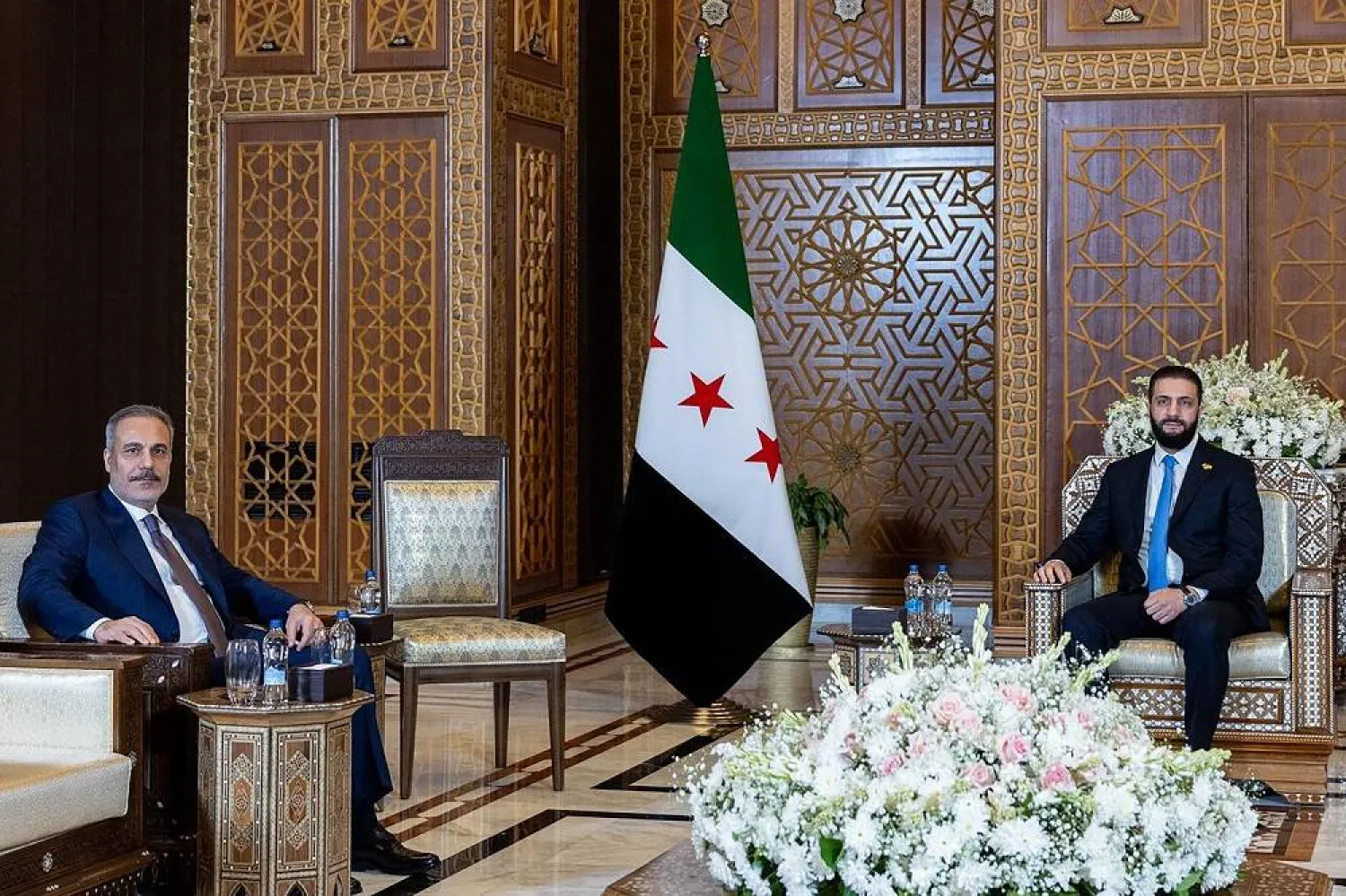

Türkiye Reaffirms Support for Syria’s Stability and Reconstruction 

A handout picture released by the Turkish Foreign Ministry on August 7, 2025, shows Syrian interim President Ahmed al-Sharaa meeting with Türkiye’s Foreign Minister Hakan Fidan in Damascus. (Turkish Foreign Ministry / AFP)
TT

Türkiye Reaffirms Support for Syria’s Stability and Reconstruction 

A handout picture released by the Turkish Foreign Ministry on August 7, 2025, shows Syrian interim President Ahmed al-Sharaa meeting with Türkiye’s Foreign Minister Hakan Fidan in Damascus. (Turkish Foreign Ministry / AFP)

Turkish Foreign Minister Hakan Fidan reaffirmed Ankara's support to Syria’s stability and reconstruction following a meeting on Thursday with Syrian interim President Ahmed al-Sharaa in Damascus.

In a statement posted on X, Fidan pledged continued support for Syria’s fight against extremist groups, and reiterated Türkiye’s readiness to help manage camps in northeastern Syria that house people with alleged ties to the ISIS group.

The two also discussed Israel’s actions in Syria, Fidan said on X, accusing Israel of “pursuing a policy of destabilization in our region” and calling on the international community not to allow its “policies to prevail.”

Ankara has been a strong backer of the interim government in Damascus since former Syrian President Bashar al-Assad was toppled in a lightning opposition offensive in December. It was Fidan's third visit to Damascus since Assad's fall.

Syria last month requested Türkiye’s support to strengthen its defense capabilities following sectarian violence that increased tensions in the country and drew Israeli intervention.

Clashes erupted last month between members of Bedouin tribes and armed factions from the Druze religious minority in Syria’s southern Sweida province. Government forces intervened to quell the fighting.

Israel then launched strikes on government convoys in Sweida and on the Defense Ministry headquarters in Damascus, saying it was acting to protect the Druze.

Türkiye has been vocally critical of Israeli intervention in Syria and also wants to curb the influence of the Kurdish groups controlling northeastern Syria.

The Kurdish-led Syrian Democratic Forces has been a key US ally in the fight against the ISIS extremist group, but Ankara regards the SDF as a terrorist group because of its ties to the Kurdistan Workers’ Party, which waged a decades-long insurgency in Türkiye.

In March, the SDF and Damascus reached an agreement to merge their forces, but its details were vague and the deal has not been implemented.

Turkish defense ministry officials, speaking on condition of anonymity in accordance with regulations, accused the SDF Thursday of not following through on its commitment, adding that Ankara remains “committed to supporting the Syrian administration’s fight against terrorist organizations and to providing the requested training, advisory, and technical assistance to strengthen its defense and security capacity.”



Israeli Military Says it Struck Hezbollah Fighters after Drone Spotted

The caskets of Hezbollah fighters killed during clashes with the Israeli army are pictured to the right and left of a mock coffin of Iran's slain supreme leader, Ali Khamenei, during a mass funeral in the southern Lebanese village of Majdel Selm on July 18, 2026. (Photo by Ibrahim AMRO / AFP)
TT

Israeli Military Says it Struck Hezbollah Fighters after Drone Spotted

The caskets of Hezbollah fighters killed during clashes with the Israeli army are pictured to the right and left of a mock coffin of Iran's slain supreme leader, Ali Khamenei, during a mass funeral in the southern Lebanese village of Majdel Selm on July 18, 2026. (Photo by Ibrahim AMRO / AFP)

Israeli military said it struck a Hezbollah cell near Tebnit in southern Lebanon on Saturday after soldiers identified ⁠a Hezbollah drone in ⁠the area.

The air force located fighters that ⁠had been operating drones and taking cover near Israeli troops, the military said in a statement, adding that the activity ⁠violated ⁠ceasefire understandings.

Hezbollah held a mass funeral for dozens of people, most of them fighters killed in the most recent fighting with Israel, in southern Lebanon's Majdal Selm on Saturday.

The group does not reveal the number of fighters it has lost. But it has organized several funerals during the current lull in fighting, which followed the June 17 signing of a US-Iran memorandum of understanding.

In the heavily-damaged village, Hezbollah buried 44 people, 39 of them fighters and four civilians said to have been killed in Israeli operations, and one man who died of natural causes.


Israeli Strikes in Gaza Kill 3 Children and 6 Adults

A Palestinian inspects a house destroyed in an Israeli airstrike in northern Gaza City, Gaza Strip, 18 July 2026. EPA/MOHAMMED SABER
TT

Israeli Strikes in Gaza Kill 3 Children and 6 Adults

A Palestinian inspects a house destroyed in an Israeli airstrike in northern Gaza City, Gaza Strip, 18 July 2026. EPA/MOHAMMED SABER

Israeli strikes in Gaza City on Saturday killed at least nine Palestinians, including three children, hospital officials said.

A strike on an apartment in the Nasr neighborhood killed at least five people, including the children between the ages of 8 and 18, said Mohammed Abu Selmiya, director of Shifa Hospital where the bodies were taken. Six other people were wounded, including four children between the ages of 8 and 16, he said.

Israel's military said it targeted Hamas infrastructure and had located Hamas militants in the area, without elaborating.

Another Israeli strike hit a group of people in the Zeitoun neighborhood, killing four and wounding another critically, The Associated Press quoted health officials as saying.

The Israeli military said it targeted a “Hamas terrorist" and it was looking into the results of the strike.

Palestinians have reported an increase in the scale of Israeli strikes across the enclave over the past few days.

Despite a ceasefire agreement reached in October between Israel and the Hamas militant group, Israel still carries out near-daily attacks across the territory. It says it is targeting Hamas and other militants who pose a threat.

Hamas and Israel have traded accusations of violating the ceasefire.

At least 1,127 Palestinians, including at least 260 children, have been killed since the ceasefire, according to Gaza’s Health Ministry. Five Israeli soldiers have been killed in that time.


Hezbollah Cuts Ties with Lebanon's Presidency While Sparing the Army

Lebanese President Joseph Aoun meets with Army Commander Rodolphe Haykal during an earlier meeting. (Lebanese Presidency)
TT

Hezbollah Cuts Ties with Lebanon's Presidency While Sparing the Army

Lebanese President Joseph Aoun meets with Army Commander Rodolphe Haykal during an earlier meeting. (Lebanese Presidency)

In recent days, Hezbollah has sharply escalated its confrontation with the Lebanese authorities, particularly the presidency, ahead of President Joseph Aoun's visit to Washington. One of the group's lawmakers openly declared that "the bridges with the authorities have been severed and the consequences will not be favorable."

At the same time, however, Hezbollah has continued to avoid direct confrontation with the Lebanese Army's leadership, despite previously warning that it would treat any party attempting to disarm it by force in the same way it treats the Israeli military.

As Lebanese, American, and Israeli discussions continue over implementing the proposed "pilot zones" in southern Lebanon, a plan that would place those areas under the control of the Lebanese Army while removing both Israeli forces and Hezbollah's military presence, the group's recent escalation appears to signal that it is unwilling to cooperate with the proposal. Hezbollah had previously strongly criticized the framework agreement and its provisions.

No Decision to Use Force

According to military sources, there is "no political or military-security decision to implement the pilot zones by force." The sources told Asharq Al-Awsat that "the issue must be resolved through dialogue and politics, not by placing the Lebanese Army in direct confrontation with Hezbollah, as the consequences would be catastrophic on every level."

After Hezbollah MP Hassan Fadlallah used the parliamentary podium earlier this week to launch a sharp attack on President Joseph Aoun, accusing him of "becoming a political actor who deepens divisions among the Lebanese instead of serving as president and a symbol of national unity," fellow Hezbollah lawmaker Ali Fayyad said on Friday that "the problem with this government has become serious, very serious. The bridges with it have been severed, the possibility of reaching an understanding no longer exists, and the consequences will not be favorable."

Escalation in the Streets?

Hilal Khashan, professor of political science at the American University of Beirut, attributed Hezbollah's escalating rhetoric toward the authorities to what he described as the existential challenges the group currently faces "after finding itself on the chopping block and after the decision was made to eliminate its military wing." He added that "it is not unlikely that Hezbollah will escalate in the streets in the coming days and weeks, despite President Aoun's warning that taking to the streets is a red line."

Speaking to Asharq Al-Awsat, Khashan said the available indications suggest that "Hezbollah is preparing for confrontation and that the next phase will be extremely difficult and dangerous." He added that concerns over divisions within the Lebanese Army if it were forced into a confrontation with Hezbollah are well founded and that the consequences of such a decision should not be underestimated.

According to Khashan, the army commander is fully aware of those risks and is acting accordingly. President Aoun, himself a product of the military establishment, also understands this reality well and is familiar with the army's internal composition.

Khashan believes Hezbollah is currently in a weakened position. However, he argues that strong communal solidarity has led most Lebanese Shiites to rally behind the group, believing that if Hezbollah were ultimately defeated, the gains achieved by the Shiite community over recent decades would come to an end. In their view, they want their community to remain the dominant force in the country.

A Return to Assassinations?

Ali Al-Amin, political writer and editor-in-chief of the Janoubia news website, argues that Hezbollah "is not operating as a Lebanese political party concerned with the national considerations that shape the president's positions on negotiations, Lebanon's foreign relations, or the country's security. Hezbollah today is, in effect, part of Iran's Revolutionary Guard, and its position toward President Joseph Aoun reflects Iran's position toward him."

Asked whether this rhetoric could foreshadow action by Hezbollah against domestic opponents, whether the government or rival political forces, Al-Amin said such a scenario "cannot be ruled out." He suggested it could take various forms, "including assassinations or efforts to stir unrest in the streets." However, he argued that none of these options would ultimately benefit Hezbollah.

"The more Hezbollah attacks President Aoun, the more Lebanese rally around him and the more isolated the party becomes. Any attempt by Hezbollah to provoke internal confrontation would harm everyone, but there is no doubt that Hezbollah itself would be the first to pay the price."

Hezbollah Wants the Army to Remain Neutral

Responding to another question, Al-Amin argued that Hezbollah's efforts to keep the Lebanese Army out of the confrontation are "far from innocent." He said the party has sought to amplify praise for the army as a military institution loved by all, on the condition that it satisfies all political factions by remaining neutral.

Speaking to Asharq Al-Awsat, Al-Amin said Hezbollah wants the army to remain, as it has always preferred, "a force that is effectively sidelined except when its role serves the party's own interests." He pointed to Hezbollah's refusal to hand over its positions to the army when requested, citing the case of Ali al-Taher Hill north of the Litani River. He also recalled the explosion that killed six Lebanese soldiers as they attempted to take control of one of Hezbollah's tunnels in the Tyre district following the November ceasefire agreement.

Al-Amin added that Hezbollah also seeks to exploit any disagreement between the government and the army, "even if merely superficial," in order to deepen and magnify those divisions.