


Israel Plans to Take over Gaza City to Pressure Hamas, Sparking Alarm over Civilians and Hostages

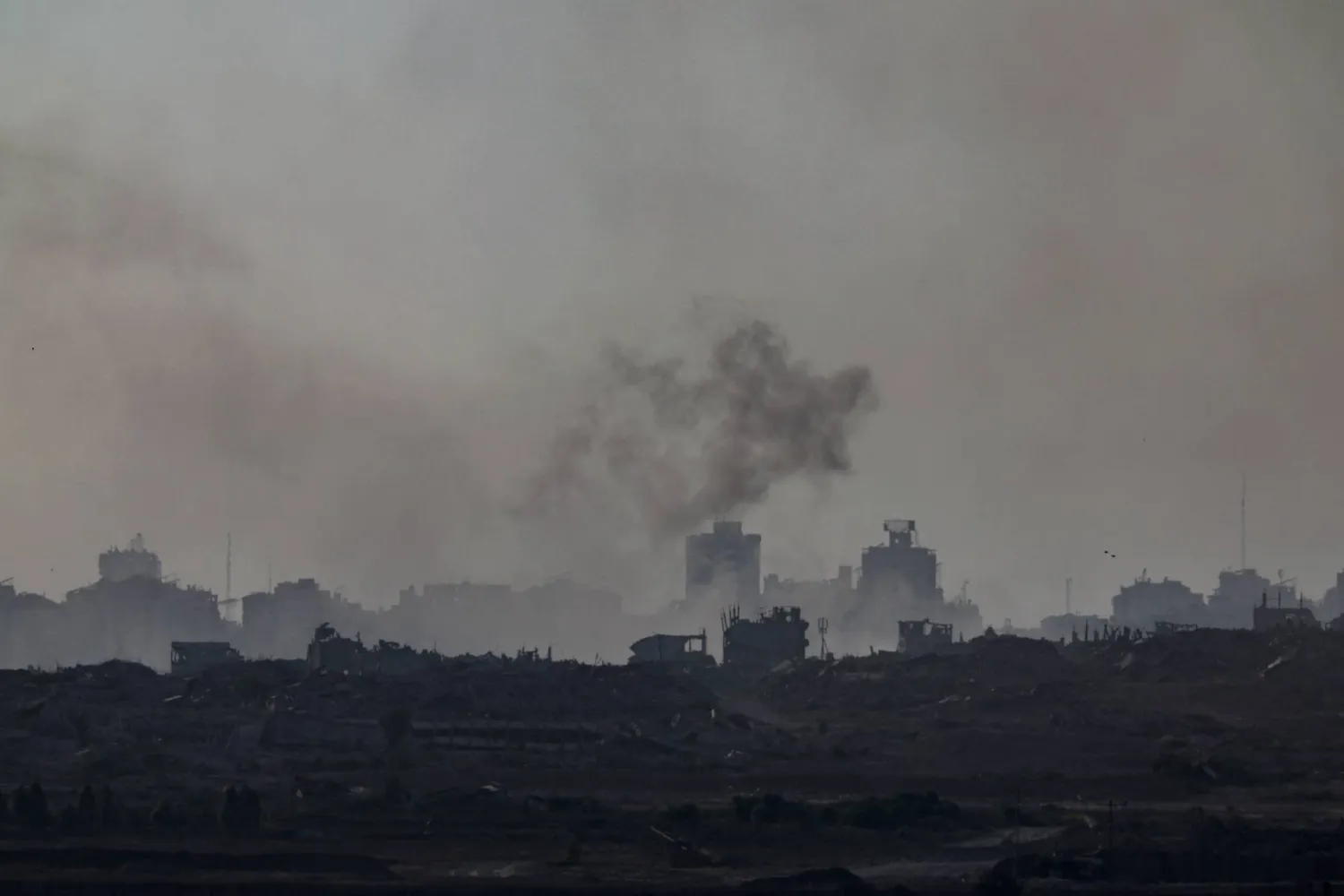
Smoke rises as a result of an explosion in the northern part of the Gaza Strip, as seen from the Israeli side of the border with Gaza, in southern Israel, 07 August 2025. EPA/ATEF SAFADI
TT

Israel Plans to Take over Gaza City to Pressure Hamas, Sparking Alarm over Civilians and Hostages

Smoke rises as a result of an explosion in the northern part of the Gaza Strip, as seen from the Israeli side of the border with Gaza, in southern Israel, 07 August 2025. EPA/ATEF SAFADI

Israel said Friday it will intensify its 22-month war with Hamas by taking over Gaza City, drawing a dismissal from the group and renewed international calls to end the conflict, while stirring fears for Palestinian civilians and Israeli hostages still held in Gaza. 

Israel’s air and ground war has killed tens of thousands of people in Gaza, displaced most of the population, destroyed vast areas and pushed the territory toward famine. The timing of another major ground operation is unclear. It will likely require mobilizing thousands of troops and forcibly evacuating civilians, almost certainly exacerbating the humanitarian catastrophe. 

An official familiar with the plans to take over Gaza City said the operation would be “gradual” and that there is no start date. The official spoke on condition of anonymity to discuss sensitive matters. 

Mediators from Egypt and Qatar are working on a new framework that will include the release of all hostages — dead and alive — in one go in return for an end of the war in Gaza and the withdrawal of Israeli forces from the strip, two Arab officials told The Associated Press. 

Before Israel's Security Cabinet approved the plan to take over Gaza City, Prime Minister Benjamin Netanyahu had outlined more sweeping plans Thursday in an interview with Fox News, saying Israel planned to take control of all of Gaza. Israel already controls around three-quarters of the territory. 

Hamas rejected Israel’s plans. “Expanding of aggression against our Palestinian people will not be a walk in the park,” the group said in a statement. 

United Nations Secretary-General Antonio Guterres said Friday that Israel's Gaza control plan was a "dangerous escalation" that risked worsening conditions for ordinary Palestinians, his spokesperson said.  

"The Secretary-General is gravely alarmed by the decision of the Israeli Government to 'take control of Gaza City'. This decision marks a dangerous escalation and risks deepening the already catastrophic consequences for millions of Palestinians," Guterres's spokesperson said in a statement. 

Several countries have requested an emergency meeting of the UN Security Council over Israeli plans for Gaza City, two diplomatic sources told AFP Friday.

"As we speak, there will be a number of countries on our behalf and on their own behalf (that) will be requesting a meeting of the Security Council," the Palestinian ambassador to the UN Riyad Mansour had told reporters earlier.

Netanyahu had signaled plans for even broader war 

International powers, including Israeli allies, have stepped up criticism of the war amid mounting shock over media reports showing starvation. 

Germany said Friday it would not authorize the export of military equipment that could be used in Gaza until further notice. 

Tensions could rise further if Netanyahu follows through on the more sweeping plans to take control of the entire territory, two decades after Israel’s unilateral withdrawal. 

Asked in the interview with Fox News ahead of the Security Cabinet meeting if Israel would “take control of all of Gaza,” Netanyahu replied: “We intend to, in order to assure our security, remove Hamas there.” He added that Israel did not intend to “keep it.” 

Israel's new plan may be aimed in part at pressuring Hamas to accept a ceasefire on Israel's terms. 

It may also reflect the reservations of Israel’s military chief of staff, Lt. Gen. Eyal Zamir, who reportedly warned that expanding operations would endanger the remaining 20 or so living hostages held by Hamas and further strain Israel’s army after nearly two years of regional wars. 

The military “will prepare to take control of Gaza City while providing humanitarian aid to the civilian population outside the combat zones,” Netanyahu's office said in a statement after the Security Cabinet meeting. 

Amir Avivi, a retired brigadier general and chairman of Israel’s Defense and Security Forum, estimated it would take less than three months to mobilize some 30,000 troops, evacuate Palestinian civilians and take over Gaza City. 

Hamas-led fighters triggered the war when they stormed into Israel on Oct. 7, 2023, killing around 1,200 people and abducting 251 people. Most of the hostages have been released in ceasefires or other deals but 50 remain inside Gaza. Israel believes around 20 of them to be alive. 

Israel’s retaliatory campaign has killed over 61,000 Palestinians, according to Gaza’s Health Ministry, which does not say how many were fighters or civilians. The ministry is part of the Hamas-run government and staffed by medical professionals. 

The United Nations and independent experts view the ministry’s figures as the most reliable estimate of casualties. Israel has disputed them without offering a toll of its own. 

Mediators try again to end the war 

The yet-to-be finalized framework for a ceasefire aims to address the contentious issue of what to do with Hamas’ weapons, with Israel seeking full disarmament and Hamas refusing. The official directly involved in the efforts said discussions are underway about “freezing arms,” which may involve Hamas retaining but not using its weapons. It also calls for the group to relinquish power in the strip. 

A Palestinian-Arab committee would run Gaza and oversee the reconstruction efforts until the establishment of a Palestinian administration with a new police force, trained by two US allies in the Middle East, to take over the strip, the official said. It is unclear what role the Western-backed Palestinian Authority would play. 

The second official said the US administration has been briefed on the broad lines of the framework. 

A senior Hamas official, speaking on condition of anonymity because he wasn’t authorized to brief the media, said the group has yet to receive details on the latest efforts to revive ceasefire talks. 

AP reached out to the governments in Qatar, Egypt and Israel as well as the White House for comment. 

US envoy Steve Witkoff told hostage families during his recent visit that Israel was shifting its approach to pursue a comprehensive “all-or-nothing” deal aimed at ending the war and securing the release of hostages, a person who attended the meeting told the AP, speaking on the condition of anonymity as they were not authorized to speak about the private meeting. 

‘There is nothing here to occupy’  

Israel has repeatedly bombarded Gaza City and carried out numerous raids there, only to return to neighborhoods again and again as fighters regrouped. Today, it is one of the few areas in Gaza that hasn’t been turned into an Israeli buffer zone or placed under evacuation orders. 

Umm Youssef from Gaza City said she had left the city for over 16 months before returning to her home. 

“The area is all rubble. Rubble is an overstatement, it is a sandpile. There is nothing here to occupy. There is no life here,” she said. 

A major ground operation there could displace tens of thousands of people and further disrupt efforts to deliver food to the hunger-stricken territory. 

It’s unclear how many people are still in Gaza City, the territory's largest before the war. Hundreds of thousands fled under evacuation orders in the opening weeks of the conflict, but many returned during a ceasefire at the start of this year. 


Israelis No Longer See Netanyahu as Best PM Choice

Israeli Prime Minister Benjamin Netanyahu attends Holocaust Remembrance Day ceremony in Jerusalem, April 14, 2026 (AP)
TT

Israelis No Longer See Netanyahu as Best PM Choice

Israeli Prime Minister Benjamin Netanyahu attends Holocaust Remembrance Day ceremony in Jerusalem, April 14, 2026 (AP)

A new opinion poll shows that Israelis, for the first time since he became their leader, no longer view Benjamin Netanyahu as the most suitable figure for prime minister, with Naftali Bennett overtaking him.

The results also show Bennett is no longer the only challenger, as former general Gadi Eisenkot now outpaces both.

The findings come from a weekly poll by Maariv, conducted with Lazar Research, headed by Menachem Lazar, and Pane4ll. Respondents were asked the standard question, “Who is the most suitable political figure for the post of prime minister?”

For nearly four years, Netanyahu consistently led his rivals, even when party polling suggested his government could fall.

But in the poll published on Friday, Bennett ranked first for the first time, with 46% saying he is more suitable than Netanyahu, who scored 41%. Eisenkot also surpassed Netanyahu, with 44% compared with 42%.

When Netanyahu was excluded from the comparison, Eisenkot edged ahead, winning 33% to Bennett’s 32%, signaling growing public confidence in him.

The poll also points to a shift in the Knesset balance if elections were held now. A joint list between Bennett and Yair Lapid, announced earlier this week, would emerge as the largest party with 28 seats, ahead of Likud with 26.

A previous poll had shown the two could win 31 seats combined if they ran separately, Bennett 24 and Lapid 7, but the joint list would still be positioned to receive the mandate to form a government.

Opposition figures see the alliance as generating fresh momentum and are pressing Eisenkot to join with his party, “Yashar,” to form a bloc strong enough to defeat Netanyahu.

Eisenkot, however, is not rushing to join a lineup that would place him second to Bennett. With his popularity rising, he is waiting for further polls, and if his support continues to climb, he is expected to seek the top spot on a unified list and run as its candidate for prime minister.

The survey also shows a sharp decline for Netanyahu’s coalition, dropping from 68 seats to 50. Likud accounts for the biggest fall, sliding from 36 to 26 seats. Religious parties drop from 18 to 15, while Bezalel Smotrich’s party, currently holding 8 seats, disappears.

The only right-wing party to gain is that of Itamar Ben-Gvir, rising from 6 to 9 seats.

Jewish opposition parties would secure 60 seats, alongside 10 for Arab parties, leaving them short of forming a stable government unless they abandon their refusal to partner with Arab factions or expand their support further.

Netanyahu, however, is far from finished. He is preparing multiple strategies to counter the opposition, including efforts to reunite Ben-Gvir and Smotrich, form a new right-wing party to recover lost votes, and advance legal and administrative measures that could reduce the influence of Arab parties.

Some accuse him of preparing steps that could manipulate elections or sway outcomes using artificial intelligence.

At the same time, the opposition is reassessing its position to strengthen cohesion and avoid internal rifts. Veteran political commentator Nahum Barnea says Eisenkot is best placed to advance steadily in an election battle in a way that would be difficult for Netanyahu to undermine.

Though a former army chief of staff, Eisenkot is seen as modest, and the deaths of his son and nephew in the recent war have brought him closer to the public. Barnea notes that Eisenkot displays a quote attributed to David Ben-Gurion on his wall: “It is good for our enemies to know that Israel’s security is led by an unbreakable man.”

He projects a positive approach to regional issues. Unlike Bennett, he backs a two-state solution and the Oslo Accords. He has openly criticized the war in Iran and Lebanon, describing both fronts as failures, and his stance toward Arab parties is not marked by racism.

Barnea also recounts that “legendary pilot” Iftach Spector asked Eisenkot why he rejects forming a government with an Arab party, noting Arabs make up 20% of Israel’s population.

Eisenkot replied: “Pay attention to what I said. I said I would form a Zionist and official government. ‘Official’ includes Arabs and ultra-Orthodox Jews. Anyone joining must meet three conditions: Israel as a Jewish and democratic state, the values of the Declaration of Independence, and commitment to service, military or civilian.”


Aoun Insists on Ceasefire Before Lebanon-Israel Talks

A billboard depicting Lebanese President Joseph Aoun and sentence reading in Arabic "The decision is up to Lebanon" is seen in the predominantly Christian Ashrafieh neighborhood in Beirut, Lebanon, 01 May 2026. (EPA)
TT

Aoun Insists on Ceasefire Before Lebanon-Israel Talks

A billboard depicting Lebanese President Joseph Aoun and sentence reading in Arabic "The decision is up to Lebanon" is seen in the predominantly Christian Ashrafieh neighborhood in Beirut, Lebanon, 01 May 2026. (EPA)

Lebanese President Joseph Aoun is pushing to lock in a ceasefire and halt Israeli strikes on civilians before Lebanese and Israeli representatives resume bilateral talks in Washington, as Hezbollah continues to vehemently reject the negotiations.

Aoun is under pressure from both sides. The United States is urging direct engagement between Lebanon and Israel, including a meeting between Aoun and Israeli Prime Minister Benjamin Netanyahu. Hezbollah, meanwhile, rejects direct talks outright.

Aoun says diplomacy is the only option to secure a ceasefire, ensure an Israeli withdrawal, and extend state control across all Lebanese territory. But he refuses any meeting with Netanyahu, after rejecting even a phone call with him as part of a US-mediated three-way contact.

Consolidating the ceasefire

Aoun’s push to cement the ceasefire was discussed with US Ambassador to Beirut Michel Issa, hours after the US Embassy said a direct meeting between Aoun and Netanyahu, "facilitated by President Trump, would give Lebanon the chance to secure concrete guarantees on full sovereignty, territorial integrity, secure borders, humanitarian and reconstruction support, and the complete restoration of Lebanese state authority over every inch of its territory -- guaranteed by the United States."

The Lebanese presidency said Aoun met Issa after returning from Washington and reviewed developments, focusing on consolidating the ceasefire and stopping attacks on civilians and civilian facilities, ahead of further Washington talks aimed at securing peace and stability along the border.

Issa reaffirmed the US’s continued support for Lebanon and its institutions. Aoun thanked Washington for its backing.

Prime Minister Nawaf Salam also met Issa to discuss consolidating the ceasefire and negotiations with Israel, the prime minister’s office said.

Sources close to the presidency told Asharq Al-Awsat that a ceasefire and a halt to attacks on civilians and civilian facilities are “the basis for completing negotiations.”

Aoun’s position on a direct meeting “is known and declared,” the sources said. “Anyone who rejected a phone call with Netanyahu will certainly reject meeting him.”

Hezbollah pressure

Alongside US pressure, Aoun faces pressure from Hezbollah, which has vowed to keep fighting Israel in the south, and is holding the state responsible for the path it is taking.

Hezbollah’s Loyalty to the Resistance parliamentary bloc said the authorities’ move toward direct negotiations is “rejected and condemned,” calling it a deviation from national principles, a violation of sovereignty, and a contradiction of the Taif Accord and national consensus.

It said it is “not concerned at all” with their outcomes.

The bloc accused Israel of daily killings of civilians and systematic destruction of border villages, calling them war crimes that will not deter people from defending the country, but instead reinforce support for the resistance- Hezbollah.

It added that such actions should push the authorities to “stop their series of free concessions.”

Geagea

The move toward direct talks with Israel has drawn support from some political forces, led by the Lebanese Forces.

MP Sethrida Geagea said Lebanon’s current phase “cannot tolerate more one-upmanship or populist rhetoric,” which she said has only led to further collapse.

She voiced full support for Aoun’s efforts to end the war through a “clear and explicit negotiating path” aimed at protecting Lebanon and re-establishing the state as the sole authority.


In South Syria, Families Fear for Relatives Seized by Israel

Fifty-three-year-old Syrian Aicha al-Safadi, holds the a picture of her son Hassane Mohammed al-Safadi, with details of when he was detained by Israel as she sits in her house in the southern Syrian village of Beit Jinn, near the Israeli-annexed Syrian Golan Heights and at the foot Mount Hermon, known in Arabic as Jabal al-Sheikh on April 29, 2026. (AFP)
TT

In South Syria, Families Fear for Relatives Seized by Israel

Fifty-three-year-old Syrian Aicha al-Safadi, holds the a picture of her son Hassane Mohammed al-Safadi, with details of when he was detained by Israel as she sits in her house in the southern Syrian village of Beit Jinn, near the Israeli-annexed Syrian Golan Heights and at the foot Mount Hermon, known in Arabic as Jabal al-Sheikh on April 29, 2026. (AFP)

Whenever Fatima al-Safadi hears a knock at the door, she imagines it might be her sons -- among dozens of people Israel has seized from southern Syria and whose fate remains unknown months later.

Mohammed, 40, and Ahmed, 36, were among seven people seized in a nighttime Israeli army incursion into the village of Beit Jinn, southwest of Damascus, in June last year.

Israel's army said it apprehended several alleged members of Palestinian group Hamas accused of planning attacks on Israeli civilians and troops, and transferred them to Israeli territory "for further interrogation".

Syria said a civilian was killed in the incident.

Safadi, 57, has not seen her two sons since.

"Sometimes I hear a knock at the door and I rush to open it, but there is nobody there," she said, holding a picture of her sons close.

"I'm afraid about what has happened... and that they won't be released," she told AFP.

Beit Jinn is located near the Israeli-annexed Syrian Golan Heights and at the foot of Mount Hermon, known in Arabic as Jabal al-Sheikh.

Israel moved its forces into a UN-patrolled demilitarized zone on the Golan after the December 2024 ousting of longtime Syrian ruler Bashar al-Assad and now controls a permanent position at the summit of Mount Hermon.

It has also launched hundreds of strikes on Syria and carries out regular incursions into the country's south, where it demands a demilitarized zone.

Safadi said her joy at Assad's overthrow was overtaken by suffering after her sons were taken.

- 'Incommunicado' -

Along the road leading from Damascus to Beit Jinn, Syrian soldiers with light weapons man checkpoints, while heavy army vehicles previously stationed near Jabal al-Sheikh are gone.

Another resident, Aisha al-Safadi, 53, fought back tears as she spoke of her son Hassane who was among those seized in Beit Jinn last June.

"It's hard because we don't know what's happened to him," she said, kissing one of his photographs.

"I've been counting the days and nights" since he was taken, she said, his three children gathered around her.

"Every day, I say to myself, he'll be released."

She pleaded for the Syrian government to "help in every way possible to get our people released from Israel".

In a report this week, Human Rights Watch said that since Assad's fall, Israeli forces have "carried out frequent ground raids, airstrikes, and other operations in Quneitra, Daraa, and Sweida" provinces in the country's south.

"Israeli forces have also arbitrarily detained Syrian civilians and transferred them into Israel, where they are held without charge and incommunicado," it added.

Last November, the Israeli army said it carried out an operation in Beit Jinn to apprehend suspects from Lebanese group Jamaa Islamiya, a Hamas ally which denied having any activity outside Lebanon.

The operation left 13 Syrians dead and six Israeli soldiers wounded.

- 'Torment' -

In a government building close to a new Israeli military base, Quneitra province official Mohammed al-Saeed said that "the Israeli army has kidnapped more than 50 people" from the region.

Israel "has occupied new lands at a depth between 500 meters (1,640 feet) and one kilometer, over an area of around 240 square kilometers" where its forces have set up temporary checkpoints and stormed homes, he added.

Israel's army told AFP's Jerusalem bureau that in Syria its forces "have apprehended individuals where there was reasonable suspicion of their involvement in terrorist activity against the State of Israel".

"In appropriate cases, continued detention is carried out for preventive security purposes, in accordance with Israeli law and the applicable rules of international law," it said in a statement.

"Detention orders and their duration are subject to judicial review as required by law," it added.

Since ousting Assad, Syria's new authorities have held a series of talks with Israeli officials.

This year, under US pressure, Israel and Syria agreed to establish an intelligence-sharing mechanism as the two countries edge towards a security agreement after decades of hostilities.

In the Quneitra province town of Khan Arnabah, real estate agent Mohammed al-Sayed, 45, recounted with anguish his detention by Israeli forces last year.

"During my 65 days in prison, every moment far from our families, our children, our relatives, was like being besieged," he said.

"Every moment that passed was a torment," he said.

"What about those who have been there for more than a year without any news of their families, and without their families knowing what has happened to them?"
