


Sudan’s Burhan Vows to Forge ahead in Defeating RSF

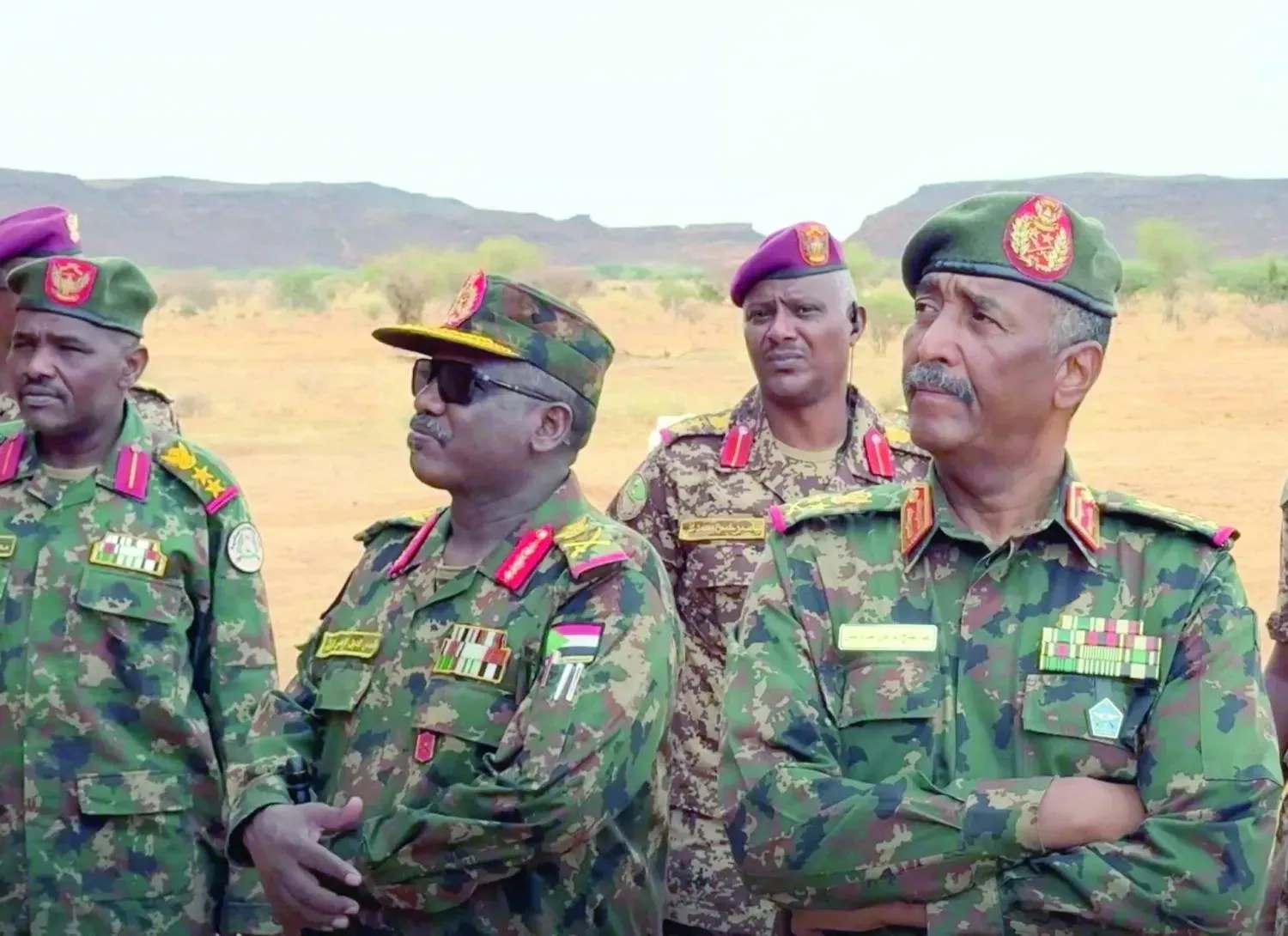
Head of Sudan’s Sovereignty Council and army commander Abdel Fattah al-Burhan (R) during a visit to Musawwarat. (Facebook)
TT

Sudan’s Burhan Vows to Forge ahead in Defeating RSF

Head of Sudan’s Sovereignty Council and army commander Abdel Fattah al-Burhan (R) during a visit to Musawwarat. (Facebook)

Head of Sudan’s Sovereignty Council and army commander Abdel Fattah al-Burhan declared on Thursday that there can be no reconciliation with the Rapid Support Forces (RSF).

“We are forging ahead with the battle for dignity to defeat this rebellion. We will not betray the sacrifices of our sons and brothers, who gave their lives in defending their country,” he said during a visit to the Naqa and Musawwarat region in the Nile River state on the occasion of the 71st Army Day.

He hailed the Sudanese people who have stood by the armed forces, especially in the regions of El-Fasher, Babanusa and Kadugli, as well as all the forces that are defending and protecting the people.

On the same occasion, Prime Minister Kamil Idris said the armed forces have made several sacrifices in defending Sudan’s sovereignty.

“The country is waging a fateful war” against the RSF in order to preserve its unity and independence, he stressed.

The country is facing a fierce attack that is threatening the state, which demands internal unity and solidarity with the armed forces, he went on to say.

Meanwhile, reactions continued to pour in over the United Nations Security Council’s strong rejection of the establishment of a parallel government in areas held by the RSF, led by Mohamed Hamdan Dagalo.

The Foreign Ministry welcomed the statement, saying the Sudanese government remains committed to preserving the sovereignty, safety, security, stability and unity of the country.

It said it was ready to work with the international community in line with rules and norms that serve the interests of the people.

The Security Council on Wednesday rejected plans by the RSF to establish a rival government in areas it controls, warning that the move threatens the country’s territorial integrity and risks further exacerbating the ongoing civil war.

The strongly worded statement “unequivocally reaffirmed” its unwavering commitment to Sudan’s sovereignty, independence and unity.

Any steps to undermine these principles “threaten not only the future of Sudan but also the peace and stability of the broader region,” the statement said.

The 15-member council said the announcement by the RSF also risks “fragmenting the country and worsening an already dire humanitarian situation.”

Sudan plunged into conflict in mid-April 2023, when long-simmering tensions between its military and paramilitary leaders broke out in the capital, Khartoum, and spread to other regions, including western Darfur. Some 40,000 people have been killed, nearly 13 million displaced and many pushed to the brink of famine, UN agencies say.

The RSF and their allies announced in late June that they had formed a parallel government in areas the group controls, mainly in the vast Darfur region where allegations of war crimes and crimes against humanity are being investigated.


Hamas Disarmament, Reconstruction Plan Hinge on Gaza Truce Understandings

A Palestinian child pulls containers filled with water at the Jabalia refugee camp in the northern Gaza Strip (AFP)
TT

Hamas Disarmament, Reconstruction Plan Hinge on Gaza Truce Understandings

A Palestinian child pulls containers filled with water at the Jabalia refugee camp in the northern Gaza Strip (AFP)

Attention is once again turning to the stalled second phase of the Gaza ceasefire agreement, as momentum builds toward its long-delayed implementation and questions mount over how its most contentious provisions will be handled, notably those concerning the disarmament of Hamas and the reconstruction of the war-ravaged enclave.

The anticipated provisions, unfolding amid ongoing Israeli obstacles and violations since the agreement took effect months ago, require further understanding to push the ceasefire forward, experts told Asharq Al-Awsat.

They estimated that Washington would exert significant pressure to complete the agreement, driven by its need to do so to support its presidency of the Peace Council, whose role remains disputed between the United States and Western countries.

Egyptian Foreign Minister Badr Abdelatty, in a phone call with his Emirati counterpart Sheikh Abdullah bin Zayed Al Nahyan, voiced support for US President Donald Trump’s initiative to launch the Peace Council and welcomed the move, according to a statement by Egypt’s Foreign Ministry on Friday.

Abdelatty stressed the importance of moving ahead with the requirements of the second phase of the US president’s plan, backing the national committee to administer Gaza, and swiftly deploying an international stabilization force to monitor the ceasefire, paving the way for early recovery and reconstruction.

Meanwhile, Israel’s i24NEWS website reported on Thursday that “understandings are taking shape between the United States and Hamas regarding disarmament in the Gaza Strip.” It said an upcoming meeting between US envoy Steve Witkoff and senior Hamas official Khalil al-Hayya would seek to bridge gaps between the two sides and examine whether a disarmament agreement could be advanced while preserving Israel’s security and reducing security threats.

Witkoff is expected to meet al-Hayya soon to discuss a draft agreement that includes, among other issues, arrangements for dismantling weapons in the enclave, including distinguishing between heavy and light arms, to sign what would be called an “understanding agreement” on firearms, rather than a weapons surrender deal.

Disarmament is not the only issue under discussion. Talk has also intensified over reconstruction, which Egypt and Arab states insist should cover the entire Gaza Strip, in line with the Egyptian plan approved by Arab leaders in March 2025.

By contrast, US President Trump’s son-in-law, Jared Kushner, said on Thursday in Davos that Washington envisions a “new Gaza,” transforming the war-ravaged territory into a luxury resort within three years.

Said Okasha, a political analyst specializing in Israeli affairs at the Al-Ahram Center for Political and Strategic Studies, said the remaining provisions of the Gaza agreement clearly require further understandings, especially on Hamas disarmament and reconstruction, given the current uncertainty over Israel’s positions.

He said Israel accepts low-intensity attacks but rejects any withdrawal or reconstruction without the complete disarmament of Hamas. Any gradual disarmament understandings may not be accepted and could obstruct the phase, pushing the parties back to new negotiations with mediators. Still, he said, there is no alternative to continuing talks at this critical time.

Palestinian political analyst Nizar Nazzal said the US understanding of Hamas’ weapons differs from Israel’s zero-tolerance approach, and that understandings may emerge from the Witkoff-al-Hayya meeting to freeze or manage the arms issue.

He expected Hamas to find common ground with Washington on the matter, bolstering implementation of the agreement.

In his speech at the Davos forum on Thursday, Kushner stressed that Hamas disarmament is one of the ceasefire provisions in force since Oct. 10, saying it would encourage companies and donors to commit to the enclave.

He outlined what he called a “new Gaza” within three years and called for at least $25 billion in investments to rebuild infrastructure and public services.

Okasha said Kushner’s plan may be the most likely to move forward, provided understandings are reached with mediators on how to implement it.

Nazzal, however, cast doubt on Kushner’s remarks, saying he presented videos depicting Gaza as a paradise, but that Washington’s track record in resolving the Israeli-Palestinian conflict does not inspire confidence, raising expectations that fighting could resume.

Amid these concerns, Israel’s public broadcaster reported on Thursday that Israel had settled the issue of operating the Rafah border crossing with Egypt, saying it would establish an additional crossing, “Rafah 2,” adjacent to the existing one and operated by Israel itself.

The broadcaster said the main crossing would be run by the European Union Border Assistance Mission, with participation from officers of the Palestinian Authority’s General Intelligence Service. In contrast, the new crossing would be subject to Shin Bet checks and Israeli remote screening procedures, including facial imaging and identity card verification.

Okasha said the new crossing would likely be built inside Palestinian territory rather than on the Egyptian border, possibly near the Karni crossing, noting that Cairo would reject any arrangement on its border with Israel.

He added that Israel does not want to take any additional steps under the agreement, but that US pressure remains decisive in implementing its provisions.

Nazzal said Israel does not want more crossings but seeks to assert its sovereignty through control over any crossing, using it to apply pressure in future solutions that advance its gains.

He stressed that the United States would not allow Israel or others to derail the “Trump plan,” predicting Israeli withdrawals, increased aid, the reopening of Rafah, and further positive developments.


Report: US Pressures Iraq to ‘Rapidly’ Disarm Iran-Backed Factions

Iraqi border security force personnel patrol in their armored vehicles along the border with Syria, in Sinjar district, northern Iraq on January 22, 2026. (AFP)
TT

Report: US Pressures Iraq to ‘Rapidly’ Disarm Iran-Backed Factions

Iraqi border security force personnel patrol in their armored vehicles along the border with Syria, in Sinjar district, northern Iraq on January 22, 2026. (AFP)

US officials have been pressuring Iraq to disarm Iran-backed armed factions, reported the Financial Times on Friday.

“In tense meetings with senior Iraqi political leaders tasked with forming the next government, US officials have in recent weeks also pushed the Iraqis to produce a ‘credible’ plan to rapidly disarm the groups,” it said.

Washington is exerting pressure on senior Iraqi politicians to form a government that excludes those factions, amid US President Donald Trump's efforts to curb Tehran's influence in Baghdad.

The newspaper quoted informed sources as saying that American officials threatened to take punitive measures if Baghdad did not do so, including economic measures, such as limiting dollar flows related to Iraqi oil sales.

Since 2003, under an arrangement after the American invasion of Iraq, Washington has been sending Baghdad cash shipments worth billions of dollars annually via monthly air freight flights, which are funds collected from Iraqi oil sales, the proceeds of which are deposited in the country's account with the Federal Reserve.

However, the United States has long been concerned that armed factions and Iran would use these funds. In 2015, Washington temporarily suspended dollar supplies to Baghdad amid concerns that they were flowing to Tehran and the ISIS extremist group.

The sources said that Iraqis fear instability and the outbreak of an economic crisis if Washington stops these supplies again.


Israel Aims to Ensure More Palestinians Are Let Out of Gaza than Back In

People stand at the gate of the border crossing between Egypt and the Gaza Strip, in Rafah, Egypt, February 11, 2025. REUTERS/Amr Abdallah Dalsh
TT

Israel Aims to Ensure More Palestinians Are Let Out of Gaza than Back In

People stand at the gate of the border crossing between Egypt and the Gaza Strip, in Rafah, Egypt, February 11, 2025. REUTERS/Amr Abdallah Dalsh

Israel wants to restrict the number of Palestinians entering Gaza through the border crossing with Egypt to ensure that more are allowed out than ​in, three sources briefed on the matter said ahead of the border's expected opening next week.

The head of a transitional Palestinian committee backed by the US to temporarily administer Gaza, Ali Shaath, announced on Thursday that the Rafah Border Crossing - effectively the sole route in or out of Gaza for nearly all of the more than 2 million people who live there - would open next week.

The border was supposed to have opened during the initial phase of President Donald Trump's plan to end the war, under a ceasefire reached in October between Israel and Hamas.

Earlier this month, Washington announced that the plan had now ‌moved into the ‌second phase, under which Israel is expected to withdraw troops further from ‌Gaza ⁠and ​Hamas ‌is due to yield control of the territory's administration. The Gaza side of the crossing has been under Israeli military control since 2024.

The three sources, who spoke on condition of anonymity due to the sensitivity of the issue, said it was still not clear how Israel planned to enforce limits on the number of Palestinians entering Gaza from Egypt, or what ratio of exits to entries it aimed to achieve, Reuters reported.

Israeli officials have spoken in the past about encouraging Palestinians to emigrate from Gaza, although they deny intending to transfer the population out by force. Palestinians ⁠are highly sensitive to any suggestion that Gazans could be expelled, or that those who leave temporarily could be barred from returning.

The Rafah ‌Crossing is expected to be staffed by Palestinians affiliated with the ‍Ramallah-based Palestinian Authority and monitored by EU personnel, ‍as took place during an earlier, weeks-long ceasefire between Israel and Hamas early last year.

The Israeli ‍prime minister's office did not immediately respond to a request for comment for this story. The military referred questions to the government, declining to comment.

The three sources said that Israel also wants to establish a military checkpoint inside Gaza near the border, through which all Palestinians entering or leaving would be required to pass and be subjected to Israeli ​security checks.

Two other sources also said that Israeli officials had insisted on setting up a military checkpoint in Gaza to screen Palestinians moving in and out.

The US Embassy in ⁠Israel did not immediately respond to a request for comment on whether Washington supported Israel in limiting the number of Palestinians entering Gaza or setting up a checkpoint to screen those entering and leaving.

Under the initial phase of Trump's plan, the Israeli military partially pulled back its forces within Gaza but retained control of 53% of the territory including the entire land border with Egypt. Nearly all of the territory's population lives in the rest of Gaza, under Hamas control and mostly in makeshift tents or damaged buildings.

The sources said that it was not clear how individuals would be dealt with if they were blocked by Israel's military from passing through its checkpoint, particularly those entering from Egypt.

The Israeli government has repeatedly objected to the opening of the border, with some officials saying Hamas must first return the body of an Israeli police officer held in Gaza, the ‌final human remains of a hostage due to be transferred under the ceasefire's first phase.

US officials in private say that Washington, not Israel, is driving the rollout of the president's plan to end the war.
