UN Human Rights Office Says Israeli Plan for Settlement Near East Jerusalem Breaks Int'l Law

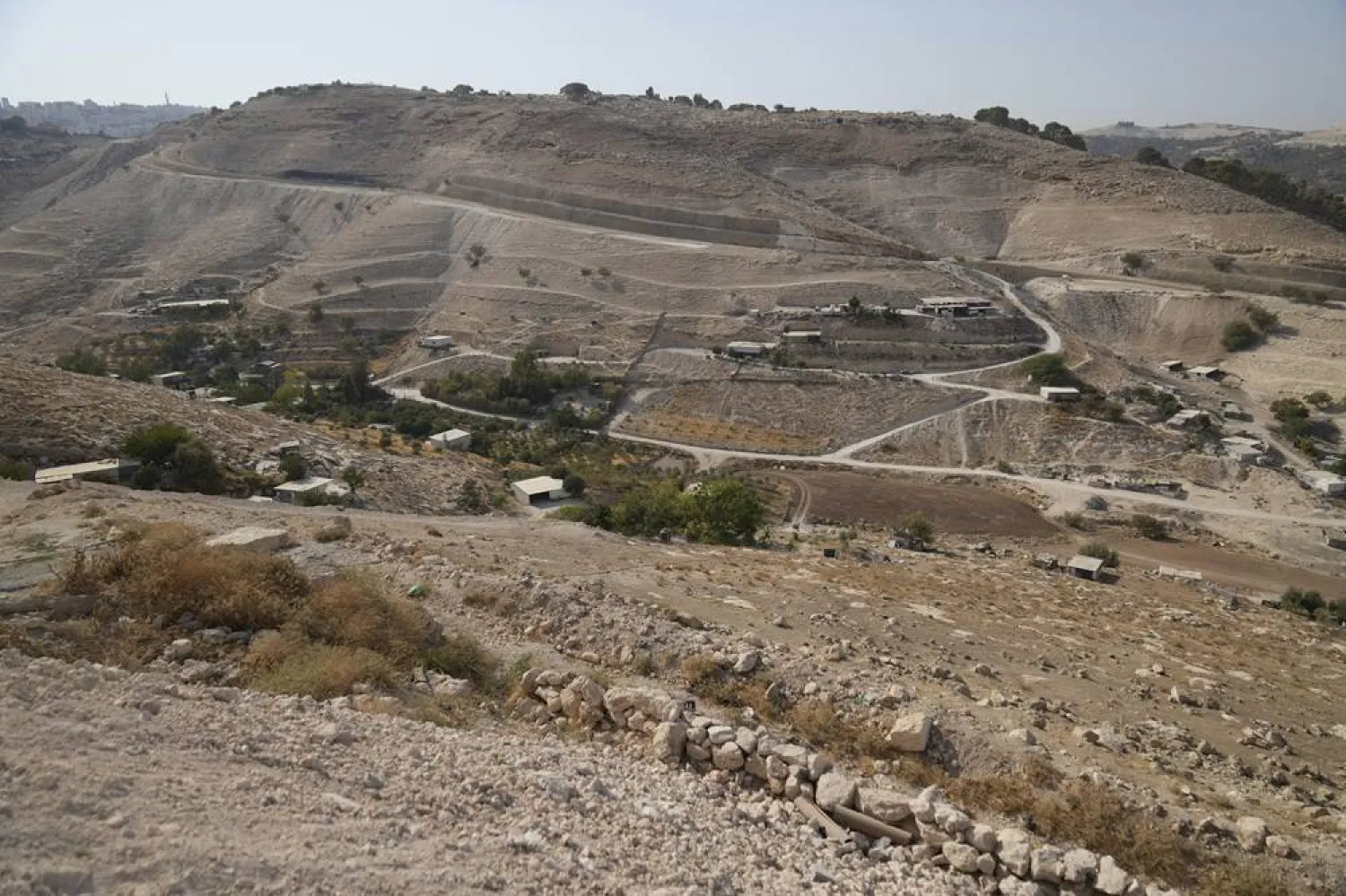
 A general view shows the E1 area, an open tract of land east of Jerusalem, between the Israeli settlement of Maale Adumim and the occupied West Bank town of Eizariya Thursday, Aug. 14, 2025. (AP)
A general view shows the E1 area, an open tract of land east of Jerusalem, between the Israeli settlement of Maale Adumim and the occupied West Bank town of Eizariya Thursday, Aug. 14, 2025. (AP)
TT

UN Human Rights Office Says Israeli Plan for Settlement Near East Jerusalem Breaks Int'l Law

 A general view shows the E1 area, an open tract of land east of Jerusalem, between the Israeli settlement of Maale Adumim and the occupied West Bank town of Eizariya Thursday, Aug. 14, 2025. (AP)
A general view shows the E1 area, an open tract of land east of Jerusalem, between the Israeli settlement of Maale Adumim and the occupied West Bank town of Eizariya Thursday, Aug. 14, 2025. (AP)

The UN human rights office said on Friday an Israeli plan to build to build thousands of new homes between an Israeli settlement in the West Bank and near East Jerusalem was illegal under international law, and would put nearby Palestinians at risk of forced eviction, which it described as a war crime. 

Israeli far-right Finance Minister Bezalel Smotrich on Thursday vowed to press on a long-delayed settlement project, saying the move would "bury" the idea of a Palestinian state. 

The UN rights office spokesperson said the plan would break the West Bank into isolated enclaves and that it was "a war crime for an occupying power to transfer its own civilian population into the territory it occupies". 

About 700,000 Israeli settlers live among 2.7 million Palestinians in the West Bank and East Jerusalem. Israel annexed East Jerusalem in 1980, a move not recognised by most countries, but has not formally extended sovereignty over the West Bank. 

Most world powers say settlement expansion erodes the viability of a two-state solution by breaking up territory the Palestinians seek as part of a future independent state. 

The two-state plan envisages a Palestinian state in East Jerusalem, the West Bank and Gaza, existing side by side with Israel, which captured all three territories in the 1967 Middle East war. 

Israel cites historical and biblical ties to the area and says the settlements provide strategic depth and security and that the West Bank is "disputed" not "occupied". 


Egypt Stresses Full Support for Somalia's Unity, Sovereignty

Residents wave Somali flags as they attend a rally denouncing Israel's recent announcement recognizing the breakaway Somaliland region, during a gathering calling for Somalia's territorial unity at Mogadishu Stadium in Mogadishu on December 30, 2025. (AFP)
TT

Egypt Stresses Full Support for Somalia's Unity, Sovereignty

Residents wave Somali flags as they attend a rally denouncing Israel's recent announcement recognizing the breakaway Somaliland region, during a gathering calling for Somalia's territorial unity at Mogadishu Stadium in Mogadishu on December 30, 2025. (AFP)

Egyptian Foreign Minister Badr Abdelatty underscored on Tuesday Cairo's full support for the unity, sovereignty, and inviolability of Somali territory, describing it as a fundamental pillar for the stability of the Horn of Africa and the Red Sea region.

He stressed Egypt's rejection of any unilateral measures or attempts to impose parallel entities or create a new political reality outside internationally recognized legal frameworks.

He made his remarks during his participation in the session of the African Peace and Security Council (PSC), held virtually at Egypt’s request, in support of the unity, sovereignty, and territorial integrity of Somalia.

Abdelatty said that Israel's unilateral and unlawful recognition of what is termed the "Somaliland region" is a flagrant violation of Somalia's sovereignty, unity, and territorial integrity.

It undermines the principles of international law, the United Nations (UN) Charter, and the Constitutive Act of the African Union (AU), he declared. Moreover, it sets a dangerous precedent threatening regional and international peace and security.

This demands a unified stance in support of Somalia and concerted efforts to achieve security and stability in Somalia and the Horn of Africa region, urged Abdelatty.

He called on the African PSC to adopt a strong and unified position condemning the recognition of so-called "Somaliland" and urged all AU member states to categorically reject any measures arising from the Israeli recognition.

He also underlined the need for full and unconditional support for the sovereignty, unity, and territorial integrity of Somalia.


Yemen's PLC Holds Emergency Meeting, Approves Measures to Protect Civilians, Facilities in Aden

This photo taken on January 4, 2026 shows Yemeni forces deployed in the city of Mukalla. (AFP)
TT

Yemen's PLC Holds Emergency Meeting, Approves Measures to Protect Civilians, Facilities in Aden

This photo taken on January 4, 2026 shows Yemeni forces deployed in the city of Mukalla. (AFP)

The Yemeni Presidential Leadership Council, chaired by President Dr. Rashad Al-Alimi, held an emergency meeting on Wednesday to review the latest security and military developments in the southern governorates,

The meeting was attended by members Sultan Al-Aradah, Tariq Saleh, Abdulrahman Al-Mahrami, Dr. Abdullah Al-Alimi, and Othman Majali.

According to the Yemeni News Agency (SABA), the meeting reviewed the developments following a statement from the Joint Forces Command of the Coalition to Restore Legitimacy in Yemen, which highlighted a serious escalation by some rebel leaders and their obstruction of de-escalation efforts.

The council was briefed on the consequences of one member’s failure to respond to an invitation from Saudi Arabia, as well as unilateral actions and movements that clearly deviated from the agreed framework for the transitional phase, undermining efforts to protect civilians and prevent the spread of violence.

In response, the council decided to expel Aidrous Al-Zubaidi from his position and refer him to the Attorney General on charges of high treason, harming the political and economic standing of Yemen, obstructing state efforts to confront the Houthi coup, and inciting internal strife.

The meeting also approved the dismissal of Minister of Transport Abdulsalam Hamid and Minister of Planning and International Cooperation Waed Badhib, referring both for investigation.

It further ordered the pursuit and arrest of individuals involved in distributing weapons and threatening civil peace, ensuring they face justice. The council emphasized that the state will act firmly against all violations to uphold the rule of law and protect public rights and freedoms.

The PLC reaffirmed that unity in military and security decision-making and respect for the chain of command are inviolable principles, stressing that any serious breach of these duties will be met with accountability under the constitution and the law.

Accordingly, the council approved a series of urgent measures, including instructing the relevant authorities to take all necessary steps to protect civilians and public facilities in the interim capital, Aden, and the liberated governorates, unify command and control over all military and security formations, and prevent any movements or mobilizations outside the framework of the state.

The council expressed its gratitude for Saudi Arabia's efforts and the leadership of the Coalition to Restore Legitimacy in Yemen in de-escalating tensions, protecting civilians, maintaining security and stability, and preventing a return to internal conflict. It underscored the state’s commitment to implementing its sovereign decisions and upholding its legal authority.

The council commended the national stance of the people of Aden and the liberated governorates in defending the republican system and legitimate state institutions during this critical stage. It renewed its call for citizens to cooperate with security and military agencies fully and report any actions or movements that could disrupt security or endanger civilian lives.


Abou Zaraa Al-Mahrami: PLC's Go-to Man in Handling Yemen's Challenging Files

Abdul Rahman Al-Mahrami. (Saba)
TT

Abou Zaraa Al-Mahrami: PLC's Go-to Man in Handling Yemen's Challenging Files

Abdul Rahman Al-Mahrami. (Saba)

Amid the tensions in Yemen's interim capital Aden rose the name of Vice President of the Presidential Leadership Council Abdul Rahman Al-Mahrami, also known as Abou Zaraa, as one of the main figures trying to restore calm in southern Yemen.

He was tasked with imposing security and preventing clashes in Aden, reflecting the confidence he enjoys inside the PLC and his rising role in handling sensitive military files.

Abou Zaraa Al-Mahrami was born in 1980 in the Yafaa region in the Abyan province.

He rose to prominence as a decisive field commander during the war in Yemen. In a short period of time, he managed to impose himself through the leadership of the southern Giants Brigades, which had turned into a mighty force in combating the Houthis.

In contrast to several military commanders, Abou Zaraa Al-Mahrami was actually involved in ground operations that helped reclaim strategic regions. He consequently gained a military and popular reputation, consolidating his standing in Yemen.

He was named a member of the PLC in April 2022 during one of the most complicated phases of Yemen's recent history. Since then, he has maintained his image as a disciplined military commander who balances between political and security duties.

In May 2023, he was named Vice President of the Southern Transitional Council (STC), placing him in a prominent position in both the PLC and on the southern scene. He remained committed to the work of the legitimate government and maintaining security.

Abou Zaraa Al-Mahrami has long held firm stances in combating terrorism and preventing the proliferation of weapons. These positions made him the go-to man for tackling sensitive security files.

He has been tasked with imposing security in Aden in wake of the latest tensions with the STC.

People familiar with his work said he is keen on protecting civilians and state institutions and preventing political disputes from turning into armed clashes - a challenging task in a city where weapons are everywhere and tensions are high.

Abou Zaraa Al-Mahrami has also represented Yemen at important regional meetings. He recently met with Saudi Defense Minister Prince Khalid bin Salman in Riyadh to discuss the security and political developments in Yemen, reflecting the trust he enjoys among regional partners.