
King Abdullah II Rejects ‘Greater Israel’ Concept, Reaffirms Support for Syria’s Territorial Integrity

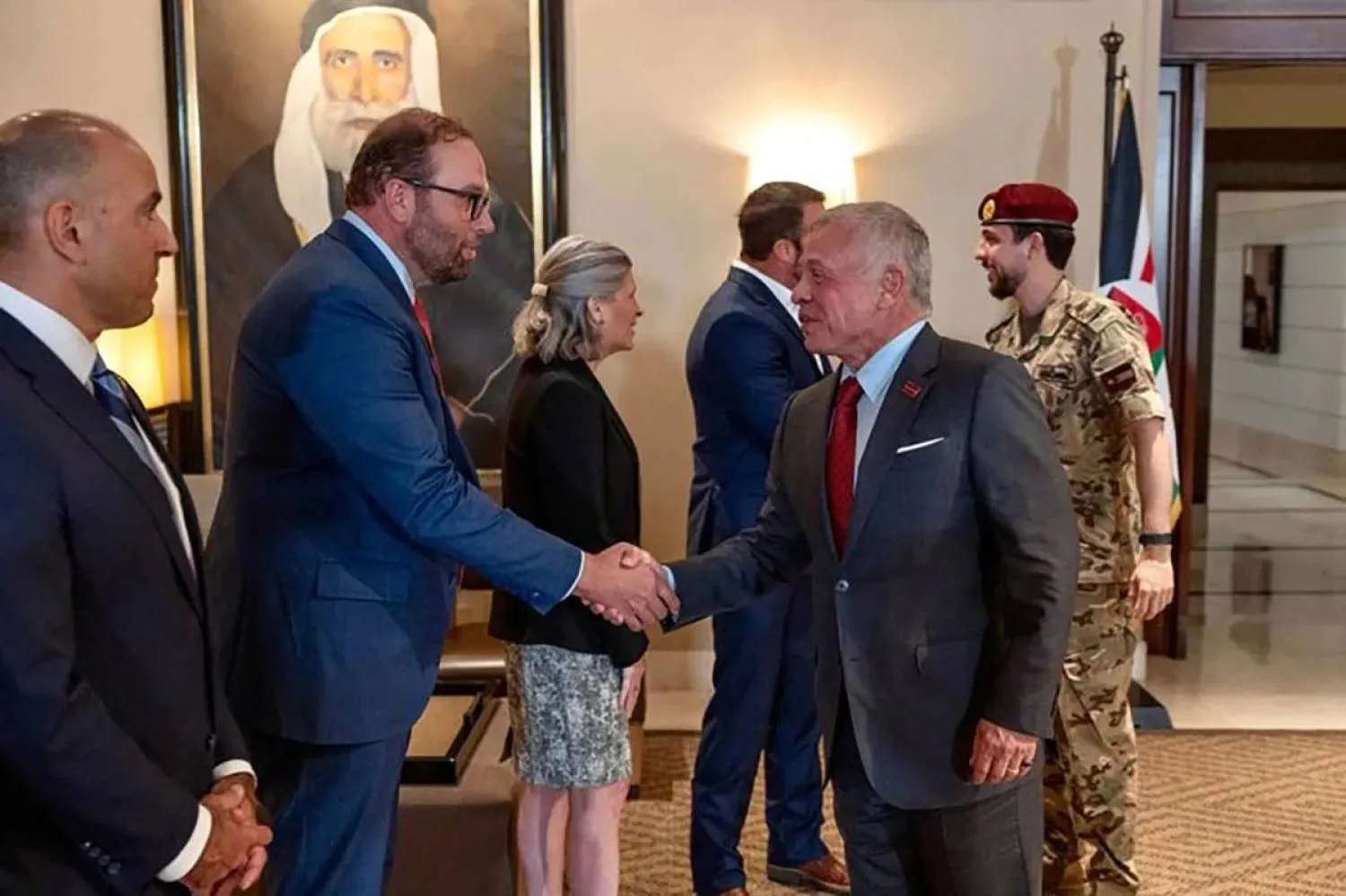
Abdullah II Receives US Congressional Delegation to Discuss Regional Developments (Jordan News Agency)
TT

King Abdullah II Rejects ‘Greater Israel’ Concept, Reaffirms Support for Syria’s Territorial Integrity

Abdullah II Receives US Congressional Delegation to Discuss Regional Developments (Jordan News Agency)

Jordan’s King Abdullah II reiterated his country’s firm rejection of Israeli rhetoric surrounding the so-called vision of a “Greater Israel” and condemned unilateral measures in the West Bank, including settlement expansion in the controversial “E1” area.

The King stressed that such actions constitute a violation of international law and an assault on the Palestinian people’s right to establish an independent state.

The King’s remarks came on Monday during a meeting in Amman with a US congressional delegation that included Senators Markwayne Mullin and Joni Ernst, along with Representatives Jason Smith and Jimmy Panetta.

He underscored the urgent need for an immediate ceasefire in Gaza and the facilitation of humanitarian aid through all possible channels. Abdullah II also voiced Jordan’s categorical opposition to Israeli plans aimed at consolidating its military occupation of Gaza.

According to a statement released by the Royal Hashemite Court, discussions also touched on developments in Syria, with the King affirming Jordan’s support for Syria’s security, stability, sovereignty, and territorial unity.

Meanwhile, government spokesperson Mohammed Al-Momani warned that the practices of Israel’s far-right represent a direct threat to regional stability and the interests of states. He stressed that “the Jordanian people stand shoulder to shoulder with their armed forces and security services in confronting challenges and risks.”

Al-Momani’s comments came during a joint press conference with Military Media Director Mustafa Al-Hiyari, outlining details of the new phased structure of the national military service program, set to launch in 2026.

On Sunday, Crown Prince Hussein bin Abdullah II formally announced the reintroduction of the National Service Program (mandatory military conscription) during a meeting with youth in the northern governorate of Irbid. In a statement issued by the Royal Court, the Crown Prince emphasized the importance of preparing young Jordanians “to be fully ready to serve and defend the homeland,” noting that those who participate in the program will appreciate the value of the experience.

Jordan has reinstated mandatory military service after suspending it in the early 1990s, ahead of the 1994 Jordan–Israel peace treaty. Under the new framework, males born in 2007 will be required to complete the service beginning in 2026.

In its initial phase, the program will target 6,000 18-year-old Jordanians, divided into three batches of 2,000 each, selected through a draw system.

While the Crown Prince highlighted the program’s role in strengthening national identity, discipline, and youth connection to the land, officials and analysts view the move as a direct response to extremist Israeli rhetoric calling for Jordan to serve as an “alternative homeland” for Palestinians. The decision also comes amid heightened Israeli military operations in the West Bank and Gaza, and Prime Minister Benjamin Netanyahu’s renewed references to the notion of a “Greater Israel.”

Sources revealed that planning for the program began more than a year ago, with the aim of rebuilding youth capacity, diversifying skills, and fostering resilience through structured training and national engagement.



Lebanon Tells a UN Team the Country Will Need a Back-up Force Once Peacekeepers’ Term Ends

Lebanese Prime Minister Nawaf Salam, in front of the Lebanese flags (C), meets with a United Nations Security Council delegation at the government palace in Beirut, Lebanon, 05 December 2025. (EPA)
TT

Lebanon Tells a UN Team the Country Will Need a Back-up Force Once Peacekeepers’ Term Ends

Lebanese Prime Minister Nawaf Salam, in front of the Lebanese flags (C), meets with a United Nations Security Council delegation at the government palace in Beirut, Lebanon, 05 December 2025. (EPA)

The Lebanese prime minister on Friday told a visiting UN delegation that his country will need a follow-up force in southern Lebanon along the border with Israel to fill the vacuum once the UN peacekeepers' term expires by the end of next year.

The UN Security Council voted unanimously in August to terminate the UN Interim Force in Lebanon (UNIFIL) at the end of 2026 — nearly five decades after the force was deployed. The multinational force has played a significant role in monitoring the security situation in the region, including during the Israel-Hezbollah war last year.

But it has drawn criticism from officials in President Donald Trump’s administration, which has moved to slash US funding for the operation as Trump remakes America’s approach to foreign policy.

Lebanese Prime Minister Nawaf Salam held talks with the team representing the 15 members of the UN Security Council, saying he believes another, follow-up force would help Lebanese troops along the border where they have intensified efforts in the volatile area that witnessed the 14-month war between Israel and the Iran-backed Hezbollah group.

Salam proposed that a small follow-up force could work much like the UN observers force that has been deployed along Syria’s border with Israel since 1974.

There was no immediate response from the UN delegation, which arrived in Lebanon after a visit to Syria. Earlier Friday, the delegation also met with Lebanese President Joseph Aoun, who said Lebanon would welcome any country's decision to keep its forces in southern Lebanon after UNIFIL's term expires.

Aoun also touted Lebanon’s appointment of former ambassador to Washington, Simon Karam, to head the Lebanese delegation to a previously military-only committee that monitors the US-brokered ceasefire that halted the latest Israel-Hezbollah war.

The appointment has angered Hezbollah, whose leader Sheikh Naim Qassem said in a televised speech later Friday that the appointment of the ex-ambassador was allegedly a “concession" to Israel.

Qassem said it would not change "the enemy’s stance and its aggression,” referring to Israel’s almost daily airstrikes on what the Israeli military says are Hezbollah targets in Lebanon since the ceasefire went into effect in November last year. The UN says that the Israeli strikes since the ceasefire have killed 127 civilians.

Israel’s air force carried out a series of airstrikes on Thursday in south Lebanon, saying it struck Hezbollah’s infrastructure. Warnings were issued in advance to evacuate the area.

The latest Israel-Hezbollah war began a day after Hamas attacked southern Israel on Oct. 7, 2023, with Hezbollah firing rockets into Israel in solidarity with the Palestinian Hamas group. Israel's response operation that included bombardment and a ground operation last year has severely weakened Hezbollah.


Palestinians Say Israeli Army Killed Man in Occupied West Bank

 Israeli military vehicles roll during a raid in Ramallah, in the occupied West Bank on December 1, 2025. (AFP)
Israeli military vehicles roll during a raid in Ramallah, in the occupied West Bank on December 1, 2025. (AFP)
TT

Palestinians Say Israeli Army Killed Man in Occupied West Bank

 Israeli military vehicles roll during a raid in Ramallah, in the occupied West Bank on December 1, 2025. (AFP)
Israeli military vehicles roll during a raid in Ramallah, in the occupied West Bank on December 1, 2025. (AFP)

The Ramallah-based Palestinian health ministry said that Israeli forces killed a man in the northern occupied West Bank on Friday.

"Bahaa Abdel-Rahman Rashid (38 years old) was killed by Israeli fire in the town of Odala, south of Nablus," the health ministry said in a statement.

Shortly before, the Palestinian Red Crescent said its teams handled the case of a man "who suffered a critical head injury during clashes in the town of Odala near Nablus, and CPR is currently being performed on him".

The Israeli military told AFP it was looking into the incident.

Witness and Odala resident Muhammad al-Kharouf told AFP that Israeli troops were patrolling in Odala and threw tear gas canisters at men who were exiting the local mosque for Friday prayer.

Rashid was killed by live fire in the clashes that followed, added Kharouf, who had been inside the mosque with him.

The Israeli military said Friday it had completed a two-week counter-terrorism operation in the northern West Bank during which it killed six gunmen and questioned dozens of suspects.

It told AFP that Rashid was not among the six gunmen killed over the past two weeks.

Dozens of men including Rashid's father gathered at the nearby city of Nablus' Rafidia hospital to bid him goodbye on Friday, an AFP journalist reported.

Violence in the West Bank has soared since Hamas's October 2023 attack on Israel triggered the Gaza war.

It has not ceased despite the fragile truce between Israel and Hamas that came into effect in October.

Israeli troops or settlers have killed more than 1,000 Palestinians, many of them gunmen, but also scores of civilians, in the West Bank since the start of the Gaza war, according to an AFP tally based on Palestinian health ministry figures.

At least 44 Israelis, including both soldiers and civilians, have been killed in Palestinian attacks or Israeli military operations, according to official Israeli figures.


Lebanese President, Hezbollah Split Over Expanded Talks with Israel

A handout photo made available by the Lebanese Presidency press office shows Lebanese President Joseph Aoun (9-R) posing for a photo with a United Nations Security Council delegation following their meeting at the Presidential Palace in Baabda, east of Beirut, Lebanon, 05 December 2025. (Lebanese Presidency)
TT

Lebanese President, Hezbollah Split Over Expanded Talks with Israel

A handout photo made available by the Lebanese Presidency press office shows Lebanese President Joseph Aoun (9-R) posing for a photo with a United Nations Security Council delegation following their meeting at the Presidential Palace in Baabda, east of Beirut, Lebanon, 05 December 2025. (Lebanese Presidency)

Lebanon's president on Friday defended his decision to expand talks with Israel as a way to avoid further violence, but the head of armed group Hezbollah called it a blunder, lifting the lid on divisions at a watershed moment for the country.

Israel and Lebanon on Wednesday both sent civilian envoys to a military committee monitoring their ceasefire, a step towards a months-old US demand that the two countries broaden talks in line with President Donald Trump's Middle East peace agenda.

President Joseph Aoun told visiting representatives of the United Nations Security Council that his country "has adopted the option of negotiations with Israel" and that "there is no going back".

"These negotiations are mainly aimed at stopping the hostile actions carried out by Israel on Lebanese territory, securing the return of the captives, scheduling the withdrawal from the occupied areas, and resolving the disputed points along the Blue Line," Aoun said in a statement on Friday, referring to the UN-mapped line that separates Israel from Lebanon.

HEZBOLLAH CALLS MOVE 'FREE CONCESSION'

But the expanded talks were criticized by armed group Hezbollah.

Its head, Sheikh Naim Qassem, said on Friday afternoon that sending a civilian delegate to the truce monitoring committee was a "blunder," and urged the government to rethink its decision.

"You offered a free concession that will not change anything in the enemy's (Israel's) position or its attacks," Qassem said.

Lebanon and Israel have been officially enemy states for more than 70 years, and meetings between their civilian officials have been extraordinarily rare throughout their fraught history.

Over the last year, military officials have met as part of a committee, chaired by the United States, to monitor a 2024 truce that ended more than a year of fighting between Israel and Hezbollah which badly weakened the Lebanese Iran-backed armed group.

In that time, Israel has continued its air strikes on what it says are Hezbollah's attempts to re-arm in violation of the truce. Lebanon says those strikes and Israel's occupation of southern Lebanese territory are ceasefire breaches.

Fears are growing in Lebanon that Israel could expand its air campaign further to ratchet up pressure on the Lebanese government to disarm Hezbollah more swiftly across the country.

The group has refused to disarm in full and has raised the specter of internal strife if the state tries to confront it.