


Sudanese Lay First Bricks to Rebuild War-torn Khartoum

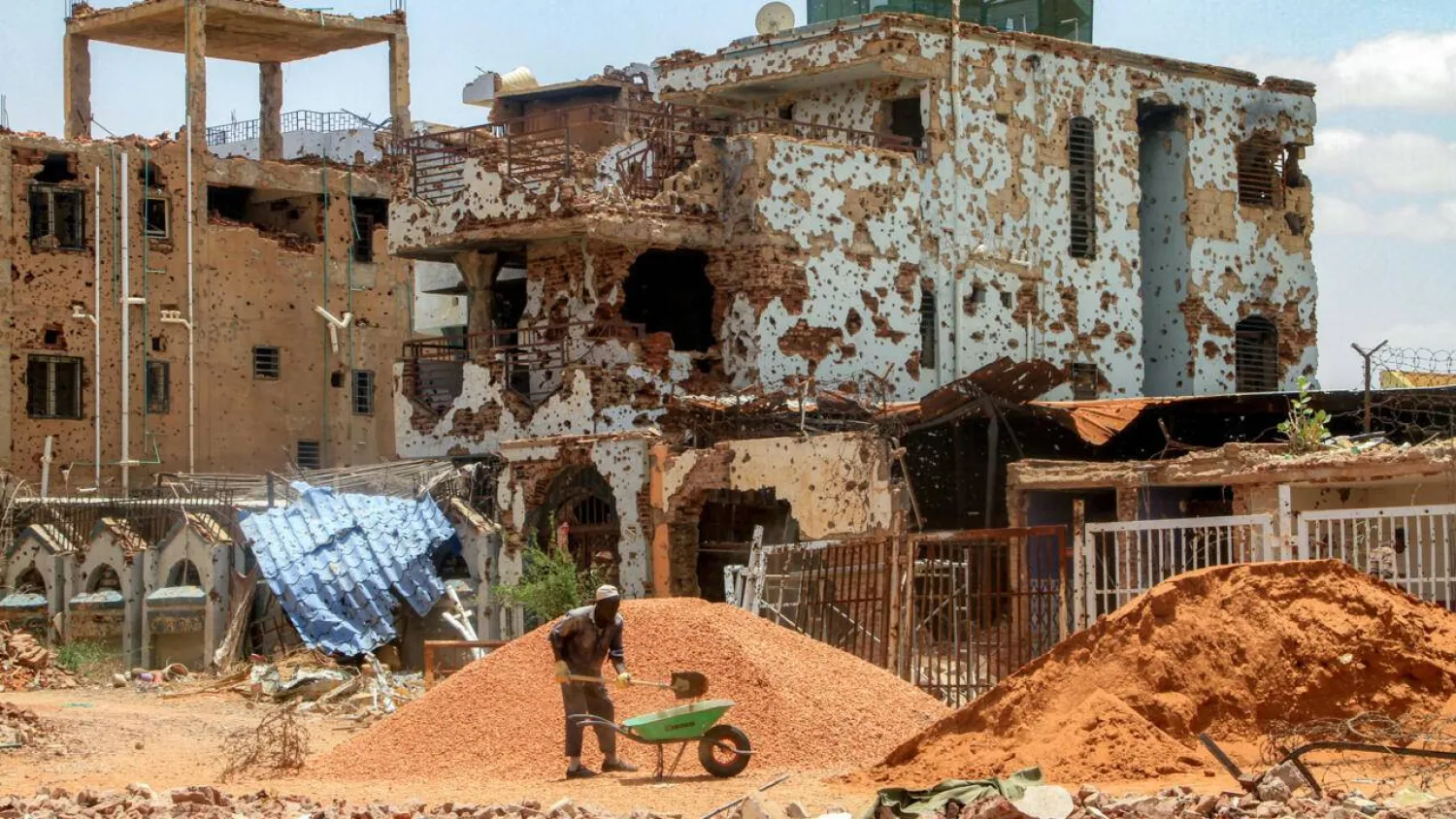
(FILES) A worker shovels pebbles from a mound into a wheelbarrow near a heavily-damaged buildings at a site in the Lamab suburb on the southwestern outskirts of Sudan's capital Khartoum. Ebrahim Hamid / AFP/File
TT

Sudanese Lay First Bricks to Rebuild War-torn Khartoum

(FILES) A worker shovels pebbles from a mound into a wheelbarrow near a heavily-damaged buildings at a site in the Lamab suburb on the southwestern outskirts of Sudan's capital Khartoum. Ebrahim Hamid / AFP/File

On the streets of Sudan's capital Khartoum, builders clear rubble from houses pockmarked with bullet holes, haul away fallen trees and repair broken power lines, in the city's first reconstruction effort since war began over two years ago.

Fighting between Sudan's army and the paramilitary Rapid Support Forces (RSF), which broke out in April 2023, has left the capital battered and hollowed out.

But reconstruction -- led by government agencies and youth-led volunteer groups -- has finally begun to repair hospitals, schools and water and power networks, AFP reported.

"We are working to restore the state's infrastructure," volunteer Mostafa Awad said.

Once a thriving metropolis of nine million people, Khartoum's skyline is now a jagged silhouette of collapsed buildings.

Electrical poles lean precariously or lie snapped on the ground in the streets. Cars, stripped for parts, sit burnt-out and abandoned, their tires melted into the asphalt.

AFP correspondents saw entire residential blocks standing with their exterior walls ripped away in the fighting.

Danger remains within the soot-stained buildings as authorities slowly work to clear tens of thousands of unexploded bombs left behind by fighters.

The UN warns Khartoum is "heavily contaminated by unexploded ordnance", and this month said landmines have been discovered across the capital.

Sudan's war has killed tens of thousands, displaced 13 million and plunged the nation into the world's worst hunger and displacement crisis.

'Proud national capital'

Until the army pushed the RSF out of Khartoum in March, the capital -- where four million alone were displaced by fighting -- was a battlefield.

Before they left, paramilitary fighters stripped infrastructure bare, looting everything from medical equipment and water pumps to copper wiring.

"Normally in a war zone, you see massive destruction... but you hardly ever see what happened in Khartoum," the UN's resident and humanitarian coordinator Luca Renda said.

"All the cables have been taken away from homes, all the pipes have been destroyed," he told AFP, describing systematic looting of both small and large-scale items.

Today, power and water systems remain among the city's greatest challenges.

The head of east Khartoum's electricity department, Mohamed al-Bashir, described "massive damage" in the capital's main transformer stations.

"Some power stations were completely destroyed," he told AFP, explaining the RSF had "specifically targeted transformer oil and copper cables".

Vast swathes of Khartoum are without electricity, and with no reliable water supply, a cholera outbreak gripped the city this summer.

Health officials reported up to 1,500 new cases a day in June, according to the UN.

On his first visit to Khartoum last month, Sudan's prime minister pledged a wide-scale recovery effort.

"Khartoum will return as a proud national capital," Kamil Idris said.

Even as war rages on elsewhere in the country, the government has begun planning its return from its wartime capital Port Sudan.

Taking shape

On Tuesday, it announced central Khartoum -- the devastated business and government district where some of the fiercest battles took place -- would be evacuated and redesigned.

The UN estimates the rehabilitation of the capital's essential facilities to cost around $350 million, while the full rebuilding of Khartoum "will take years and several billion dollars", Renda told AFP.

Hundreds have rolled up their sleeves to start the long and arduous rebuilding work, but obstacles remain.

"We faced challenges such as the lack of raw materials, especially infrastructure tools, sanitation (supplies) and iron," said Mohamed El Ser, a construction worker.

"Still, the market is relatively starting to recover," he told AFP.

In downtown Khartoum, a worker, his hands coated in mud, stacks bricks beside a crumbling building.

AFP correspondents accompanied workers carefully refitting pipes into what once was a family home, while nearby others lifted slabs of concrete and mangled metal into wheelbarrows.

On one road that had been a front line, a man repaired a downed streetlight while others dragged a felled tree onto a flatbed truck.

The UN expects up to two million people to make their way back to Khartoum by the end of the year.

Those who have already returned, estimated to be in the tens of thousands, say life is still difficult, but there's reason for hope.

"Honestly, there is an improvement in living conditions," said Ali Mohamed, who recently returned.

"There is more stability now, and real services are beginning to come back, like water, electricity and even basic medical care."
Sisi, Macron Hold Strategic Talks amid Escalating Regional Crises

Sisi welcomed Macron and the two discussed regional developments. (Egyptian Presidency)
TT

Sisi, Macron Hold Strategic Talks amid Escalating Regional Crises

Sisi welcomed Macron and the two discussed regional developments. (Egyptian Presidency)

Egyptian President Abdel Fattah al-Sisi and French President Emmanuel Macron held wide-range talks in Alexandria on Saturday focused on bilateral ties and mounting regional crises, as the two leaders inaugurated the new headquarters of Senghor University.

Macron arrived in the Mediterranean city after landing at Borg El Arab airport to open the campus of the francophone institution, which specializes in African development and leadership training.

The Egyptian presidency said the discussions covered strategic relations between Cairo and Paris as well as regional developments, describing Macron’s visit as a reflection of the “distinguished friendship” between the two countries.

Sisi praised what he called significant progress in bilateral ties, particularly after relations were elevated to a strategic partnership during Macron’s visit to Egypt in April 2025.

According to presidential spokesman Mohamed al-Shennawy, Sisi stressed the need to strengthen cooperation in trade, investment, education, industry and transport in ways that serve the interests of both peoples and deepen ties between Egypt and the European Union.

The talks also focused on regional tensions. Sisi reviewed Egyptian efforts aimed at containing current crises and warned against further escalation and instability, citing their impact on regional and global security as well as supply chains, trade and transport.

He reiterated Egypt’s support for the security and stability of Arab states and rejected any infringement on their sovereignty. Macron, for his part, said he hoped the current regional crisis would be resolved quickly to restore peace and stability to the Middle East.

The leaders also discussed the Palestinian issue, with Sisi outlining Egyptian efforts to preserve the Gaza ceasefire agreement and implement the second phase of the truce. He called for unrestricted humanitarian aid access to the Gaza Strip and for the launch of early recovery and reconstruction efforts.

Sisi also expressed Egypt’s “deep concern” over escalating violations in the occupied West Bank and reiterated support for a Palestinian state based on the June 4, 1967 borders with East Jerusalem as its capital, in line with international legitimacy and the two-state solution.

The discussions further touched on developments in Lebanon, with both sides emphasizing the importance of preserving peace and stability and enhancing Mediterranean cooperation to promote shared prosperity.

French foreign ministry spokesman Pascal Confavreux said Macron’s visit underscored the depth of the strategic partnership between Paris and Cairo and reflected French confidence in Egypt’s regional role.

In remarks to Egypt’s state news agency MENA, he said bilateral relations had gained momentum since the launch of strategic dialogue talks in April 2025, alongside stronger cooperation in priority sectors including the economy, energy and transport, supported by the French Development Agency.

The inauguration ceremony for Senghor University was attended by Burundi Prime Minister Nestor Ntahontuye, Organization internationale de la Francophonie Secretary-General Louise Mushikiwabo, Senegalese Foreign Minister Cheikh Tidiane Niang and African Union Commissioner for Education, Science, Technology and Innovation Mohammed Belhocine.

In his address, Sisi described the opening of the university’s new headquarters as coming at a critical moment marked by growing development challenges and a rising need for effective international partnerships, particularly among Global South countries.

Founded in 1990 on the initiative of the Organization internationale de la Francophonie, Senghor University focuses on African development issues and the training of future leaders across the continent.

Macron described the institution as a center for academic, scientific and cultural cooperation among francophone countries and said the Egypt-France alliance stood for “peace, stability and generosity”.

The French president is due to continue his African tour in Kenya for a France-Africa summit before heading to Ethiopia for talks with Prime Minister Abiy Ahmed.


Israeli Strikes in Gaza Kill Three, Medics Say, Testing Fragile Ceasefire

Palestinians inspect the damage to a home in the Shati refugee camp after Israeli airstrikes targeted a house in Gaza City Saturday, May 9, 2026. (AP)
TT

Israeli Strikes in Gaza Kill Three, Medics Say, Testing Fragile Ceasefire

Palestinians inspect the damage to a home in the Shati refugee camp after Israeli airstrikes targeted a house in Gaza City Saturday, May 9, 2026. (AP)

Israeli ‌strikes killed at least three Palestinians in Gaza on Sunday, including two members of the Hamas-run police force, health officials said, in violence that underscored the fragility of a US-brokered ceasefire.

Medics said an air strike killed one person in the Maghazi refugee camp in ‌the Gaza ‌Strip, while another killed ‌the ⁠head of the criminal ⁠police force in Khan Younis, Wessam Abdel-Hadi, and his aide, according to Gaza’s Hamas-run interior ministry.

Reuters has previously reported that Israel has heightened its attacks ⁠on Gaza's Hamas-run police force ‌that the fighters ‌have used to re-establish governance in ‌areas under their control.

The Israeli ‌military didn't immediately comment on either incident.

Violence in Gaza has persisted despite an October 2025 ceasefire, with Israel conducting ‌almost daily attacks.

At least 850 Palestinians have been killed ⁠since ⁠the ceasefire took effect, local medics say, while Israel says fighters have killed four of its soldiers over the same period.

Israel and Hamas have blamed each other for ceasefire violations.

More than 72,500 Palestinians have been killed since the Gaza war started in October 2023, Gaza health authorities say, most of them civilians.


Report: Efforts Underway to Bring Gaza Administration Committee into Strip Before Eid al-Adha

Mourners attend the funeral of Azzam al-Hayya, the son of Khalil al-Hayya, Hamas' chief negotiator in US-mediated talks over Gaza's future, after Azzam succumbed to his injuries on Thursday after being struck in an Israeli attack on Wednesday, in Gaza City May 7, 2026. (Reuters)
TT

Report: Efforts Underway to Bring Gaza Administration Committee into Strip Before Eid al-Adha

Mourners attend the funeral of Azzam al-Hayya, the son of Khalil al-Hayya, Hamas' chief negotiator in US-mediated talks over Gaza's future, after Azzam succumbed to his injuries on Thursday after being struck in an Israeli attack on Wednesday, in Gaza City May 7, 2026. (Reuters)

A well-informed Egyptian source told Asharq Al-Awsat on Saturday that mediators are working to bring members of the National Committee for the Administration of Gaza into the enclave soon, with discussions proposing that the move take place before Eid al-Adha, which falls at the end of the month.

“The negotiations did not stop because of the killing of the son of Hamas leader Khalil al-Hayya, and they will not stop,” it added, saying mediators are waiting for the Israeli government to respond to proposals by senior representative of the Gaza Board of Peace Nickolay Mladenov.

On Thursday, Hamas confirmed the death of Khalil al-Hayya's son Azzam from wounds sustained after an Israeli attack targeted him and others in Gaza City on Wednesday.

The attack also killed Hamza al-Sharbasi, a field commander in Hamas’ Qassam Brigades armed wing, in the Shujaiyya neighborhood.

Two days before the killing, Mladenov said he had a “positive and substantive discussion” with Israeli Prime Minister Benjamin Netanyahu.

In a post on X after meeting the PM, Mladenov added that all parties were working to turn Gaza commitments into concrete measures, saying that progress would require decisions to be made. He did not elaborate.

The Egyptian source revealed that the meeting between Mladenov and Netanyahu “was not successful.”

It explained that Mladenov presented the Israeli prime minister with a working paper outlining new paths of action for the coming period, but the meeting “did not achieve progress and was not good.”

The source revealed that the paper focused on two main points. The first was allowing members of the Gaza administration committee to enter the Strip, something the parties agreed would take place during the coming period, specifically before Eid al-Adha.

The second was increasing the entry of humanitarian aid.

Speaking to Asharq Al-Awsat, the source said Cairo would soon host leaders from the Palestinian Fatah movement and its various factions ahead of its general conference on May 14.

The meetings aim to support Egypt’s efforts to reorganize Palestinian priorities following the successful municipal elections, which included Gaza’s Deir al-Balah city.

The source stressed that contacts regarding completion of the ceasefire implementation have not stopped, and that Cairo remains determined to ensure the success of efforts and deny Israel the opportunity to evade previous agreements.

According to the source, continuous contacts are also taking place with Türkiye and Qatar, alongside a role played by the United Arab Emirates, in order to push forward a Gaza agreement.

The source said all parties are currently waiting to see how Israel responds to regional and international pressure, while efforts continue to strengthen communication with the United States to increase pressure on Netanyahu, who argues that there has been no breakthrough on the disarmament of factions, including Hamas.

The source said Cairo recognizes the importance of timing, particularly with Israeli parliamentary elections approaching.
