


Hezbollah Softens Tone after US Envoy Barrack’s Beirut Visit

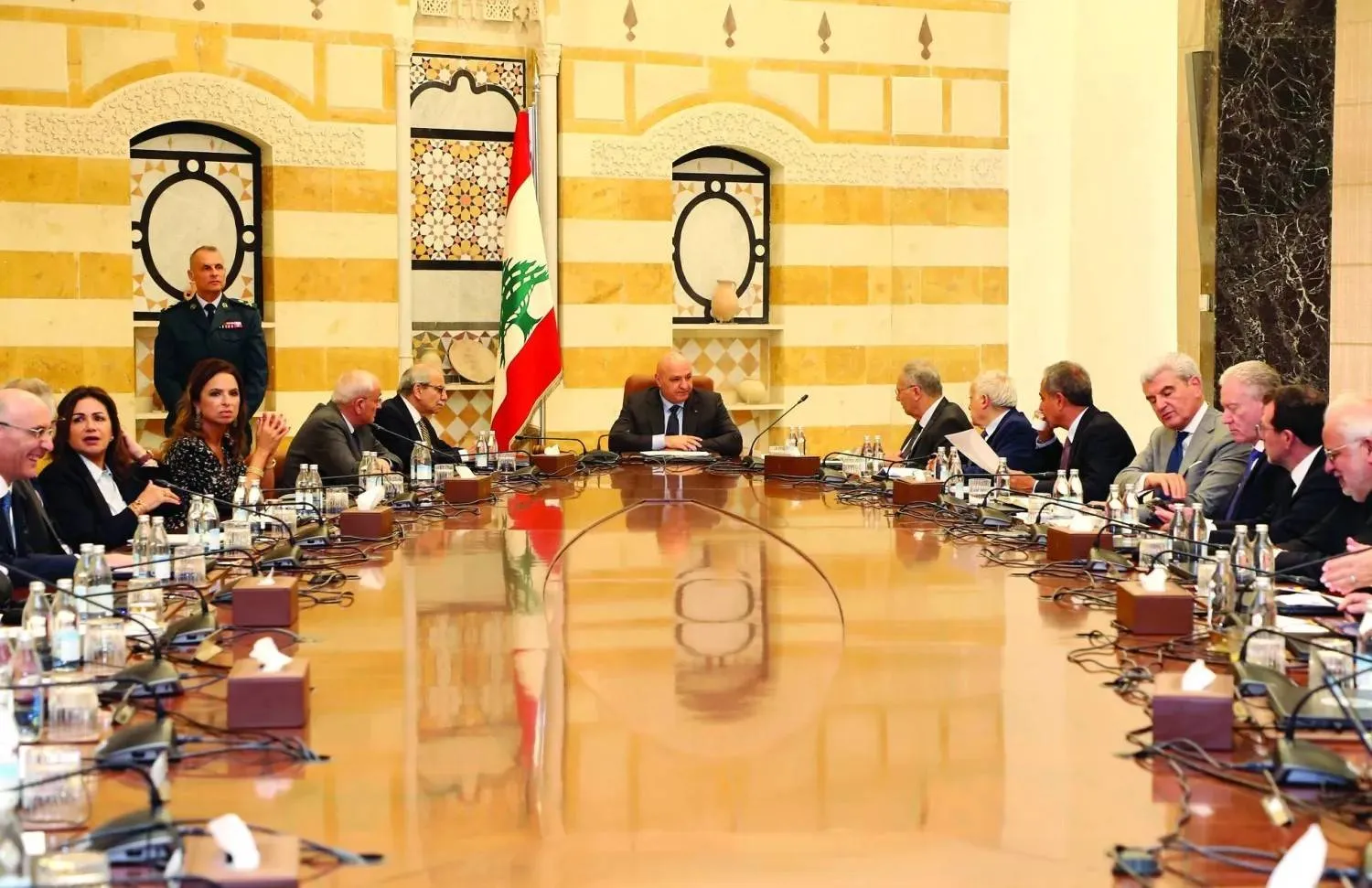
Lebanese government meets under President Joseph Aoun’s chairmanship (AP)
TT

Hezbollah Softens Tone after US Envoy Barrack’s Beirut Visit

Lebanese government meets under President Joseph Aoun’s chairmanship (AP)

The Lebanese government’s decision to move toward ending the armed presence of Hezbollah across the country has set off a heated political debate, with eyes now on how Israel will respond following US-brokered talks in Beirut.

US envoy Tom Barrack met Lebanese President Joseph Aoun at the presidential palace this week in what officials described as a constructive round of diplomacy.

The envoy conveyed that Beirut had taken the “first step” by pledging to disarm Hezbollah by year’s end, and said Israel must now reciprocate within the framework of a ceasefire.

Hezbollah, which initially reacted with fiery rhetoric to the government’s announcement, has notably toned down its messaging since Barrack’s visit.

The group has issued no fresh threats, while Mustafa Bayram, a former minister aligned with Hezbollah, struck a more symbolic note on Wednesday, saying the movement “will remain like a seed growing in the dark, destined to blossom into spring.”

Kataeb Party Slams Hezbollah Rhetoric

The Kataeb Party lashed out at Hezbollah deputy chief Naim Qassem, who recently warned of civil war if the group’s weapons were challenged.

Party leader Samy Gemayel chaired a political bureau meeting that described Qassem’s remarks as a “serious threat to national security and social peace.”

Kataeb said Qassem’s comments echoed those of senior Iranian official Ali Larijani, accusing Hezbollah of prioritizing Tehran’s interests over Lebanon’s.

The party reaffirmed that only constitutional institutions had the authority to decide on weapons, urging the army to present its operational plan for implementing the government’s decision.

Lebanese Forces: Hezbollah’s Legitimacy Eroded

Fadi Karam, a lawmaker from the Lebanese Forces bloc, said Hezbollah had lost any “legitimate cover” for its arsenal.

He dismissed talk of internal strife, arguing security forces were in control.

“All this scaremongering is pressure to prevent the army from executing government decisions,” he said, adding Hezbollah had brought only “destruction” to Lebanon.

Karam called for curbing Hezbollah’s “ideological project” and stressed Lebanon must resist external ambitions, whether from Israel or Iran.

Bilal Abdallah of the Progressive Socialist Party expressed strong backing for Prime Minister Nawaf Salam and his cabinet.

He said the government was committed to stability and implementing UN Security Council Resolution 1701, which calls for an Israeli withdrawal from occupied Lebanese land, the return of detainees and an end to attacks and assassinations.

“Stability is a prerequisite for political consensus, investment and economic recovery,” Abdallah said, while warning against personal attacks on Salam, who he said enjoyed parliamentary legitimacy and significant national support.



Saudi Intervention Ends Socotra Power Crisis

Socotra power generators restarted after Saudi intervention (X)
TT

Saudi Intervention Ends Socotra Power Crisis

Socotra power generators restarted after Saudi intervention (X)

Electricity has returned to Yemen’s Socotra archipelago after urgent Saudi intervention ended days of outages that disrupted daily life and crippled vital institutions, including the general hospital, the university and the technical institute.

The breakthrough followed a sudden shutdown of the power plants after the operating company withdrew and disabled control systems, triggering widespread blackouts and deepening hardship for residents.

The Saudi Program for the Development and Reconstruction of Yemen said its engineering and technical teams moved immediately after receiving an appeal from local authorities. Specialists were dispatched to reactivate operating systems that had been encrypted before the company left the island.

Generators were brought back online in stages, restoring electricity across most of the governorate within a short time.

The restart eased intense pressure on the grid, which had faced rising demand in recent weeks after a complete halt in generation.

Health and education facilities were among the worst affected. Some medical departments scaled back services, while parts of the education sector were partially suspended as classrooms and laboratories were left without power.

Socotra’s electricity authority said the crisis began when the former operator installed shutdown timers and password protections on control systems, preventing local teams from restarting the stations. Officials noted that the archipelago faced a similar situation in 2018, which was resolved through official intervention.

Local sources said the return of electricity quickly stabilized basic services. Water networks resumed regular operations, telecommunications improved, and commercial activity began to recover after a period of economic disruption linked to the outages.

Health and education rebound

In the health sector, stable power, combined with operational support, secured the functioning of Socotra General Hospital, the archipelago’s main medical facility.

Funding helped provide fuel and medical supplies and support healthcare staff, strengthening the hospital’s ability to receive patients and reducing the need to transfer cases outside the governorate, a burden that had weighed heavily on residents.

Medical sources said critical departments, including intensive care units and operating rooms, resumed normal operations after relying on limited emergency measures.

In education, classes and academic activities resumed at Socotra University and the technical institute after weeks of disruption.

A support initiative covered operational costs, including academic staff salaries and essential expenses, helping curb absenteeism and restore the academic schedule.

Local authorities announced that studies at the technical institute would officially restart on Monday, a move seen as a sign of gradual stabilization in public services.

Observers say sustained technical and operational support will be key to safeguarding electricity supply and preventing a repeat of the crisis in a region that depends almost entirely on power to run its vital sectors.


Egypt’s Prime Minister and FM Head to Washington for Trump Peace Council Meeting

Egyptian Foreign Minister Badr Abdelatty speaks during a joint press conference with Kenyan Prime Cabinet Secretary/Cabinet Secretary for Foreign Diaspora Affairs Musalia Mudavadi in Nairobi, Kenya, Monday, Feb. 16, 2026. (AP)
TT

Egypt’s Prime Minister and FM Head to Washington for Trump Peace Council Meeting

Egyptian Foreign Minister Badr Abdelatty speaks during a joint press conference with Kenyan Prime Cabinet Secretary/Cabinet Secretary for Foreign Diaspora Affairs Musalia Mudavadi in Nairobi, Kenya, Monday, Feb. 16, 2026. (AP)

Egypt's Prime Minister Mostafa Madbouly headed to Washington on Tuesday ‌to ‌participate in ‌the inaugural ⁠meeting of a "Board of Peace" established by US President Donald ⁠Trump, the ‌cabinet ‌said.

Madbouly is ‌attending ‌on behalf of President Abdel ‌Fattah al-Sisi and is accompanied by ⁠Foreign ⁠Minister Badr Abdelatty.

Foreign Minister Gideon Saar will represent Israel at the inaugural meeting, his office said on Tuesday.

Hamas, meanwhile, called on the newly-formed board to pressure Israel to halt what it described as ongoing violations of the ceasefire in Gaza.

The Board of Peace, of which Trump is the chairman, was initially designed to oversee the Gaza truce and the territory's reconstruction after the war between Hamas and Israel.

But its purpose has since morphed into resolving all sorts of international conflicts, triggering fears the US president wants to create a rival to the United Nations.

Saar will first attend a ministerial level UN Security Council meeting in New York on Wednesday, and on Thursday he "will represent Israel at the inaugural session of the board, chaired by Trump in Washington DC, where he will present Israel's position", his office said in a statement.

It was initially reported that Prime Minister Benjamin Netanyahu might attend the gathering, but his office said last week that he would not.

Ahead of the meeting, Hamas spokesman Hazem Qassem told AFP that the Palestinian movement urged the board's members "to take serious action to compel the Israeli occupation to stop its violations in Gaza".

"The war of genocide against the Strip is still ongoing -- through killing, displacement, siege, and starvation -- which have not stopped until this very moment," he added.

He also called for the board to work to support the newly formed Palestinian technocratic committee meant to oversee the day-to-day governance of post-war Gaza "so that relief and reconstruction efforts in Gaza can commence".

Announcing the creation of the board in January, Trump also unveiled plans to establish a "Gaza Executive Board" operating under the body.

The executive board would include Turkish Foreign Minister Hakan Fidan and Qatari diplomat Ali Al-Thawadi.

Netanyahu has strongly objected to their inclusion.

Since Trump launched his "Board of Peace" at the World Economic Forum in Davos in January, at least 19 countries have signed its founding charter.


Palestinian Child Dies After Stepping on Mine in West Bank

Israeli troops conduct a military raid in the village of Al-Yamoun, west of Jenin, West Bank, 17 February 2026. (EPA)
TT

Palestinian Child Dies After Stepping on Mine in West Bank

Israeli troops conduct a military raid in the village of Al-Yamoun, west of Jenin, West Bank, 17 February 2026. (EPA)

A Palestinian child died after stepping on a mine near an Israeli military camp in the occupied West Bank on Tuesday, the Palestinian Red Crescent said, with an Israeli defense ministry source confirming the death.

"Our crews received the body of a 13-year-old child who was killed after a mine exploded in one of the old camps in Jiftlik in the northern Jordan Valley," the Red Crescent said in a statement.

A source at COGAT, the Israeli defense ministry's agency in charge of civilian matters in the Palestinian territories, confirmed the death to AFP and identified the boy as Mohammed Abu Dalah, from the village of Jiftlik.

Israel's military had previously said in a statement that three Palestinians were injured "as a result of playing with unexploded ordnance", without specifying their ages.

It added that the area of the incident, Tirzah, is "a military camp in the area of the Jordan Valley", near Jiftlik and close to the Jordanian border.

"This area is a live-fire zone and entry into it is prohibited," the military said.

Jiftlik village council head Ahmad Ghawanmeh told AFP that three children, the oldest of whom was 16, were collecting herbs near the military base when they detonated a mine.

Jiftlik as well as the nearby Tirzah base are located in the Palestinian territory's Area C, which falls under direct Israeli control.

Israel has occupied the West Bank since 1967.

Much of the area near the border with Jordan -- which Israel signed a peace deal with in 1994 -- remains mined.

In January, Israel's defense ministry said it had begun demining the border area as part of construction works for a new barrier it says aims to stem weapons smuggling.