
Gaza City Officially in Famine, with Hunger Spreading, Says Global Hunger Monitor

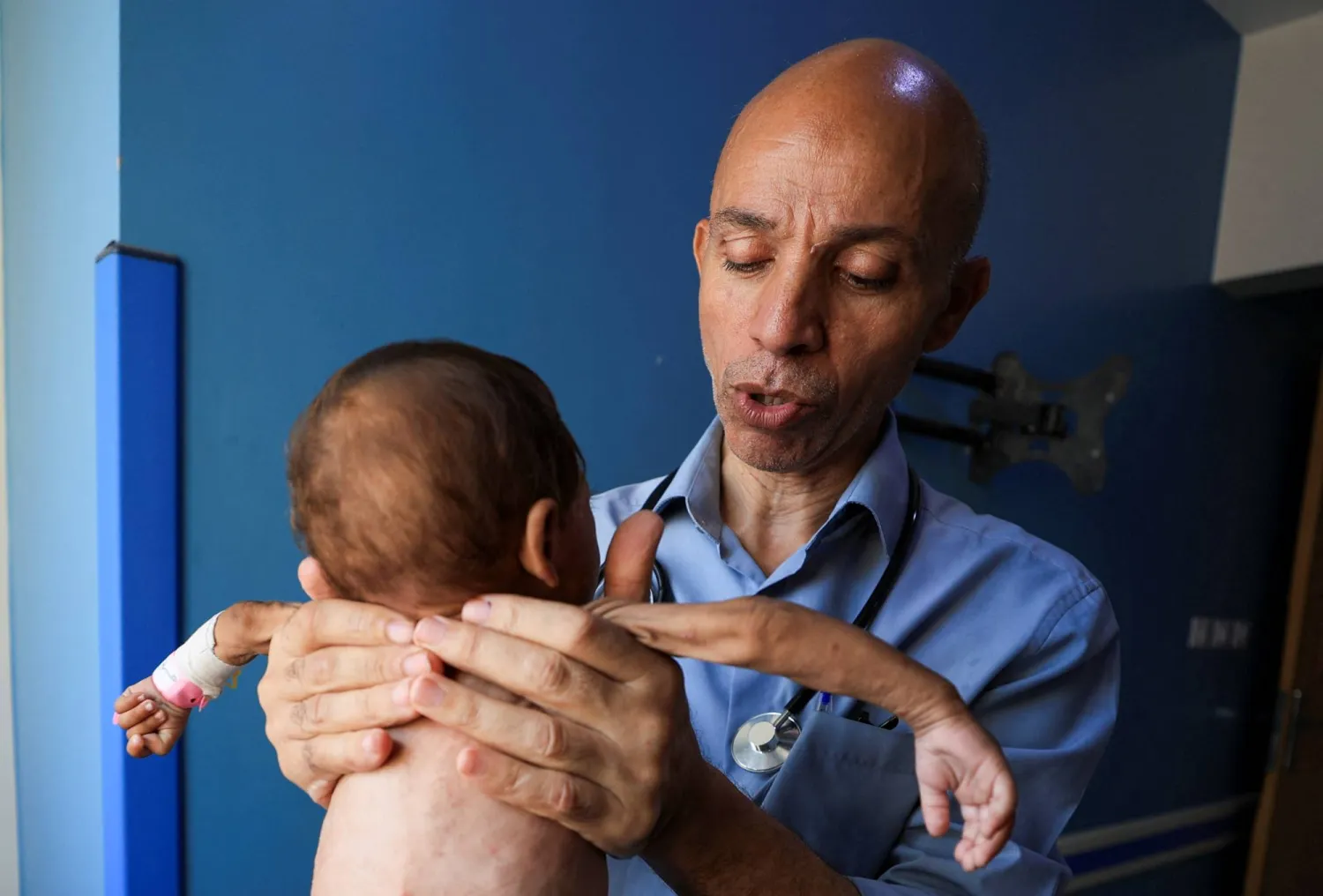
Palestinian doctor Ahmed Basal examines a child for malnutrition at Al-Rantisi Hospital in Gaza City, August 7, 2025. REUTERS/Dawoud Abu Alkas
TT

Gaza City Officially in Famine, with Hunger Spreading, Says Global Hunger Monitor

Palestinian doctor Ahmed Basal examines a child for malnutrition at Al-Rantisi Hospital in Gaza City, August 7, 2025. REUTERS/Dawoud Abu Alkas

Gaza City and surrounding areas are officially suffering from famine, and it will likely spread, a global hunger monitor determined on Friday, an assessment that will escalate pressure on Israel to allow more aid into the Palestinian territory. 

The Integrated Food Security Phase Classification (IPC) system said 514,000 people - close to a quarter of Palestinians in Gaza - are experiencing famine, with the number due to rise to 641,000 by the end of September. 

Some 280,000 of those people are in a northern region covering Gaza City - known as Gaza governorate - which the IPC said was in famine following nearly two years of war between Israel and Palestinian group Hamas. 

It was the first time the IPC has recorded famine outside of Africa, and the global group predicted that famine conditions would spread to the central and southern areas of Deir al-Balah and Khan Younis by the end of next month. 

It added that the situation further north could be even worse than in Gaza City, but that limited data prevented any precise classification. Reuters has previously reported on the IPC's struggle to get access to data required to assess the crisis. 

"It is a famine that we could have prevented had we been allowed," said UN humanitarian chief Tom Fletcher. "Yet food stacks up at borders because of systematic obstruction by Israel." 

Israel dismissed the findings as false and biased, saying the IPC had based its survey on partial data largely provided by Hamas, which did not take into account a recent influx of food. 

The report was an "outright lie", said Israeli Prime Minister Benjamin Netanyahu. 

"Israel does not have a policy of starvation," he said in a statement. "Israel has a policy of preventing starvation. Since the beginning of the war Israel has enabled 2 million tons of aid to enter the Gaza Strip, over one ton of aid per person." 

For a region to be classified as in famine at least 20% of people must be suffering extreme food shortages, with one in three children acutely malnourished and two people out of every 10,000 dying daily from starvation or malnutrition and disease. 

Previously, the IPC has only registered famines in Somalia, South Sudan and Sudan. UN Secretary-General Antonio Guterres said the Gaza famine was a "man-made disaster, a moral indictment, and a failure of humanity itself". 

He called for an immediate ceasefire, the release of all hostages still held by Hamas and unfettered humanitarian access. 

UN human rights chief Volker Turk warned that deaths from starvation could amount to a war crime. 

Turk's office said in June that "weaponization" of food for civilians in Gaza constitutes a war crime, while cautioning that a court of law would have to determine whether Israel was guilty of such a crime. Israel rejects war crimes charges in Gaza. 

DIPLOMATIC FALLOUT 

Israel controls all access to Gaza. COGAT, the arm of the Israeli military that oversees aid flows, said the IPC report ignored Israeli data on aid deliveries and was part of an international campaign aimed at denigrating Israel. 

"The IPC report is not only biased but also serves Hamas' propaganda campaign," the agency said. 

In Israel, Hebrew-language news websites highlighted the famine report on their front pages, with the liberal Haaretz focused on the severity of starvation in Gaza City, while Israel Hayom, N12 and ynet emphasized Israel's rejection of the report as biased and cited concerns over the possible diplomatic fallout. 

Underscoring those worries, Britain called the IPC report "utterly horrifying" and demanded that Israel immediately allow unhindered supplies of food, medicines and fuel. 

"The Israeli government's refusal to allow sufficient aid into Gaza has caused this man-made catastrophe. This is a moral outrage," British Foreign Secretary David Lammy said. Britain, Canada, Australia and many European states recently said the humanitarian crisis had reached "unimaginable levels". 

Israel has long counted on the US, its most powerful ally, for military aid and diplomatic support. A Reuters/Ipsos poll released this week found that 65% of Americans believe the US should help those starving in Gaza. 

An erosion of US public support would be a worrisome sign for Israel as it faces not only Hamas in Gaza but unresolved conflict with Iran, its regional arch-foe. 

US President Donald Trump last month said many people there were starving, putting him at odds with Netanyahu, who has repeatedly said there was no starvation. 

FAMINE CLASSIFICATION 

The IPC said its analysis only covered people living in Gaza, Deir al-Balah and Khan Younis governorates. It was unable to classify North Gaza governorate due to access restrictions and a lack of data and it excluded any remaining population in the southern Rafah region as it is largely uninhabited. 

The UN has complained of obstacles to delivering and distributing aid in Gaza, blaming impediments on Israel and lawlessness. Israel had criticized the UN-led operation and accuses Hamas of stealing aid, which the group denies. 

It is the fifth time in the past 14 years that a famine has been determined by the IPC - an initiative involving 21 aid groups, UN agencies and regional organizations that is funded by the European Union, Germany, Britain and Canada. 

The Gaza war was triggered on October 7, 2023, when Hamas killed 1,200 people in southern Israel and took some 250 hostages, according to Israeli tallies. Since then, Israel's military campaign has killed more than 62,000 Palestinians, according to Gaza health authorities. 

The United States, Qatar and Egypt have been trying to broker an end to the conflict. 


US Congress Ends Syria Sanctions

The new Syrian government headed by Ahmed al-Sharaa had urged the US to remove sanctions. Brendan SMIALOWSKI / AFP
TT

US Congress Ends Syria Sanctions

The new Syrian government headed by Ahmed al-Sharaa had urged the US to remove sanctions. Brendan SMIALOWSKI / AFP

The US Congress on Wednesday permanently ended sanctions imposed on Syria under ousted leader Bashar al-Assad, paving the way for the return of investment to the war-ravaged nation.

President Donald Trump had already twice suspended the implementation of sanctions in response to calls from Saudi Arabia and Türkiye.

The new government headed by Ahmed al-Sharaa had sought a permanent end to the sanctions, fearing that so long as the measures remained on the books they would deter businesses wary of legal risks in the world's largest economy, reported AFP.

The Senate passed the repeal of the 2019 Caesar Act as part of a sweeping annual defense package. The Senate voted 77 to 20 in favor of the legislation, which was already approved by the House of Representatives and is expected to be signed by Trump.

The repeal, broadly backed by lawmakers of both parties, "is a decisive step toward giving the Syrian people a real chance to rebuild after decades of unimaginable suffering," said Senator Jeanne Shaheen, the top Democrat on the Senate Foreign Relations Committee.

Damascus hailed the decision as a turning point.

"We express our gratitude and appreciation to the US Senate for its support of the Syrian people and its vote to repeal the Caesar Act," Syrian Foreign Minister Asaad al-Shaibani said.

He described the move as "a positive development that opens new horizons for cooperation and partnership between our country and the world".

The Caesar Act, named after an anonymous photographer who documented atrocities in Assad's prisons, severely restricted investment and cut off Syria from the international banking system.

The law was intended to prevent the influx of foreign businesses to rebuild Syria at a time when it had seemed that Assad had triumphed following more than a decade of brutal civil war that triggered a massive flow of refugees toward Europe and helped spawn the birth of the ISIS extremist movement.

Sharaa's fighters seized Damascus a year ago in a lightning offensive.

Sharaa has impressed Trump, including when they first met during the US leader's May trip to Riyadh.


UN, Aid Groups Warn Gaza Operations at Risk from Israel Impediments

TOPSHOT - Displaced Palestinians gather to receive donated food portions at a charity kitchen in Khan Yunis in the southern Gaza Strip on December 17, 2025. (Photo by Bashar Taleb / AFP)
TT

UN, Aid Groups Warn Gaza Operations at Risk from Israel Impediments

TOPSHOT - Displaced Palestinians gather to receive donated food portions at a charity kitchen in Khan Yunis in the southern Gaza Strip on December 17, 2025. (Photo by Bashar Taleb / AFP)

The United Nations and aid groups warned on Wednesday that humanitarian operations in the Palestinian territories, particularly Gaza, were at risk of collapse if Israel does not lift impediments that include a "vague, arbitrary, and highly politicized" registration process.

Dozens of international aid groups face de-registration by December 31, which then means they have to close operations within 60 days, said the UN and more than 200 local and international aid groups in a joint statement, Reuters reported.

"The deregistration of INGOs (international aid groups) in Gaza will have a catastrophic impact on access to essential and basic services," the statement read.

"INGOs run or support the majority of field hospitals, primary healthcare centers, emergency shelter responses, water and sanitation services, nutrition stabilization centers for children with acute malnutrition, and critical mine action activities," it said.

SUPPLIES LEFT OUT OF REACH: GROUPS

While some international aid groups have been registered under the system that was introduced in March, "the ongoing re-registration process and other arbitrary hindrances to humanitarian operations have left millions of dollars’ worth of essential supplies - including food, medical items, hygiene materials, and shelter assistance - stuck outside of Gaza and unable to reach people in need," the statement read.

Israel's mission to the United Nations in New York did not immediately respond to a request for comment on the statement. Under the first phase of US President Donald Trump's Gaza plan, a fragile ceasefire in the two-year-old war between Israel and the Palestinian Hamas group began on October 10. Hamas released hostages, Israel freed detained Palestinians and more aid began flowing into the enclave where a global hunger monitor said in August famine had taken hold.

However, Hamas says fewer aid trucks are entering Gaza than was agreed. Aid agencies say there is far less aid than required, and that Israel is blocking many necessary items from coming in. Israel denies that and says it is abiding by its obligations under the truce.

"The UN will not be able to compensate for the collapse of INGOs’ operations if they are de-registered, and the humanitarian response cannot be replaced by alternative actors operating outside established humanitarian principles," the statement by the UN and aid groups said.

The statement stressed "humanitarian access is not optional, conditional or political," adding: "Lifesaving assistance must be allowed to reach Palestinians without further delay."


Paris Meeting Sets Three Priorities to Back Lebanese Army

A convoy of the Spanish battalion of the United Nations Interim Force in Lebanon passes through Qlayaa in southern Lebanon on Oct. 12, 2024 (DPA)
TT

Paris Meeting Sets Three Priorities to Back Lebanese Army

A convoy of the Spanish battalion of the United Nations Interim Force in Lebanon passes through Qlayaa in southern Lebanon on Oct. 12, 2024 (DPA)

Paris will host a four party meeting on Thursday bringing together representatives of France, Saudi Arabia, the United States and Lebanon, amid fears that an Israeli escalation could upend a ceasefire agreement in place for more than a year.

French officials say Paris senses an imminent threat facing Lebanon in light of repeated and public Israeli threats to resume the war.

France is also concerned about uncertainty surrounding the US position on Israel’s intentions, with a prevailing French view that President Donald Trump’s administration is not inclined to restrain Israel.

Israel accuses the Lebanese army of failing to carry out commitments made by the government under the first phase of a plan to disarm Hezbollah in the area south of the Litani River.

Caught between Israeli pressure on one side and Hezbollah’s refusal to hand over its weapons on the other, Paris has been searching for a way out and for a clear, visible means of protecting Lebanon.

French officials want to demonstrate that the Lebanese army, contrary to prevailing claims, is doing what is required of it regarding Hezbollah’s weapons.

A new mechanism to track disarmament

Against this backdrop, France has put forward a proposal to establish a new “mechanism” to clearly document the actions taken by the Lebanese army, based on tangible and verifiable evidence.

Paris has also suggested that elements of the United Nations Interim Force in Lebanon, UNIFIL, accompany army units during inspection and seizure operations, document them and make the results public. The aim is to provide concrete proof of the army’s seriousness and of the outcomes achieved.

French Foreign Minister Jean-Noel Barrot summed up the proposal by saying France is “working on a second mechanism to monitor the disarmament of Hezbollah.”

A large scale tour organized by the army leadership in the south on Dec. 15, led by army commander General Rodolphe Haykal and attended by several ambassadors and military attachés, along with an earlier visit by representatives of UN Security Council member states and a separate tour for Lebanese and international media, were all part of efforts to show the government’s and the army’s commitment to implementing UN Security Council Resolution 1701 and to rebut claims of government foot dragging and military shortcomings.

In recent weeks, Paris has stepped up its engagement on the Lebanese file. Thursday’s meeting caps a diplomatic push that has included, in less than a month, two visits by Anne Claire Legendre, President Emmanuel Macron’s adviser for Middle East and Arab affairs, and Jean-Yves Le Drian, a former foreign minister and Macron’s personal envoy to Lebanon.

As part of this effort, Legendre has made regional visits, most notably to Saudi Arabia.

Macron himself has held a series of key calls focused on two tracks: a conference expected in the coming weeks to support the Lebanese army and security forces, and a separate conference on economic support and reconstruction.

No dates have yet been set for either event.

Importance of Haykal’s participation

Well informed sources in Paris say Thursday’s meeting will focus on three main priorities.

The first is reviewing the work of the “mechanism” tasked with monitoring the cessation of hostilities between Israel and Lebanon, and considering how to enhance it through the new mechanism outlined by Barrot.

Another development concerns the mechanism’s expanded membership, which now includes a Lebanese diplomat, former ambassador Simon Karam, and an Israeli representative, Yuri Resnik, director of foreign policy at Israel’s National Security Council.

Israel and Washington are pressing to broaden the scope of discussions to include economic and political issues, a move that has raised Lebanese concerns and drawn opposition from Hezbollah.

US envoy for Lebanon Morgan Ortagus and Le Drian, both attending the Paris meeting, are expected to travel to Lebanon afterward to take part in a meeting of the mechanism.

That adds to the importance of the five party committee, which has failed, more than a year after its creation, to halt near daily Israeli operations.

The US ambassador to Beirut, Michel Issa, will also attend Thursday’s meeting, his first such gathering since formally taking up his post.

Curbing Israeli escalation in Lebanon is the second priority of the meeting, which Haykal will attend alongside a series of engagements at the foreign ministry, defense ministry and presidential palace.

Haykal’s participation is seen as especially significant, as it will give him the opportunity to present a comprehensive account of the difficulties facing army units in carrying out their missions, foremost among them Israel’s refusal to withdraw from five additional positions it still holds on Lebanese territory.

The Lebanese army commander is also expected to outline the achievements of his forces over the past four months south of the Litani River, as well as his plan for other parts of Lebanon, aimed at restricting weapons to the hands of the Lebanese state.

Attention will also focus on Ortagus’s presentation on US plans for Lebanon, including efforts to push Lebanon toward negotiations with Israel on political and economic issues, as well as the timelines Washington is setting for Lebanon to complete the process of placing weapons exclusively under state control.

The long awaited army support conference

The central theme of Thursday’s Paris meeting, however, is expected to be support for the Lebanese army and security forces as an essential preparatory step that cannot be bypassed ahead of the long promised conference to back the army.

Two key questions remain unanswered: where the conference will be held, whether in Paris or another capital, and when it will take place. It had previously been expected before the end of the year, but that now appears unlikely.

Paris does not hide its concern that confidence in Lebanon has been badly damaged in the past, not only among potential donors in the Gulf but also elsewhere.

As a result, external parties are increasingly insisting on evaluating results and are linking military and economic assistance to concrete outcomes, whether on the security front or in economic reforms.

Another issue that could make its way onto the Paris agenda is the Lebanese Syrian border, which has seen sporadic tensions. Paris believes the border needs to be demarcated to prevent it from being used by Hezbollah as an additional justification for retaining its weapons.

France says it is ready to help both Lebanon and Syria, but stresses the need to rebuild trust between the two. Lebanon wants assurances that Syria will not again become a party that routinely violates its sovereignty, while Damascus fears Hezbollah could play a destabilizing role inside Syria.