
Protesters in Israel Demand Release of Hostages as Israeli Strikes Kill 16 in Gaza, Hospitals Say

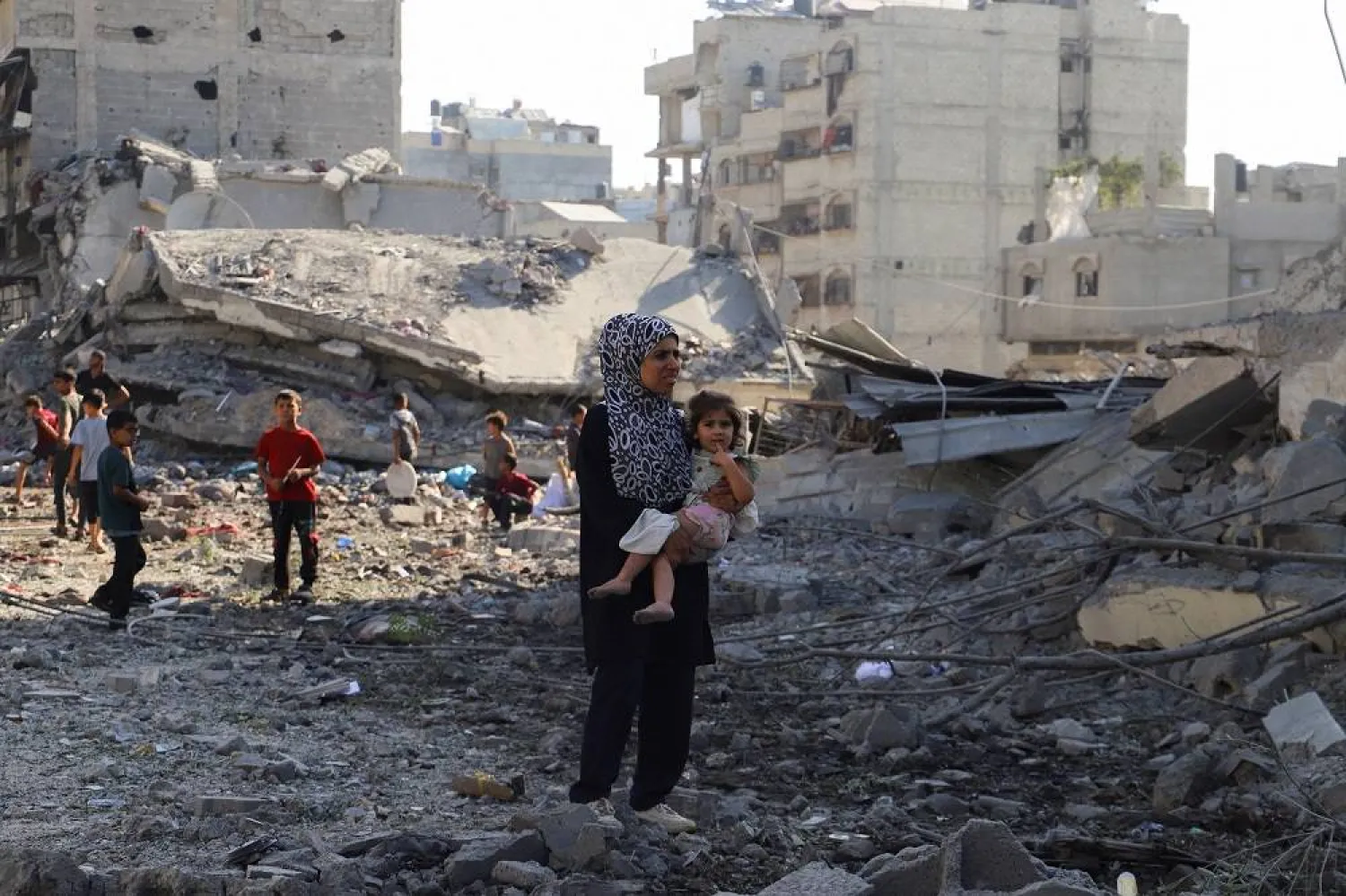
A Palestinian woman carries a child, as they inspect the site of an overnight Israeli strike on a house, in Gaza City, August 26, 2025. (Reuters) 
TT

Protesters in Israel Demand Release of Hostages as Israeli Strikes Kill 16 in Gaza, Hospitals Say

A Palestinian woman carries a child, as they inspect the site of an overnight Israeli strike on a house, in Gaza City, August 26, 2025. (Reuters) 

Protesters in Israel on Tuesday torched tires, blocked highways and clamored for a ceasefire that would free hostages still in Gaza, even as Israeli leaders moved forward with plans for an offensive which they argue is needed to defeat Hamas. 

The disruption came as Palestinians in Gaza braced for the expanded offensive against a backdrop of displacement, destruction and parts of the territory plunging into famine. It also followed deadly strikes a day earlier on Gaza’s main hospital which killed 20 people including medics and journalists. Among them was Mariam Dagga, a journalist who worked for The Associated Press. 

Prime Minister Benjamin Netanyahu was expected to convene a security cabinet meeting later Tuesday. However, the government said the meeting will not include discussion of ceasefire talks, according to an official with knowledge of the situation. The official, who spoke on the condition of anonymity because they were not authorized to speak on the matter, said there was a delegation from Egypt in Israel on Monday and they discussed the negotiations. 

Netanyahu has said that Israel will launch an expanded offensive in Gaza City while simultaneously pursuing a ceasefire, though Israel has yet to send a negotiating team to discuss a proposal on the table. Netanyahu has said the offensive is the best way to weaken Hamas and return hostages, but hostage families and their supporters have pushed back. 

"Go back to the negotiation table. There’s a good deal on the table. It’s something we can work with," said Ruby Chen, the father of 21-year-old Itay Chen, a dual Israeli-American citizen whose body is being held in Gaza. "We could get a deal done to bring all the hostages back." 

Hamas captured 251 hostages on Oct. 7, 2023, in the attack that triggered the current war. Most have been released during previous ceasefires. Israel has managed to rescue only eight hostages alive. Fifty remain in Gaza, and Israeli officials believe around 20 are still alive. 

Responding to a call from Israel’s Hostages and Missing Families Forum for a "National Day of Struggle," protesters waved banners that read "Hostage Deal Now." The relatives of hostages said they hope sustained public pressure can push Netanyahu and his security cabinet to commit to meaningful ceasefire talks. However far-right members of his coalition have threatened to resign if Israel agrees to a truce, dismissing the protesters’ demands. 

Israeli strikes continue after deadly hospital attack 

Calls for a ceasefire came a day after Israel struck southern Gaza’s main hospital, killing at least five journalists and 15 others, including Dagga, who had covered doctors treating children for starvation at the same facility days before. 

The strike, among the deadliest of the war against both journalists and hospitals, sparked shock and outrage among press freedom advocates and Palestinians, who mourned the dead at funerals on Monday. 

It was swiftly condemned across the globe. Netanyahu called it a "tragic mishap" and said the military would investigate. 

Most of those killed died after rushing to the scene of the first blast, only to be hit by a second strike — an attack captured on television by several networks. 

The southern Gaza strike came as Israel prepares to expand its offensive into densely populated areas of northern Gaza. Israel's military wants people in hospitals, displacement camps and Gaza City neighborhoods to evacuate southward to so-called safe zones so it can destroy Hamas and prevent attacks like the Oct. 7, 2023, assault that killed about 1,200 people and triggered the war. 

A day after the strike, Israeli strikes killed at least 16 Palestinians on Tuesday, hospitals said. 

Officials from Nasser Hospital, Shifa Hospital and Gaza City's Sheikh Radwan clinic reported that among the 16 were families, women and children. 

Gaza's Health Ministry also said on Tuesday that three more adults died of causes related to malnutrition and starvation, bringing the malnutrition-related death toll to 186 since late June, when the ministry started to count fatalities among this age category. The toll includes 117 children since the start of the war. 

Israel’s military offensive has killed 62,819, according to Gaza’s Health Ministry, which does not say how many were fighters or civilians but says around half were women and children. The ministry is part of the Hamas-run government and staffed by medical professionals. The UN and independent experts consider it the most reliable source on war casualties. Israel disputes its figures but has not provided its own. 

Israeli forces raid downtown Ramallah  

Lines of Israeli military vehicles entered downtown Ramallah on Tuesday afternoon in a rare daytime raid on one of the largest Palestinian cities in the Israeli-occupied West Bank. 

The Israeli military acknowledged an ongoing operation in the city but would not provide any information about the purpose of the raid. 

Ramallah is the headquarters of the Palestinian Authority, which has been largely sidelined since the start of the war. The city has faced similar raids before, including in May when Israeli forces targeted money transfer businesses there and in other Palestinian cities, alleging they had ties to armed groups. 

The Palestinian Red Crescent said there were 58 injuries during the raid, including injuries from live fire, rubber bullets, tear gas inhalation, and "live bullet shrapnel." Israeli armored vehicles entered a busy downtown intersection in the city, stopping traffic. A few dozen people attempted to throw rocks at the military vehicles. 

The war in Gaza has sparked a surge of violence in the West Bank, with the Israeli military carrying out large-scale operations targeting gunmen that have killed hundreds of Palestinians and displaced tens of thousands. That has coincided with a rise in settler violence and Palestinian attacks on Israelis. 

There have been more than 1,000 attacks by Israeli settlers throughout 2025, with 11 Palestinians killed and roughly 700 injured, according to the United Nations Office for the Coordination of Humanitarian Affairs. 


Moving ISIS Prisoners from Syria to Iraq Came at the Request of Baghdad, Officials Say

Local youth play atop of a damaged armored vehicle belonging to the Syrian Democratic Forces (SDF) at the site of clashes with Syrian government forces in the village of al-Hol in northeastern Syria’s Hasakeh province, Syria, Wednesday, Jan. 21, 2026. (AP Photo/Ghaith Alsayed)
TT

Moving ISIS Prisoners from Syria to Iraq Came at the Request of Baghdad, Officials Say

Local youth play atop of a damaged armored vehicle belonging to the Syrian Democratic Forces (SDF) at the site of clashes with Syrian government forces in the village of al-Hol in northeastern Syria’s Hasakeh province, Syria, Wednesday, Jan. 21, 2026. (AP Photo/Ghaith Alsayed)

The decision to move prisoners of the ISIS group from northeast Syria to detention centers in Iraq came after a request by officials in Baghdad that was welcomed by the US-led coalition and the Syrian government, officials said Thursday.

American and Iraqi officials told The Associated Press about the Iraqi request, a day after the US military said that it started transferring some of the 9,000 ISIS detainees held in more than a dozen detention centers in northeast Syria controlled by the Kurdish-led Syrian Democratic Forces, or SDF, in northeast Syria.

The move to start transferring the detainees came after Syrian government forces took control of the sprawling al-Hol camp — which houses thousands of mostly women and children — from the SDF, which withdrew as part of a ceasefire. Troops on Monday seized a prison in the northeastern town of Shaddadeh, where some ISIS detainees escaped and many were recaptured, state media reported.

The SDF said Thursday that government forces shelled al-Aqtan prison near the northern city of Raqqa with heavy weapons, while simultaneously imposing a siege around the prison using tanks and deployed fighters.

Al-Aqtan prison, where some ISIS prisoners are held, was surrounded by government forces earlier this week and negotiations were ongoing on the future of the detention facility.

With the push by government forces into northeast Syria along the border with Iraq, there have been concerns in Baghdad that some of the detainees might become danger to Iraq’s security, if they manage to flee from the detention centers amid the chaos.

An Iraqi security official said that the decision to transfer the prisoners from Syria to Iraq was an Iraqi decision, welcomed by the US-led coalition and the Syrian government. The official added that it was in Iraq’s security interest to detain them in Iraqi prisons rather than leaving them in Syria.

Also Thursday, a senior US military official confirmed to the AP that Iraq “offered proactively” to take the ISIS prisoners rather than the US requesting it of them.

Both the Iraqi and US officials spoke on condition of anonymity because they weren't authorized to comment publicly.

Over the past several years, the SDF has handed over to Iraqi authorities foreign fighters, including French citizens, who were put on trial and received sentences.

The SDF still controls more than a dozen detention facilities holding around 9,000 ISIS members, but is slated to hand the prisons over to government control under a peace process that also is supposed to eventually merge the SDF with government forces.

US Central Command said that the first transfer on Wednesday involved 150 ISIS members, who were taken from Syria’s northeastern province of Hassakeh to “secure locations” in Iraq. The statement said that up to 7,000 detainees could be transferred to Iraqi-controlled facilities.

ISIS declared a caliphate in 2014 in large parts of Syria and Iraq, attracting large numbers of fighters from around the world. The group was defeated in Iraq in 2017, and in Syria two years later, but its sleeper cells still carry out deadly attacks in both countries. The SDF played a major role in defeating ISIS.


Yemen: Coalition Steps Up Engagement with Aden’s Civil Society

Coalition to Restore Legitimacy oversees the normalization of life and improvement of services in Aden (Government Media) 
TT

Yemen: Coalition Steps Up Engagement with Aden’s Civil Society

Coalition to Restore Legitimacy oversees the normalization of life and improvement of services in Aden (Government Media) 

Amid rapidly evolving developments on the ground led by the leadership of the Coalition Forces to Restore Legitimacy in Yemen, efforts are continuing to normalize life in Aden, the country’s temporary capital, within a comprehensive vision aimed at restoring the city’s civil character and strengthening the role of the state and its service and security institutions.

Major General Falah Al-Shahrani, adviser to the Coalition Forces to Restore Legitimacy in Yemen, has intensified meetings with representatives of civil sectors, activists, and media professionals, seeking to build broad partnerships with Aden’s community and expand participation in shaping and implementing a plan to restore the city’s civil identity after years of conflict.

Alongside the daily follow-up of plans to remove military camps from Aden and restructure and integrate security units, the adviser to the joint forces is giving particular priority to basic services—especially electricity and water—viewed as a practical gateway to restoring public trust and improving living standards.

Al-Shahrani has also been holding regular meetings with journalists, activists, and community figures, listening to their views on the challenges facing the city and the aspirations of its residents in this new phase. Many hope this stage will restore Aden’s economic, cultural, and social standing as one of the oldest cities that embodied values of coexistence and openness.

Participants in these meetings stressed the importance of granting Aden’s residents a greater and more meaningful role in decision-making, noting that they had suffered marginalization in previous periods and that any successful plan to restore the city’s civil character must begin with their inclusion as direct stakeholders.

They also emphasized the need to give top priority to the education sector, describing it as the cornerstone of reconstruction and sustainable development and the primary foundation for rebuilding civic awareness and entrenching a culture of the rule of law.

Participants further called for directing support toward sustainable projects, foremost among them the rehabilitation of buildings damaged by the Houthi invasion of the city in 2015, given the direct impact of such projects on residents’ lives in terms of housing, services, and economic activity.

They noted that discussions with Al-Shahrani were marked by seriousness and transparency, reflecting the Coalition leadership’s determination to listen directly to public concerns beyond rigid official frameworks.

They affirmed that they sensed a genuine commitment and a clear vision to rebuild what the war had destroyed in Aden and other liberated provinces, in parallel with efforts to consolidate security and stability.


US Transfers ISIS Detainees from Syria to Iraq

 US soldiers at a military base north of Baghdad (Reuters – archive photo) 
 US soldiers at a military base north of Baghdad (Reuters – archive photo) 
TT

US Transfers ISIS Detainees from Syria to Iraq

 US soldiers at a military base north of Baghdad (Reuters – archive photo) 
 US soldiers at a military base north of Baghdad (Reuters – archive photo) 

US Central Command has launched a new operation to transfer ISIS detainees from northeastern Syria to Iraq, aiming to ensure that they remain in secure detention facilities and to reduce the risk of instability.

The operation began with the transfer of 150 ISIS militants from a detention facility in Hasakah, Syria, to a secure site in Iraq. US officials say the number of detainees moved from Syria to Iraqi-controlled prisons could eventually reach about 7,000.

Admiral Brad Cooper, the head of US Central Command, said: “We are closely coordinating with regional partners, including the Iraqi government, and we sincerely appreciate their role in ensuring the enduring defeat of ISIS.

“Facilitating the orderly and secure transfer of ISIS detainees is critical to preventing a breakout that would pose a direct threat to the United States and regional security.”

According to Reuters, the move follows the rapid collapse of the Kurdish-led Syrian Democratic Forces in northeastern Syria, which raised doubts about the security of roughly a dozen prisons and detention camps previously guarded by the group.

US officials also discussed the situation with Syrian President Ahmed al-Sharaa, focusing on ongoing tensions in Syria, the need for government forces to respect ceasefire arrangements with the Syrian Democratic Forces, and support for the coordinated transfer of ISIS detainees to Iraq.

The US side outlined plans to relocate thousands of detainees in a controlled manner and urged all parties to avoid actions that could disrupt the process.

An Iraqi official told Asharq Al-Awsat that the transfer would help ease growing concerns about possible escapes. He added that holding the detainees in prisons supervised by the Iraqi government, in direct coordination with the United States, would significantly reduce the chances of ISIS rebuilding its capabilities.

Syrian media reported that security forces recently arrested 90 group members who had escaped from al-Shaddadi prison south of Hasakah. The Syrian army later announced it had taken control of the city, imposed a curfew, and launched operations to secure the area and capture fugitives.

Recent government advances, combined with what appears to be a reduction in US support for the SDF, mark the most significant shift in territorial control since the fall of Bashar al-Assad 13 months ago.

The United States said this week that the main objectives of its partnership with the SDF have largely been achieved after years of fighting ISIS.