
Protesters in Israel Demand Release of Hostages as Israeli Strikes Kill 16 in Gaza, Hospitals Say

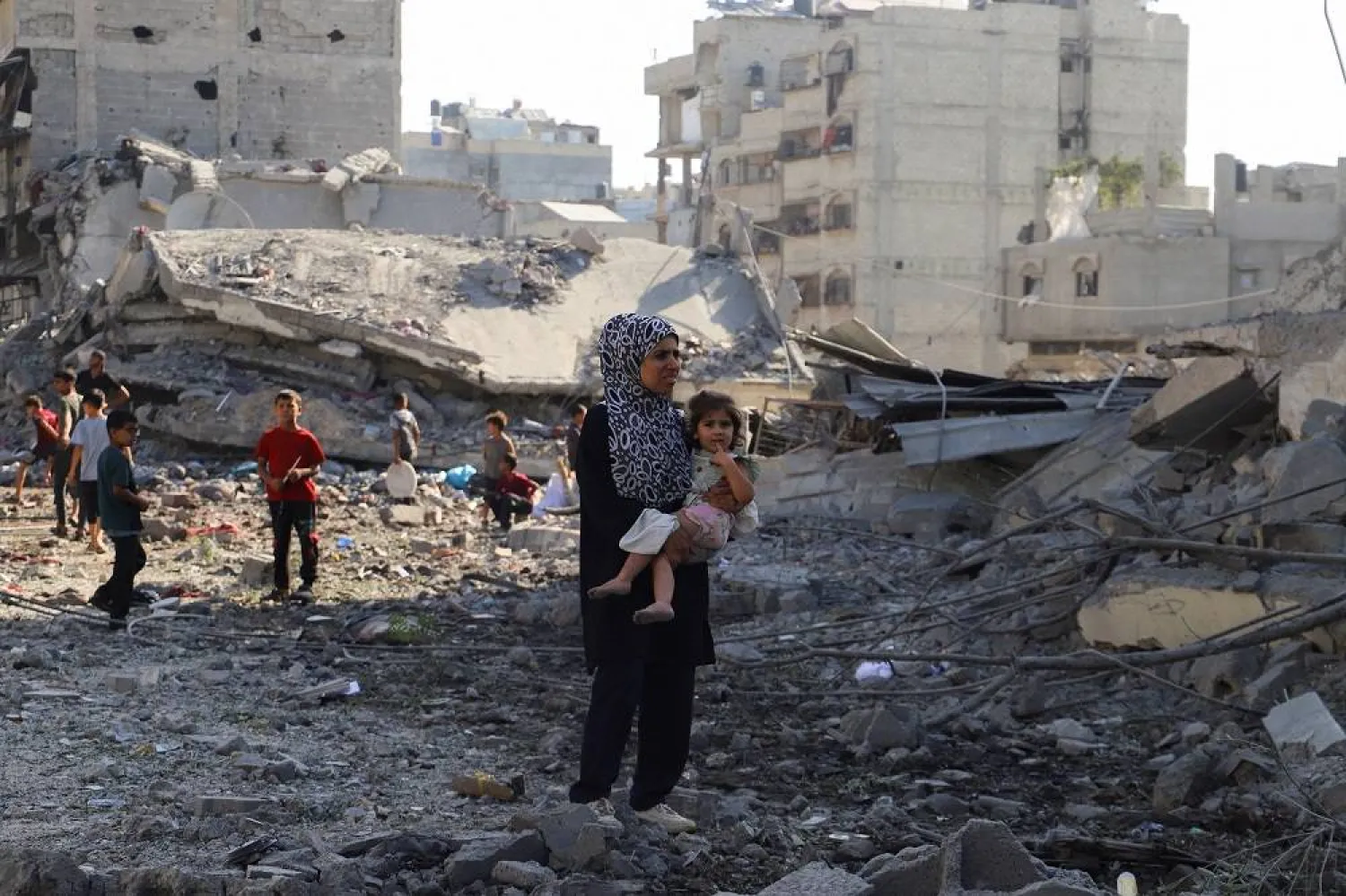
A Palestinian woman carries a child, as they inspect the site of an overnight Israeli strike on a house, in Gaza City, August 26, 2025. (Reuters) 
TT

Protesters in Israel Demand Release of Hostages as Israeli Strikes Kill 16 in Gaza, Hospitals Say

A Palestinian woman carries a child, as they inspect the site of an overnight Israeli strike on a house, in Gaza City, August 26, 2025. (Reuters) 

Protesters in Israel on Tuesday torched tires, blocked highways and clamored for a ceasefire that would free hostages still in Gaza, even as Israeli leaders moved forward with plans for an offensive which they argue is needed to defeat Hamas. 

The disruption came as Palestinians in Gaza braced for the expanded offensive against a backdrop of displacement, destruction and parts of the territory plunging into famine. It also followed deadly strikes a day earlier on Gaza’s main hospital which killed 20 people including medics and journalists. Among them was Mariam Dagga, a journalist who worked for The Associated Press. 

Prime Minister Benjamin Netanyahu was expected to convene a security cabinet meeting later Tuesday. However, the government said the meeting will not include discussion of ceasefire talks, according to an official with knowledge of the situation. The official, who spoke on the condition of anonymity because they were not authorized to speak on the matter, said there was a delegation from Egypt in Israel on Monday and they discussed the negotiations. 

Netanyahu has said that Israel will launch an expanded offensive in Gaza City while simultaneously pursuing a ceasefire, though Israel has yet to send a negotiating team to discuss a proposal on the table. Netanyahu has said the offensive is the best way to weaken Hamas and return hostages, but hostage families and their supporters have pushed back. 

"Go back to the negotiation table. There’s a good deal on the table. It’s something we can work with," said Ruby Chen, the father of 21-year-old Itay Chen, a dual Israeli-American citizen whose body is being held in Gaza. "We could get a deal done to bring all the hostages back." 

Hamas captured 251 hostages on Oct. 7, 2023, in the attack that triggered the current war. Most have been released during previous ceasefires. Israel has managed to rescue only eight hostages alive. Fifty remain in Gaza, and Israeli officials believe around 20 are still alive. 

Responding to a call from Israel’s Hostages and Missing Families Forum for a "National Day of Struggle," protesters waved banners that read "Hostage Deal Now." The relatives of hostages said they hope sustained public pressure can push Netanyahu and his security cabinet to commit to meaningful ceasefire talks. However far-right members of his coalition have threatened to resign if Israel agrees to a truce, dismissing the protesters’ demands. 

Israeli strikes continue after deadly hospital attack 

Calls for a ceasefire came a day after Israel struck southern Gaza’s main hospital, killing at least five journalists and 15 others, including Dagga, who had covered doctors treating children for starvation at the same facility days before. 

The strike, among the deadliest of the war against both journalists and hospitals, sparked shock and outrage among press freedom advocates and Palestinians, who mourned the dead at funerals on Monday. 

It was swiftly condemned across the globe. Netanyahu called it a "tragic mishap" and said the military would investigate. 

Most of those killed died after rushing to the scene of the first blast, only to be hit by a second strike — an attack captured on television by several networks. 

The southern Gaza strike came as Israel prepares to expand its offensive into densely populated areas of northern Gaza. Israel's military wants people in hospitals, displacement camps and Gaza City neighborhoods to evacuate southward to so-called safe zones so it can destroy Hamas and prevent attacks like the Oct. 7, 2023, assault that killed about 1,200 people and triggered the war. 

A day after the strike, Israeli strikes killed at least 16 Palestinians on Tuesday, hospitals said. 

Officials from Nasser Hospital, Shifa Hospital and Gaza City's Sheikh Radwan clinic reported that among the 16 were families, women and children. 

Gaza's Health Ministry also said on Tuesday that three more adults died of causes related to malnutrition and starvation, bringing the malnutrition-related death toll to 186 since late June, when the ministry started to count fatalities among this age category. The toll includes 117 children since the start of the war. 

Israel’s military offensive has killed 62,819, according to Gaza’s Health Ministry, which does not say how many were fighters or civilians but says around half were women and children. The ministry is part of the Hamas-run government and staffed by medical professionals. The UN and independent experts consider it the most reliable source on war casualties. Israel disputes its figures but has not provided its own. 

Israeli forces raid downtown Ramallah  

Lines of Israeli military vehicles entered downtown Ramallah on Tuesday afternoon in a rare daytime raid on one of the largest Palestinian cities in the Israeli-occupied West Bank. 

The Israeli military acknowledged an ongoing operation in the city but would not provide any information about the purpose of the raid. 

Ramallah is the headquarters of the Palestinian Authority, which has been largely sidelined since the start of the war. The city has faced similar raids before, including in May when Israeli forces targeted money transfer businesses there and in other Palestinian cities, alleging they had ties to armed groups. 

The Palestinian Red Crescent said there were 58 injuries during the raid, including injuries from live fire, rubber bullets, tear gas inhalation, and "live bullet shrapnel." Israeli armored vehicles entered a busy downtown intersection in the city, stopping traffic. A few dozen people attempted to throw rocks at the military vehicles. 

The war in Gaza has sparked a surge of violence in the West Bank, with the Israeli military carrying out large-scale operations targeting gunmen that have killed hundreds of Palestinians and displaced tens of thousands. That has coincided with a rise in settler violence and Palestinian attacks on Israelis. 

There have been more than 1,000 attacks by Israeli settlers throughout 2025, with 11 Palestinians killed and roughly 700 injured, according to the United Nations Office for the Coordination of Humanitarian Affairs. 


Gaza Ceasefire Enters Phase Two Despite Unresolved Issues

 Palestinians walk amid buildings destroyed by Israeli air and ground operations in Gaza City Thursday, Jan. 15, 2026. (AP)
Palestinians walk amid buildings destroyed by Israeli air and ground operations in Gaza City Thursday, Jan. 15, 2026. (AP)
TT

Gaza Ceasefire Enters Phase Two Despite Unresolved Issues

 Palestinians walk amid buildings destroyed by Israeli air and ground operations in Gaza City Thursday, Jan. 15, 2026. (AP)
Palestinians walk amid buildings destroyed by Israeli air and ground operations in Gaza City Thursday, Jan. 15, 2026. (AP)

A US-backed plan to end the war in Gaza has entered its second phase despite unresolved disputes between Israel and Hamas over alleged ceasefire violations and issues unaddressed in the first stage.

The most contentious questions remain Hamas's refusal to publicly commit to full disarmament, a non-negotiable demand from Israel, and Israel's lack of clarity over whether it will fully withdraw its forces from Gaza.

The creation of a Palestinian technocratic committee, announced on Wednesday, is intended to manage day-to-day governance in post-war Gaza, but it leaves unresolved broader political and security questions.

Below is a breakdown of developments from phase one to the newly launched second stage.

- Gains and gaps in phase one -

The first phase of the plan, part of a 20-point proposal unveiled by US President Donald Trump, began on October 10 and aimed primarily to stop the fighting in the Gaza Strip, allow in aid and secure the return of all remaining living and deceased hostages held by Hamas and allied Palestinian armed groups.

All hostages have since been returned, except for the remains of one Israeli, Ran Gvili.

Israel has accused Hamas of delaying the handover of Gvili's body, while Hamas has said widespread destruction in Gaza made locating the remains difficult.

Gvili's family had urged mediators to delay the transition to phase two.

"Moving on breaks my heart. Have we given up? Ran did not give up on anyone," his sister, Shira Gvili, said after mediators announced the move.

Israeli Prime Minister Benjamin Netanyahu said efforts to recover Gvili's remains would continue but has not publicly commented on the launch of phase two.

Hamas has accused Israel of repeated ceasefire violations, including air strikes, firing on civilians and advancing the so-called "Yellow Line," an informal boundary separating areas under Israeli military control from those under Hamas authority.

Gaza's Hamas-run health ministry said Israeli forces had killed 451 people since the ceasefire took effect.

Israel's military said it had targeted suspected fighters who crossed into restricted zones near the Yellow Line, adding that three Israeli soldiers were also killed by fighters during the same period.

Aid agencies say Israel has not allowed the volume of humanitarian assistance envisaged under phase one, a claim Israel rejects.

Gaza, whose borders and access points remain under Israeli control, continues to face severe shortages of food, clean water, medicine and fuel.

Israel and the United Nations have repeatedly disputed figures on the number of aid trucks permitted to enter the Palestinian territory.

- Disarmament, governance in phase two -

Under the second phase, Gaza is to be administered by a 15-member Palestinian technocratic committee operating under the supervision of a so-called "Board of Peace," to be chaired by Trump.

"The ball is now in the court of the mediators, the American guarantor and the international community to empower the committee," Bassem Naim, a senior Hamas leader, said in a statement on Thursday.

Mediators Egypt, Türkiye and Qatar said Ali Shaath, a former deputy minister in the Ramallah-based Palestinian Authority, had been appointed to lead the committee.

Shaath, in an interview, said the committee would rely on "brains rather than weapons" and would not coordinate with armed groups.

US Middle East envoy Steve Witkoff said phase two aims for the "full demilitarization and reconstruction of Gaza," including the disarmament of all unauthorized armed factions.

Witkoff said Washington expected Hamas to fulfill its remaining obligations, including the return of Gvili's body, warning that failure to do so would bring "serious consequences".

The plan also calls for the deployment of an International Stabilization Force to help secure Gaza and train vetted Palestinian police units.

For Palestinians, the central issue remains Israel's full military withdrawal from Gaza - a step included in the framework but for which no detailed timetable has been announced.

With fundamental disagreements persisting over disarmament, withdrawal and governance, diplomats say the success of phase two will depend on sustained pressure from mediators and whether both sides are willing - or able - to move beyond long-standing red lines.


Lebanon Charges Four Accused of Kidnapping for Israel’s Mossad

A handout photo from Israeli television made available on July 13, 2008, shows a photograph of Ron Arad, an Israeli Air Force navigator who was captured after his fighter jet was shot down in Lebanon in 1986. (Handout / AFP)
TT

Lebanon Charges Four Accused of Kidnapping for Israel’s Mossad

A handout photo from Israeli television made available on July 13, 2008, shows a photograph of Ron Arad, an Israeli Air Force navigator who was captured after his fighter jet was shot down in Lebanon in 1986. (Handout / AFP)

Four people accused of a kidnapping in Lebanon for Israel's Mossad spy agency last month have been charged, a judicial official said on Thursday, after a retired security officer whose brother was linked to an Israeli airman's disappearance went missing.

Israel has apprehended suspects in Lebanon before and Mossad is accused of regularly attempting to contact Lebanese people to facilitate its operations, while Lebanon has arrested dozens of people on suspicion of collaborating with Israel over the years.

Lebanese authorities believe the agency known for espionage operations outside of Israel's borders was behind the disappearance of retired security officer Ahmad Shukr last month.

Shukr, whose brother Hassan is suspected of involvement in the 1986 capture of Israeli air force navigator Ron Arad, disappeared in the Bekaa region of eastern Lebanon.

Authorities have arrested and charged one Lebanese man and charged three more who remain at large.

The four were charged with "communicating with and working for Mossad within Lebanon in exchange for money, and carrying out the kidnapping of Ahmad Shukr", a judicial official told AFP on condition of anonymity.

The three are "a Lebanese woman, a Lebanese-French man, and a Syrian-Swedish man," the official said.

The Israeli airman Ron Arad, whose plane went down in southern Lebanon during the country's civil war between 1975 and 1990, is now presumed dead and his remains were never returned.

Hassan Shukr was killed in 1988 in a battle between Israeli forces and local fighters, including from the Iran-backed Hezbollah group, a source close to the family told AFP last month, requesting anonymity.


Israeli Strikes Kill Five in Gaza, Say Local Health Authorities

 Makeshift tents shelter displaced Palestinians stand among buildings destroyed by Israeli air and ground operations in Gaza City Thursday, Jan. 15, 2026. (AP)
Makeshift tents shelter displaced Palestinians stand among buildings destroyed by Israeli air and ground operations in Gaza City Thursday, Jan. 15, 2026. (AP)
TT

Israeli Strikes Kill Five in Gaza, Say Local Health Authorities

 Makeshift tents shelter displaced Palestinians stand among buildings destroyed by Israeli air and ground operations in Gaza City Thursday, Jan. 15, 2026. (AP)
Makeshift tents shelter displaced Palestinians stand among buildings destroyed by Israeli air and ground operations in Gaza City Thursday, Jan. 15, 2026. (AP)

Two Israeli airstrikes killed five people, including a 16-year-old, in Deir al-Balah on Thursday, said local health authorities.

The Israeli military did not immediately respond to a Reuters request for comment on the incident.

It was not immediately clear what triggered the attacks, which were in areas outside the control of Israeli forces in the strip.

More than 400 Palestinians ‌and three Israeli ‌soldiers have been reported ‌killed ⁠since a ‌fragile ceasefire took effect in October.

Israel has razed buildings and ordered residents out of more than half of Gaza where its troops remain. Nearly all of the territory's more than 2 million people now live in ⁠makeshift homes or damaged buildings in a sliver of ‌territory where Israeli troops have withdrawn ‍and Hamas has ‍reasserted control.

The United Nations children agency ‍said on Tuesday that over 100 children have been killed in Gaza since the ceasefire, including victims of drone and quadcopter attacks.

Israel and Hamas have traded blame for violations of the ceasefire and remain far apart ⁠from each other on key issues, despite the United States announcing the second phase of the ceasefire on Wednesday.

Israel launched its operations in Gaza in the wake of an attack by Hamas-led fighters on October, 2023 which killed 1,200 people, according to Israeli tallies. Israel's assault has killed 71,000 people, according to health authorities in the strip, ‌and left much of Gaza in ruins.