
US Envoy Says Economic Zone in South Lebanon Will Help Disarmed Hezbollah Members

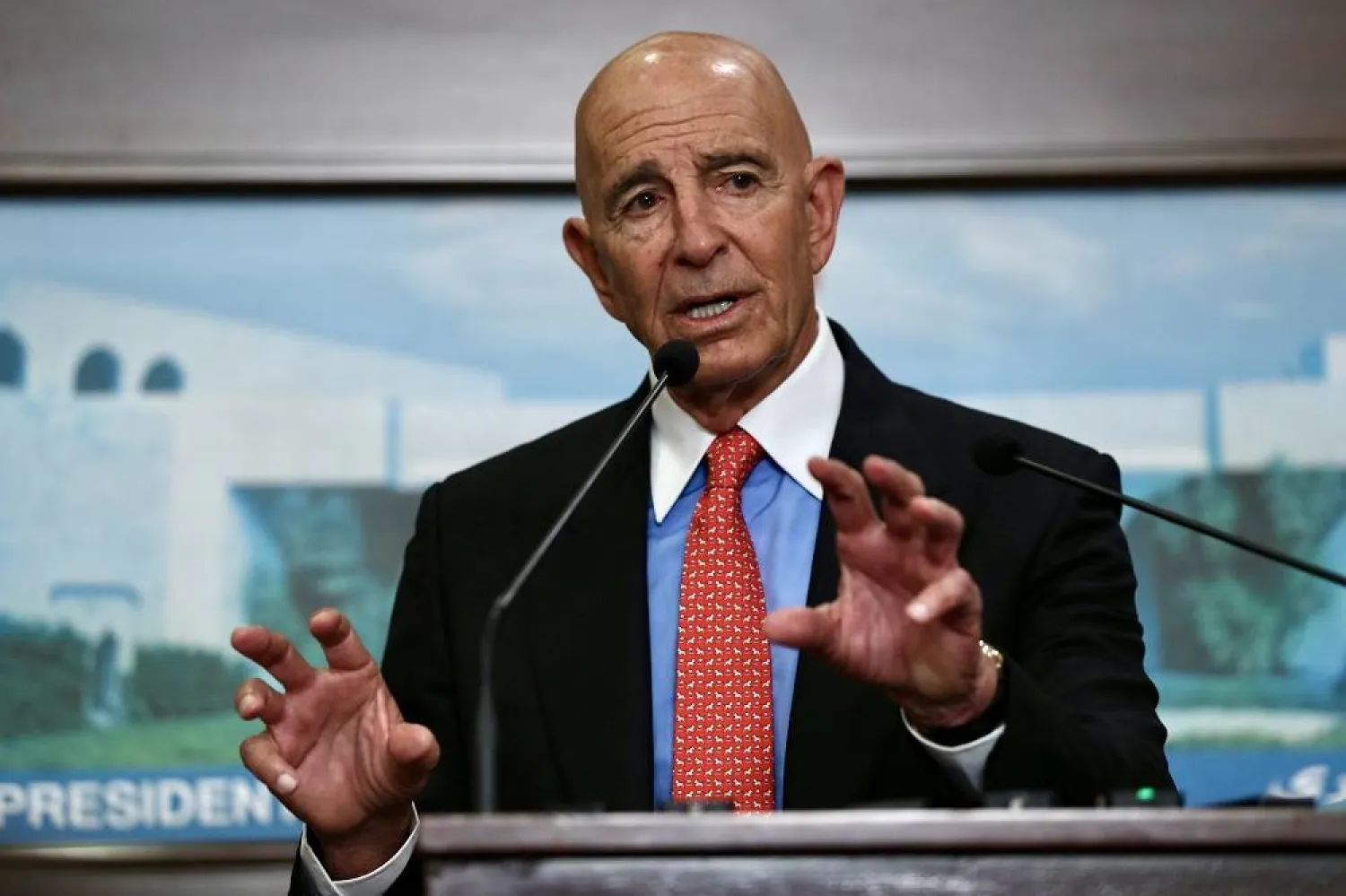
US Ambassador to Türkiye and Special Envoy to Syria Tom Barrack speaks during a news conference following a meeting with Lebanese President Joseph Aoun at the presidential palace in Baabda, east of Beirut, Lebanon, 26 August 2025. (EPA)
TT

US Envoy Says Economic Zone in South Lebanon Will Help Disarmed Hezbollah Members

US Ambassador to Türkiye and Special Envoy to Syria Tom Barrack speaks during a news conference following a meeting with Lebanese President Joseph Aoun at the presidential palace in Baabda, east of Beirut, Lebanon, 26 August 2025. (EPA)

US envoy Tom Barrack said on Tuesday that Gulf countries are ready to invest in an economic zone in south Lebanon near the border with Israel that would create jobs for members of the Hezbollah group and its supporters once they lay down their weapons.

He made his comments in Beirut after trips to Israel and Syria where he discussed with officials there the ongoing situation in Lebanon following this month’s decision by the Lebanese government to disarm Hezbollah by the end of the year. Hezbollah’s leader rejected the government’s plan, vowing to keep the weapons.

On Monday, Israeli Prime Minister Benjamin Netanyahu said Israeli forces could begin withdrawing from territory they hold in southern Lebanon after the Lebanese government’s “momentous decision” to disarm Hezbollah.

The Lebanese army is preparing a plan for Hezbollah’s disarmament that should be ready by the end of August. The government is expected to discuss the army’s plan and approve it during a meeting scheduled for Sept. 2.

“We have to have money coming into the system. The money will come from the Gulf,” Barrack told reporters after meeting President Joseph Aoun. “Qatar and Saudi Arabia are partners and are willing to do that for the south (of Lebanon) if we’re asking a portion of the Lebanese community to give up their livelihood.”

“We have 40,000 people that are being paid by Iran to fight. What are you gonna do with them? Take their weapon and say ‘by the way, good luck planting olive trees’? It can’t happen. We have to help them,” Barrack said. He was referring to tens of thousands of Hezbollah members who have been funded since the early 1980s by Tehran.

“We, all of us, the Gulf, the US, the Lebanese are all gonna act together to create an economic forum that is gonna produce a livelihood,” Barrack said.

When asked why the US doesn’t go to discuss the Hezbollah issue directly with Iran rather than traveling to Israel and Syria, Barrack said: “You think that’s not happening? Goodbye.” Barrack then ended his news conference and walked out of the room.

Speaking on the UN peacekeeping force that has been deployed in south Lebanon since Israel first invaded the country in 1978, Barrack said the US would rather fund the Lebanese army than the force that is known as UNIFIL. Speaking about this week’s vote at the United Nations in New York, Barrack said the US backs extending UNIFIL’s term for one year only.

Conflict escalated to war in September 2024, before November ceasefire A low-level conflict between Israel and Hezbollah started a day after the Oct. 7, 2023, Hamas-led attack against Israel from Gaza, when Hezbollah began launching rockets across the border in support of its Palestinian ally. The conflict escalated into war in September 2024 and left more than 4,000 people dead, and caused destruction worth $11 billion in Lebanon, according to the World Bank.

The war ended in November with a US-brokered ceasefire and since then Hezbollah says it has ended its presence along the border area. Israel has continued almost daily airstrikes that have killed dozens of Hezbollah members.

Amnesty International in a report released Tuesday said it had identified more than 10,000 buildings that were “heavily damaged or destroyed” in southern Lebanon between October 2024 and January this year.

Israeli forces remained in much of the border area for weeks after the ceasefire agreement went into effect and are still holding five strategic points.

Amnesty’s report alleged that Israeli forces may have violated international law by destroying civilian property in areas they were controlling with “manually laid explosives and bulldozers” after the active fighting had ended and there was no longer an “imperative military necessity.”


Power Supply across Kurdistan Drops Due to Technical Issue at Iraq's Khor Mor Gas Field

Representation photo: This file photo taken on October 17, 2017 shows excess flammable gasses burning from gas flares at the Bai Hassan oil field, west of the multi-ethnic northern Iraqi city of Kirkuk. (AFP)
TT

Power Supply across Kurdistan Drops Due to Technical Issue at Iraq's Khor Mor Gas Field

Representation photo: This file photo taken on October 17, 2017 shows excess flammable gasses burning from gas flares at the Bai Hassan oil field, west of the multi-ethnic northern Iraqi city of Kirkuk. (AFP)

Electricity supply across Kurdistan dropped by 1,000 megawatts due to a "technical issue” at Khor Mor gas field, one of the largest in the Kurdish region, the Kurdish ministry of electricity said on Thursday.

The Ministry of Natural Resources, together with the UAE's Dana ‌Gas teams, which ‌jointly operate ‌the ⁠field, are making efforts ‌to address the problem and restore stability, the ministry of electricity said.

A source at the field also said the technical glitch is under repair and expected to be resolved ⁠in a few hours, reported Reuters.

The ministry's statement did ‌not elaborate on what ‍the technical issue ‍was, but said the supply ‍of 250 million standard cubic feet of gas has been reduced.

In November, a rocket hit a storage tank at the gas field, leading to a shutdown in production and extensive power cuts. ⁠Operations resumed days later.

The attack was the most significant since a series of drone attacks in July hit oilfields and cut production from the region by around 150,000 barrels per day.

The Kurdistan Regional Government exercises autonomy in northern Iraq, where US companies have significant investments in energy.


Russia Mediating between Syria, Israel to Reach Security Agreement

Israeli military vehicles return from the buffer zone with Syria, near the Druze village of Majdal Shams in the Golan Heights on Dec. 10, 2024. (AFP via Getty Images)
TT

Russia Mediating between Syria, Israel to Reach Security Agreement

Israeli military vehicles return from the buffer zone with Syria, near the Druze village of Majdal Shams in the Golan Heights on Dec. 10, 2024. (AFP via Getty Images)

Political sources in Tel Aviv revealed that Russia is secretly mediating between Syria and Israel to reach a security agreement between them with the United States' blessing.

Israel's Kan 11 state radio said Azerbaijan was hosting and leading meetings and discussions with Syrian and Israeli officials visiting Baku.

An informed security source said Moscow and Damascus were working on bolstering their relations, reported Kan. Russia last month dispatched soldiers and equipment to Syria's coastal Latakia region.

The sources revealed that Israel prefers that Russia, not Türkiye, consolidate its position in Syria.

Syrian Foreign Minister Asaad al-Shaibani was in Moscow this week where he held talks with President Vladimir Putin on Tuesday and his counterpart Sergei Lavrov on Wednesday.

Shaibani said the visit sought to elevate relations between Syria and Russia to the strategic level.

Putin had on October 15 welcomed Syrian interim President Ahmed al-Sharaa in Moscow with the leaders stressing the importance of bolstering strategic and political ties, as well as cooperation in various fields.

Israel enjoys warm ties with Russia and is trying to reach an understanding with it over dividing interests in Syria, while Tel Aviv has been wary of Ankara's influence.

Putin and Israeli Prime Minister Benjamin Netanyahu have held four long telephone calls since May to discuss several issues, including Syria.

Following one of the phone calls in May, a Syrian Foreign Ministry statement said Putin had stressed during his meetings with Syrian officials Russia's "categorical rejection" of Israeli meddling or attempts to divide Syria.

He underscored Moscow's commitment in supporting Syria's reconstruction and efforts to restore stability.

In Tel Aviv, Israeli media spoke about "joint interests with Moscow in Syria to counter Turkish influence."

The Maariv daily said the Russians enjoy good relations with Türkiye and Israel and are keen on making sure they don't deteriorate.

At the same time, Russia wants to maintain its positions in Syria with Ankara and Tel Aviv's approval and is doing so in coordination with them, as well as with Damascus.

The US has also been trying to strike security understandings between Syria and Israel and has not opposed positive contributions from other parties, including Russia.

Michael Harari, an expert on Syria and the Middle East, said Sharaa was wisely leading Syria, allowing it to be embraced by the region and international community.

Israel, meanwhile, must not appear as though it wants chaos to persist in Syria, he wrote in Maariv.

For it to well manage its interests, it must strike a security deal with Damascus, he urged, explaining that it should translate its military gains in the latest war to political ones.

To do so, it can no longer maintain its current policy towards Syria, he added.


Syria Kurds Chief Says 'All Efforts' Being Made to Salvage Deal with Damascus

Mazloum Abdi, commander of the Kurdish-led and US-backed Syrian Democratic Forces speaks during an interview with the Associated Press, in the northeastern city of Hassakeh, Syria, Thursday, Oct. 16, 2025. (AP Photo/Hogir Al Abdo)
TT

Syria Kurds Chief Says 'All Efforts' Being Made to Salvage Deal with Damascus

Mazloum Abdi, commander of the Kurdish-led and US-backed Syrian Democratic Forces speaks during an interview with the Associated Press, in the northeastern city of Hassakeh, Syria, Thursday, Oct. 16, 2025. (AP Photo/Hogir Al Abdo)

Syrian Kurdish leader Mazloum Abdi said Thursday that "all efforts" were being made to prevent the collapse of talks on an agreement with Damascus to integrate his forces into the central government.

The remarks came days after Aleppo saw deadly clashes between the two sides before their respective leaders ordered a ceasefire, AFP said.

In March, Abdi signed a deal with Syrian President Ahmed al-Sharaa to merge the Kurds' semi-autonomous administration into the government by year's end, but differences have held up its implementation.

Abdi said the Syrian Democratic Forces (SDF), the Kurds' de facto army, remained committed to the deal, adding in a statement that the two sides were working towards "mutual understanding" on military integration and counter-terrorism, and pledging further meetings with Damascus.

Downplaying the year-end deadline, he said the deal "did not specify a time limit for its ending or for the return to military solutions".

He added that "all efforts are being made to prevent the collapse of this process" and that he considered failure unlikely.

Abdi also repeated the SDF's demand for decentralization, which has been rejected by Syria's authorities, who took power after ousting longtime ruler Bashar al-Assad last year.

Türkiye, an important ally of Syria's new leaders, sees the presence of Kurdish forces on its border as a security threat.

In Damascus this week, Turkish Foreign Minister Hakan Fidan stressed the importance of the Kurds' integration, having warned the week before that patience with the SDF "is running out".

The SDF control large swathes of the country's oil-rich north and northeast, and with the support of a US-led international coalition, were integral to the territorial defeat of the ISIS group in Syria in 2019.

Syria last month joined the anti-ISIS coalition and has announced operations against the extremist group in recent days.