
Strike Hits Beirut Apartment Block as Lebanon Grapples with 800,000 Displaced

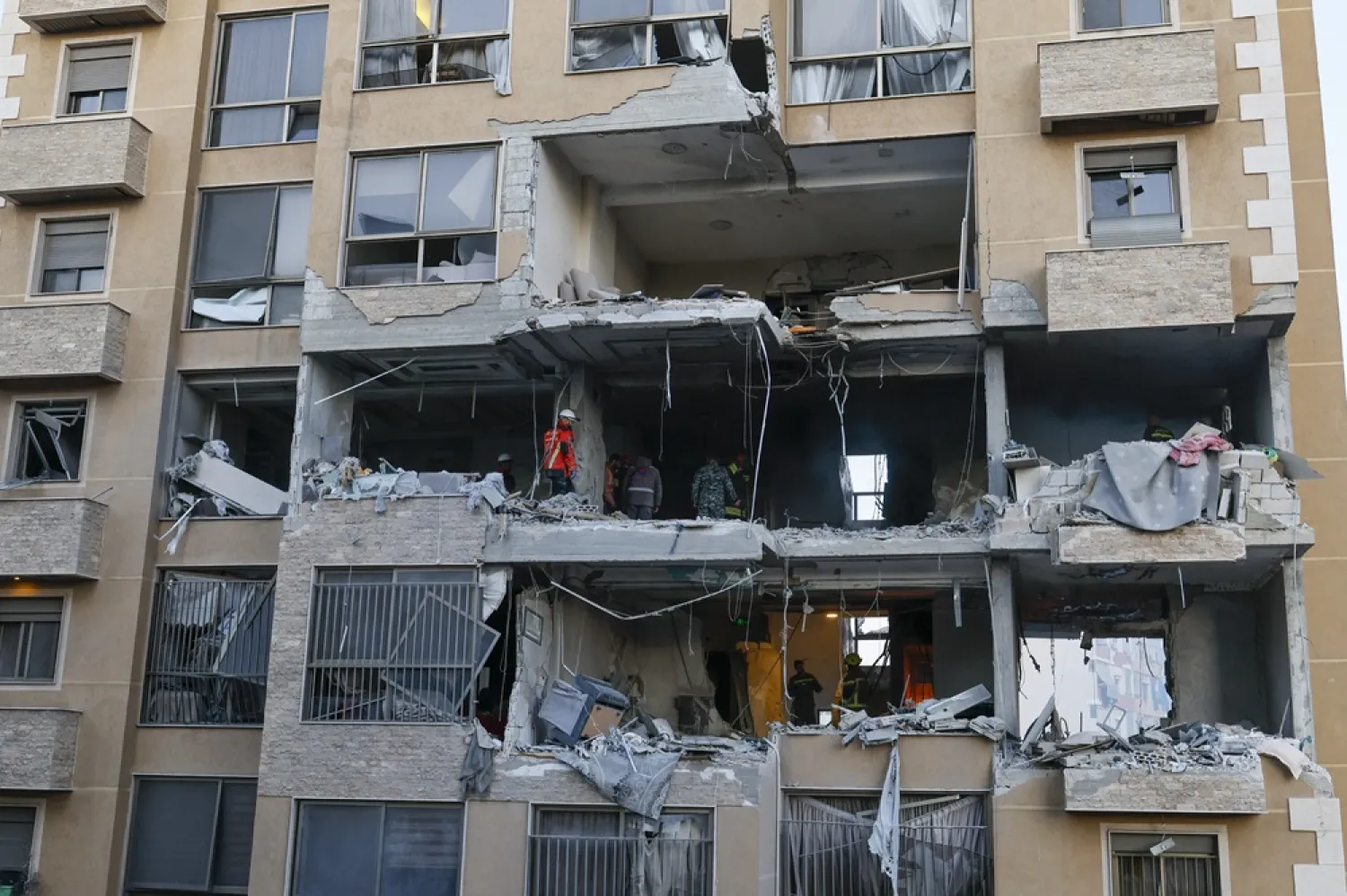
Emergency services inspect the damage after an Israeli strike targeted an apartment at a building in the Aisha Bakkar neighborhood, Beirut, Lebanon, 11 March 2026. (EPA)
TT

Strike Hits Beirut Apartment Block as Lebanon Grapples with 800,000 Displaced

Emergency services inspect the damage after an Israeli strike targeted an apartment at a building in the Aisha Bakkar neighborhood, Beirut, Lebanon, 11 March 2026. (EPA)

An Israeli strike hit an apartment block in central Beirut on Wednesday, Lebanese authorities said, further widening Israeli attacks in the capital beyond the Hezbollah-controlled southern suburbs where heavy bombardment continued. 

Israel launched an offensive against Iran-backed Hezbollah after it opened fire on March 2 to avenge the killing of Iran's supreme leader at the start of the US-Israeli war on Iran. Israeli strikes have killed more than 600 people in Lebanon and uprooted 800,000 more, Lebanese authorities say. 

The Israeli military ordered reinforcements to the area bordering Lebanon including its elite Golani Brigade. Reuters reported on Tuesday that Hezbollah fighters were braced for the possibility of a full-scale Israeli invasion of the south. 

'THIS IS A NIGHTMARE' 

Footage showed heavy damage to two floors of the apartment block in Beirut's Aisha Bakkar neighborhood, and smoke rising from the building. Four people were ‌wounded in the ‌strike, the Lebanese health ministry said. 

The Israeli military did not comment on the strike. 

"The sound ‌was ⁠indescribable, the fear ⁠is indescribable. Enough is enough, enough. This is a nightmare, when will it end?" said Bassima Ramadan, a woman living across the street who was woken up by the strike around 5:30 a.m. (0330 GMT).  

It would mark the second Israeli strike in the heart of Beirut in four days. On Sunday, an Israeli strike hit a hotel in a seafront neighborhood. Israel said that strike killed five senior members of Iran's Revolutionary Guards, which established Hezbollah in 1982. 

Israel kept up heavy strikes on the southern suburbs on Wednesday, sending towers of smoke billowing across the skyline. 

Israel has ordered residents of the suburbs to leave, along with residents of a swathe of southern Lebanon and ⁠parts of the east - all areas where Hezbollah has a grip on security and political ‌sway. 

MEDIC, PRIEST KILLED IN ISRAELI STRIKES 

Over 100,000 people are in organized shelters, ‌while others are staying with friends, family or are on the streets. 

After fleeing her village in the south, Mariam Rida, 73, said she spent $110 ‌for a night at a hotel, then three nights sleeping under a Beirut bridge and a few nights at ‌a school-turned-shelter. 

"I want to go back to my hometown. I'm afraid, I'm scared for myself. There are strikes here and there are strikes there, I’m confused about where to go," said Rida. 

Displaced people have struggled to reach shelters and once they do, they are living in "super rough conditions," said Maureen Philippon, the Norwegian Refugee Council's Lebanon director. 

Shelters lack showers and sufficient toilets, several families occupy the same rooms and there are fears of infectious diseases ‌spreading, she told Reuters. 

Lebanon's health ministry said on Wednesday that 634 people had been killed and more than 1,500 wounded in Israeli strikes since March 2. 

This week's toll includes Catholic ⁠priest Pierre al-Rahi and Red ⁠Cross medic Youssef Assaf. Both died after sustaining injuries in separate Israeli strikes on southern Lebanon earlier this week and were buried on Wednesday. 

Pope Leo offered his condolences for Rahi on Wednesday, saying he was a "true shepherd" who was killed while trying to help parishioners injured in a strike. 

The International Committee of the Red Cross mourned Assaf in a statement posted on social media, saying Assaf "lost his life while carrying out his humanitarian duty". 

ISRAEL PRESSES LEBANON AT UN 

The Israeli military says it has struck hundreds of Hezbollah targets since March 2, launching daily airstrikes in the south, Beirut's southern suburbs, and the Bekaa Valley. 

The Israeli military has sent more soldiers into south Lebanon and established new positions it said would help prevent Hezbollah attacks on northern Israel. 

Lebanon said last year it aims to establish a state monopoly on arms and its cabinet last week outlawed Hezbollah's military activities. 

But Israel's ambassador to the United Nations Danny Danon said on Wednesday that Beirut needed to take direct action. 

"If Hezbollah is being dismantled, what are the evidence? What are the operations against the launch sites? Where are the seizures of their weapons? Where is your military?" Danon said. 


Lebanon Says Israel Strikes Kill 14 in Deadliest Day Since Truce

Israeli soldiers operate on the Lebanese side of the border, as seen from the Upper Galilee in northern Israel, 26 April 2026, amid a ceasefire between Israel and Lebanon. (EPA)
TT

Lebanon Says Israel Strikes Kill 14 in Deadliest Day Since Truce

Israeli soldiers operate on the Lebanese side of the border, as seen from the Upper Galilee in northern Israel, 26 April 2026, amid a ceasefire between Israel and Lebanon. (EPA)

Lebanon's health ministry said Israeli strikes on the country's south on Sunday killed 14 people, the deadliest day since a ceasefire in the Israel-Hezbollah war came into force over a week ago.

It came as Israel and the Iran-backed group traded fresh accusations of breaching the fragile truce, with Prime Minister Benjamin Netanyahu saying the military was "vigorously" targeting Hezbollah and the group vowing to keep responding to "violations".

Israel's military has carried out repeated strikes in Lebanon since the April 17 ceasefire, which on Thursday was extended for three weeks, after six weeks of war in which Israel also invaded the country's south.

Israeli troops are operating inside an Israeli-announced "yellow line", which demarcates a ribbon of Lebanese territory around 10 kilometers (six miles) deep along the length of the border, where residents have been warned not to return.

Lebanon's health ministry said the dead on Sunday included two women and two children, adding that 37 other people were wounded.

Israeli strikes have killed at least 36 people since the truce began, according to an AFP tally of health ministry figures.

Israel's military said Sunday that one of its soldiers was killed "during combat" in southern Lebanon, and six were wounded, four of them severely.

- 'Freedom of action' -

Lebanon's state-run National News Agency (NNA) reported Israeli strikes in multiple locations in the south on Sunday, both in areas where Israel issued an evacuation warning and elsewhere.

AFP correspondents reported heavy traffic heading north as people fled following the warning and intensified raids.

"Hezbollah's violations are, in practice, dismantling the ceasefire," Netanyahu told his weekly cabinet meeting.

Tehran-backed Hezbollah drew Lebanon into the Middle East war on March 2 by firing rockets at Israel to avenge the death of Iran's supreme leader Ali Khamenei in US-Israeli strikes.

"We are acting vigorously in accordance with arrangements agreed with the United States and, incidentally, also with Lebanon," Netanyahu said.

Under the truce, which came after a landmark meeting between Israeli and Lebanese officials that angered Hezbollah, Israel reserves the right to respond to "planned, imminent or ongoing attacks".

"This means freedom of action not only to respond to attacks... but also to pre-empt immediate threats and even emerging threats," Netanyahu said.

Hezbollah said that Israel's "continued ceasefire violations... and above all its continued occupation of Lebanese territory and violations of its sovereignty will be met with a response".

It said its fighters targeted Israeli troops and positions in south Lebanon in response to ceasefire violations and attacks on Lebanese villages.

- More than 2,500 killed -

Israel's military issued evacuation orders for residents of seven towns and villages in the south on Sunday.

Shortly afterwards, the NNA said Israeli warplanes struck in Kfar Tibnit, causing casualties, while a raid on Zawtar al-Sharqiyah, another of the flagged villages, destroyed a mosque and another religious building.

The NNA also reported Israeli shelling in several border villages.

AFP correspondents saw clouds of grey smoke rise over Nabatieh al-Fawqa and several other locations after Israeli strikes.

Israel's military said it had struck "rocket-launching terrorist cells and weapons storage facilities" after earlier conducting "artillery and aerial strikes targeting terrorists and military infrastructure sites" used by Hezbollah north of the so-called "yellow line".

Shortly after Netanyahu's remarks, the military said it had intercepted three drones heading for Israeli territory.

Lebanon's health ministry says Israeli attacks have killed more than 2,500 people and wounded over 7,700 others since the war erupted.

The United Nations' UNIFIL peacekeeping force said it held a memorial in Beirut for an Indonesian peacekeeper who died on Friday after being wounded in a blast in south Lebanon last month.

A preliminary UN investigation found that an Israeli tank shell caused the explosion.


UN: Drone Attack Hits Sudan Aid Truck

Shops operate beneath a war-damaged building in Omdurman, on the outskirts of Khartoum, Sudan, Thursday, April 23, 2026. (AP Photo/Bernat Armangue)
TT

UN: Drone Attack Hits Sudan Aid Truck

Shops operate beneath a war-damaged building in Omdurman, on the outskirts of Khartoum, Sudan, Thursday, April 23, 2026. (AP Photo/Bernat Armangue)

A drone attack hit an aid truck in Sudan's North Darfur state, destroying all the supplies on board, the UN refugee agency said on Sunday, without identifying who was responsible.

Drone strikes by both the Sudanese army and the Rapid Support Forces (RSF), who have been locked in a brutal war since April 2023, have escalated in recent months, often killing dozens at a time.

The UNHCR-operated vehicle "came under drone attack" on Friday while transporting emergency shelter kits to Tawila, home to more than 700,000 displaced people who fled fighting elsewhere in the western Darfur region, AFP quoted the agency as saying.

The driver escaped unhurt, but all supplies were destroyed in the resulting fire, it added.

UNHCR condemned the attack, warning that it would "leave 1,314 families living in desperate conditions in Tawila without shelter" at a time when humanitarian needs are already overwhelming.

More than 127,000 people fled El-Fasher, North Darfur's capital and the army's last stronghold in the region, after it fell to paramilitary forces in October, with reports of mass killings, sexual violence, looting and rape following the takeover.

Fighting has since spread to neighboring Kordofan, now the main theatre of the war, and the southeastern Blue Nile state, raising fears of a longer and increasingly fragmented conflict.

According to the UN, nearly 700 civilians have been killed in drone strikes by both sides since January alone.

UNHCR voiced "deep concern" over the rising use of drones, calling repeated attacks on humanitarian operations "particularly abhorrent".

According to an assessment by the UN's Food and Agriculture Organization, 28.9 million people, around 62 percent of Sudan's population, are facing acute food insecurity.

That includes 10.2 million who face severe food insecurity, in particular in the wider Darfur region and South Kordofan state.

Famine was declared last year in El-Fasher and Kadugli, the capital of South Kordofan, with 20 other areas at risk in Darfur and Kordofan, a UN-backed assessment found.

The conflict has already killed tens of thousands, uprooted over 11 million and created the world's largest displacement and hunger crises.


Palestinian Leader's Loyalists Win Local Elections, including Some in Gaza

A Palestinian man votes during the municipal election at a polling station in Deir al-Balah, central Gaza Strip April 25, 2026. REUTERS/Mahmoud Issa
TT

Palestinian Leader's Loyalists Win Local Elections, including Some in Gaza

A Palestinian man votes during the municipal election at a polling station in Deir al-Balah, central Gaza Strip April 25, 2026. REUTERS/Mahmoud Issa

Loyalists of President Mahmoud Abbas won most races in Palestinian municipal elections, election officials said on Sunday, in a vote that for the first time in nearly two decades included a city in the Gaza Strip run by rival Hamas.

Saturday’s ballot marked the first elections of any kind in Gaza since 2006 and the first Palestinian polls since the Gaza war began more than two years ago with Hamas' cross-border attack on southern Israel.

Abbas' West Bank–based Palestinian Authority (PA) said the inclusion of the Gaza city Deir al-Balah, which suffered less damage than other areas of the coastal territory during the war, was intended to show that Gaza was an inseparable part of a future Palestinian state.

The elections, in which voter turnout was low, had been held "at a highly sensitive moment amid complex challenges and exceptional circumstances", Palestinian Prime Minister Mohammad Mustafa said as results were announced on Sunday.

But they represented "an important first step in a broader national process aimed at strengthening democratic life ... and ultimately achieving the unity of the land", he said.

POSSIBLE INDICATOR OF HAMAS SUPPORT

Hamas, which ousted the PA from Gaza in 2007, did not formally nominate candidates in Gaza and boycotted the race in the Israeli-occupied West Bank, where Fatah's victory was widely expected.

But some candidates on one of the Deir al-Balah lists were widely seen by residents and analysts as aligned with the movement, making the vote a potential indicator of support for the Islamist group.

Preliminary results showed that the list, known as Deir al-Balah Brings Us Together, won only two of the 15 seats contested in Gaza.

The Nahdat Deir al-Balah list, backed by Abbas' Fatah party and the Western-backed PA, secured six seats. The remaining seats were won by two other Gaza-based groups, Future of Deir al-Balah and Peace and Building, not affiliated with either faction.

Abbas loyalists swept the election in the West Bank, running unchallenged in many seats.

"By electing figures linked to Fatah, voters appear to be seeking unrestricted international support for municipal governance and a gradual political shift that could extend beyond the local level," said Palestinian political analyst Reham Ouda.

The recent war has left much of Gaza reduced to rubble, with many residents displaced and focused on survival. Israel has continued conducting strikes despite an October ceasefire.

In Gaza voter turnout reached just 23%, while in the West Bank it was 56%, according to Chairman of the Central Elections Commission Rami al-Hamdallah.

Al-Hamdallah said some of the ballot boxes and voting equipment did not make it into the enclave because of Israeli security restrictions, though those challenges were overcome.

Hamas' Gaza spokesperson, Hazem Qassem, downplayed the significance of the election results, saying that they had no impact on wider national issues.